Simple Cooking
Recipes
Tips & Tricks
Simple Cooking
Recipes
Tips & Tricks
Dinosaur Jungle Plate: A Dish Kids Actually Finish
Dinosaur Jungle Plate: A Dish Kids Actually Finish
FamFood
|
Dinosaur Jungle Plate: A Dish Kids Actually Finish
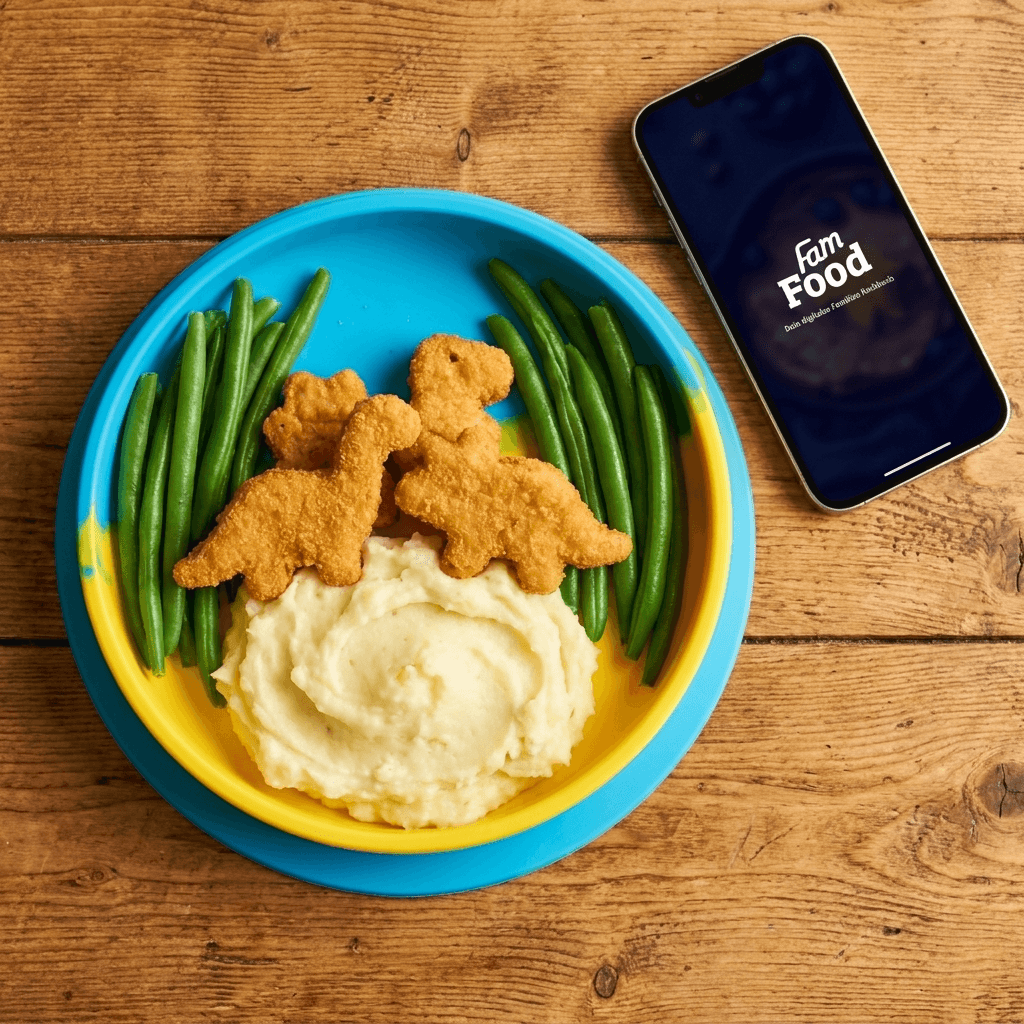
The plate comes back empty. Five minutes ago, the child said they weren't hungry. What changed? Not the food. The stage it was served on. Dinosaur nuggets in a bean jungle isn't a marketing trick—it's a simple plating principle that actually works with kids.
Key Takeaways
Kids eat more when food tells a story: The German Federal Centre for Nutrition (BZfE) confirms playful presentation as an effective gateway to more vegetables.
The plate is ready in under 30 minutes, no special skills or equipment needed.
Variations for fish lovers, vegetarians, and seasonal preferences work with the same plating technique.
Kids can help build it, which boosts acceptance and takes the pressure off mealtimes.
What's the idea behind the dinosaur jungle plate?
The dinosaur jungle plate combines crispy poultry nuggets in dinosaur shapes, creamy mashed potatoes as the base, and green beans as jungle vegetation into one edible mini-scene. It takes under 30 minutes and no special skills.
What sets this plate apart from a standard meal is spatial composition. Instead of nuggets, potatoes, and beans arranged side by side, you create a small landscape: the mashed potato hill anchors the center, beans stand upright in the potatoes as "trees," and the dinos sit on the summit. The child sees a scene, not three separate components.
It works nutritionally too. Soft potatoes, crispy nuggets, and firm beans deliver three different textures on one plate, which stimulates sensory perception while eating. The pale yellow of the potatoes contrasts nicely with the bright green of the beans and the golden-brown nuggets. Younger kids respond especially well to this visual contrast.
Age-wise, this plate works best between ages two and eight. From around age three, kids can actively help with assembly, which boosts acceptance even more.
Why do kids eat more when food tells a story?
Preschool and early elementary-aged children think in stories, not nutritional facts. When a plate forms a scene, it activates imaginative play and lowers resistance to unfamiliar or disliked vegetables—proven far more effective than simple encouragement, according to BZfE research.
Behind this sits a well-documented phenomenon in child nutrition: food neophobia, or fear of unknown foods, affects an estimated 50 percent of children ages two to six. The rejection isn't defiance—it's a developmental safety mechanism. Visual cues help because they capture attention on the scene before the child even thinks about "like or dislike."
The BZfE explicitly recommends playful vegetable presentation in its child nutrition guidelines—shapes and arrangements that spark curiosity as a low-barrier entry point, especially for children with strong rejection patterns around specific foods.
What we observe at FamFood directly: In tests with the jungle plate, kids finished green beans more completely than when beans were served side-by-side. The critical difference was that children had placed the beans themselves as "trees" into the potatoes, so they already had connection to them before the first bite.
What matters: Pressure doesn't work. The principle invites, it doesn't force. If a child leaves the beans and eats only the dinos, that's fine. Next time goes better.
Ingredients: What you need for the jungle plate
For four child-sized servings, you need: dinosaur nuggets (frozen or homemade), waxy potatoes, green beans (fresh or frozen), butter, milk, and salt. Optional: peas as "rocks" and carrot sticks as "tree trunks."
Ingredient | Amount (4 servings) | Note |
|---|---|---|
Dinosaur nuggets (frozen) | 500 g | about 20–24 pieces |
Waxy potatoes | 800 g | peeled weight |
Green beans (frozen or fresh) | 300 g | frozen saves time |
Butter | 40 g | for creamy potatoes |
Milk (3.5% fat) | 100 ml | adjust as needed |
Salt | to taste | |
Peas (optional) | 80 g | as "rocks" or base |
Carrot sticks (optional) | 2 carrots | as "tree trunks" |
Frozen beans are nearly as good as fresh: The German Federal Ministry of Food and Agriculture (BMEL) notes that shock-frozen vegetables often retain more vitamins than vegetables stored fresh for days, because freezing preserves nutrients.
When buying nuggets, a quick label check pays off. Stiftung Warentest has tested children's nuggets repeatedly and recommends looking for at least 65 percent poultry content and short ingredient lists without flavor enhancers.
Optional extras for more jungle feeling
To expand the scene: halved cherry tomatoes as "volcanoes," cucumber slices as "lakes," or a toothpick flag from paper stuck in the dino's summit. These details take no more than three minutes but kids remember them.
Step by step: How to build the jungle plate
Boil and mash potatoes, blanch beans, bake nuggets, then assemble: potatoes as a hill in the center, beans as trees around it, dinos on top. Done in under 30 minutes.
The timeline works like this:
Start the potatoes (about 20 min): Boil peeled potatoes in salted water until soft.
Nuggets in the oven (per package directions, usually 200°C / 400°F, 15–18 min): Use parchment paper, flip halfway through.
Blanch the beans (4–5 min): In boiling salted water, then plunge into ice water so they stay crisp and green.
Mash the potatoes: Drain, let steam off, then mash with butter and warm milk. Consistency tip: the mash should be firmer than usual, soft gush won't hold a "hill" shape. Use slightly less milk and adjust as needed.
Plate it: Place a large spoonful of mash in the plate center and press gently. Stick beans into the edge of the hill with the base down, upright like trees. Dinos on top. Scatter optional extras around.
The whole scene takes two minutes to assemble once the components are done.
Which steps kids can handle themselves
From about age three, kids can stick beans into the potatoes—no strength or knife needed. By age five, they can scoop the mash onto the plate themselves and position the dinos. This moment of control over "their" dish isn't a side note; it's why the plate comes back empty.
How healthy is this plate really?
Green beans provide fiber, folate, and potassium. Potatoes contribute vitamin C and complex starch. Dinosaur nuggets are the most processed component but can be swapped for homemade versions made from chicken breast without losing the jungle concept.
Component | Main nutrients | Per child serving |
|---|---|---|
Green beans (100 g) | Fiber 3.4 g, folate 57 µg | about 31 kcal |
Mashed potatoes (150 g) | Vitamin C 14 mg, potassium 450 mg | about 120 kcal |
Dinosaur nuggets (125 g / 5 pieces) | Protein 13 g, fat 9 g | about 215 kcal |
Total | about 366 kcal |
The BMEL recommends children have at least two servings of vegetables daily, with one serving roughly the size of the child's hand. The jungle plate covers one of those servings well with beans (and optional peas).
Homemade nuggets are simpler than you'd think: cut chicken breast into bite-sized pieces, lightly salt, coat in flour, egg, and breadcrumbs, then bake at 200°C / 400°F for 20 minutes until golden. No deep frying, no additives. Active work time: about ten minutes.
Honestly: a fun plate isn't a nutrition plan. But it's a tool that introduces vegetables kids might otherwise ignore. That's not nothing.
Which variations work for picky eaters?
The jungle concept adapts to almost any preference: fish sticks instead of nuggets for fish lovers, cauliflower mash instead of potatoes for more vegetables, sugar snap peas or regular peas as green vegetation if beans are rejected.
Variation | Protein | Base/mash | Vegetation | Best season |
|---|---|---|---|---|
Classic | Dinosaur nuggets | Mashed potatoes | Green beans | Year-round |
Fish jungle | Fish sticks | Mashed potatoes | Sugar snap peas | Year-round |
Autumn jungle | Dinosaur nuggets | Pumpkin mash | Brussels sprout halves | Sept.–Nov. |
Vegetarian | Lentil nuggets | Mashed potatoes | Peas + beans | Year-round |
Cauliflower base | Dinosaur nuggets | Cauliflower mash | Broccoli florets | Year-round |
One tip that really helps: let the child pick the variation. "Should dinosaurs or fish walk through the jungle today?" gives real choice, makes the meal their decision, and saves you the guesswork.
Seasonally, this plate makes sense year-round: in summer, fresh snap peas or regular peas as vegetation; in fall, halved Brussels sprouts as "round trees"; in winter, frozen beans work fine. At FamFood, you can save your own theme-plate ideas as recipe variations and link them straight to your weekly shopping list so the idea doesn't disappear into a phone screenshot you can't find three months later.
Vegetarian and vegan adaptations
Lentil nuggets from the frozen section of most supermarkets work well. For a vegan version: use plant-based milk and margarine in the mash, done. The jungle principle stays identical. Only the actors on the hill change.
How do you turn a one-time fun meal into a real eating routine?
A fun plate works long-term if you vary the principle instead of repeating it. Establishing a weekly "theme plate" keeps curiosity alive without you needing to plate creatively every day.
The key is regularity without perfection. One theme day a week, say Friday, is enough. The child knows: today gets creative. The expectation itself does half the work. Theme day doesn't have to be jungle—a space plate with peas as planets or a farm with carrot-stick fences follows the same rules.
More on steady family meals: check out how to build sustainable eating habits without pressure or restrictive rules.
Frequently asked questions
From what age can kids help assemble the jungle plate?
From about age three, children can stick beans into the mash and position the dinos, since these steps need no force or knife skills. By age five, most kids can shape a potato hill with a spoon. Helping boost acceptance because kids eat what they built themselves.
Can I make dinosaur nuggets at home without deep frying?
Yes, and it's easier than expected. Cut chicken breast into small pieces, lightly salt, coat in flour, egg, and breadcrumbs, then bake at 200°C / 400°F on standard heat for 18 to 20 minutes until golden. Crispy result, no fryer. Active time: about 10 minutes. For dino shapes, cut pieces roughly triangle-shaped or use small cookie cutters.
What if my child just refuses green beans?
Switch the vegetation. Sugar snap peas, regular peas, broccoli florets, or halved Brussels sprouts serve the same visual function as "jungle trees." The concept works with any green vegetable that stands upright or lies flat. Important: don't give up after one refusal. Kids often need 10 to 15 exposures to a new food before accepting it.
How long does mashed potato keep if I prep ahead?
Covered in the fridge, mashed potatoes last two days. When reheating, add a splash of warm milk and butter, then warm gently while stirring until creamy again. Freezing works but slightly changes texture. For the jungle plate, freshly mashed is best because it holds the hill shape better.
Is the jungle plate good for birthday parties or larger groups?
Great option with a twist: instead of plating individually, put components in bowls on the table and let kids build their own plate. Works from about age four, turns eating into an activity, and takes major pressure off the cook. For ten kids: 1.2 kg nuggets, 2 kg potatoes, 700 g beans. Total time stays under 40 minutes.
About FamFood
FamFood is the digital family cookbook for everyday German cooking: save recipes, adapt them, share with the whole family. We develop ideas at the kitchen table, test with real families, and write down what actually works, not what sounds good.
Dinosaur Jungle Plate: A Dish Kids Actually Finish
The plate comes back empty. Five minutes ago, the child said they weren't hungry. What changed? Not the food. The stage it was served on. Dinosaur nuggets in a bean jungle isn't a marketing trick—it's a simple plating principle that actually works with kids.
Key Takeaways
Kids eat more when food tells a story: The German Federal Centre for Nutrition (BZfE) confirms playful presentation as an effective gateway to more vegetables.
The plate is ready in under 30 minutes, no special skills or equipment needed.
Variations for fish lovers, vegetarians, and seasonal preferences work with the same plating technique.
Kids can help build it, which boosts acceptance and takes the pressure off mealtimes.
What's the idea behind the dinosaur jungle plate?
The dinosaur jungle plate combines crispy poultry nuggets in dinosaur shapes, creamy mashed potatoes as the base, and green beans as jungle vegetation into one edible mini-scene. It takes under 30 minutes and no special skills.
What sets this plate apart from a standard meal is spatial composition. Instead of nuggets, potatoes, and beans arranged side by side, you create a small landscape: the mashed potato hill anchors the center, beans stand upright in the potatoes as "trees," and the dinos sit on the summit. The child sees a scene, not three separate components.
It works nutritionally too. Soft potatoes, crispy nuggets, and firm beans deliver three different textures on one plate, which stimulates sensory perception while eating. The pale yellow of the potatoes contrasts nicely with the bright green of the beans and the golden-brown nuggets. Younger kids respond especially well to this visual contrast.
Age-wise, this plate works best between ages two and eight. From around age three, kids can actively help with assembly, which boosts acceptance even more.
Why do kids eat more when food tells a story?
Preschool and early elementary-aged children think in stories, not nutritional facts. When a plate forms a scene, it activates imaginative play and lowers resistance to unfamiliar or disliked vegetables—proven far more effective than simple encouragement, according to BZfE research.
Behind this sits a well-documented phenomenon in child nutrition: food neophobia, or fear of unknown foods, affects an estimated 50 percent of children ages two to six. The rejection isn't defiance—it's a developmental safety mechanism. Visual cues help because they capture attention on the scene before the child even thinks about "like or dislike."
The BZfE explicitly recommends playful vegetable presentation in its child nutrition guidelines—shapes and arrangements that spark curiosity as a low-barrier entry point, especially for children with strong rejection patterns around specific foods.
What we observe at FamFood directly: In tests with the jungle plate, kids finished green beans more completely than when beans were served side-by-side. The critical difference was that children had placed the beans themselves as "trees" into the potatoes, so they already had connection to them before the first bite.
What matters: Pressure doesn't work. The principle invites, it doesn't force. If a child leaves the beans and eats only the dinos, that's fine. Next time goes better.
Ingredients: What you need for the jungle plate
For four child-sized servings, you need: dinosaur nuggets (frozen or homemade), waxy potatoes, green beans (fresh or frozen), butter, milk, and salt. Optional: peas as "rocks" and carrot sticks as "tree trunks."
Ingredient | Amount (4 servings) | Note |
|---|---|---|
Dinosaur nuggets (frozen) | 500 g | about 20–24 pieces |
Waxy potatoes | 800 g | peeled weight |
Green beans (frozen or fresh) | 300 g | frozen saves time |
Butter | 40 g | for creamy potatoes |
Milk (3.5% fat) | 100 ml | adjust as needed |
Salt | to taste | |
Peas (optional) | 80 g | as "rocks" or base |
Carrot sticks (optional) | 2 carrots | as "tree trunks" |
Frozen beans are nearly as good as fresh: The German Federal Ministry of Food and Agriculture (BMEL) notes that shock-frozen vegetables often retain more vitamins than vegetables stored fresh for days, because freezing preserves nutrients.
When buying nuggets, a quick label check pays off. Stiftung Warentest has tested children's nuggets repeatedly and recommends looking for at least 65 percent poultry content and short ingredient lists without flavor enhancers.
Optional extras for more jungle feeling
To expand the scene: halved cherry tomatoes as "volcanoes," cucumber slices as "lakes," or a toothpick flag from paper stuck in the dino's summit. These details take no more than three minutes but kids remember them.
Step by step: How to build the jungle plate
Boil and mash potatoes, blanch beans, bake nuggets, then assemble: potatoes as a hill in the center, beans as trees around it, dinos on top. Done in under 30 minutes.
The timeline works like this:
Start the potatoes (about 20 min): Boil peeled potatoes in salted water until soft.
Nuggets in the oven (per package directions, usually 200°C / 400°F, 15–18 min): Use parchment paper, flip halfway through.
Blanch the beans (4–5 min): In boiling salted water, then plunge into ice water so they stay crisp and green.
Mash the potatoes: Drain, let steam off, then mash with butter and warm milk. Consistency tip: the mash should be firmer than usual, soft gush won't hold a "hill" shape. Use slightly less milk and adjust as needed.
Plate it: Place a large spoonful of mash in the plate center and press gently. Stick beans into the edge of the hill with the base down, upright like trees. Dinos on top. Scatter optional extras around.
The whole scene takes two minutes to assemble once the components are done.
Which steps kids can handle themselves
From about age three, kids can stick beans into the potatoes—no strength or knife needed. By age five, they can scoop the mash onto the plate themselves and position the dinos. This moment of control over "their" dish isn't a side note; it's why the plate comes back empty.
How healthy is this plate really?
Green beans provide fiber, folate, and potassium. Potatoes contribute vitamin C and complex starch. Dinosaur nuggets are the most processed component but can be swapped for homemade versions made from chicken breast without losing the jungle concept.
Component | Main nutrients | Per child serving |
|---|---|---|
Green beans (100 g) | Fiber 3.4 g, folate 57 µg | about 31 kcal |
Mashed potatoes (150 g) | Vitamin C 14 mg, potassium 450 mg | about 120 kcal |
Dinosaur nuggets (125 g / 5 pieces) | Protein 13 g, fat 9 g | about 215 kcal |
Total | about 366 kcal |
The BMEL recommends children have at least two servings of vegetables daily, with one serving roughly the size of the child's hand. The jungle plate covers one of those servings well with beans (and optional peas).
Homemade nuggets are simpler than you'd think: cut chicken breast into bite-sized pieces, lightly salt, coat in flour, egg, and breadcrumbs, then bake at 200°C / 400°F for 20 minutes until golden. No deep frying, no additives. Active work time: about ten minutes.
Honestly: a fun plate isn't a nutrition plan. But it's a tool that introduces vegetables kids might otherwise ignore. That's not nothing.
Which variations work for picky eaters?
The jungle concept adapts to almost any preference: fish sticks instead of nuggets for fish lovers, cauliflower mash instead of potatoes for more vegetables, sugar snap peas or regular peas as green vegetation if beans are rejected.
Variation | Protein | Base/mash | Vegetation | Best season |
|---|---|---|---|---|
Classic | Dinosaur nuggets | Mashed potatoes | Green beans | Year-round |
Fish jungle | Fish sticks | Mashed potatoes | Sugar snap peas | Year-round |
Autumn jungle | Dinosaur nuggets | Pumpkin mash | Brussels sprout halves | Sept.–Nov. |
Vegetarian | Lentil nuggets | Mashed potatoes | Peas + beans | Year-round |
Cauliflower base | Dinosaur nuggets | Cauliflower mash | Broccoli florets | Year-round |
One tip that really helps: let the child pick the variation. "Should dinosaurs or fish walk through the jungle today?" gives real choice, makes the meal their decision, and saves you the guesswork.
Seasonally, this plate makes sense year-round: in summer, fresh snap peas or regular peas as vegetation; in fall, halved Brussels sprouts as "round trees"; in winter, frozen beans work fine. At FamFood, you can save your own theme-plate ideas as recipe variations and link them straight to your weekly shopping list so the idea doesn't disappear into a phone screenshot you can't find three months later.
Vegetarian and vegan adaptations
Lentil nuggets from the frozen section of most supermarkets work well. For a vegan version: use plant-based milk and margarine in the mash, done. The jungle principle stays identical. Only the actors on the hill change.
How do you turn a one-time fun meal into a real eating routine?
A fun plate works long-term if you vary the principle instead of repeating it. Establishing a weekly "theme plate" keeps curiosity alive without you needing to plate creatively every day.
The key is regularity without perfection. One theme day a week, say Friday, is enough. The child knows: today gets creative. The expectation itself does half the work. Theme day doesn't have to be jungle—a space plate with peas as planets or a farm with carrot-stick fences follows the same rules.
More on steady family meals: check out how to build sustainable eating habits without pressure or restrictive rules.
Frequently asked questions
From what age can kids help assemble the jungle plate?
From about age three, children can stick beans into the mash and position the dinos, since these steps need no force or knife skills. By age five, most kids can shape a potato hill with a spoon. Helping boost acceptance because kids eat what they built themselves.
Can I make dinosaur nuggets at home without deep frying?
Yes, and it's easier than expected. Cut chicken breast into small pieces, lightly salt, coat in flour, egg, and breadcrumbs, then bake at 200°C / 400°F on standard heat for 18 to 20 minutes until golden. Crispy result, no fryer. Active time: about 10 minutes. For dino shapes, cut pieces roughly triangle-shaped or use small cookie cutters.
What if my child just refuses green beans?
Switch the vegetation. Sugar snap peas, regular peas, broccoli florets, or halved Brussels sprouts serve the same visual function as "jungle trees." The concept works with any green vegetable that stands upright or lies flat. Important: don't give up after one refusal. Kids often need 10 to 15 exposures to a new food before accepting it.
How long does mashed potato keep if I prep ahead?
Covered in the fridge, mashed potatoes last two days. When reheating, add a splash of warm milk and butter, then warm gently while stirring until creamy again. Freezing works but slightly changes texture. For the jungle plate, freshly mashed is best because it holds the hill shape better.
Is the jungle plate good for birthday parties or larger groups?
Great option with a twist: instead of plating individually, put components in bowls on the table and let kids build their own plate. Works from about age four, turns eating into an activity, and takes major pressure off the cook. For ten kids: 1.2 kg nuggets, 2 kg potatoes, 700 g beans. Total time stays under 40 minutes.
About FamFood
FamFood is the digital family cookbook for everyday German cooking: save recipes, adapt them, share with the whole family. We develop ideas at the kitchen table, test with real families, and write down what actually works, not what sounds good.