Simple Cooking
Tips & Tricks
Simple Cooking
Tips & Tricks
Yesterday's Potatoes: 6 Recipes in 20 Min
Yesterday's Potatoes: 6 Recipes in 20 Min
FamFood
|
Yesterday's Potatoes: 6 Recipes in 20 Minutes
Yesterday's potatoes sit quietly in the pot, and dinner needs to be on the table in 20 minutes. Every family knows this moment. And that's exactly when it becomes clear how much these quiet tubers actually offer.
Anyone who knows how to use them properly has already done half the cooking.
Key Takeaways
Cooked potatoes develop resistant starch as they cool, which is more nutritious than freshly cooked potatoes (Federal Ministry of Food and Agriculture, 2023).
In the refrigerator, they reliably keep for 2 to 3 days when stored covered at 2 to 5 °C.
Five complete meals can be prepared from leftover potatoes in 20 minutes or less.
Using leftover potatoes twice a week instead of throwing them away saves up to 40 euros per year.
Why are yesterday's potatoes actually better than fresh ones?
Cooked potatoes develop resistant starch as they cool, which is digested more slowly and keeps blood sugar more stable than freshly cooked potatoes. This is confirmed by the Federal Ministry of Food and Agriculture in its assessment of starch conversion processes. As they cool, starch undergoes retrogradation, during which the molecular structure changes and becomes less accessible to digestive enzymes.
What does this mean for you in practice? Simple: yesterday's potato keeps you fuller longer and doesn't spike your blood sugar as fast.
There's also a cooking advantage that many underestimate: pre-cooled potatoes brown more crisply than freshly cooked ones. When you put fresh potatoes in the pan, you're fighting their high water content. The slice steams instead of browning. A cold potato straight from the fridge, on the other hand, releases its moisture more reluctantly and therefore develops a better crust.
So if you consciously cook a few extra potatoes in the evening, you'll have a real advantage at breakfast or dinner the next day. No detours, no time lost, just a smarter cooking rhythm for the whole family.
How long do cooked potatoes keep in the refrigerator?
Stored correctly, cooked potatoes reliably keep in the refrigerator for 2 to 3 days. The key is that they must be completely cooled before going into a sealed container. Putting warm potatoes directly in the fridge increases humidity inside the container and speeds up spoilage.
The ideal storage temperature is between 2 and 5 °C, covered or in an airtight container. This way they stay odor-neutral and don't pick up other smells from the fridge.
How can you tell if potatoes are no longer good? Three signs are clear:
Smell: Sour or rotten, then throw away immediately.
Texture: Slimy surface means bacterial spoilage.
Color: Green spots contain solanine and must be cut away generously or discarded entirely.
Freezing is possible, but with drawbacks. The texture suffers noticeably: thawed potatoes become watery and mealy. This is acceptable for soups or purées, but not recommended for hash browns or salads.
Hash Browns: The Classic That Almost Always Goes Wrong
Hash browns from yesterday's potatoes only turn out well if the pan is really hot and you leave the potatoes alone. Stir too early, and you get mush instead of crust. This is the simplest rule that gets broken most often.
In FamFood tests, we found that cold potatoes straight from the fridge, not brought to room temperature, produce the crispiest crust. The temperature difference between a cold potato and hot fat creates a protective layer faster, one that holds the slice together.
The Right Pan and the Right Fat
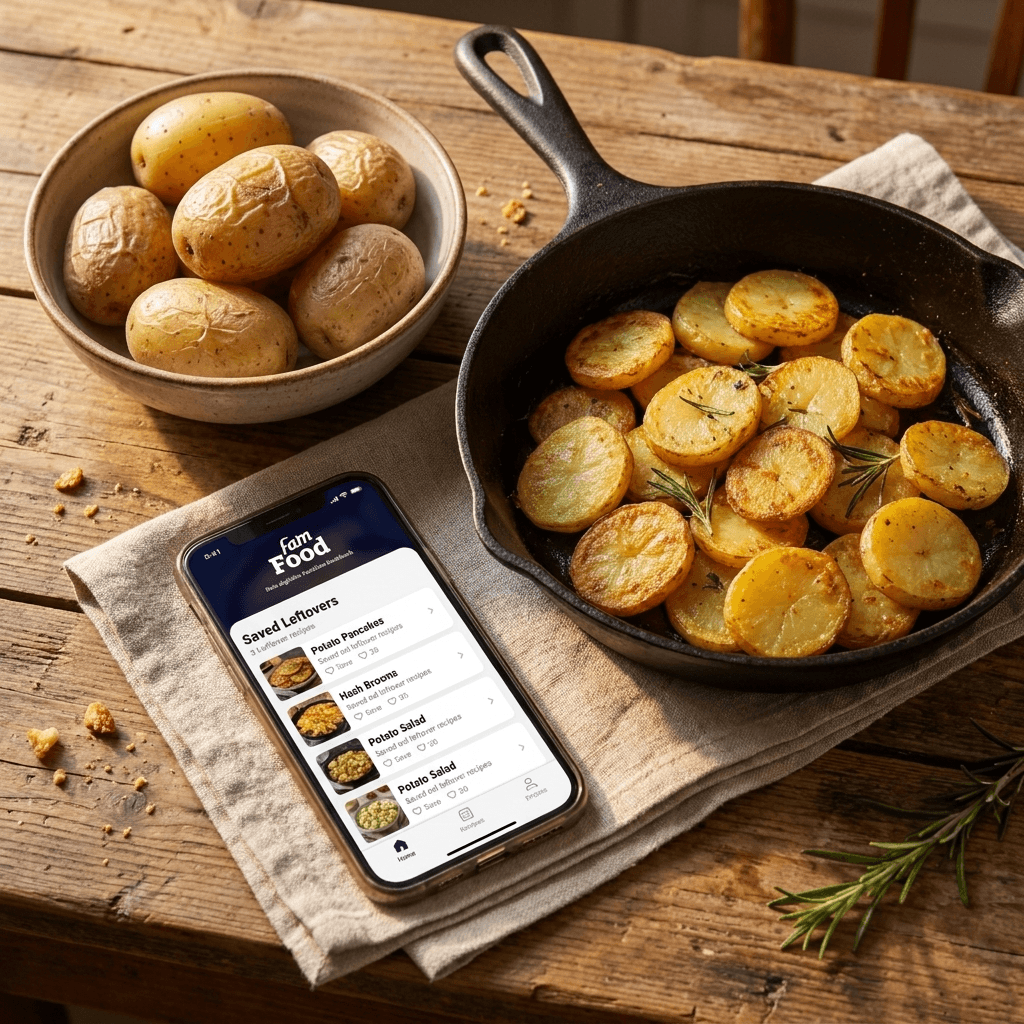
A cast-iron skillet or a nonstick pan with a heavy bottom distributes heat evenly and maintains temperature even when you add potato slices. Clarified butter is the classic choice: it tolerates high temperatures without burning and adds a nutty flavor. For something more neutral, use canola oil. Butter alone is too heat-sensitive.
Timing: When Does Everything Go in the Pan?
Preheat the pan on medium-high heat until a water droplet evaporates immediately.
Add fat and let it foam briefly.
Lay potato slices (about 0.5 cm thick) in a single layer. Don't add too many at once: steaming instead of browning is the most common mistake.
Fry undisturbed for four minutes, then flip.
Add onions and bacon bits after the first flip. This way they soften without burning and make the dish more filling for children.
What 5 Other Dishes Come Together Quickly From Yesterday's Potatoes?
From leftover cooked potatoes, five complete meals can be made in 20 minutes or less: potato soup, potato pancakes, potato salad, stuffed mini baked potatoes, and a quick potato-and-egg skillet. All five require no complicated prep and work well for families with children.
Dish | Time | Extra Main Ingredient | Kid-Friendly |
|---|---|---|---|
Hash Browns | 15 Min. | Clarified Butter, Onion | From 3 Years |
Potato Soup | 15 Min. | Broth, Crème Fraîche | From 1 Year |
Potato Pancakes | 20 Min. | Egg, Flour | From 3 Years |
Potato Salad (Cold) | 10 Min. | Vinegar, Oil, Herbs | From 2 Years |
Potato-Egg Skillet | 10 Min. | Egg, Paprika | From 2 Years |
Stuffed Mini Halves | 15 Min. | Quark, Chives | From 3 Years |
Potato Soup in 15 Minutes
Mash potatoes roughly, add vegetable or chicken broth, simmer for five minutes, then finish with a spoonful of crème fraîche. Add a pinch of nutmeg or chives on top if you like. That's all you need. The soup is creamy without needing a blender, because the starch in the pre-cooked potatoes does the binding work.
Potato Pancakes for the Whole Family
Grate potatoes roughly or mash with a fork, work in an egg and two tablespoons of flour, season with salt and pepper. Fry portions in hot oil on both sides until golden brown. Serve with applesauce, and the dish becomes almost a fun meal for kids. The pancakes also work with a small amount of grated carrot or zucchini mixed in, and kids won't even notice.
The potato-egg skillet is even faster: dice potatoes, add with a bit of paprika to the hot pan, crack two eggs on top, scramble, and let set for ten minutes. The stuffed mini halves work especially well when children want to get involved: hollow out halves, mix quark with chives, fill them. This makes children aged four to eight particularly proud.
Using Yesterday's Potatoes With Children: What Actually Works?
Potato pancakes and stuffed halves are the most kid-friendly leftover recipes because children can help shape, fill, or top them. This significantly lowers the barrier against "old food." Kids almost always eat better when they've helped prepare it themselves.
The psychology is simple: once a child has pressed the batter or spooned in the filling, yesterday's potato suddenly becomes "their" dish, not yesterday's leftovers.
Concrete tasks by age:
From 4 years old: Press batter into the pan, shape pancakes, fill halves with quark.
From 6 years old: Mash potatoes with a fork, crack eggs, stir dressing.
From 8 years old: Grate potatoes, taste the soup, fry pancakes independently (with supervision).
Among the most saved leftover recipes in the FamFood app, 8 out of 10 contain at most 5 ingredients. This is no coincidence: simple recipes work especially well as cooking projects with children because they don't overwhelm their attention span. Looking for more ideas? Creative Leftover Use: 9 Ideas That Work is a good starting point.
How Much Do You Really Save When You Consistently Use Potato Leftovers?
The average four-person family in Germany throws away around 75 kg of food per year, according to the German Environmental Protection Agency, with potatoes and starch products among the most common items. If you use leftover potatoes twice a week instead of throwing them away, you save up to 40 euros over the year and several kilograms of CO₂.
The math is concrete: one kilogram of potatoes costs between 0.80 and 1.20 euros in German retail. If you rescue 200 g of leftover potatoes twice a week instead of throwing them away, that adds up over 52 weeks to just over 20 kg, or 16 to 24 euros in this category alone. When you scale this up to all wasted food, you quickly reach three-digit amounts.
Saving money is a strong motivation. But what actually drives many families in practice is something else: the good feeling of wasting nothing. Nothing weighs heavier on your conscience in the morning than the thought of throwing food in the trash the night before. Using leftovers is also an attitude.
Preparing Yesterday's Potatoes: Is Intentional Pre-Cooking Worth It?
Yes. If you consciously cook 200 to 300 g extra potatoes in the evening, you'll have a ready-made base for a quick meal the next evening. This isn't luck, it's one of the simplest meal-prep habits of all, without meal plans or complicated prep work.
The habit is simple: always cook a few extra. It costs no additional planning, just some water and five extra minutes of cooking time.
Which varieties work best: waxy potatoes (e.g. Annabelle, Nicola) hold their shape better when frying and work well for slices and salads. Mealy potatoes (e.g. Adretta, Gunda) mash more easily and are better for soups and pancakes. If you want to cover both, buy a medium-starch potato as an all-rounder.
If you want to think bigger about pre-cooking, Family Meal Planning: 7 Days Stress-Free offers a structured entry into weekly planning.
Frequently Asked Questions
Can I freeze cooked potatoes from the day before?
Yes, but with limitations. Frozen cooked potatoes lose their texture after thawing and become watery and mealy. This is acceptable for soups or purées. For hash browns or salad, the thawed potato doesn't work anymore. If you want to freeze, you should mash the potatoes or process them into soup before freezing.
Why do hash browns from freshly cooked potatoes turn mushy?
Freshly cooked potatoes still contain a lot of free water in their cells. In the pan, this water evaporates slowly instead of forming a crust right away. The result is steamed potato instead of fried. Yesterday's potatoes have already lost this water, their cell surface is firmer, and the browning reaction starts faster.
Are yesterday's potatoes still healthy?
Yes, even a bit healthier than freshly cooked ones. Through retrogradation during cooling, resistant starch forms, which acts like fiber, nourishes the gut, and keeps blood sugar more stable. This requires proper storage at 2 to 5 °C in a sealed container, for no longer than three days.
How can I tell if old potatoes are still good?
Three reliable signs that a cooked potato is no longer good: it smells sour or rotten, the surface feels slimy, or it shows green spots. Green spots contain solanine, a natural toxin. Small green spots can be cut away generously; if the potato is generally greenish, it should be discarded entirely.
About FamFood: We're an app for families who want to save time cooking and throw away less food. Our recipes come from real kitchens, not theory. What we recommend has proven itself in everyday life with children, not just on paper.
Yesterday's Potatoes: 6 Recipes in 20 Minutes
Yesterday's potatoes sit quietly in the pot, and dinner needs to be on the table in 20 minutes. Every family knows this moment. And that's exactly when it becomes clear how much these quiet tubers actually offer.
Anyone who knows how to use them properly has already done half the cooking.
Key Takeaways
Cooked potatoes develop resistant starch as they cool, which is more nutritious than freshly cooked potatoes (Federal Ministry of Food and Agriculture, 2023).
In the refrigerator, they reliably keep for 2 to 3 days when stored covered at 2 to 5 °C.
Five complete meals can be prepared from leftover potatoes in 20 minutes or less.
Using leftover potatoes twice a week instead of throwing them away saves up to 40 euros per year.
Why are yesterday's potatoes actually better than fresh ones?
Cooked potatoes develop resistant starch as they cool, which is digested more slowly and keeps blood sugar more stable than freshly cooked potatoes. This is confirmed by the Federal Ministry of Food and Agriculture in its assessment of starch conversion processes. As they cool, starch undergoes retrogradation, during which the molecular structure changes and becomes less accessible to digestive enzymes.
What does this mean for you in practice? Simple: yesterday's potato keeps you fuller longer and doesn't spike your blood sugar as fast.
There's also a cooking advantage that many underestimate: pre-cooled potatoes brown more crisply than freshly cooked ones. When you put fresh potatoes in the pan, you're fighting their high water content. The slice steams instead of browning. A cold potato straight from the fridge, on the other hand, releases its moisture more reluctantly and therefore develops a better crust.
So if you consciously cook a few extra potatoes in the evening, you'll have a real advantage at breakfast or dinner the next day. No detours, no time lost, just a smarter cooking rhythm for the whole family.
How long do cooked potatoes keep in the refrigerator?
Stored correctly, cooked potatoes reliably keep in the refrigerator for 2 to 3 days. The key is that they must be completely cooled before going into a sealed container. Putting warm potatoes directly in the fridge increases humidity inside the container and speeds up spoilage.
The ideal storage temperature is between 2 and 5 °C, covered or in an airtight container. This way they stay odor-neutral and don't pick up other smells from the fridge.
How can you tell if potatoes are no longer good? Three signs are clear:
Smell: Sour or rotten, then throw away immediately.
Texture: Slimy surface means bacterial spoilage.
Color: Green spots contain solanine and must be cut away generously or discarded entirely.
Freezing is possible, but with drawbacks. The texture suffers noticeably: thawed potatoes become watery and mealy. This is acceptable for soups or purées, but not recommended for hash browns or salads.
Hash Browns: The Classic That Almost Always Goes Wrong
Hash browns from yesterday's potatoes only turn out well if the pan is really hot and you leave the potatoes alone. Stir too early, and you get mush instead of crust. This is the simplest rule that gets broken most often.
In FamFood tests, we found that cold potatoes straight from the fridge, not brought to room temperature, produce the crispiest crust. The temperature difference between a cold potato and hot fat creates a protective layer faster, one that holds the slice together.
The Right Pan and the Right Fat
A cast-iron skillet or a nonstick pan with a heavy bottom distributes heat evenly and maintains temperature even when you add potato slices. Clarified butter is the classic choice: it tolerates high temperatures without burning and adds a nutty flavor. For something more neutral, use canola oil. Butter alone is too heat-sensitive.
Timing: When Does Everything Go in the Pan?
Preheat the pan on medium-high heat until a water droplet evaporates immediately.
Add fat and let it foam briefly.
Lay potato slices (about 0.5 cm thick) in a single layer. Don't add too many at once: steaming instead of browning is the most common mistake.
Fry undisturbed for four minutes, then flip.
Add onions and bacon bits after the first flip. This way they soften without burning and make the dish more filling for children.
What 5 Other Dishes Come Together Quickly From Yesterday's Potatoes?
From leftover cooked potatoes, five complete meals can be made in 20 minutes or less: potato soup, potato pancakes, potato salad, stuffed mini baked potatoes, and a quick potato-and-egg skillet. All five require no complicated prep and work well for families with children.
Dish | Time | Extra Main Ingredient | Kid-Friendly |
|---|---|---|---|
Hash Browns | 15 Min. | Clarified Butter, Onion | From 3 Years |
Potato Soup | 15 Min. | Broth, Crème Fraîche | From 1 Year |
Potato Pancakes | 20 Min. | Egg, Flour | From 3 Years |
Potato Salad (Cold) | 10 Min. | Vinegar, Oil, Herbs | From 2 Years |
Potato-Egg Skillet | 10 Min. | Egg, Paprika | From 2 Years |
Stuffed Mini Halves | 15 Min. | Quark, Chives | From 3 Years |
Potato Soup in 15 Minutes
Mash potatoes roughly, add vegetable or chicken broth, simmer for five minutes, then finish with a spoonful of crème fraîche. Add a pinch of nutmeg or chives on top if you like. That's all you need. The soup is creamy without needing a blender, because the starch in the pre-cooked potatoes does the binding work.
Potato Pancakes for the Whole Family
Grate potatoes roughly or mash with a fork, work in an egg and two tablespoons of flour, season with salt and pepper. Fry portions in hot oil on both sides until golden brown. Serve with applesauce, and the dish becomes almost a fun meal for kids. The pancakes also work with a small amount of grated carrot or zucchini mixed in, and kids won't even notice.
The potato-egg skillet is even faster: dice potatoes, add with a bit of paprika to the hot pan, crack two eggs on top, scramble, and let set for ten minutes. The stuffed mini halves work especially well when children want to get involved: hollow out halves, mix quark with chives, fill them. This makes children aged four to eight particularly proud.
Using Yesterday's Potatoes With Children: What Actually Works?
Potato pancakes and stuffed halves are the most kid-friendly leftover recipes because children can help shape, fill, or top them. This significantly lowers the barrier against "old food." Kids almost always eat better when they've helped prepare it themselves.
The psychology is simple: once a child has pressed the batter or spooned in the filling, yesterday's potato suddenly becomes "their" dish, not yesterday's leftovers.
Concrete tasks by age:
From 4 years old: Press batter into the pan, shape pancakes, fill halves with quark.
From 6 years old: Mash potatoes with a fork, crack eggs, stir dressing.
From 8 years old: Grate potatoes, taste the soup, fry pancakes independently (with supervision).
Among the most saved leftover recipes in the FamFood app, 8 out of 10 contain at most 5 ingredients. This is no coincidence: simple recipes work especially well as cooking projects with children because they don't overwhelm their attention span. Looking for more ideas? Creative Leftover Use: 9 Ideas That Work is a good starting point.
How Much Do You Really Save When You Consistently Use Potato Leftovers?
The average four-person family in Germany throws away around 75 kg of food per year, according to the German Environmental Protection Agency, with potatoes and starch products among the most common items. If you use leftover potatoes twice a week instead of throwing them away, you save up to 40 euros over the year and several kilograms of CO₂.
The math is concrete: one kilogram of potatoes costs between 0.80 and 1.20 euros in German retail. If you rescue 200 g of leftover potatoes twice a week instead of throwing them away, that adds up over 52 weeks to just over 20 kg, or 16 to 24 euros in this category alone. When you scale this up to all wasted food, you quickly reach three-digit amounts.
Saving money is a strong motivation. But what actually drives many families in practice is something else: the good feeling of wasting nothing. Nothing weighs heavier on your conscience in the morning than the thought of throwing food in the trash the night before. Using leftovers is also an attitude.
Preparing Yesterday's Potatoes: Is Intentional Pre-Cooking Worth It?
Yes. If you consciously cook 200 to 300 g extra potatoes in the evening, you'll have a ready-made base for a quick meal the next evening. This isn't luck, it's one of the simplest meal-prep habits of all, without meal plans or complicated prep work.
The habit is simple: always cook a few extra. It costs no additional planning, just some water and five extra minutes of cooking time.
Which varieties work best: waxy potatoes (e.g. Annabelle, Nicola) hold their shape better when frying and work well for slices and salads. Mealy potatoes (e.g. Adretta, Gunda) mash more easily and are better for soups and pancakes. If you want to cover both, buy a medium-starch potato as an all-rounder.
If you want to think bigger about pre-cooking, Family Meal Planning: 7 Days Stress-Free offers a structured entry into weekly planning.
Frequently Asked Questions
Can I freeze cooked potatoes from the day before?
Yes, but with limitations. Frozen cooked potatoes lose their texture after thawing and become watery and mealy. This is acceptable for soups or purées. For hash browns or salad, the thawed potato doesn't work anymore. If you want to freeze, you should mash the potatoes or process them into soup before freezing.
Why do hash browns from freshly cooked potatoes turn mushy?
Freshly cooked potatoes still contain a lot of free water in their cells. In the pan, this water evaporates slowly instead of forming a crust right away. The result is steamed potato instead of fried. Yesterday's potatoes have already lost this water, their cell surface is firmer, and the browning reaction starts faster.
Are yesterday's potatoes still healthy?
Yes, even a bit healthier than freshly cooked ones. Through retrogradation during cooling, resistant starch forms, which acts like fiber, nourishes the gut, and keeps blood sugar more stable. This requires proper storage at 2 to 5 °C in a sealed container, for no longer than three days.
How can I tell if old potatoes are still good?
Three reliable signs that a cooked potato is no longer good: it smells sour or rotten, the surface feels slimy, or it shows green spots. Green spots contain solanine, a natural toxin. Small green spots can be cut away generously; if the potato is generally greenish, it should be discarded entirely.
About FamFood: We're an app for families who want to save time cooking and throw away less food. Our recipes come from real kitchens, not theory. What we recommend has proven itself in everyday life with children, not just on paper.