Shopping list
Tips & Tricks
Save
Shopping list
Tips & Tricks
Save
Emergency Food Storage for Families
Emergency Food Storage for Families
FamFood
|
Emergency Food Storage for Families
Most families assume an emergency stockpile requires a cellar and cold storage. But the math is simple: if you plan for 10 days, you need less than one shoe-box shelf of groceries when you buy the right items in the right order. No relocation. No special budget. Just a little system.
Key Takeaways
Germany's Federal Office for Civil Protection and Disaster Relief (BBK) recommends a 10-day supply for four people: roughly 20 kg of food and 56–80 liters of water.
A 3-phase buying plan costs realistically €60–80 and spreads the effort over 5 weeks.
No cellar needed: dry, cool, and dark is enough—even under the bed or in a hallway cabinet.
Stock only what your family actually eats. The biggest trap is supplies that sit untouched for years.
How long should a family emergency food supply last?
Germany's Federal Office for Civil Protection and Disaster Relief (BBK) recommends a stockpile for at least 10 days. For a four-person household, that means roughly 20 kg of food and 56 liters of drinking water. This sounds like a lot, but it fits in three standard storage boxes if you shop systematically.
The often-cited 72-hour minimum simply doesn't cover most real crises. A power outage after a winter storm, a burst water pipe in your neighborhood, or a regional supply shortage often lasts longer than three days. For families with children, this matters even more: if your child is sick and you can't go out, you don't want to face empty shelves on day two.
The gap between emergency stock and everyday pantry is smaller than most think. Emergency stock (by BBK definition) must work without electricity or refrigeration. A normal weekly pantry relies on a fridge and fresh ingredients. If you combine both, you save money: canned goods you rotate into your meals after 6 months pay for themselves twice over.
Quick math for household size:
Household | Food (10 days) | Drinking Water (10 days) |
|---|---|---|
2 people | roughly 10 kg | 40 liters |
4 people (2 children) | roughly 20 kg | 56–80 liters |
6 people | roughly 30 kg | 120 liters |
What foods belong in a family emergency stockpile?
Start with calorie-dense shelf-stable foods that need no refrigeration: beans and lentils, whole-grain pasta, oats, canned goods, nuts, and stable fats. For families with children, add kid-friendly favorites—jarred tomato sauce and applesauce pouches. The rule: buy only what your family actually eats in everyday life.
The basic groups: calories first
The BBK divides its food guide into six categories. This table shows what's realistic for a four-person household (2 adults, 2 children) for 10 days:
Category | Examples | Amount (4 people / 10 days) | Note |
|---|---|---|---|
Grains & Starch | Pasta, rice, oats, crispbread | 6–8 kg | Whole grains preferred, more filling |
Vegetables & Legumes | Lentils (canned/dry), kidney beans, peas, tomatoes | 5–6 kg | Mix of canned and dry |
Fats & Oils | Olive oil, sunflower oil, nut butter | 1–1.5 liters | Store away from light |
Protein | Tuna, sardines, nuts, legumes | 2–3 kg | Canned protein keeps 3–5 years |
Sweet & Savory | Honey, jam, crackers | 0.5–1 kg | Important for children's morale |
Drinks | Water (separate), tea bags, instant coffee | as needed | Juices only if shelf-stable |
What we hear repeatedly from FamFood families: parents who plan their meals in advance buy far more strategically, and their stockpile naturally gets used instead of forgotten. No wonder: nearly all frequently-cooked family recipes work with pantry staples, because simple recipes work even when the fridge is off.
What extra items children need
Children have different needs than adults, and these are easiest to overlook in a crisis. List these separately:
Infant formula (if needed), at least 2 weeks' supply
Juice boxes and applesauce pouches as a stress-free hydration alternative
Granola bars and dried fruit for quick energy without cooking
Favorite canned goods kids will actually eat (pasta in tomato sauce, corn, chickpeas)
Special products for allergies or intolerances: gluten-free pasta, shelf-stable lactose-free milk
What most guides forget: pet food. If you have a dog or cat, you need to stock for them too.
How much water does a four-person family need in an emergency?
For a four-person household, 100–120 liters of water for 10 days is realistic. The BBK calculates 2 liters of drinking water per person daily—80 liters just for drinking. Add water for cooking and basic hygiene: realistically 1.5 to 2 extra liters per person daily. Drinking water must be food-grade; water for washing dishes and hygiene can come from larger containers. City families without a cellar do best with stackable 5-liter jugs from the supermarket.
The key distinction in practice: drinking water (2 liters per person daily) must be in food-grade containers. Gray water for dishes and washing can come from larger jugs or rain barrels but doesn't need to be potable.
Practical solutions for city families without cellar storage:
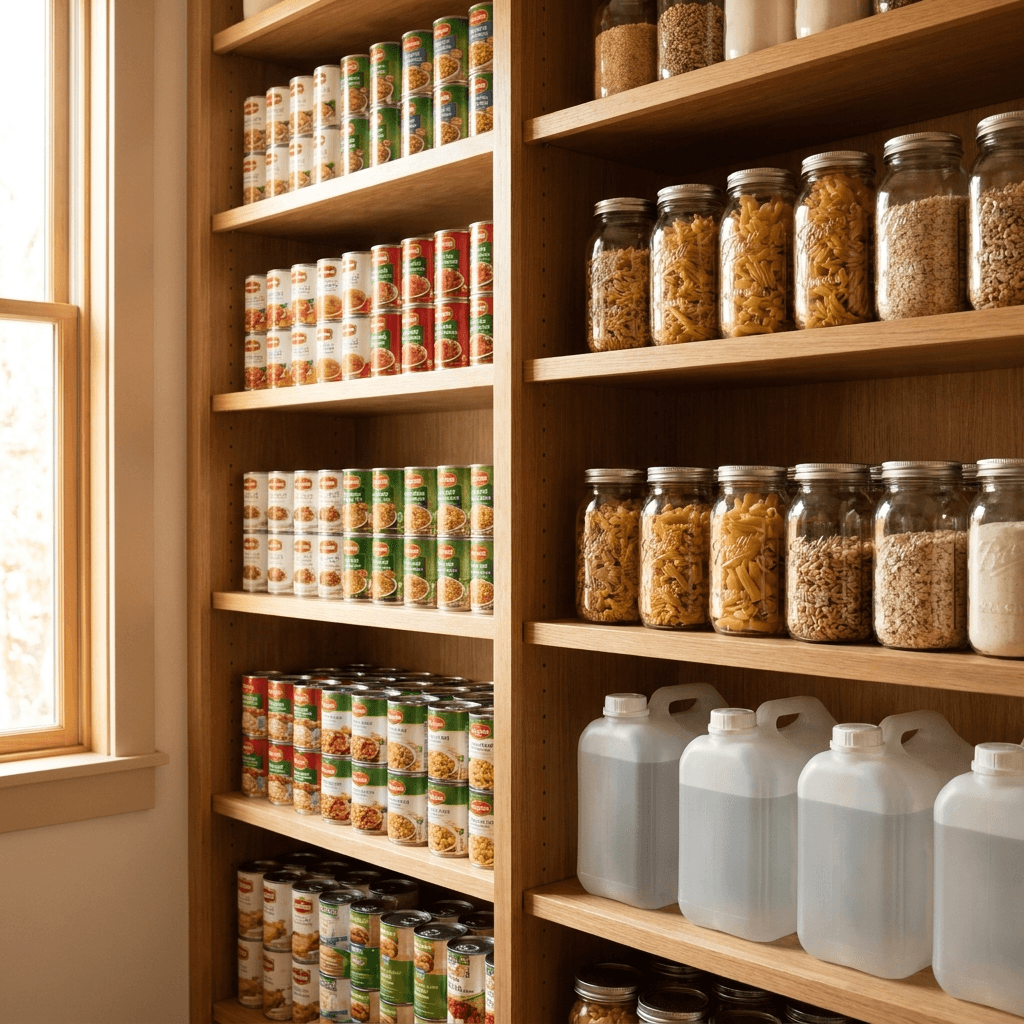
5-liter jugs from the supermarket stack well and rotate easily
Water filters (like LifeStraw or Berkey) as backup if tap water becomes unsafe
Replace at least every 6 months: bottled water doesn't lose quality, but containers can become permeable
Germany's Federal Centre for Nutrition (BZfE) also recommends storing water jugs in the dark and cool, away from direct sunlight, because UV light degrades plastic containers faster.
One question almost no one asks: how do you cook pasta without water to drain? Plan that in, and count cooking water as part of your water needs.
Where do you store an emergency stockpile without a cellar?
No cellar? No problem. Dry, cool, and dark matters more than space. A bedroom dresser, under-bed storage, or a shaded closet shelf is plenty for a four-person family's basic stockpile. Most German city families have these spaces but don't use them strategically.
Ideal storage conditions per Germany's Consumer Federation: 15–18°C, dark, dry, no direct sunlight. Heat and moisture are every stockpile's enemies.
What works in tight spaces:
Under-bed rolling cart: 2–3 flat bins with canned goods and pasta
Hallway dresser with deep drawers: perfect for shelf-stable drinks and dry goods
Under-bed storage boxes with lids: protect from dust and stay hidden
Dark-curtained bookshelf in the bedroom: with a simple cover or curtain
What doesn't work: garage in summer (can hit 60°C), damp bathrooms, next to the stove. Your car isn't a pantry either.
The first-in-first-out principle is your best friend: oldest product in front, newest in back. You rotate without thinking.
In what order do you build up a stockpile best?
Don't buy everything at once. Build your supply in three phases—water first, then basics, then extras—and you spend only €15–25 extra per shop. You'll barely notice it. For a four-person household, a realistic 10-day stockpile costs €60–80.
Most guides hide the most important part: your first emergency stockpile doesn't have to feel perfect to work. If Phase 1 has only water, pasta, and canned goods, you're already better off than 80% of households.
Phase 1: The foundation in two weeks
First two weeks, basics only. No perfectionism:
What | Amount | Cost (approx.) |
|---|---|---|
Water (5-liter jugs) | 15–20 bottles | €12–16 |
Pasta and rice | 4 kg | €5–7 |
Canned goods (tomatoes, corn, beans) | 10–12 cans | €10–14 |
Olive oil | 1 liter | €5–7 |
Phase 1 Total | approx. €32–44 |
Phases 2 and 3: Fill in without stress
From week three, add protein, grains, and kid-specific items. Phase 3 handles what you forgot:
Phase | Contents | Cost (approx.) |
|---|---|---|
Phase 2 (weeks 3–4) | Legumes, oats, nuts, nut butter, crispbread | €15–20 |
Phase 3 (week 5+) | Child products, sweets, hygiene items, can opener | €13–16 |
Total Budget | approx. €60–80 |
With a digital shopping list, you can structure your meal plan so items nearing expiration automatically roll into your next shop. You restock before anything expires, and your supply stays fresh.
How do you keep track of expiration dates?
A simple list works: product, best-by date, quantity. Track it digitally and you skip the yearly cellar inspection—you can feed products with upcoming dates straight into your meal plan instead of throwing them out later.
Paper checklist has one advantage: taped to the door, always visible. Downside: it gets outdated fast, and who likes shopping from a handwritten list?
Digital stockpile list beats paper in family life: editable, shareable, with reminders. Linking it to your meal plan is the crucial step. When a tin of lentils with a June expiration shows up in your meal recipes for early May, you eat it on time. No waste, no guilt.
With FamFood, you can set this up directly: log your supplies, note expiration dates, and the app reminds you before anything spoils.
Annual check rhythm: once a year, ideally in spring, go through everything. What expires gets used. What needs restocking goes on the list. Twenty minutes, no more.
What mistakes happen most often with emergency stockpiles?
The biggest mistake: stockpiling foods your family doesn't actually eat in everyday life, then watching them sit untouched for years. An emergency supply works only if it fits into normal meals. Buying quinoa when your kids refuse it wastes money and space.
Three other mistakes that cost dearly in a real crisis:
Mistake 1: Buying exotic items. A tin of lentil curry sounds good, but if your family doesn't eat lentils normally, they won't want them in an emergency either.
Mistake 2: Stocking and never touching it. Forgotten expiration dates cause the most waste. If you never rotate, you'll throw everything out after 3 years.
Mistake 3: Cans without a can opener. Sounds silly, happens anyway. Put a manual opener right in your stockpile box. Add a lighter. Add a flashlight with batteries.
What we hear from FamFood families over and over: an emergency stockpile feels way less overwhelming once it feels like an extended weekly pantry. Not a separate project, but part of your normal kitchen rhythm.
Frequently asked questions about family emergency stockpiles
How much does a 10-day emergency supply cost for a family with 2 children?
A realistic 10-day stockpile for four people costs €60–80 if you build it over 5 weeks. That's €15–25 extra per shop, barely noticeable in your monthly budget. Special products for infants or allergies cost extra.
Which canned foods keep longest and are worth stocking?
Canned protein like tuna, sardines, and kidney beans last 3–5 years, sometimes longer. Canned tomatoes, corn, and peas last at least 2–3 years. Rule of thumb: the lower the acid content, the longer the shelf life.
Can I build an emergency stockpile without extra space in a small apartment?
Yes. Under-bed boxes, hallway dressers, and rolling shelves offer more storage in a 60-square-meter flat than you'd think. Space matters less than storage temperature: 15–18°C, dry, and dark. A darkened bedroom shelf works fine.
How often do I need to refresh my emergency stockpile?
Replace water every 6 months. Rotate canned goods and dry goods continuously using the first-in-first-out method. Once a year, ideally in spring, check the entire stock and work products nearing expiration into your meal plan. Half an hour tops.
Do frozen foods count as part of an emergency stockpile?
No. Crisis stockpiles must work without power or refrigeration. Frozen food spoils within 24–48 hours of a power outage. They supplement your everyday pantry but can't replace shelf-stable shelf-life foods.
About FamFood
FamFood is a digital family cookbook that combines recipes, shopping lists, and pantry management under one roof. We cook with children ourselves, know that real life rarely goes to plan, and build tools that reflect actual kitchen experience, not glossy ideals. If you want to link your stockpile directly to your weekly meal plan, visit FamFood.
Emergency Food Storage for Families
Most families assume an emergency stockpile requires a cellar and cold storage. But the math is simple: if you plan for 10 days, you need less than one shoe-box shelf of groceries when you buy the right items in the right order. No relocation. No special budget. Just a little system.
Key Takeaways
Germany's Federal Office for Civil Protection and Disaster Relief (BBK) recommends a 10-day supply for four people: roughly 20 kg of food and 56–80 liters of water.
A 3-phase buying plan costs realistically €60–80 and spreads the effort over 5 weeks.
No cellar needed: dry, cool, and dark is enough—even under the bed or in a hallway cabinet.
Stock only what your family actually eats. The biggest trap is supplies that sit untouched for years.
How long should a family emergency food supply last?
Germany's Federal Office for Civil Protection and Disaster Relief (BBK) recommends a stockpile for at least 10 days. For a four-person household, that means roughly 20 kg of food and 56 liters of drinking water. This sounds like a lot, but it fits in three standard storage boxes if you shop systematically.
The often-cited 72-hour minimum simply doesn't cover most real crises. A power outage after a winter storm, a burst water pipe in your neighborhood, or a regional supply shortage often lasts longer than three days. For families with children, this matters even more: if your child is sick and you can't go out, you don't want to face empty shelves on day two.
The gap between emergency stock and everyday pantry is smaller than most think. Emergency stock (by BBK definition) must work without electricity or refrigeration. A normal weekly pantry relies on a fridge and fresh ingredients. If you combine both, you save money: canned goods you rotate into your meals after 6 months pay for themselves twice over.
Quick math for household size:
Household | Food (10 days) | Drinking Water (10 days) |
|---|---|---|
2 people | roughly 10 kg | 40 liters |
4 people (2 children) | roughly 20 kg | 56–80 liters |
6 people | roughly 30 kg | 120 liters |
What foods belong in a family emergency stockpile?
Start with calorie-dense shelf-stable foods that need no refrigeration: beans and lentils, whole-grain pasta, oats, canned goods, nuts, and stable fats. For families with children, add kid-friendly favorites—jarred tomato sauce and applesauce pouches. The rule: buy only what your family actually eats in everyday life.
The basic groups: calories first
The BBK divides its food guide into six categories. This table shows what's realistic for a four-person household (2 adults, 2 children) for 10 days:
Category | Examples | Amount (4 people / 10 days) | Note |
|---|---|---|---|
Grains & Starch | Pasta, rice, oats, crispbread | 6–8 kg | Whole grains preferred, more filling |
Vegetables & Legumes | Lentils (canned/dry), kidney beans, peas, tomatoes | 5–6 kg | Mix of canned and dry |
Fats & Oils | Olive oil, sunflower oil, nut butter | 1–1.5 liters | Store away from light |
Protein | Tuna, sardines, nuts, legumes | 2–3 kg | Canned protein keeps 3–5 years |
Sweet & Savory | Honey, jam, crackers | 0.5–1 kg | Important for children's morale |
Drinks | Water (separate), tea bags, instant coffee | as needed | Juices only if shelf-stable |
What we hear repeatedly from FamFood families: parents who plan their meals in advance buy far more strategically, and their stockpile naturally gets used instead of forgotten. No wonder: nearly all frequently-cooked family recipes work with pantry staples, because simple recipes work even when the fridge is off.
What extra items children need
Children have different needs than adults, and these are easiest to overlook in a crisis. List these separately:
Infant formula (if needed), at least 2 weeks' supply
Juice boxes and applesauce pouches as a stress-free hydration alternative
Granola bars and dried fruit for quick energy without cooking
Favorite canned goods kids will actually eat (pasta in tomato sauce, corn, chickpeas)
Special products for allergies or intolerances: gluten-free pasta, shelf-stable lactose-free milk
What most guides forget: pet food. If you have a dog or cat, you need to stock for them too.
How much water does a four-person family need in an emergency?
For a four-person household, 100–120 liters of water for 10 days is realistic. The BBK calculates 2 liters of drinking water per person daily—80 liters just for drinking. Add water for cooking and basic hygiene: realistically 1.5 to 2 extra liters per person daily. Drinking water must be food-grade; water for washing dishes and hygiene can come from larger containers. City families without a cellar do best with stackable 5-liter jugs from the supermarket.
The key distinction in practice: drinking water (2 liters per person daily) must be in food-grade containers. Gray water for dishes and washing can come from larger jugs or rain barrels but doesn't need to be potable.
Practical solutions for city families without cellar storage:
5-liter jugs from the supermarket stack well and rotate easily
Water filters (like LifeStraw or Berkey) as backup if tap water becomes unsafe
Replace at least every 6 months: bottled water doesn't lose quality, but containers can become permeable
Germany's Federal Centre for Nutrition (BZfE) also recommends storing water jugs in the dark and cool, away from direct sunlight, because UV light degrades plastic containers faster.
One question almost no one asks: how do you cook pasta without water to drain? Plan that in, and count cooking water as part of your water needs.
Where do you store an emergency stockpile without a cellar?
No cellar? No problem. Dry, cool, and dark matters more than space. A bedroom dresser, under-bed storage, or a shaded closet shelf is plenty for a four-person family's basic stockpile. Most German city families have these spaces but don't use them strategically.
Ideal storage conditions per Germany's Consumer Federation: 15–18°C, dark, dry, no direct sunlight. Heat and moisture are every stockpile's enemies.
What works in tight spaces:
Under-bed rolling cart: 2–3 flat bins with canned goods and pasta
Hallway dresser with deep drawers: perfect for shelf-stable drinks and dry goods
Under-bed storage boxes with lids: protect from dust and stay hidden
Dark-curtained bookshelf in the bedroom: with a simple cover or curtain
What doesn't work: garage in summer (can hit 60°C), damp bathrooms, next to the stove. Your car isn't a pantry either.
The first-in-first-out principle is your best friend: oldest product in front, newest in back. You rotate without thinking.
In what order do you build up a stockpile best?
Don't buy everything at once. Build your supply in three phases—water first, then basics, then extras—and you spend only €15–25 extra per shop. You'll barely notice it. For a four-person household, a realistic 10-day stockpile costs €60–80.
Most guides hide the most important part: your first emergency stockpile doesn't have to feel perfect to work. If Phase 1 has only water, pasta, and canned goods, you're already better off than 80% of households.
Phase 1: The foundation in two weeks
First two weeks, basics only. No perfectionism:
What | Amount | Cost (approx.) |
|---|---|---|
Water (5-liter jugs) | 15–20 bottles | €12–16 |
Pasta and rice | 4 kg | €5–7 |
Canned goods (tomatoes, corn, beans) | 10–12 cans | €10–14 |
Olive oil | 1 liter | €5–7 |
Phase 1 Total | approx. €32–44 |
Phases 2 and 3: Fill in without stress
From week three, add protein, grains, and kid-specific items. Phase 3 handles what you forgot:
Phase | Contents | Cost (approx.) |
|---|---|---|
Phase 2 (weeks 3–4) | Legumes, oats, nuts, nut butter, crispbread | €15–20 |
Phase 3 (week 5+) | Child products, sweets, hygiene items, can opener | €13–16 |
Total Budget | approx. €60–80 |
With a digital shopping list, you can structure your meal plan so items nearing expiration automatically roll into your next shop. You restock before anything expires, and your supply stays fresh.
How do you keep track of expiration dates?
A simple list works: product, best-by date, quantity. Track it digitally and you skip the yearly cellar inspection—you can feed products with upcoming dates straight into your meal plan instead of throwing them out later.
Paper checklist has one advantage: taped to the door, always visible. Downside: it gets outdated fast, and who likes shopping from a handwritten list?
Digital stockpile list beats paper in family life: editable, shareable, with reminders. Linking it to your meal plan is the crucial step. When a tin of lentils with a June expiration shows up in your meal recipes for early May, you eat it on time. No waste, no guilt.
With FamFood, you can set this up directly: log your supplies, note expiration dates, and the app reminds you before anything spoils.
Annual check rhythm: once a year, ideally in spring, go through everything. What expires gets used. What needs restocking goes on the list. Twenty minutes, no more.
What mistakes happen most often with emergency stockpiles?
The biggest mistake: stockpiling foods your family doesn't actually eat in everyday life, then watching them sit untouched for years. An emergency supply works only if it fits into normal meals. Buying quinoa when your kids refuse it wastes money and space.
Three other mistakes that cost dearly in a real crisis:
Mistake 1: Buying exotic items. A tin of lentil curry sounds good, but if your family doesn't eat lentils normally, they won't want them in an emergency either.
Mistake 2: Stocking and never touching it. Forgotten expiration dates cause the most waste. If you never rotate, you'll throw everything out after 3 years.
Mistake 3: Cans without a can opener. Sounds silly, happens anyway. Put a manual opener right in your stockpile box. Add a lighter. Add a flashlight with batteries.
What we hear from FamFood families over and over: an emergency stockpile feels way less overwhelming once it feels like an extended weekly pantry. Not a separate project, but part of your normal kitchen rhythm.
Frequently asked questions about family emergency stockpiles
How much does a 10-day emergency supply cost for a family with 2 children?
A realistic 10-day stockpile for four people costs €60–80 if you build it over 5 weeks. That's €15–25 extra per shop, barely noticeable in your monthly budget. Special products for infants or allergies cost extra.
Which canned foods keep longest and are worth stocking?
Canned protein like tuna, sardines, and kidney beans last 3–5 years, sometimes longer. Canned tomatoes, corn, and peas last at least 2–3 years. Rule of thumb: the lower the acid content, the longer the shelf life.
Can I build an emergency stockpile without extra space in a small apartment?
Yes. Under-bed boxes, hallway dressers, and rolling shelves offer more storage in a 60-square-meter flat than you'd think. Space matters less than storage temperature: 15–18°C, dry, and dark. A darkened bedroom shelf works fine.
How often do I need to refresh my emergency stockpile?
Replace water every 6 months. Rotate canned goods and dry goods continuously using the first-in-first-out method. Once a year, ideally in spring, check the entire stock and work products nearing expiration into your meal plan. Half an hour tops.
Do frozen foods count as part of an emergency stockpile?
No. Crisis stockpiles must work without power or refrigeration. Frozen food spoils within 24–48 hours of a power outage. They supplement your everyday pantry but can't replace shelf-stable shelf-life foods.
About FamFood
FamFood is a digital family cookbook that combines recipes, shopping lists, and pantry management under one roof. We cook with children ourselves, know that real life rarely goes to plan, and build tools that reflect actual kitchen experience, not glossy ideals. If you want to link your stockpile directly to your weekly meal plan, visit FamFood.