Simple Cooking
Nutrition
Tips & Tricks
Simple Cooking
Nutrition
Tips & Tricks
Healthy Family Meals: 3 Changes That Work
Healthy Family Meals: 3 Changes That Work
FamFood
|
It's 5:30 p.m. Everyone's hungry. And "healthy" feels like something for people with more time, more energy, and a perfectly organized fridge.
Almost every family knows this feeling. But here's the good news: you don't need a new cooking system. Three small shifts are enough to transform your family dinner table permanently. This article shows you what that actually looks like in practice.
The essentials at a glance
Healthy cooking doesn't mean complicated. It means: more nutrients, fewer processed foods, meals everyone actually eats.
Five affordable staples (legumes, frozen vegetables, whole grains, eggs, plain yogurt) improve almost every meal instantly.
The German Nutrition Society recommends a maximum of 6g salt daily for adults. Most German households exceed this regularly.
Families that plan weekly menus cook convenience foods 40% less often than families without a set plan.
What does healthy cooking for families actually mean?
Healthy cooking for families doesn't mean: complicated, expensive, or tasteless. It means: more vegetables, fewer processed ingredients, and meals that everyone at the table actually eats. That's the short version. And it matters because the opposite—diet thinking—usually fails in everyday family life.
"Healthy" doesn't equal "low-calorie." The term here means nutrient-dense: meals that deliver vitamins, fiber, good fats, and enough protein. Especially for children, this is crucial because their nutritional needs differ significantly from adults'. More calcium, more iron, less salt.
The Federal Centre for Nutrition (BZfE) recommends that families orient themselves toward the food pyramid: plant-based foods as the foundation, animal products in moderation, heavily processed foods as rarely as possible. In practice, that means potatoes instead of chips, plain yogurt instead of fruit yogurt, water instead of juice. Compromise is completely normal. No child eats broccoli every day. No parent has an hour to cook every evening. That's not what this is about.
Which 5 ingredients make the biggest difference?
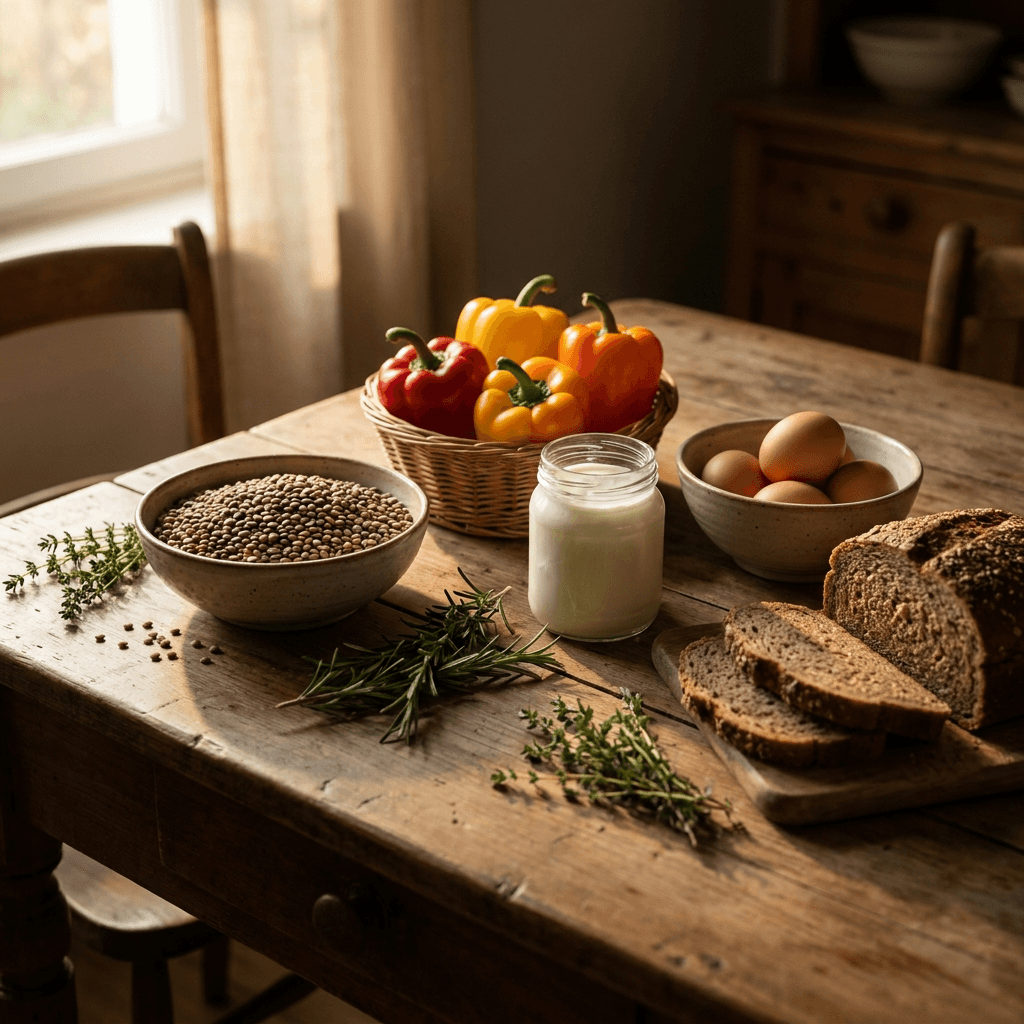
Five ingredients that fit into almost every meal and instantly add more nutrients: legumes, frozen vegetables, whole grain products, eggs, and plain yogurt. None are expensive. None require extensive prep. And all five can make their way into the pot even when the evening is already half over.
Ingredient | Nutrient Highlight | Everyday Advantage |
|---|---|---|
Lentils / Chickpeas | Protein, iron, fiber | Affordable, filling, good for kids |
Frozen vegetables | Vitamins often better preserved than fresh produce | Always in stock, no chopping |
Whole grain pasta / bread | Fiber, B vitamins | The switch goes barely noticed |
Eggs | Protein, vitamin D, B12 | Ready in 5 minutes |
Plain yogurt | Calcium, probiotics | Dip, breakfast, dessert base |
The freezer as a hidden treasure
Frozen vegetables have a bad reputation. Unfairly. Stiftung Warentest has shown in multiple tests that frozen peas, spinach, or beans often match—or even exceed—fresh supermarket produce in terms of vitamin content. The reason: frozen vegetables are processed immediately after harvest, while fresh produce often spends days in transport.
What this means in practice: a well-stocked freezer isn't a backup plan. It's strategy. Someone who adds a handful of frozen spinach to the pan at 6 p.m. has a nutrient-rich side dish on the table in ten minutes. The same principle applies to switching to whole grains. Whole grain pasta instead of white flour pasta barely registers on pasta night if the sauce is good. The difference lies in the fiber content, not the taste.
How much salt is actually too much, and what can you do?
The German Nutrition Society recommends a maximum of 6g salt per day for adults. For children, it's significantly less. Toddlers shouldn't have more than 1g daily; school-age children, no more than 3g. Most German households exceed these amounts regularly, often without noticing, because processed foods are the real culprit.
Bread and processed meats are the biggest hidden salt sources in German households. A slice of whole grain bread contains 0.4 to 0.6g of salt depending on the type. Add two slices of deli meat, and a school-age child has nearly reached their daily limit by lunchtime, before a salt shaker even came into view.
The counter-strategy is simpler than you'd think. Acid works like salt. If you finish dishes with a squeeze of lemon juice or a splash of vinegar, you need less salt. Fresh herbs, garlic, and onions add depth without raising sodium. And your palate adjusts. Within two to three weeks, it registers less salt as completely satisfying. Children notice this first, by the way: their taste sense is more finely tuned than adults'.
Healthy cooking when time is short: Which methods actually work?
Batch cooking on a single afternoon and clear freezer logic are the two methods that actually stick in family life. Food processors and apps can help, but they're not essential. Someone who cooks without a plan cooks just as aimlessly with a food processor as without one.
What we observe in families who plan weekly menus with FamFood: they cook convenience foods 40% less often than families without a set plan. The reason is simple. When you know what's for dinner in the morning, you reach for the frozen pizza at 5:30 p.m. far less often.
Batch cooking in practice
Cook once, eat three times. This principle works best with base components that can be transformed. Example: a large pot of lentil soup on Sunday becomes a lentil dip for bread on Monday, a topping for baked sweet potatoes on Tuesday. That's three different meals from a single cooking session.
The focus on dishes without raw salad or uncooked toppings is worthwhile. What cooks well transforms well: sauces, soups, braised vegetables, cooked legumes. For quick ideas and complete weekly plans, it's worth checking out the article on stress-free weekly planning with the FamFood meal planner.
What's worth freezing and what isn't
Worth freezing: tomato sauce, soups, individual portions of meat, pesto, herb butter, cooked beans and lentils. These reserves save the day when it's been longer than expected.
Don't freeze: leafy salads, raw potatoes, cucumber slices, hard-boiled eggs, and cream sauces that become grainy after thawing. Knowing this list saves a lot of disappointment.
How do you convince kids to eat healthy meals?
Kids eat what they know. And know what they see often. Repetition beats persuasion. Research on so-called neophobia—children's aversion to unfamiliar foods—shows that a new food must be offered to a child up to 15 times before it's accepted. 15 times. Not twice.
That sounds like a lot of work. But it's not if you flip the logic. The new vegetable doesn't have to land on the plate. It's enough if it's visible. Raw for dipping, as decoration, on the cutting board nearby. Children who see vegetables often eventually know them. And what they know, they're more likely to try.
Including children in cooking works better than persuasion at the table. Homemade food gets eaten more willingly. A child who has grated carrots eats the carrot with a different attitude than one it's placed in front of. This isn't theory; it's everyday observation from hundreds of families.
What doesn't work: reward systems. "Eat your broccoli first, then dessert" is counterproductive from a nutritional psychology perspective. It downgrades the vegetable (the bad thing you have to eat) and upgrades dessert (the prize). Better: put broccoli and dessert side by side without hierarchy. Quick recipes that kids actually accept in our experience can be found in the 8 quick kids' recipes for the kitchen.
Is fresh milk from the farmer really healthier?
Raw milk straight from the farm contains more enzymes and short-chain fatty acids than pasteurized supermarket milk. For healthy adults, this can be an advantage. For pregnant women, young children, and immunocompromised people, raw milk is a real risk because it can contain pathogens like salmonella, EHEC, or listeria.
The Federal Institute for Risk Assessment (BfR) explicitly recommends not drinking raw milk unpasteurized. The solution is simple: heat it briefly. Heating to 70 to 80 degrees Celsius once is enough to kill pathogens without destroying all nutrients. After that, the milk is safe and retains most of its nutrients.
Practical tip for families with farm milk: raw milk is excellent for making your own yogurt or quark. The heating is part of the process anyway, so the safety question doesn't even come up.
Which three habits permanently change your family table?
Three habits that really stick: eating together at the table without screens, trying one new vegetable once a week, and making water the standard beverage. Sounds simple. Usually is.
The KiGGS study from the Robert Koch Institute shows: children who eat regularly with their family have measurably healthier eating habits than children who often eat alone or in front of a screen. This has little to do with discipline and a lot to do with modeling. Children eat what they see adults eating.
The new-vegetable principle works as a playful system without pressure. One different vegetable in the shopping cart each week, done. When cooking seasonally, there are always new ideas; the article on seasonal cooking: your year-round guide shows what's in season when.
Gradually replacing fruit juices works best when water becomes more appealing: with a slice of lemon, a few mint leaves, or sliced cucumber in a pitcher. No fighting, no bans. Just position the alternative so it becomes the first choice.
Frequently asked questions
How do I start cooking healthier for my family when I have little time?
Start with a single change: frozen vegetables instead of no side dish. Someone who adds a handful of frozen peas or spinach to the pan at 6 p.m. has more nutrients on the table in ten minutes, with no extra work. Batch cooking on the weekend is the next logical step.
Which healthy meals do kids actually enjoy?
Pasta with vegetable sauce, lentil soup with bread, homemade wraps with cottage cheese and peppers, scrambled eggs with tomato. Meals that kids can help create have a much higher success rate, regardless of the ingredients.
Is frozen vegetables as healthy as fresh?
Yes, often even more nutrient-rich than supermarket fresh produce because it's processed immediately after harvest. Stiftung Warentest confirmed this in several investigations. Vitamins like C and B2 are well preserved in properly frozen vegetables.
How much salt should children have daily?
Toddlers under 1 year: less than 1g salt daily. Children 4 to 6 years old: a maximum of 2g. School-age children up to 14 years: up to 3g. According to the German Nutrition Society, these amounts are often already reached by bread and dairy products alone before any extra salt is added.
What's better: cooking from scratch or buying healthy prepared foods?
Cooking from scratch is better because you control the salt, sugar, and fat content yourself. But this isn't an all-or-nothing question. Good prepared foods (like canned legumes, bottled tomatoes) are legitimate shortcuts. Check the ingredient list: if you know all the ingredients, it's fine.
About FamFood
FamFood is a digital recipe and cooking platform built for real family life. We gather what works: recipes, planning tools, practical tips. No lab, no nutritionist jargon—just what gets on the table in the evening and fills everyone up. Come check it out at famfood.app.
It's 5:30 p.m. Everyone's hungry. And "healthy" feels like something for people with more time, more energy, and a perfectly organized fridge.
Almost every family knows this feeling. But here's the good news: you don't need a new cooking system. Three small shifts are enough to transform your family dinner table permanently. This article shows you what that actually looks like in practice.
The essentials at a glance
Healthy cooking doesn't mean complicated. It means: more nutrients, fewer processed foods, meals everyone actually eats.
Five affordable staples (legumes, frozen vegetables, whole grains, eggs, plain yogurt) improve almost every meal instantly.
The German Nutrition Society recommends a maximum of 6g salt daily for adults. Most German households exceed this regularly.
Families that plan weekly menus cook convenience foods 40% less often than families without a set plan.
What does healthy cooking for families actually mean?
Healthy cooking for families doesn't mean: complicated, expensive, or tasteless. It means: more vegetables, fewer processed ingredients, and meals that everyone at the table actually eats. That's the short version. And it matters because the opposite—diet thinking—usually fails in everyday family life.
"Healthy" doesn't equal "low-calorie." The term here means nutrient-dense: meals that deliver vitamins, fiber, good fats, and enough protein. Especially for children, this is crucial because their nutritional needs differ significantly from adults'. More calcium, more iron, less salt.
The Federal Centre for Nutrition (BZfE) recommends that families orient themselves toward the food pyramid: plant-based foods as the foundation, animal products in moderation, heavily processed foods as rarely as possible. In practice, that means potatoes instead of chips, plain yogurt instead of fruit yogurt, water instead of juice. Compromise is completely normal. No child eats broccoli every day. No parent has an hour to cook every evening. That's not what this is about.
Which 5 ingredients make the biggest difference?
Five ingredients that fit into almost every meal and instantly add more nutrients: legumes, frozen vegetables, whole grain products, eggs, and plain yogurt. None are expensive. None require extensive prep. And all five can make their way into the pot even when the evening is already half over.
Ingredient | Nutrient Highlight | Everyday Advantage |
|---|---|---|
Lentils / Chickpeas | Protein, iron, fiber | Affordable, filling, good for kids |
Frozen vegetables | Vitamins often better preserved than fresh produce | Always in stock, no chopping |
Whole grain pasta / bread | Fiber, B vitamins | The switch goes barely noticed |
Eggs | Protein, vitamin D, B12 | Ready in 5 minutes |
Plain yogurt | Calcium, probiotics | Dip, breakfast, dessert base |
The freezer as a hidden treasure
Frozen vegetables have a bad reputation. Unfairly. Stiftung Warentest has shown in multiple tests that frozen peas, spinach, or beans often match—or even exceed—fresh supermarket produce in terms of vitamin content. The reason: frozen vegetables are processed immediately after harvest, while fresh produce often spends days in transport.
What this means in practice: a well-stocked freezer isn't a backup plan. It's strategy. Someone who adds a handful of frozen spinach to the pan at 6 p.m. has a nutrient-rich side dish on the table in ten minutes. The same principle applies to switching to whole grains. Whole grain pasta instead of white flour pasta barely registers on pasta night if the sauce is good. The difference lies in the fiber content, not the taste.
How much salt is actually too much, and what can you do?
The German Nutrition Society recommends a maximum of 6g salt per day for adults. For children, it's significantly less. Toddlers shouldn't have more than 1g daily; school-age children, no more than 3g. Most German households exceed these amounts regularly, often without noticing, because processed foods are the real culprit.
Bread and processed meats are the biggest hidden salt sources in German households. A slice of whole grain bread contains 0.4 to 0.6g of salt depending on the type. Add two slices of deli meat, and a school-age child has nearly reached their daily limit by lunchtime, before a salt shaker even came into view.
The counter-strategy is simpler than you'd think. Acid works like salt. If you finish dishes with a squeeze of lemon juice or a splash of vinegar, you need less salt. Fresh herbs, garlic, and onions add depth without raising sodium. And your palate adjusts. Within two to three weeks, it registers less salt as completely satisfying. Children notice this first, by the way: their taste sense is more finely tuned than adults'.
Healthy cooking when time is short: Which methods actually work?
Batch cooking on a single afternoon and clear freezer logic are the two methods that actually stick in family life. Food processors and apps can help, but they're not essential. Someone who cooks without a plan cooks just as aimlessly with a food processor as without one.
What we observe in families who plan weekly menus with FamFood: they cook convenience foods 40% less often than families without a set plan. The reason is simple. When you know what's for dinner in the morning, you reach for the frozen pizza at 5:30 p.m. far less often.
Batch cooking in practice
Cook once, eat three times. This principle works best with base components that can be transformed. Example: a large pot of lentil soup on Sunday becomes a lentil dip for bread on Monday, a topping for baked sweet potatoes on Tuesday. That's three different meals from a single cooking session.
The focus on dishes without raw salad or uncooked toppings is worthwhile. What cooks well transforms well: sauces, soups, braised vegetables, cooked legumes. For quick ideas and complete weekly plans, it's worth checking out the article on stress-free weekly planning with the FamFood meal planner.
What's worth freezing and what isn't
Worth freezing: tomato sauce, soups, individual portions of meat, pesto, herb butter, cooked beans and lentils. These reserves save the day when it's been longer than expected.
Don't freeze: leafy salads, raw potatoes, cucumber slices, hard-boiled eggs, and cream sauces that become grainy after thawing. Knowing this list saves a lot of disappointment.
How do you convince kids to eat healthy meals?
Kids eat what they know. And know what they see often. Repetition beats persuasion. Research on so-called neophobia—children's aversion to unfamiliar foods—shows that a new food must be offered to a child up to 15 times before it's accepted. 15 times. Not twice.
That sounds like a lot of work. But it's not if you flip the logic. The new vegetable doesn't have to land on the plate. It's enough if it's visible. Raw for dipping, as decoration, on the cutting board nearby. Children who see vegetables often eventually know them. And what they know, they're more likely to try.
Including children in cooking works better than persuasion at the table. Homemade food gets eaten more willingly. A child who has grated carrots eats the carrot with a different attitude than one it's placed in front of. This isn't theory; it's everyday observation from hundreds of families.
What doesn't work: reward systems. "Eat your broccoli first, then dessert" is counterproductive from a nutritional psychology perspective. It downgrades the vegetable (the bad thing you have to eat) and upgrades dessert (the prize). Better: put broccoli and dessert side by side without hierarchy. Quick recipes that kids actually accept in our experience can be found in the 8 quick kids' recipes for the kitchen.
Is fresh milk from the farmer really healthier?
Raw milk straight from the farm contains more enzymes and short-chain fatty acids than pasteurized supermarket milk. For healthy adults, this can be an advantage. For pregnant women, young children, and immunocompromised people, raw milk is a real risk because it can contain pathogens like salmonella, EHEC, or listeria.
The Federal Institute for Risk Assessment (BfR) explicitly recommends not drinking raw milk unpasteurized. The solution is simple: heat it briefly. Heating to 70 to 80 degrees Celsius once is enough to kill pathogens without destroying all nutrients. After that, the milk is safe and retains most of its nutrients.
Practical tip for families with farm milk: raw milk is excellent for making your own yogurt or quark. The heating is part of the process anyway, so the safety question doesn't even come up.
Which three habits permanently change your family table?
Three habits that really stick: eating together at the table without screens, trying one new vegetable once a week, and making water the standard beverage. Sounds simple. Usually is.
The KiGGS study from the Robert Koch Institute shows: children who eat regularly with their family have measurably healthier eating habits than children who often eat alone or in front of a screen. This has little to do with discipline and a lot to do with modeling. Children eat what they see adults eating.
The new-vegetable principle works as a playful system without pressure. One different vegetable in the shopping cart each week, done. When cooking seasonally, there are always new ideas; the article on seasonal cooking: your year-round guide shows what's in season when.
Gradually replacing fruit juices works best when water becomes more appealing: with a slice of lemon, a few mint leaves, or sliced cucumber in a pitcher. No fighting, no bans. Just position the alternative so it becomes the first choice.
Frequently asked questions
How do I start cooking healthier for my family when I have little time?
Start with a single change: frozen vegetables instead of no side dish. Someone who adds a handful of frozen peas or spinach to the pan at 6 p.m. has more nutrients on the table in ten minutes, with no extra work. Batch cooking on the weekend is the next logical step.
Which healthy meals do kids actually enjoy?
Pasta with vegetable sauce, lentil soup with bread, homemade wraps with cottage cheese and peppers, scrambled eggs with tomato. Meals that kids can help create have a much higher success rate, regardless of the ingredients.
Is frozen vegetables as healthy as fresh?
Yes, often even more nutrient-rich than supermarket fresh produce because it's processed immediately after harvest. Stiftung Warentest confirmed this in several investigations. Vitamins like C and B2 are well preserved in properly frozen vegetables.
How much salt should children have daily?
Toddlers under 1 year: less than 1g salt daily. Children 4 to 6 years old: a maximum of 2g. School-age children up to 14 years: up to 3g. According to the German Nutrition Society, these amounts are often already reached by bread and dairy products alone before any extra salt is added.
What's better: cooking from scratch or buying healthy prepared foods?
Cooking from scratch is better because you control the salt, sugar, and fat content yourself. But this isn't an all-or-nothing question. Good prepared foods (like canned legumes, bottled tomatoes) are legitimate shortcuts. Check the ingredient list: if you know all the ingredients, it's fine.
About FamFood
FamFood is a digital recipe and cooking platform built for real family life. We gather what works: recipes, planning tools, practical tips. No lab, no nutritionist jargon—just what gets on the table in the evening and fills everyone up. Come check it out at famfood.app.