Shopping list
Simple Cooking
Tips & Tricks
Nutrition
Recipes
Shopping list
Simple Cooking
Tips & Tricks
Nutrition
Recipes
Family Meal Planning: 7 Stress-Free Days
Family Meal Planning: 7 Stress-Free Days
FamFood
|

Monday, 5:45 p.m. Three kids, an empty fridge, zero plan. Sound familiar? Then this article is for you.
Family meal planning isn't a lifestyle trend. It's the only way to permanently kill the evening chaos — without improvising from scratch every single day. Once you understand how it actually works, you'll never go back to winging it.
Why Meal Planning Is a Game-Changer for Families
Families spend an average of over 60 minutes a day on one question: What are we eating tonight? That sounds harmless. Add it up over a year and it's nearly nine full working days — burned on indecision.
The real cost isn't the time. It's the energy. When you're exhausted by the time you get home, making one more decision pushes you straight into "whatever's fine" mode. That ends with frozen pizza, a guilty conscience, and a fridge full of ingredients that hit the trash on Sunday.
Meal planning fixes the problem at the source. Instead of deciding every day, you decide once a week — calmly, with a clear head, and a full picture. The rest of the week practically runs itself.
The 20-Minute Weekly Plan: Here's Exactly How
Most people imagine meal planning as a massive undertaking. It isn't. A working family plan doesn't need spreadsheets, diet apps, or a lost weekend.
Here's the simplest approach:
1. Assign fixed categories. Monday = pasta. Tuesday = soup or stew. Wednesday = quick meal (under 20 minutes). Thursday = vegetarian. Friday = kids' choice. Saturday = something worth lingering over. Sunday = leftovers or brunch.
This structure sounds almost too simple — and that's exactly the point. The family has a rough idea of what's coming. Kids can get involved. And you don't start from zero every week.
2. Only plan recipes you already know. At least four out of seven meals should be dishes you've made before. No experimenting on a Tuesday when time is short.
3. Think across ingredients. Half a head of broccoli on Monday? Use the rest on Thursday. Chicken breast for Tuesday? Buy extra and turn it into wraps on Wednesday. This cuts shopping trips and food waste at the same time.
The Most Common Family Meal Planning Mistakes
Meal planning usually fails because families make classic beginner mistakes. Not out of laziness — out of the wrong approach.
Mistake 1: Starting too ambitiously. Planning all seven days with new recipes is a fast track to quitting after two weeks. Start with three days and get good at those first.
Mistake 2: Ignoring what the kids will actually eat. A meal plan that only you enjoy will be met with a full-on boycott. Kids need a real say — even if Friday night means spaghetti Bolognese again.
Mistake 3: Planning with no buffer meals. Every week needs at least two wildcard evenings. Doctor's appointments, sports practice, a spontaneous visit — life doesn't follow a plan. Build in flexibility or you'll fail by Wednesday.
Mistake 4: Keeping the shopping list separate from the plan. Writing a weekly plan and then building a shopping list separately doubles your work. The two belong together — ideally linked automatically.
How to Make Meal Planning Part of Family Life
The theory is easy. Execution usually doesn't fail because of the plan itself — it fails because the plan is scribbled on a sticky note that nobody can find.
That sounds trivial. It isn't. Families run as a team. One parent plans, the other cooks, the older kid does the shopping. When information doesn't flow, the plan falls apart.
Three things help immediately:
Set a fixed planning time. Sunday morning over coffee, 15 minutes. Every week. Not when it's convenient.
Make the plan visible. Whiteboard in the kitchen, shared note on everyone's phone — doesn't matter which. What matters is that everyone can see it.
Keep the shopping list shared. Whoever shops adds what's missing on the spot. No asking around, no buying doubles.
This is exactly where a digital tool delivers real value. FamFood was built for this kind of everyday family life: save recipes, build weekly plans, and auto-generate your shopping list — all in one place, shared with the whole family.
Meal Planning and Nutrition: What Actually Matters
One fear many families have about meal planning: that it'll start to feel like a nutrition program and end up reading like a diet book. It doesn't have to.
Good family food doesn't need to be perfect. It needs to be regular and varied. A rule of thumb nutritionists keep coming back to: families who serve at least four different vegetables per week are already well ahead of the average household — a finding backed by Germany's National Nutrition Survey (Nationale Verzehrsstudie) conducted by the Max Rubner Institute.
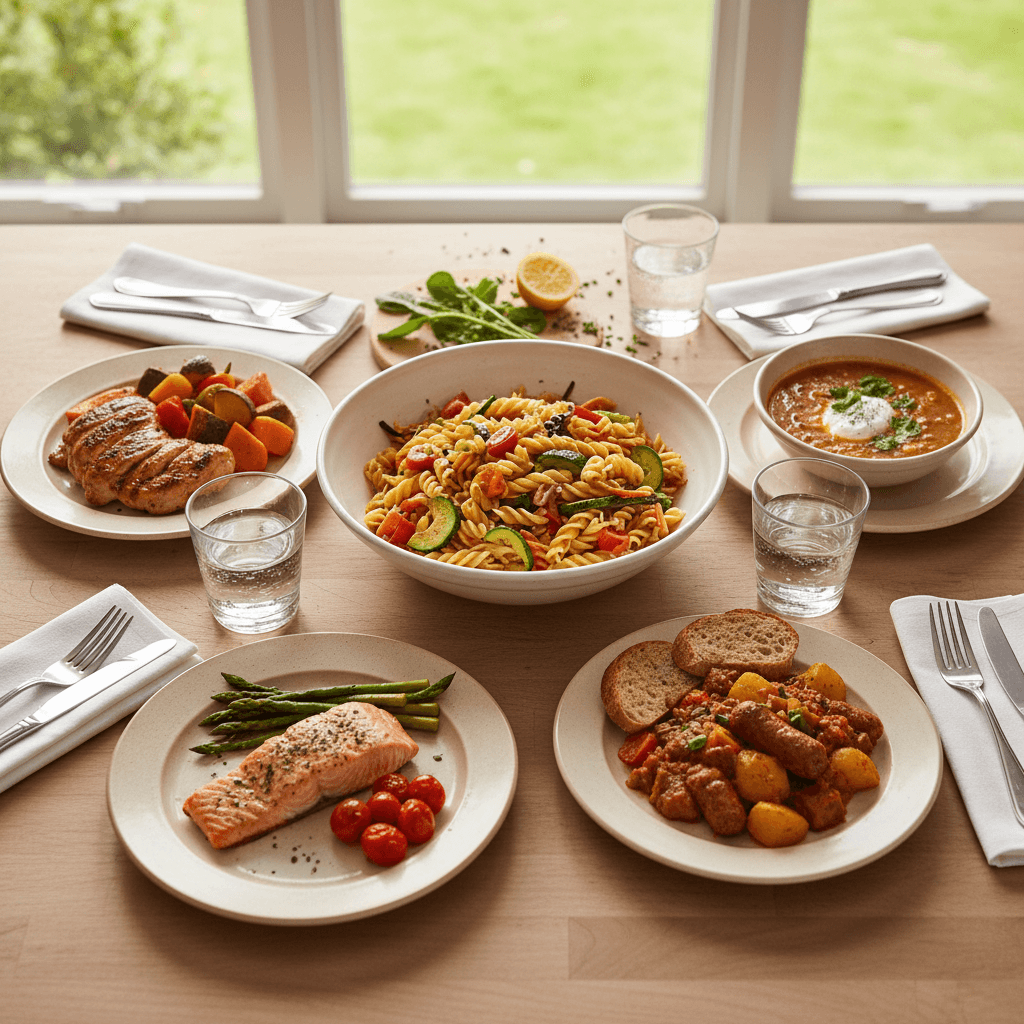
Practical tip: don't plan by nutrients. Plan by color. Green (broccoli, spinach, zucchini), orange (carrots, squash, bell pepper), white (cauliflower, leek, potato), red (tomatoes, beets, red pepper). Plan a colorful week and you'll hit good nutrition almost automatically.
FAQ: Meal Planning with the Family
How long does meal planning realistically take each week?
With a bit of practice, 15 to 25 minutes. In the first few weeks, expect 30–40 minutes while you establish your categories and go-to recipes. After that, it gets faster — not slower.
How old do kids need to be to join in?
Around five, kids can handle simple choices: "Pasta or rice?" By eight to ten, they can pick one meal per week themselves and start pitching in with cooking. Getting them involved makes a real difference at the dinner table.
What if the plan stops working mid-week?
Always build in two flexible slots. And remember: plans are allowed to change. A meal plan is not a contract. Swapping Monday's pasta for a quick soup doesn't make you a failure — it makes you adaptable.
Do I have to cook fresh every single day?
No. Meal prep — cooking ahead on the weekend — is a core part of smart meal planning. Sauces, soups, legumes, grains: most of these keep easily for two to three days.
Is meal planning worth it for smaller families?
Absolutely. It pays off even for two people. Less food waste, lower grocery bills from planned quantities, fewer impulse buys. Many households report saving up to 30% on food costs through consistent planning — a figure regularly cited in consumer surveys.
The First Step: Start Small, Stay Consistent
Family meal planning isn't a system you perfect in a week. It's a habit. And habits need repetition, not perfection.
Start with three days. Plan Monday, Wednesday, and Friday. Leave the other four open. After two weeks, add a fourth day. After a month, the whole process runs on autopilot — and you'll wonder how you ever managed without it.
What you need: one quiet moment on Sunday, a short list of your family's favorite meals, and one place everyone can access the plan.
FamFood brings all of that together: saved recipes, shared weekly planning, and automatic shopping lists — so that good intentions become a real family routine.
Start this week. Not next week. This one.
Three meals. Twenty minutes. One calmer evening. That's the deal.
Monday, 5:45 p.m. Three kids, an empty fridge, zero plan. Sound familiar? Then this article is for you.
Family meal planning isn't a lifestyle trend. It's the only way to permanently kill the evening chaos — without improvising from scratch every single day. Once you understand how it actually works, you'll never go back to winging it.
Why Meal Planning Is a Game-Changer for Families
Families spend an average of over 60 minutes a day on one question: What are we eating tonight? That sounds harmless. Add it up over a year and it's nearly nine full working days — burned on indecision.
The real cost isn't the time. It's the energy. When you're exhausted by the time you get home, making one more decision pushes you straight into "whatever's fine" mode. That ends with frozen pizza, a guilty conscience, and a fridge full of ingredients that hit the trash on Sunday.
Meal planning fixes the problem at the source. Instead of deciding every day, you decide once a week — calmly, with a clear head, and a full picture. The rest of the week practically runs itself.
The 20-Minute Weekly Plan: Here's Exactly How
Most people imagine meal planning as a massive undertaking. It isn't. A working family plan doesn't need spreadsheets, diet apps, or a lost weekend.
Here's the simplest approach:
1. Assign fixed categories. Monday = pasta. Tuesday = soup or stew. Wednesday = quick meal (under 20 minutes). Thursday = vegetarian. Friday = kids' choice. Saturday = something worth lingering over. Sunday = leftovers or brunch.
This structure sounds almost too simple — and that's exactly the point. The family has a rough idea of what's coming. Kids can get involved. And you don't start from zero every week.
2. Only plan recipes you already know. At least four out of seven meals should be dishes you've made before. No experimenting on a Tuesday when time is short.
3. Think across ingredients. Half a head of broccoli on Monday? Use the rest on Thursday. Chicken breast for Tuesday? Buy extra and turn it into wraps on Wednesday. This cuts shopping trips and food waste at the same time.
The Most Common Family Meal Planning Mistakes
Meal planning usually fails because families make classic beginner mistakes. Not out of laziness — out of the wrong approach.
Mistake 1: Starting too ambitiously. Planning all seven days with new recipes is a fast track to quitting after two weeks. Start with three days and get good at those first.
Mistake 2: Ignoring what the kids will actually eat. A meal plan that only you enjoy will be met with a full-on boycott. Kids need a real say — even if Friday night means spaghetti Bolognese again.
Mistake 3: Planning with no buffer meals. Every week needs at least two wildcard evenings. Doctor's appointments, sports practice, a spontaneous visit — life doesn't follow a plan. Build in flexibility or you'll fail by Wednesday.
Mistake 4: Keeping the shopping list separate from the plan. Writing a weekly plan and then building a shopping list separately doubles your work. The two belong together — ideally linked automatically.
How to Make Meal Planning Part of Family Life
The theory is easy. Execution usually doesn't fail because of the plan itself — it fails because the plan is scribbled on a sticky note that nobody can find.
That sounds trivial. It isn't. Families run as a team. One parent plans, the other cooks, the older kid does the shopping. When information doesn't flow, the plan falls apart.
Three things help immediately:
Set a fixed planning time. Sunday morning over coffee, 15 minutes. Every week. Not when it's convenient.
Make the plan visible. Whiteboard in the kitchen, shared note on everyone's phone — doesn't matter which. What matters is that everyone can see it.
Keep the shopping list shared. Whoever shops adds what's missing on the spot. No asking around, no buying doubles.
This is exactly where a digital tool delivers real value. FamFood was built for this kind of everyday family life: save recipes, build weekly plans, and auto-generate your shopping list — all in one place, shared with the whole family.
Meal Planning and Nutrition: What Actually Matters
One fear many families have about meal planning: that it'll start to feel like a nutrition program and end up reading like a diet book. It doesn't have to.
Good family food doesn't need to be perfect. It needs to be regular and varied. A rule of thumb nutritionists keep coming back to: families who serve at least four different vegetables per week are already well ahead of the average household — a finding backed by Germany's National Nutrition Survey (Nationale Verzehrsstudie) conducted by the Max Rubner Institute.
Practical tip: don't plan by nutrients. Plan by color. Green (broccoli, spinach, zucchini), orange (carrots, squash, bell pepper), white (cauliflower, leek, potato), red (tomatoes, beets, red pepper). Plan a colorful week and you'll hit good nutrition almost automatically.
FAQ: Meal Planning with the Family
How long does meal planning realistically take each week?
With a bit of practice, 15 to 25 minutes. In the first few weeks, expect 30–40 minutes while you establish your categories and go-to recipes. After that, it gets faster — not slower.
How old do kids need to be to join in?
Around five, kids can handle simple choices: "Pasta or rice?" By eight to ten, they can pick one meal per week themselves and start pitching in with cooking. Getting them involved makes a real difference at the dinner table.
What if the plan stops working mid-week?
Always build in two flexible slots. And remember: plans are allowed to change. A meal plan is not a contract. Swapping Monday's pasta for a quick soup doesn't make you a failure — it makes you adaptable.
Do I have to cook fresh every single day?
No. Meal prep — cooking ahead on the weekend — is a core part of smart meal planning. Sauces, soups, legumes, grains: most of these keep easily for two to three days.
Is meal planning worth it for smaller families?
Absolutely. It pays off even for two people. Less food waste, lower grocery bills from planned quantities, fewer impulse buys. Many households report saving up to 30% on food costs through consistent planning — a figure regularly cited in consumer surveys.
The First Step: Start Small, Stay Consistent
Family meal planning isn't a system you perfect in a week. It's a habit. And habits need repetition, not perfection.
Start with three days. Plan Monday, Wednesday, and Friday. Leave the other four open. After two weeks, add a fourth day. After a month, the whole process runs on autopilot — and you'll wonder how you ever managed without it.
What you need: one quiet moment on Sunday, a short list of your family's favorite meals, and one place everyone can access the plan.
FamFood brings all of that together: saved recipes, shared weekly planning, and automatic shopping lists — so that good intentions become a real family routine.
Start this week. Not next week. This one.
Three meals. Twenty minutes. One calmer evening. That's the deal.