Tips & Tricks
Simple Cooking
Inspiration
Tips & Tricks
Simple Cooking
Inspiration
10 Kitchen Tricks That Save Your Weeknight Dinners
10 Kitchen Tricks That Save Your Weeknight Dinners
FamFood
|
By Lisa Hofmann — nutritionist and mother of two. She writes for FamFood about everyday cooking, smart storage, and everything that makes weeknight dinners shorter and less stressful.
The onions are burning. The pot is boiling over. The kids are calling from the living room that they're hungry. And right at that moment you realize you forgot to defrost something.
Every family knows evenings like this. The frustrating part: one small trick would often have been enough. One step taken earlier, one habit changed — and the evening runs smoothly. The ten tricks here are not written for hobby cooks with three free hours. They are for everyone who cooks with 30 minutes on the clock and still wants to eat well.
The key points upfront
Mise en place — getting everything ready before you start cooking — cuts the feeling of kitchen stress roughly in half.
According to Germany's Federal Centre for Nutrition (BZfE), German households throw away 75 kg of food per person per year; proper storage reduces that number measurably.
One sharp knife beats five blunt ones — Stiftung Warentest (Germany's leading consumer testing body) regularly names chef's knives under €30 as top picks (2022).
Almost every cooking disaster — too salty, too spicy, burnt — can be rescued if you know the right counter-fix.
Why do so many kitchen tricks never make it into real life?
Most tips online are written for professional cooks — not for families with 30 minutes and hungry children. Anyone recommending julienne cuts and homemade stock has clearly never lived through the chaos of school bags and overtime.
The second reason: selling expensive kitchen gadgets as the solution is more convenient than actually changing habits. A high-end food processor solves nothing if you don't know how to salvage leftovers or stock your fridge sensibly.
This article does things differently. Every trick here requires no special equipment, no culinary training, and no free hour. Just a little curiosity — and the courage to try something new tonight.
Which preparation tricks actually save time?
Mise en place — getting everything ready before you start — is the one tip professional cooks and parents share. It cuts the perceived cooking time roughly in half, because kitchen chaos almost always comes from a lack of overview, not a lack of time.
In practice, for a family kitchen, this means:
Pre-chop vegetables during a quiet moment and store them in a container in the fridge. Bell peppers, carrots, and zucchini stay fresh for two days once cut.
Mix spice blends in advance. Measure out your Bolognese spices (oregano, thyme, paprika, salt) once, fill a screw-top jar, and you'll never need to weigh and hunt for them again.
Peel onions and garlic all at once and store them in a sealed container in the fridge. They keep for three to five days — and the tears only happen once a week.
Soak grains and legumes the night before. Chickpeas, lentils, and spelt need time, not attention. Soaking them in the evening means one big step is already done by lunchtime or dinner.
Mise en place for families: what actually matters
Not everything from the professional kitchen concept fits family life. What counts: the ten minutes before the first burner goes on. Ingredients out, quantities roughly estimated, necessary tools at the ready. Make that a habit and you'll cook noticeably more calmly — most people feel the difference by the second time they try it.
How do you keep food fresh longer — without extra effort?
According to Germany's Federal Centre for Nutrition (BZfE), German households throw away an average of 75 kg of food per person per year — most of it from the fridge, simply because it was stored incorrectly (BZfE, Food Waste in Germany, 2023). Knowing your fridge zones solves this with knowledge, not willpower.
The simplest fix: know your fridge zones and use them consistently.
Fridge zones: what goes where?
Zone | Temperature (approx.) | Best for |
|---|---|---|
Top (warmest zone) | 8–10 °C (46–50 °F) | Deli meats, cheese, cooked dishes |
Middle | 5–7 °C (41–45 °F) | Dairy, yogurt, butter |
Bottom (coldest zone) | 2–4 °C (36–39 °F) | Fresh meat, fish |
Crisper drawer | 8–10 °C, humid | Vegetables, fruit (except bananas, tomatoes) |
Door shelves | 10–12 °C (50–54 °F) | Drinks, mustard, jam, eggs |
Three more tricks that cost nothing:
Put fresh herbs in a glass of water like flowers. Parsley and basil last twice as long this way as they do in their plastic packaging.
Wrap cheese in baking parchment instead of cling film. The paper lets moisture escape and prevents mould.
Store bread in a bread box rather than a plastic bag. Ceramic and wooden boxes regulate moisture better — bread stays crispier for longer and is far less likely to go mouldy.
Which cutting techniques make cooking less stressful?
One sharp knife beats five blunt ones. Stiftung Warentest (Germany's leading consumer testing organization) regularly names affordable chef's knives under €30 as top performers (Stiftung Warentest, Chef's Knife Test, 2022). A blunt knife is not just frustrating — it is more dangerous, because you need more pressure and the blade is more likely to slip.
The one knife every family needs: a chef's knife with a 7–8 inch (18–20 cm) blade. Kept sharp with a honing steel (a few strokes just before cutting, not after), it will last for years.
Two cutting techniques worth learning:
The rocking chop for herbs: the front tip of the blade stays on the board while the handle rocks up and down. No crushed herbs, no loss of aroma.
The draw cut for onions and meat: the blade is pulled through in one long, smooth stroke rather than chopping straight down. Cleaner cuts and noticeably fewer tears with onions.
Cutting board rule: go large, non-slip, and use a separate board for raw meat. A damp kitchen towel placed under the board keeps it from sliding — no fuss.
How do you rescue a dish when something goes wrong?
Too salty, too spicy, burnt — almost every kitchen mishap has a simple counter-fix that most people simply don't know. That knowledge is the most valuable thing in the kitchen, because mistakes happen to everyone, no matter how experienced.
Problem | Immediate fix | Why it works |
|---|---|---|
Too salty | Simmer a raw potato slice in the dish, or add more liquid | Potato absorbs excess salt; extra liquid dilutes it |
Too spicy | Stir in yogurt, cream, or coconut milk | Fat binds capsaicin and tames the heat |
Burnt | Transfer immediately to a new pot, do not stir, leave lid off | The burnt residue stays on the bottom; a lid would trap steam and drive the flavour through |
Sauce too thin | Beurre manié: knead soft butter with flour, stir in | The fat-flour paste binds without forming lumps |
Too sour | Stir in a pinch of sugar or honey | Sweetness directly neutralises acidity |
The most important principle: never stir in a panic. Most rescue operations only work if you stop for a moment and think about what is actually happening in the pot.
Which organisation tricks keep the kitchen tidy for good?
Kitchen organisation usually fails not because of a lack of willpower but because of systems that are too complicated. Set ten rules and you'll keep none of them. Have three simple habits and you'll keep all three.
The three that genuinely stick:
One in, one out. Every new jar of pantry staple or spice that comes in replaces an old one. No accumulating, no forgetting. Expired stock is spotted immediately because space is limited.
Label everything that goes in the freezer. Masking tape and a marker — that's all you need. Contents, date, quantity. Do this consistently and you'll never throw away frozen mystery parcels again, and you'll always know what you have.
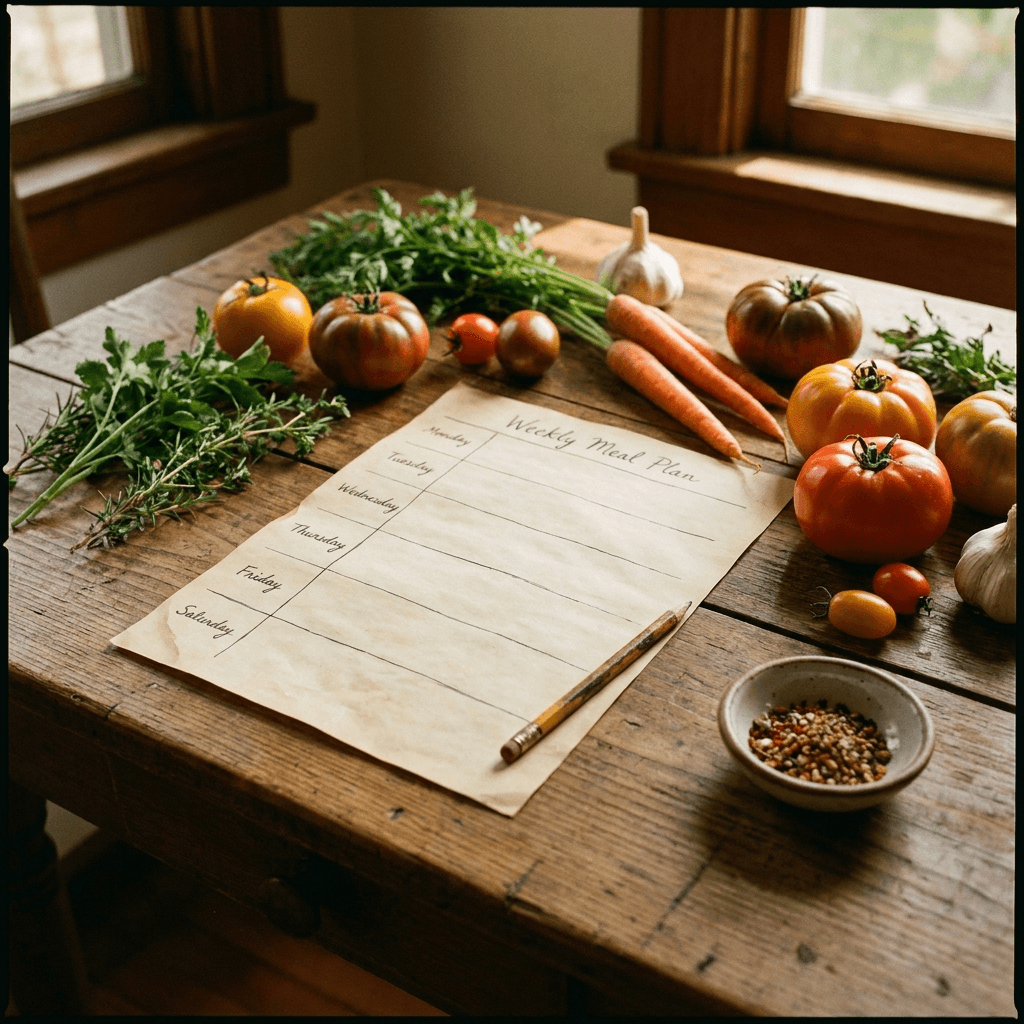
Hang the weekly menu somewhere visible. Chalkboard, whiteboard, fridge magnet — the format doesn't matter. Visible is what counts. When everyone knows what's for dinner, the nightly "what are we having?" discussions stop.
Recipes under control: go digital, ditch the chaos
Loose recipe scraps, screenshots buried deep in your camera roll, pages torn from magazines tucked into cookbooks: that costs you minutes every day and, at worst, Grandma's favourite recipe forever. Storing recipes digitally means finding them in seconds. All your recipes — from booklets, social media, or the family chat — can be kept in one place and shared with the whole family in the FamFood app.
Which energy- and cost-saving tricks are genuinely worth it?
Germany's consumer advice centres (Verbraucherzentrale) recommend consistently using pot lids and planning for residual heat — together, these two habits can noticeably reduce energy consumption at the hob (Verbraucherzentrale, Energy-Saving Tips for the Kitchen, 2023). Given the way energy prices have moved in recent years, that is not a trivial saving.
Four tricks that work immediately:
Put a lid on the pot. It sounds obvious, but the savings are measurable: an uncovered pot loses up to 60 % more energy than a covered one. Water boils faster, stews cook more evenly.
Use residual heat. Rice, pasta, and eggs don't need full heat all the way to the end. Turn the hob off two minutes early — the residual heat finishes the job.
Keep the freezer well filled. A half-empty freezer uses significantly more electricity than a full one. Not enough frozen food? Fill the gaps with water bottles.
Buy seasonal produce. Whatever is in season is cheaper, fresher, and more nutritious than imported alternatives. A quick look at a seasonal produce calendar before shopping is always worth it.
What do families most often want to know about kitchen tricks?
Which kitchen tricks does everyone know but almost nobody actually uses?
The most famous and least applied trick: add salt to pasta water before it boils — not after. And never rinse pasta with cold water if it's going to finish cooking in the sauce. Everyone knows these in theory. In practice, they rarely happen.
How do I sharpen a knife properly at home?
With a honing steel — just before you cut, not after. Hold the blade at roughly a 15–20 degree angle to the steel and draw it in smooth, even strokes from heel to tip. Four to six strokes per side is enough for most household needs. A whetstone sharpens more deeply but is only necessary when the knife is genuinely blunt.
How long do leftovers really keep in the fridge?
As a rule of thumb: cooked food kept in the fridge at below 5 °C (41 °F) will last two to three days. Meat-based dishes are better eaten within two days; vegetable dishes within three. Store them in sealed containers rather than open pots — this extends shelf life and prevents odours from spreading.
What do I do if the sauce has turned out too salty?
Either place a slice of raw potato in the sauce and let it simmer for ten minutes, then remove it. Or stretch the sauce with unsalted liquid — water, salt-free stock, or cream. Both work without ruining the flavour. Sugar, by the way, does not help with an over-salted sauce.
How do I organise my recipes so I can always find them?
One single digital location beats every binder and notebook. Bringing all your recipes together — from books, the internet, from Grandma — means you can find any of them in seconds via search. The FamFood app goes one step further: link recipes directly to your weekly meal plan and automatically generate your shopping list from there.
By Lisa Hofmann — nutritionist and mother of two. She writes for FamFood about everyday cooking, smart storage, and everything that makes weeknight dinners shorter and less stressful.
The onions are burning. The pot is boiling over. The kids are calling from the living room that they're hungry. And right at that moment you realize you forgot to defrost something.
Every family knows evenings like this. The frustrating part: one small trick would often have been enough. One step taken earlier, one habit changed — and the evening runs smoothly. The ten tricks here are not written for hobby cooks with three free hours. They are for everyone who cooks with 30 minutes on the clock and still wants to eat well.
The key points upfront
Mise en place — getting everything ready before you start cooking — cuts the feeling of kitchen stress roughly in half.
According to Germany's Federal Centre for Nutrition (BZfE), German households throw away 75 kg of food per person per year; proper storage reduces that number measurably.
One sharp knife beats five blunt ones — Stiftung Warentest (Germany's leading consumer testing body) regularly names chef's knives under €30 as top picks (2022).
Almost every cooking disaster — too salty, too spicy, burnt — can be rescued if you know the right counter-fix.
Why do so many kitchen tricks never make it into real life?
Most tips online are written for professional cooks — not for families with 30 minutes and hungry children. Anyone recommending julienne cuts and homemade stock has clearly never lived through the chaos of school bags and overtime.
The second reason: selling expensive kitchen gadgets as the solution is more convenient than actually changing habits. A high-end food processor solves nothing if you don't know how to salvage leftovers or stock your fridge sensibly.
This article does things differently. Every trick here requires no special equipment, no culinary training, and no free hour. Just a little curiosity — and the courage to try something new tonight.
Which preparation tricks actually save time?
Mise en place — getting everything ready before you start — is the one tip professional cooks and parents share. It cuts the perceived cooking time roughly in half, because kitchen chaos almost always comes from a lack of overview, not a lack of time.
In practice, for a family kitchen, this means:
Pre-chop vegetables during a quiet moment and store them in a container in the fridge. Bell peppers, carrots, and zucchini stay fresh for two days once cut.
Mix spice blends in advance. Measure out your Bolognese spices (oregano, thyme, paprika, salt) once, fill a screw-top jar, and you'll never need to weigh and hunt for them again.
Peel onions and garlic all at once and store them in a sealed container in the fridge. They keep for three to five days — and the tears only happen once a week.
Soak grains and legumes the night before. Chickpeas, lentils, and spelt need time, not attention. Soaking them in the evening means one big step is already done by lunchtime or dinner.
Mise en place for families: what actually matters
Not everything from the professional kitchen concept fits family life. What counts: the ten minutes before the first burner goes on. Ingredients out, quantities roughly estimated, necessary tools at the ready. Make that a habit and you'll cook noticeably more calmly — most people feel the difference by the second time they try it.
How do you keep food fresh longer — without extra effort?
According to Germany's Federal Centre for Nutrition (BZfE), German households throw away an average of 75 kg of food per person per year — most of it from the fridge, simply because it was stored incorrectly (BZfE, Food Waste in Germany, 2023). Knowing your fridge zones solves this with knowledge, not willpower.
The simplest fix: know your fridge zones and use them consistently.
Fridge zones: what goes where?
Zone | Temperature (approx.) | Best for |
|---|---|---|
Top (warmest zone) | 8–10 °C (46–50 °F) | Deli meats, cheese, cooked dishes |
Middle | 5–7 °C (41–45 °F) | Dairy, yogurt, butter |
Bottom (coldest zone) | 2–4 °C (36–39 °F) | Fresh meat, fish |
Crisper drawer | 8–10 °C, humid | Vegetables, fruit (except bananas, tomatoes) |
Door shelves | 10–12 °C (50–54 °F) | Drinks, mustard, jam, eggs |
Three more tricks that cost nothing:
Put fresh herbs in a glass of water like flowers. Parsley and basil last twice as long this way as they do in their plastic packaging.
Wrap cheese in baking parchment instead of cling film. The paper lets moisture escape and prevents mould.
Store bread in a bread box rather than a plastic bag. Ceramic and wooden boxes regulate moisture better — bread stays crispier for longer and is far less likely to go mouldy.
Which cutting techniques make cooking less stressful?
One sharp knife beats five blunt ones. Stiftung Warentest (Germany's leading consumer testing organization) regularly names affordable chef's knives under €30 as top performers (Stiftung Warentest, Chef's Knife Test, 2022). A blunt knife is not just frustrating — it is more dangerous, because you need more pressure and the blade is more likely to slip.
The one knife every family needs: a chef's knife with a 7–8 inch (18–20 cm) blade. Kept sharp with a honing steel (a few strokes just before cutting, not after), it will last for years.
Two cutting techniques worth learning:
The rocking chop for herbs: the front tip of the blade stays on the board while the handle rocks up and down. No crushed herbs, no loss of aroma.
The draw cut for onions and meat: the blade is pulled through in one long, smooth stroke rather than chopping straight down. Cleaner cuts and noticeably fewer tears with onions.
Cutting board rule: go large, non-slip, and use a separate board for raw meat. A damp kitchen towel placed under the board keeps it from sliding — no fuss.
How do you rescue a dish when something goes wrong?
Too salty, too spicy, burnt — almost every kitchen mishap has a simple counter-fix that most people simply don't know. That knowledge is the most valuable thing in the kitchen, because mistakes happen to everyone, no matter how experienced.
Problem | Immediate fix | Why it works |
|---|---|---|
Too salty | Simmer a raw potato slice in the dish, or add more liquid | Potato absorbs excess salt; extra liquid dilutes it |
Too spicy | Stir in yogurt, cream, or coconut milk | Fat binds capsaicin and tames the heat |
Burnt | Transfer immediately to a new pot, do not stir, leave lid off | The burnt residue stays on the bottom; a lid would trap steam and drive the flavour through |
Sauce too thin | Beurre manié: knead soft butter with flour, stir in | The fat-flour paste binds without forming lumps |
Too sour | Stir in a pinch of sugar or honey | Sweetness directly neutralises acidity |
The most important principle: never stir in a panic. Most rescue operations only work if you stop for a moment and think about what is actually happening in the pot.
Which organisation tricks keep the kitchen tidy for good?
Kitchen organisation usually fails not because of a lack of willpower but because of systems that are too complicated. Set ten rules and you'll keep none of them. Have three simple habits and you'll keep all three.
The three that genuinely stick:
One in, one out. Every new jar of pantry staple or spice that comes in replaces an old one. No accumulating, no forgetting. Expired stock is spotted immediately because space is limited.
Label everything that goes in the freezer. Masking tape and a marker — that's all you need. Contents, date, quantity. Do this consistently and you'll never throw away frozen mystery parcels again, and you'll always know what you have.
Hang the weekly menu somewhere visible. Chalkboard, whiteboard, fridge magnet — the format doesn't matter. Visible is what counts. When everyone knows what's for dinner, the nightly "what are we having?" discussions stop.
Recipes under control: go digital, ditch the chaos
Loose recipe scraps, screenshots buried deep in your camera roll, pages torn from magazines tucked into cookbooks: that costs you minutes every day and, at worst, Grandma's favourite recipe forever. Storing recipes digitally means finding them in seconds. All your recipes — from booklets, social media, or the family chat — can be kept in one place and shared with the whole family in the FamFood app.
Which energy- and cost-saving tricks are genuinely worth it?
Germany's consumer advice centres (Verbraucherzentrale) recommend consistently using pot lids and planning for residual heat — together, these two habits can noticeably reduce energy consumption at the hob (Verbraucherzentrale, Energy-Saving Tips for the Kitchen, 2023). Given the way energy prices have moved in recent years, that is not a trivial saving.
Four tricks that work immediately:
Put a lid on the pot. It sounds obvious, but the savings are measurable: an uncovered pot loses up to 60 % more energy than a covered one. Water boils faster, stews cook more evenly.
Use residual heat. Rice, pasta, and eggs don't need full heat all the way to the end. Turn the hob off two minutes early — the residual heat finishes the job.
Keep the freezer well filled. A half-empty freezer uses significantly more electricity than a full one. Not enough frozen food? Fill the gaps with water bottles.
Buy seasonal produce. Whatever is in season is cheaper, fresher, and more nutritious than imported alternatives. A quick look at a seasonal produce calendar before shopping is always worth it.
What do families most often want to know about kitchen tricks?
Which kitchen tricks does everyone know but almost nobody actually uses?
The most famous and least applied trick: add salt to pasta water before it boils — not after. And never rinse pasta with cold water if it's going to finish cooking in the sauce. Everyone knows these in theory. In practice, they rarely happen.
How do I sharpen a knife properly at home?
With a honing steel — just before you cut, not after. Hold the blade at roughly a 15–20 degree angle to the steel and draw it in smooth, even strokes from heel to tip. Four to six strokes per side is enough for most household needs. A whetstone sharpens more deeply but is only necessary when the knife is genuinely blunt.
How long do leftovers really keep in the fridge?
As a rule of thumb: cooked food kept in the fridge at below 5 °C (41 °F) will last two to three days. Meat-based dishes are better eaten within two days; vegetable dishes within three. Store them in sealed containers rather than open pots — this extends shelf life and prevents odours from spreading.
What do I do if the sauce has turned out too salty?
Either place a slice of raw potato in the sauce and let it simmer for ten minutes, then remove it. Or stretch the sauce with unsalted liquid — water, salt-free stock, or cream. Both work without ruining the flavour. Sugar, by the way, does not help with an over-salted sauce.
How do I organise my recipes so I can always find them?
One single digital location beats every binder and notebook. Bringing all your recipes together — from books, the internet, from Grandma — means you can find any of them in seconds via search. The FamFood app goes one step further: link recipes directly to your weekly meal plan and automatically generate your shopping list from there.