Freeze Egg Whites: Skip the Meringue at 9pm
Second Sunday of Advent. The shortbread dough for your cookies just used four egg yolks, and there's a cup with four egg whites sitting in your fridge. Four egg whites in a cup, and right now you're probably thinking the same thing as everyone else: either bake meringue fast, or dump them, right? It's Sunday evening. You want a clean kitchen. Tomorrow morning there's no time for baking experiments.
If you want to use those egg whites now, you're facing a bad choice. Four egg whites in the trash. Or a tray of meringue nobody eats, just so nothing gets wasted. So here's the real question: What do you do with four leftover egg whites without forcing yourself to bake something tonight that nobody will want anyway?
Key Takeaways
- You can freeze leftover raw egg whites in portions. Once thawed, they whip up stiff again.
- Separated egg whites last 1 to 2 days in the fridge, several months in the freezer.
- The amount determines the recipe: 1 egg white for breading, 2 for an omelet or macaroons, 4 for meringue, 6+ for pavlova.
- Toddlers should only eat fully cooked egg whites (Federal Institute for Risk Assessment). Cold doesn't kill bacteria.
Do You Really Have to Bake Meringue Tonight?
No. Leftover raw egg whites don't need to be used the same evening. Sealed well and portioned into small containers, they go straight into the freezer and stay usable for several months. Unlike egg yolks, which gel when frozen and turn rubbery and lumpy afterward, egg whites stay liquid after thawing. Left to thaw overnight in the fridge, they whip back up into stiff peaks. So instead of time pressure, you've got a stockpile, and you can pick your recipe when you feel like making it.
The common assumption goes like this: egg whites have to be used today. So at 9pm the oven gets turned on, and that tray of meringue sits in the cookie tin for three weeks.
Raw egg whites freeze beautifully in portions and whip back to stiff peaks once thawed. You can decide on the recipe later.
This is also the more logical order. The cookie season produces egg whites in quantities no single recipe needs the same evening. Three kinds of shortbread, and you've got twelve egg whites on the counter. If you hunt for a recipe every time, you'll bake more meringue than cookies in December.
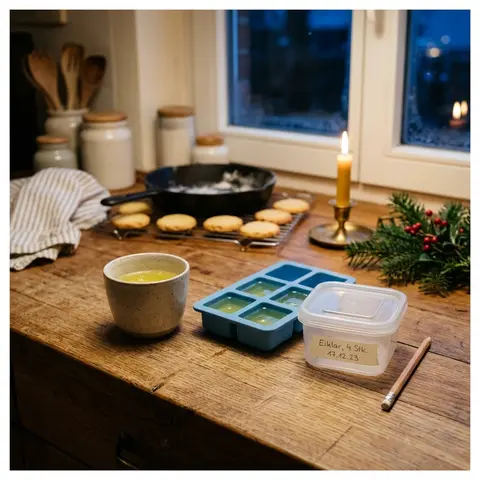
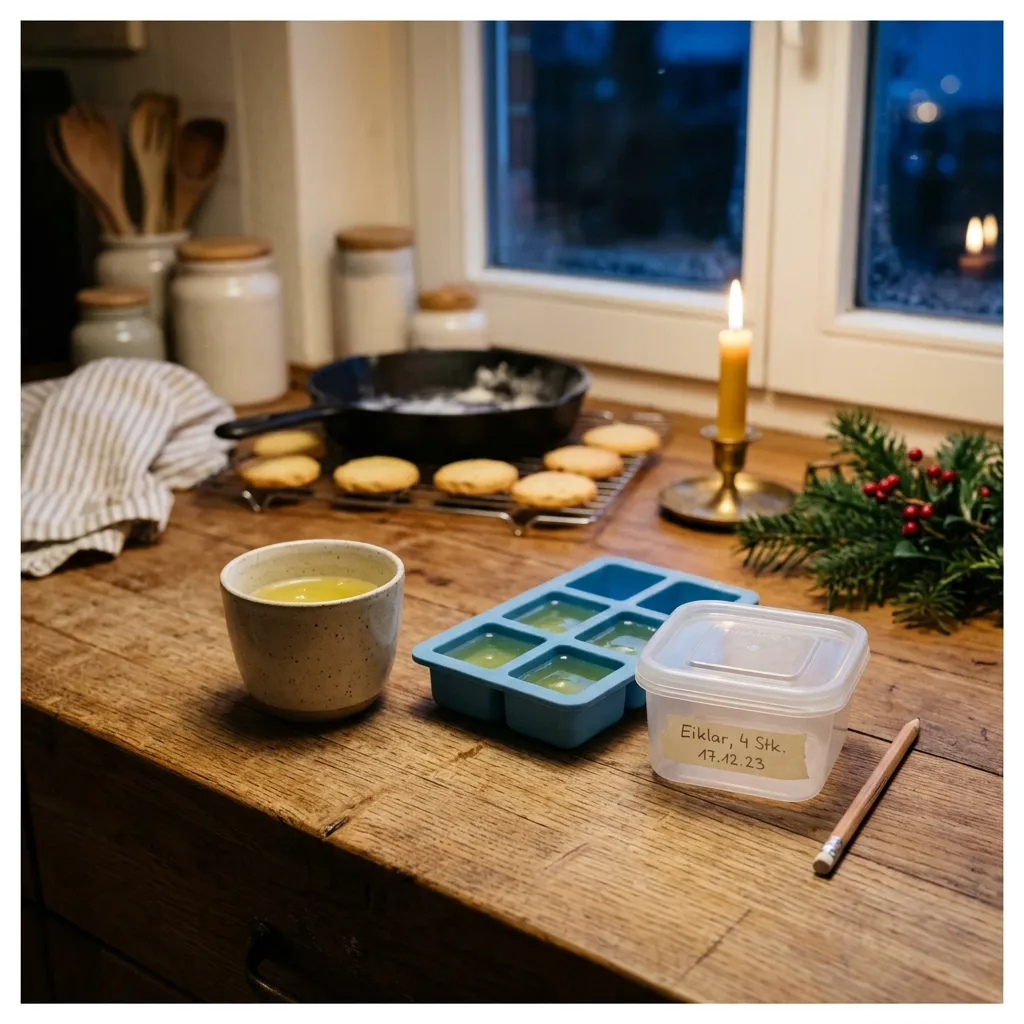
Here's how you do it: pour the egg whites into an ice cube tray, one egg white per compartment if the compartments are large enough. Once frozen, the cubes go into a freezer container. Write the number and today's date on the lid.
Last year in December we froze 14 egg whites this way and baked them in January. Every portion whipped up stiff. The only difference from fresh egg whites: the peaks took about a minute longer with the hand mixer.
How long can that container sit there? For the fridge, the answer is much shorter than most people think.
How Long Do Egg Whites Last in the Fridge and Freezer?
Separated raw egg whites belong in the fridge in an airtight container and should be used within 1 to 2 days. Frozen, they keep for several months. Thaw only overnight in the fridge, never on the counter, and after thawing don't refreeze—cook them fully and use them quickly. The German Federal Centre for Nutrition treats raw eggs as a delicate food that needs to stay cold and be used fast.
Storage Location | Shelf Life | What to Remember |
|---|---|---|
Fridge | 1 to 2 days | Airtight seal, back of the fridge, not the door |
Freezer | Several months | Portioned, labeled with quantity and date |
Thawed | Same day or next day | Thaw only in fridge, don't refreeze, cook fully |
Why so strict? Raw eggs can carry salmonella. The Federal Institute for Risk Assessment recommends in its consumer tips on preventing foodborne illness that you keep raw egg dishes chilled, use them quickly, and heat egg dishes thoroughly.
Here's one more trick to avoid guessing in January: weigh them. One medium egg white usually weighs 30 to 35 grams in our kitchen. Many recipes call for grams, and eggs vary in size. When you write "140 g" on the lid, you won't have to do math later.
Now you know how much egg white is in the container. What's more interesting is which recipes use exactly that amount.
What Recipes Use Exactly How Much Leftover Egg White?
The amount determines the recipe. One egg white is enough to brush pastries or make a breading. Two egg whites become a fluffy omelet or coconut macaroons. Four egg whites work for meringue or a sponge cake base. Six or more egg whites are worth pavlova, a white cake, or an oven frittata. If you search by amount instead of mood, you'll find a recipe that uses every drop.
Number of Egg Whites | Sweet Recipe | Savory Recipe | Time |
|---|---|---|---|
1 | Brush cookies or sweet bread | Breading for cutlets or fish sticks | 5 min. |
2 | Coconut macaroons | Omelet with vegetable scraps | 10–25 min. |
4 | Meringue, sponge cake base | Vegetable patties, consommé | 20 min.–2 hrs. |
6+ | Pavlova, white cake | Oven frittata with potatoes and leeks | 30 min.–2 hrs. |
At our house, a pairing system works well: when you save an egg yolk recipe, you put the matching egg white recipe right next to it. Vanilla crescents and coconut macaroons. Shortbread and vegetable patties. That way, Sunday evening already makes the decision for you.
A word on the sweet column. Meringue and macaroons are mostly sugar. The German Nutrition Society recommends getting less than 10% of your daily energy from free sugar. For kids that means macaroons are holiday treats, not lunchbox snacks.
Look back at that table. The right column is the one almost nobody uses.
Can You Use Egg Whites Savory, with No Sugar?
Yes, and often better. Egg whites bind vegetable patties, make breading crispier, fluff up omelets and scrambled eggs, and clarify cloudy broth. Two egg whites with one whole egg make a 10-minute dinner from vegetable scraps. Savory recipes have no added sugar and always cook the egg white fully. That way you can use egg whites all year, not just during cookie season.
In winter, an egg white omelet goes with whatever else is on hand: a piece of leek, two cooked potatoes, some leftover kale. Whisk the egg white and egg together, salt, pour it over the sautéed vegetables, put a lid on, let it set.
For vegetable patties, egg white replaces a whole egg as the binder. Grated carrots, oats, one egg white, spices. The mixture holds and stays light.
Clarifying broth sounds fancy but is quick. Stir egg white into cold, defatted broth and heat slowly. The egg white coagulates and traps the cloudy particles. Strain through cloth afterward.
For everything in the pan: use an uncoated pan made of stainless steel, cast iron, or carbon steel, heat it well, and cook with fat. Non-stick coatings with PTFE belong to the PFAS family. Consumer protection organizations point out that particles can break free from damaged coatings, and their effects in the body aren't yet understood. Even "PFOA-free" isn't reassuring.
In savory cooking, the egg white always cooks fully. With sweet recipes, that's not automatically true, and that matters most for the small people at your table.
What Can Kids Safely Eat with Egg White?
Kids can eat egg white when it's fully cooked. Raw or barely set egg white isn't safe for toddlers, pregnant people, or older adults, because raw eggs can carry salmonella. The Federal Institute for Risk Assessment advises these groups to eat egg dishes only when thoroughly heated. For families that means skipping mousse, unbaked meringue desserts, and raw glazes. Fully baked macaroons, completely crisp meringue, and set omelet are the better choice.
This applies to sneaking tastes too. Raw dough or freshly whipped peaks? Not for kids. Pavlova with a soft center stays something for the grown-ups.
One thing often overlooked: freezing doesn't sterilize. Cold slows bacteria but doesn't kill it. Thawed egg white is just as raw as fresh.
Kids can still help. Whipping peaks is a nice job from preschool age on. What comes out of the oven is what they eat.
And if your proud kid whips and the peaks just won't form? It's almost never the kid's fault.
Why Won't Your Egg White Peaks Get Stiff?
Peaks stay liquid usually because fat got into the bowl. Even a trace of yolk, a slightly greasy whisk, or a plastic bowl disrupts the foam. The fix: a clean bowl made of stainless steel or glass, room-temperature egg white, a few drops of lemon juice, and sugar only once the peaks are soft and foamy. That way, thawed egg white whips up reliably stiff. The Federal Centre for Nutrition has background on the structure and properties of whipped egg.
Plastic holds onto fat residue, even when the bowl looks clean. Room-temperature egg white foams faster than cold. So take the thawed portion out of the fridge half an hour before you bake.
Sugar too early is the second classic mistake. It dissolves in liquid egg white and keeps the peaks soft. Whip first until soft peaks form, then sprinkle sugar gradually.
What we notice every time we bake cookies: on the fifth egg, a yolk breaks and ruins the whole bowl. That's why you crack each egg separately over a cup and only then add it to the rest.
Stiff peaks are solvable. The only question left is what happens to that cup tonight.
So What Happens to Those Four Egg Whites in the Cup?
Those four leftover egg whites become: nothing tonight. No meringue at 9pm, no trash. The four egg whites go portioned into the ice cube tray, tomorrow morning into a labeled container, and your kitchen is clean. Whether they become coconut macaroons, a leek omelet, or a tray of vegetable patties is a choice you make on a day when you feel like it. That's the answer to the question at the start: using egg whites doesn't mean forcing a recipe tonight.
The container sits in the freezer. Which recipe it becomes depends on a number you write on the lid now. A four and today's date. That's all you need.
Common Questions About Using Leftover Egg Whites
Can you freeze egg whites and whip them again?
Yes. Raw egg whites freeze beautifully in portions and keep for several months. Thaw overnight in the fridge and bring to room temperature, then whip again into stiff peaks. Unlike yolks, which gel when frozen, egg whites stay liquid after thawing. Don't refreeze them.
How long do leftover egg whites last in the fridge?
Separated raw egg whites last 1 to 2 days in the fridge when sealed airtight and well chilled. Raw eggs can carry salmonella, so the Federal Institute for Risk Assessment stresses consistent chilling and quick use. If you can't manage that, freeze the egg whites in portions the same evening.
What can you make with 2 egg whites?
Two egg whites make coconut macaroons or a fluffy omelet. For savory dishes, 2 egg whites plus one whole egg make a quick dinner with vegetable scraps in about ten minutes. They also work as a binder for a batch of vegetable patties or as breading for cutlets.
Can you use egg whites in savory dishes?
Yes. Egg whites bind vegetable patties, make breading crispy, fluff up omelets and scrambled eggs, and clarify cloudy broth. Savory recipes use no sugar and always cook the egg white fully. For the pan, uncoated stainless steel, cast iron, or carbon steel work best, heated well and cooked with fat.
Can kids eat meringue and macaroons if they're made from raw egg white?
Yes, if they're fully baked. The Federal Institute for Risk Assessment advises toddlers to eat only thoroughly heated egg dishes. Completely crispy meringue and baked macaroons meet that standard. Pavlova with a soft center and unbaked meringue desserts don't. Both treats are high in sugar anyway, so they stay holiday foods, not everyday snacks.
About FamFood
We're a small kitchen circle of parents who stand in front of the egg white cup every holiday season ourselves. In our family recipe app we collect what actually gets cooked at home, including the leftover recipes for January. If an idea here helped, save it in FamFood right next to your cookies.