Save Grandma's Recipes: Weigh, Don't Ask
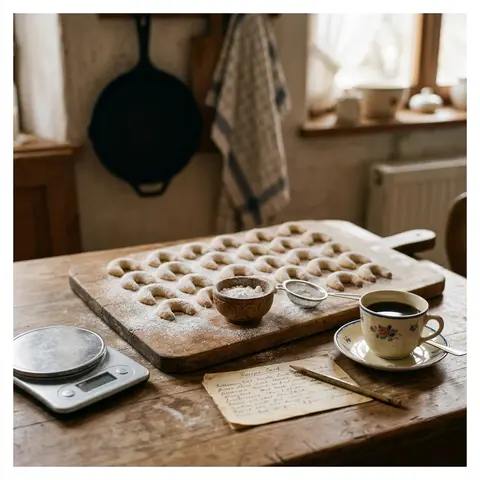
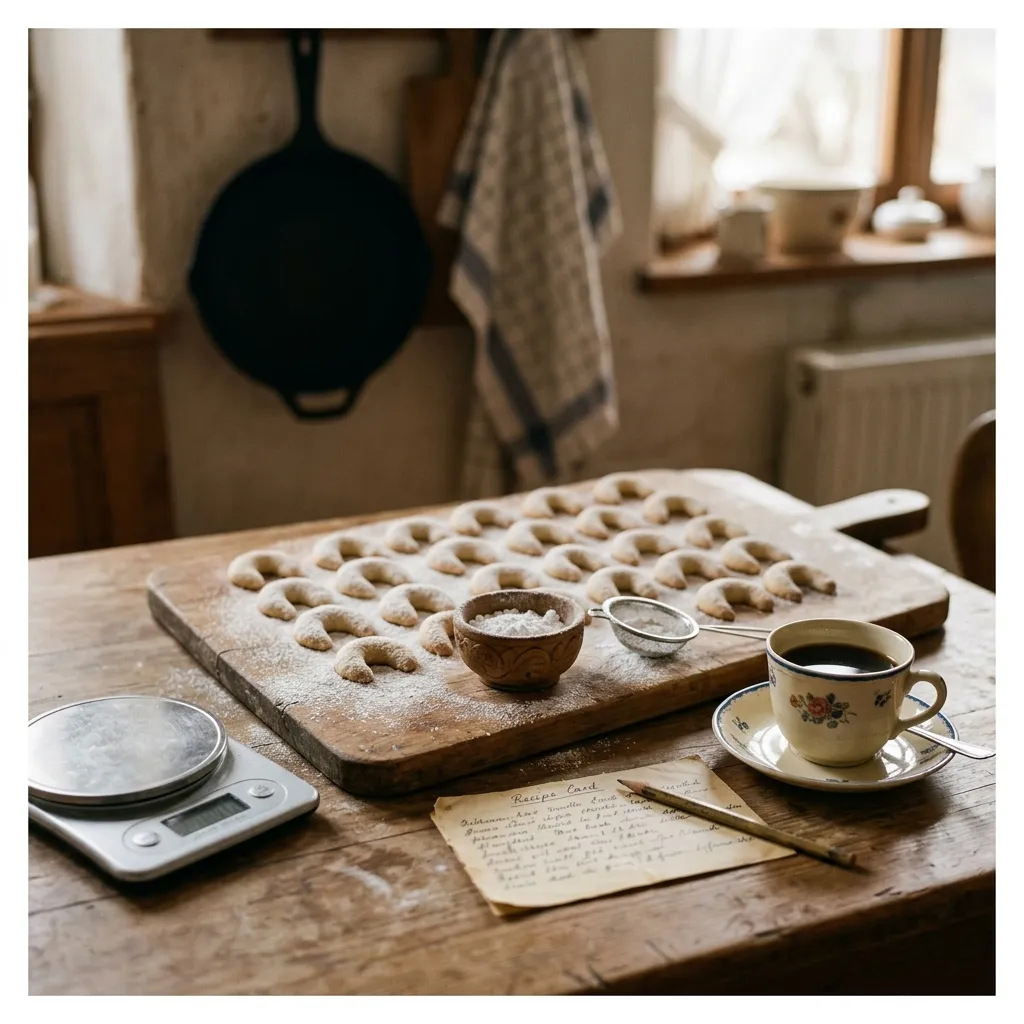
Most people sit down next to Grandma with a card and ask: How much flour do you use? Sounds reasonable, right? You're in your mid-thirties, it's Sunday, and your grandma is 84. She's the only one who knows how her roulades and vanilla crescents work. In six weeks it's Advent. Baking cookies at her place might be your last chance to watch her do it.
On the card you take home, it says "a handful" and "until it feels right." No one can cook that dish anymore with those words alone. So, how do you get a recipe onto paper that Grandma herself can't put into words?
Key Takeaways
- Grandma's answers show what she remembers. What she actually uses, only the scale reveals.
- Weigh packages and bowls before and after. The difference is Grandma's real amount.
- Film consistency, color, and timing. Most gaps hide in time instructions.
- Cook the recipe alone and let Grandma taste it. Plan for two to three test runs.
Why isn't it enough to just ask Grandma for the recipe?
Because cooking by feel is hands-on knowledge, and hands-on knowledge is hard to put into words. Philosopher Michael Polanyi described this tacit, implicit knowledge back in 1966 in one sentence: we know more than we can tell. When you ask Grandma about her vanilla crescents, she tells you how the recipe lives in her head. But her hands often work with different amounts. You have to write down what she says and what she does separately.
That's where the index card stops working.
Questions give you Grandma's memory, not her recipe.
The recipe lives in her hands. It only becomes reliable through watching, weighing, and filming.
Looking back, it all clicks into place: "a handful," "by feel," "until the dough is right." Add in years of experience, and why that dish never tastes like hers when you follow the card. You didn't mishear. The card was incomplete from the start.
At our house, Grandma said "two tablespoons of sugar." When we weighed it, it came to 60g, so more like four. She wasn't fibbing. Her hands had adjusted that recipe over decades, for every new flour brand, every new oven. Her head held onto the old number. And this wasn't unique: in twelve recipes our FamFood team weighed at our own grandparents' homes, nine of them had at least one stated amount off by more than a quarter from what we actually weighed.
That leaves the biggest obstacle, and it shows up in almost every old recipe: amounts no scale recognizes.
What do pinch, handful, and cup mean in grams?
A pinch of salt is roughly 0.5 to 1g, a level tablespoon of flour is around 10g, a cup of liquid is 150 to 200ml. A handful has no fixed value, it depends on hand size and ingredient. Conversion charts only work as a starting point. The reliable number is the one you measure once using Grandma's own hand, her spoon, and her cup on a kitchen scale, then write down.
Grandma's Measure | Common Reference | Why It Varies |
|---|---|---|
A pinch of salt | about 0.5 to 1g | Two or three fingers, fine or coarse salt |
One tablespoon of flour | around 10g (level) | Heaped goes in much higher |
A cup of liquid | 150 to 200ml | Coffee cup, tea cup, or mug |
A handful | no fixed value | Hand size, ingredient, loose or tight grip |
"A piece of butter" | no fixed value | Pure guesswork, often cut from a block |
Grandma's cup isn't your cup. Put it empty on the scale, tare it, and fill it with water. One gram of water equals roughly one milliliter. Write that number straight on the card: "Grandma's cup = 180ml."
Ingredients have changed too. Ask what flour type Grandma buys. Today eggs are sorted by EU marketing standards into weight classes, from S under 53g to XL from 73g. The BZfE explains egg labeling and weight classes. And if Grandma used margarine back then but butter now, the taste comes out different.
With the chart, you know what to look for. How to capture it in a single afternoon without spoiling the fun is the next question.
How do you document a cooking afternoon with Grandma?
With a kitchen scale, your phone, and one trick: weigh each package or bowl before and after. The difference is the amount Grandma took, and she doesn't have to change a thing. Then film the steps you can't weigh: how the dough looks, when she turns down the heat, what it sounds like when it's done. Note the time for each clip.
The beauty of this: you don't interrupt her. If you stop Grandma for every move, you get cautious, slow cooking. That's not how she cooks.
What you prepare beforehand
- A kitchen scale that measures to 1g precision
- A charged phone with free storage
- A notepad with two columns: time and observation
- All packages, cans, and bowls, weighed empty and full
Note the cookware too. Grandma's cast-iron pan or stainless steel braiser often makes the difference, especially for roulades: the pan drippings carry the sauce. Don't swap it for a nonstick pan when you cook it again. PTFE is part of PFAS, and the consumer center describes open questions about Teflon coatings, like toxic fumes above 360°C. Stick with stainless steel, cast iron, or carbon steel.
Which moments to film
- The dough before and after kneading, close up if you like
- The color of the roulades as they brown
- The moment she turns down the heat
- The sound when she says "now it's done"
What we see over and over at FamFood: most gaps in old recipes come from timing, not amounts. Amounts you can reweigh. "Until it's ready" you have to watch for.
By the end of the afternoon, you have numbers and videos. What you're still missing, you'll notice years later.
Which sentences absolutely belong in the recipe?
The sentences that aren't an ingredient: when Grandma made that dish, what she deliberately leaves out, which mistake she made early on, and where she shops for the ingredients. These notes turn a list of ingredients into a family recipe. They vanish first, because no one thinks they matter. Write them down word-for-word, in Grandma's voice, and put them right next to the amounts, not at the end.
Don't turn it into an interview. Ask three questions while she's stirring:
- When did you used to make this at home?
- What do you leave out on purpose, even though other recipes have it?
- What went wrong for you early on?
"Never put the lid on, or it gets mushy" holds more wisdom than any summary.
Also document old habits honestly, like a lot of salt. When you cook it, you'll adjust for today's standards. The German Nutrition Society recommends adults no more than 6g of salt a day. Note Grandma's amount and yours next to it.
Now everything's on paper. But you don't know yet if it's right.
How do you check if your written recipe is correct?
Cook it alone, using only your notes, and let Grandma taste it. Where she hesitates, that's where the gap is. From our experience, most recipes need two to three test runs like this before they work without a call-back. Then comes the strictest test: give the card to someone who was never there. If that person can cook the dish without video and without explanation in a way Grandma recognizes, your recipe is done.
Grandma stays out of the kitchen during the test run, but she sits at the table. If she says "something's missing," ask what. Acid? Roasted flavors? Time?
Don't fix the recipe silently. Write down every change: "Test run 2: crescents too brown, bake 3 minutes longer." That way you'll see later why a number is there.
For the outsider test, your sister or partner work well. What comes out shows you the last blind spots.
And when it's right, the question most families ask too late finally comes up: who actually has it?
Where does the recipe go once it's done?
In a shared place every family member can reach, with three parts together: the text with Grandma's own words, the weighed amounts in grams and milliliters, and the short video clips. Separated, they disappear, the card in a drawer, the videos lost in phone storage somewhere. Make at least one backup with another family member. Only then does the recipe stop depending on one person, not Grandma and not you.
One option: save recipes with grams and video in the family cookbook and invite the family to it.
That answers the question from the start. You don't get a recipe Grandma can't put into words by asking. You get it by watching, weighing, filming, and cooking. Her words belong anyway, as story, not as a measurement.
Which recipe is next at your house, and when does Grandma stand at the stove again? Call her today and lock in the date for cookie baking.
Frequently Asked Questions
How many grams is a pinch of salt?
A pinch of salt weighs roughly 0.5 to 1g. The amount depends on whether you use two or three fingers and how fine the salt is. Have Grandma sprinkle her pinch onto a precise scale once, and you'll know her personal amount instead of guessing from charts.
How do I write down a recipe when Grandma cooks by feel?
Watch her instead of asking. Weigh each package before and after, the difference is her amount. Film consistency, color, and timing, and note the time. Then cook it alone and let Grandma taste. Usually two to three runs are needed.
Can I film Grandma while she cooks, and how do I ask her best?
Ask her first and explain why: you want to save her recipe for the grandkids. Most grandmas love that. Film just hands, pots, and dough if she doesn't want to be on camera, and only share the videos in the family if that's what she wants.
What if ingredients from Grandma's recipe aren't available anymore?
Write down the original and the modern substitute next to it. Ask Grandma how the ingredient tasted and felt, and try both versions in test run two. Also watch for flour type and egg size: today eggs are sorted by EU standard into classes from S to XL.
How many recipes should I document first?
Start with the one your family treasures most. One clean, tested recipe with grams, video, and Grandma's own words is worth more than ten half-done ones. Plan for one cooking afternoon and two to three test runs after.
About FamFood: We're a small team that stood next to our own grandmas and grandpas at the stove with a scale and a phone. FamFood is the family cookbook where recipes, grams, and videos stay together, so the roulades taste the same in twenty years as they do today.