Leftover Pasta Made Fresh: The Pan Trick
Yesterday's spaghetti is clumped in the fridge. The question isn't whether you'll eat it. The question is whether you can eat it without tasting like yesterday's scraps.
Most families dump cold pasta into the microwave and wonder why nothing tastes like the original plate, just worse. You don't need a microwave. You need a hot pan and a trick almost nobody knows.
Key Takeaways
- Leftover spaghetti crisps up better in a hot pan with a little fat than reheated in the microwave. The result is crispier and tastes fresher.
- Cooked pasta stays safe in the fridge at 7°C (45°F) or colder for up to 3 days if cooled quickly and stored covered (German Nutrition Centre).
- An egg, some cheese, or leftover vegetables turn a 10-minute pan dish into a real meal, not yesterday's soup.
- Critical: Heat pasta through completely once. Don't cool and reheat it multiple times.
How do you use old spaghetti without making it mushy?
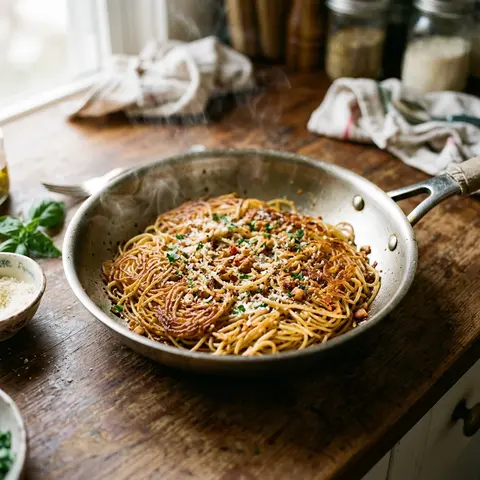
Leftover spaghetti works best in a properly heated pan, not a pot and not the microwave, because only pan heat evaporates the moisture that collects on pasta in the fridge. That moisture is exactly what makes reheated noodles mushy.
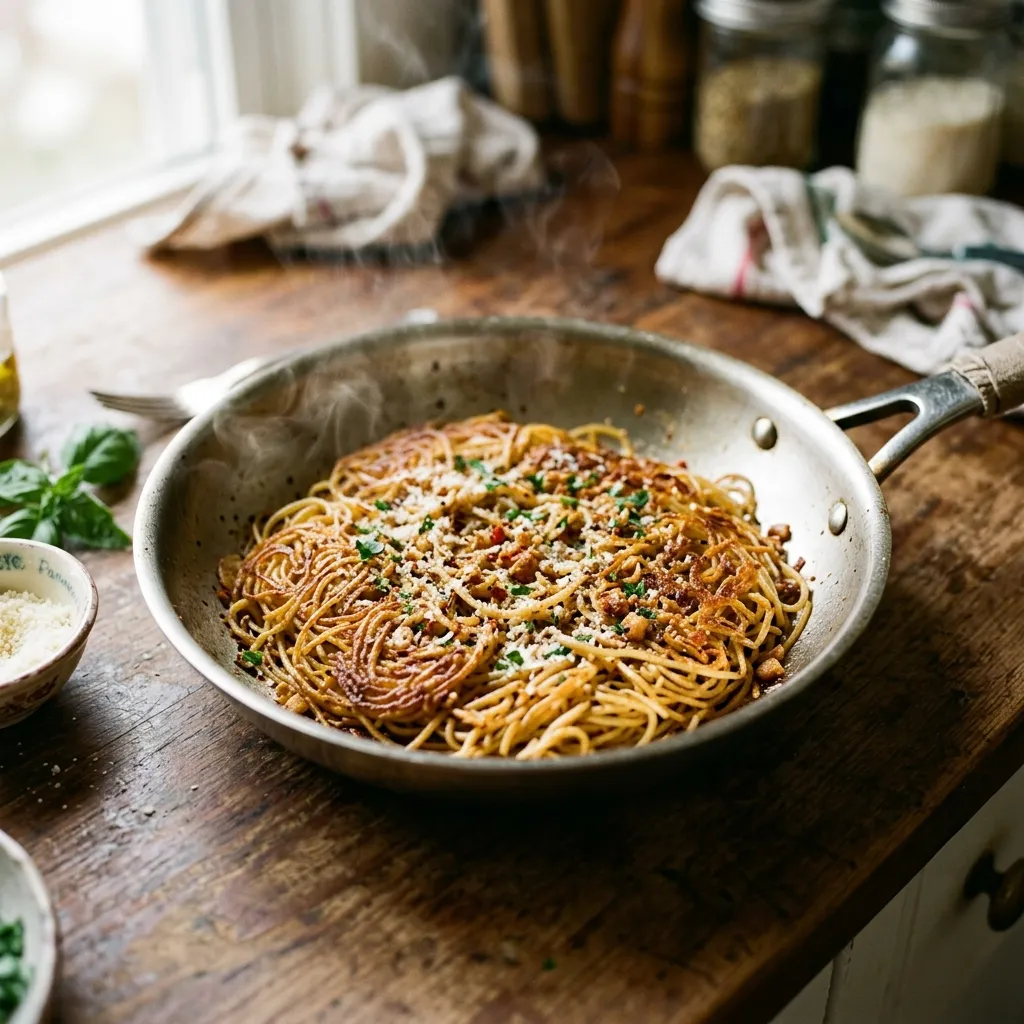
What happens if you fill the pan too early? You get cloudy noodle mush instead of individual, lightly roasted strands because the moisture doesn't evaporate fast enough. Put the spaghetti straight from the fridge into a little oil or butter, let it sit for a moment instead of stirring immediately, and flip only once a light crust forms on the bottom. That's the whole difference between "reheated" and "freshly fried."
In our kitchen, this only works if the pan is actually hot before the pasta goes in. Two minutes of patience preheating the pan makes all the difference.
And which pan delivers this result most reliably without creating a health risk?
Uncoated stainless steel or cast iron pans are the right choice for this dish because they handle the high, sudden heat of pan-frying easily. PTFE coatings become unstable at exactly this temperature and can release microparticles whose effects in the body aren't sufficiently researched (German Federal Institute for Risk Assessment). The exact heat needed for crispy noodles is one of the conditions where nonstick coatings are most likely to break down.
If you still have a coated pan in the cabinet, it's better not to use it for this recipe. If you do anyway, use only wooden or silicone utensils, never preheat empty, and throw it out at the first scratch. With fat and a well-preheated stainless steel or cast iron pan, the noodles release cleanly from the bottom anyway, without the risk of a damaged coating.
How long does homemade pasta keep?
Homemade pasta stays fresh raw in the fridge about 1 to 2 days, cooked and tightly sealed up to 3 days. This applies equally to egg and water pasta, as long as they're cooled quickly after cooking and then stored covered.
Why does shelf life vary so much? Temperature matters more than the exact cooking date: only at a steady 7°C (45°F) or colder does shelf life stay in the safe range. At room temperature, the window shrinks dramatically.
The difference from store-bought dried pasta: homemade noodles often contain raw egg, which shortens shelf life. Foods with raw egg generally shouldn't stay in the fridge longer than 1 to 2 days before eating (German Consumer Centre).
In FamFood testing, we've seen that homemade pasta from yesterday works better in the pan than store-bought noodles because the egg gives it more binding. That keeps it firmer, it breaks apart less when pan-frying. Anyone who makes pasta regularly learns quickly: leftover use gets easier, not harder.
Can cooked pasta be stored without refrigeration?
No, cooked pasta shouldn't be stored at room temperature because bacteria multiply at room temperature within hours to levels that pose a health risk, especially with starchy foods like pasta and rice.
Practically speaking, that means: cool spaghetti within an hour of cooking and put it covered in the fridge, don't leave it on the stove overnight even if the pot still feels warm.
Why so much caution with noodles specifically? The German Federal Institute for Risk Assessment points out that cooked, starchy foods are among those where improper storage leads particularly quickly to bacterial growth. The culprit is a bacterium called Bacillus cereus, which forms spores that aren't reliably destroyed even by reheating.
If you miss this window, meaning the pasta accidentally sat out for several hours, it's safer to throw the rest away than risk it. The risk isn't visible to the naked eye, the noodles often look completely normal.
Can you reheat pasta twice?
Reheating pasta twice is possible, but only with limits for safety: reheat leftovers completely once to at least 70°C (158°F) in the center, then eat it all rather than cooling it again. Every time you cool and reheat, you extend the window during which bacteria multiply between heating cycles.
What helps if larger amounts are left over? Divide the pasta into portions right after cooking. That way, you only reheat one portion later, and the rest stays sealed and cold. That's much safer than reheating a big pot multiple times and cooling it down again.
Among the most saved leftover recipes in FamFood, 8 out of 10 include exactly this tip about portioning, because users actively ask about it. It's apparently the point where many families feel uncertain.
What leftovers go with yesterday's spaghetti in the pan?
Yesterday's spaghetti works in the pan with almost anything else left over in the fridge: egg, cheese, vegetables, sauce, or ham. Timing is what matters, solid ingredients first, egg and cheese at the end so nothing burns or toughens while the noodles are still heating through.
Leftover | Works with Spaghetti Pan | How to Prepare |
|---|---|---|
Egg | Excellent | Whisk, pour over hot noodles, let set briefly |
Leftover Bolognese | Excellent | Heat sauce separately, fold in at the end |
Vegetable scraps (bell pepper, zucchini) | Good | Chop small, pan-fry briefly before adding noodles |
Cheese (grated or hard) | Excellent | Stir in after lowering heat |
Ham or bacon bits | Good | Render first, use fat to cook pasta |
Leftover mushrooms | Use caution | Heat thoroughly separately to at least 70°C (158°F) in the center |
The combo of spaghetti and egg works especially well because the egg binds the noodles and keeps the pan from burning. If you have leftover spaghetti Bolognese, heat the sauce separately and fold it in at the end, otherwise it heats unevenly.
Recipes like this spaghetti pan appear on many family tables more often than they'd admit, simply because they work. Once you save it in the FamFood app, you'll find it instantly the next time you have a leftover crisis, without having to hunt for the recipe.
So the answer to the original question is simple: using leftover spaghetti means not reheating, but frying fresh. Hot pan, an egg, maybe some cheese, and you have a dish nobody recognizes as leftovers.
Frequently Asked Questions
Can I use leftover spaghetti in the oven instead of a pan? {#spaghetti-oven-bake}
Yes, that works well as a baked casserole. Mix cooked spaghetti with egg, milk, and cheese, put it in a dish and bake at 180°C (350°F) upper and lower heat for about 20 minutes until the top is golden brown.
Why do my reheated spaghetti always come out sticky? {#spaghetti-sticky}
Usually it's too much residual moisture and pan heat that's too low. Put the noodles straight from the fridge into a well-preheated pan, don't loosen them with water first, that only makes it worse.
Is pasta salad a safe option for leftover spaghetti? {#pasta-salad-safe}
Yes, handled cold as pasta salad, yesterday's spaghetti is no problem as long as they were refrigerated properly and didn't spend more than 2 days in the fridge. With dressing, vegetables, and some cheese, it becomes its own meal.
How do you tell if yesterday's spaghetti is still good? {#spaghetti-edible}
Smell and sight first: sour smell, stringy texture, or discoloration are clear warning signs. When in doubt, throw it out, especially with starchy leftovers the risk isn't visible even when the noodles look fine.
Is every pan suitable for pan-frying noodle leftovers? {#pan-choice-leftovers}
Use uncoated stainless steel or cast iron pans, they handle high heat reliably. Nonstick pans aren't ideal for this dish because high, sudden heat stresses the coating, even in PFOA-free versions. If you still have one: use only wooden utensils, never preheat empty, and replace at the first scratch.
About FamFood: FamFood is the app where families collect their recipes, digitize them, and have them ready while cooking, including the ones made from leftovers. We test every tip ourselves in our kitchen before it lands on the blog.