Simple Cooking
Recipes
Simple Cooking
Recipes
Leftover Rice: 6 Recipes in 20 Minutes
Leftover Rice: 6 Recipes in 20 Minutes
FamFood
|
Leftover Rice: 6 Recipes in 20 Minutes
The pot of rice from yesterday sits in the fridge. Nobody wants to eat it the way it is. Every family knows this feeling. And yet that rice can become a real meal in 20 minutes—one that doesn't taste like leftovers at all.
You just need to know how.
Key Takeaways
Cooked rice keeps for a maximum of 1-2 days in the fridge (BfR recommendation).
Cold rice from yesterday is the best base for fried rice; fresh rice turns mushy.
Freezing works for up to 3 months, straight from the freezer into the hot pan.
According to FamFood tests, children who help transform leftovers eat rice remnants willingly in about 8 out of 10 cases.
How long is cooked rice safe in the fridge?
Cooked rice keeps in the fridge in a tightly sealed container for a maximum of 1 to 2 days. The Federal Institute for Risk Assessment (BfR) explicitly warns against storing rice longer than this: as it cools, Bacillus cereus spores can germinate and produce heat-stable toxins. This means normal reheating kills the bacteria, but some of the toxins remain partially active.
Sounds worrying, but with a few simple rules it's completely manageable.
Here's what to watch:
Cool rice down within 2 hours of cooking and place it in the fridge. Don't let it cool on the stovetop.
Maximum storage time: 1-2 days, no longer. When in doubt: throw it out.
When reheating, the rice core must reach at least 70 °C. Brief warming isn't enough.
Warning signs of spoiled rice: slimy texture, sour or unusual smell.
If you keep these points in mind, you have nothing to fear. And if you regularly cook too much, the freezing tips below will help.
Why does reheated rice often taste so dry?
Reheated rice becomes dry because a chemical process called retrogradation kicks in as it cools: the starch granules in the rice recrystallize and bind the water they absorbed during cooking. If you then simply reheat the rice without adding anything, you get grainy, dry grains. This isn't a cooking error—it's physics.
The good news: you can reverse this effect, and sometimes it's even desirable.
Pan with moisture: A splash of water or vegetable broth before heating returns the lost moisture. Cover, heat for two minutes on medium.
Microwave: Reheat covered with a damp kitchen towel. The towel creates steam that softens the rice again.
Deliberately dry for fried rice: Cold, dry grains become crispy in hot oil and don't stick together. Fresh rice straight from the pot turns mushy. That's why Asian restaurants always make fried rice with yesterday's rice.
So the trick is: know your goal, choose your method. Want soft rice? Add moisture. Want crispy fried rice? Use cold rice as is.
Which 6 recipe ideas will save your leftover rice?
Six ways to turn cold rice into a real meal: fried rice, rice soup, rice balls, rice and egg pan, rice and vegetable bake, and sweet rice pudding 2.0. All variations take under 25 minutes and use ingredients most kitchens already have waiting in the fridge.
Recipe | Main Ingredients | Time | Good for Kids |
|---|---|---|---|
Fried Rice | Egg, soy sauce, frozen vegetables | 15 min | Yes |
Rice Balls (Onigiri-style) | Salt, sesame, fillings of choice | 20 min | Especially good |
Rice Soup | Vegetable broth, spices, herbs | 15 min | Yes |
Rice and Egg Pan | Egg, butter or oil, salt | 10 min | Yes |
Rice and Vegetable Bake | Egg, cheese, vegetable scraps | 25 min | Yes |
Sweet Rice Pudding 2.0 | Milk, cinnamon, sugar, applesauce | 15 min | Absolutely |
Savory Ideas: When Rice Becomes the Main Event
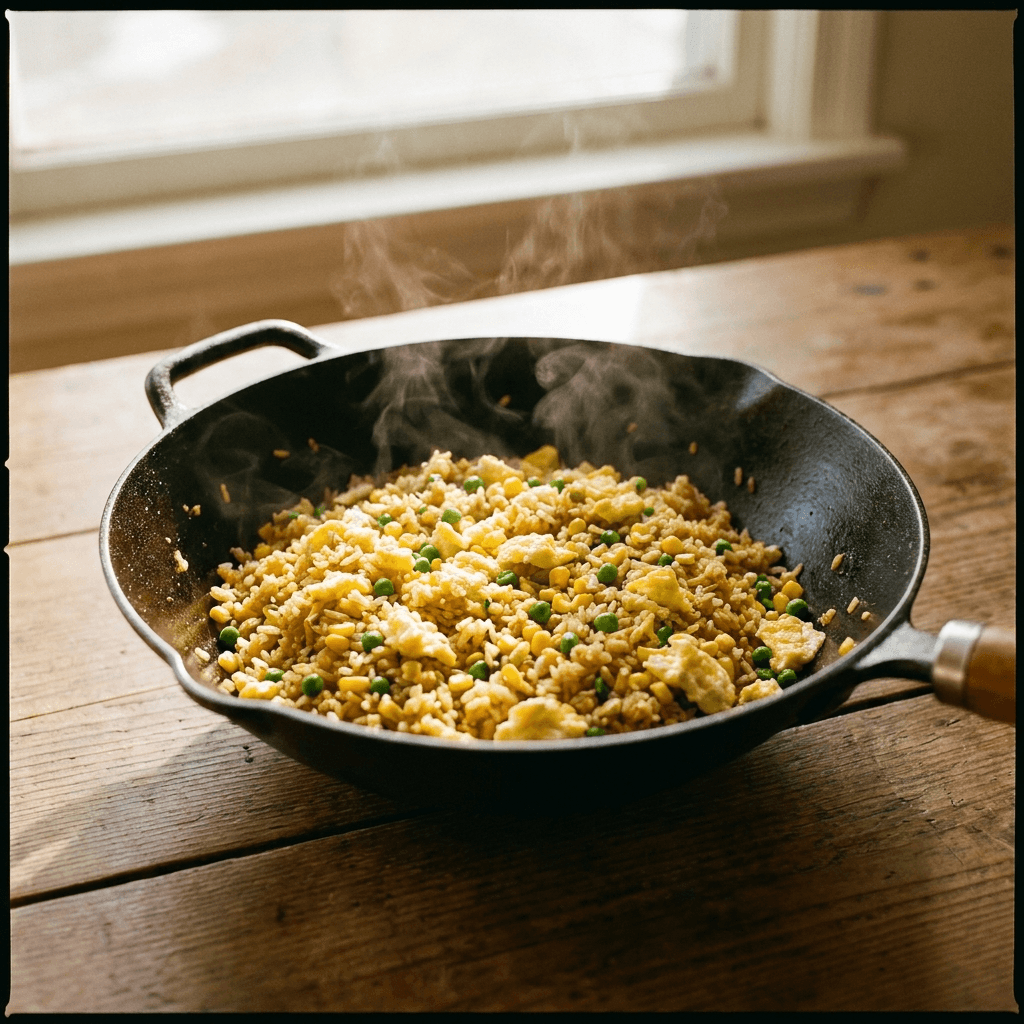
Fried rice is the most reliable base recipe. Heat oil in a pan until it smokes slightly. Add cold rice, don't stir, let it fry for 2 minutes. Then stir. Crack an egg, stir it in, let it set. Add soy sauce and frozen vegetables, done. The whole dish is on the table in 15 minutes.
Rice balls are what kids want: something they can touch and shape. Lightly salt cooked rice, form into balls or triangles with damp hands, optionally fill with some tuna, cheese, or cucumber. Wrapped in foil, they also work as a packed lunch alternative.
Rice soup rescues the smallest leftovers: bring leftover rice to a boil in vegetable broth, season with ginger, garlic, or curry paste, optionally bind with an egg. A filling soup emerges in 15 minutes.
Rice and vegetable bake works with whatever the fridge offers. Mix rice with diced vegetables, fold in two eggs and grated cheese, put in a greased baking dish, bake at 180 °C for about 20 minutes. The cheese holds everything together.
Sweet Ideas: Leftovers That Taste Like Dessert
Sweet rice pudding 2.0 sounds like effort, but it's simple: bring leftover regular rice to a boil with milk in a 1:2 ratio, stirring until the mixture becomes creamy. Add cinnamon and sugar to taste. Kids love it with warm applesauce. If you have long-grain rice left, you'll get a slightly firmer consistency than with short-grain. It doesn't hurt the flavor.
What ingredients pair well with leftover rice?
Leftover rice goes with almost everything waiting in the fridge for use: eggs, frozen vegetables, cheese, herbs, soy sauce, and leftovers of cooked vegetables or meat. The short list below shows what has worked best.
Category | Specific Ingredients | Use |
|---|---|---|
Protein sources | Egg, tofu, canned tuna, leftover chicken | Fried rice, bake, pan |
Frozen vegetables | Peas, corn, spinach, bell pepper mix | Straight from freezer into hot pan |
Seasonings | Soy sauce, fish sauce, curry paste, lemon juice | Depth of flavor, also salts the dish |
Cheese | Emmental, Gouda, feta | Bake binder, rice ball filling |
Fresh herbs | Scallions, parsley, cilantro | Top at the end for freshness |
A practical tip: frozen vegetables don't need to be thawed. Put them straight into the hot pan, the cold briefly cools the fat, but after 2 minutes everything is up to temperature. That saves time and a step.
Can you freeze leftover rice?
Yes, cooked rice freezes without any problems and keeps there for up to 3 months. Important: let rice cool completely first, then freeze in portions and take straight from the freezer into the hot pan or pot—no thawing needed.
Freezing is the most practical solution for families who regularly cook too much, but it's barely used in German kitchens. Yet the effort is minimal.
Here's how it works:
Spread rice flat in freezer bags (about 1-2 cm thick). It thaws quickly this way and you can easily break off just the portion you need.
Label bags: date and amount, so you know what's how old.
Put frozen rice straight into the hot pan or boiling broth, don't thaw first. Thawing at room temperature promotes new bacterial growth.
Quality loss is minimal as long as the rice wasn't already dry before freezing.
Those who prep and freeze rice balls have a ready meal for the kids in 10 minutes without having to cook fresh.
How do I explain to kids that rice leftovers can taste just as good?
Kids accept rice leftovers more readily when they get to help transform them. Shaping rice balls, cracking and stirring in the egg, sprinkling cheese on top: once a child has built the dish themselves, it's no longer a leftover to them—it's their own creation.
FamFood tests show: with dishes kids have a hand in making, about 8 out of 10 kids clear their plate, compared to around 6 out of 10 with leftovers simply reheated. This is especially true for rice balls and fried rice.
What specifically works:
Rice balls are the most proven entry point. Kids like the shape, shaping is fun, and the result looks like something special from an Asian restaurant.
When making fried rice, let kids crack and stir in the egg. This one step is often enough for them to feel the dish is "theirs."
Name small successes: "You made this from yesterday's rice" is stronger than any lecture about food waste.
Kids don't need a sustainability lecture. They need a sense of accomplishment. And rice gives them one of the easiest stages in the kitchen for that.
How much rice is wasted in German households?
According to research by the Federal Ministry of Food and Agriculture (BMEL), German households throw away about 78 kg of food per capita annually. Cooked side dishes like rice and pasta are among the most common items discarded, because portion sizes are often overestimated during cooking. The Federal Center for Nutrition (BZfE) therefore recommends measuring portions consistently rather than cooking by eye.
The simplest countermeasure: measure 60 to 70 g dry rice per person for a side dish. If you do this consistently, you'll have fewer leftovers and save noticeably over the year.
If you still regularly cook too much, you'll find recipes in the FamFood app that are designed from the start for using up leftovers, including a smart shopping list that automatically adjusts portions.
Common questions about rice leftovers
How do I reheat rice without it getting dry?
Heat the rice in a pan with a splash of water or broth on medium heat, cover it, and let the steam return the moisture. In the microwave, cover it with a damp kitchen towel. Important: the rice must reach at least 70 °C at the core, brief warming isn't enough. Both methods take only 2-3 minutes and deliver much better results than dry reheating without a lid.
Can you still eat rice from yesterday?
Yes, if it was refrigerated within 2 hours of cooking and hasn't been in the fridge longer than 1-2 days. The BfR recommends not storing rice longer because Bacillus cereus bacteria can produce toxins that aren't completely destroyed by heating. If the rice smells sour or has a slimy texture, definitely throw it out. When in doubt, dispose of it rather than take a risk.
What can I make from leftover rice if I'm short on time?
The quickest option is rice and egg pan: heat oil, add cold rice, fry for 2 minutes without stirring, then crack an egg and stir it in, season with soy sauce. Done in under 10 minutes. If you have frozen vegetables, add them straight in, no thawing needed. If you have even less time, just form salted rice balls with damp hands—they need no heat source at all.
Why should you cool rice quickly after cooking?
Because between 20 °C and 50 °C, Bacillus cereus bacteria multiply particularly fast. The longer rice spends in this temperature range, the higher the risk. Quick cooling within 2 hours and immediate refrigeration reliably interrupts this growth window. A practical method: spread rice thin on a baking sheet, which speeds up cooling significantly compared to a deep pot.
More ideas for what to make from what's left in the fridge, and how to plan smarter when shopping so leftovers don't pile up in the first place, you'll find in the FamFood app.
About FamFood: We're a small team that deals with the daily reality of cooking in families. FamFood grew from a desire to bring good recipes and practical kitchen knowledge together in one place, without the fuss and without perfectionism. Because real cooking looks like this.
Leftover Rice: 6 Recipes in 20 Minutes
The pot of rice from yesterday sits in the fridge. Nobody wants to eat it the way it is. Every family knows this feeling. And yet that rice can become a real meal in 20 minutes—one that doesn't taste like leftovers at all.
You just need to know how.
Key Takeaways
Cooked rice keeps for a maximum of 1-2 days in the fridge (BfR recommendation).
Cold rice from yesterday is the best base for fried rice; fresh rice turns mushy.
Freezing works for up to 3 months, straight from the freezer into the hot pan.
According to FamFood tests, children who help transform leftovers eat rice remnants willingly in about 8 out of 10 cases.
How long is cooked rice safe in the fridge?
Cooked rice keeps in the fridge in a tightly sealed container for a maximum of 1 to 2 days. The Federal Institute for Risk Assessment (BfR) explicitly warns against storing rice longer than this: as it cools, Bacillus cereus spores can germinate and produce heat-stable toxins. This means normal reheating kills the bacteria, but some of the toxins remain partially active.
Sounds worrying, but with a few simple rules it's completely manageable.
Here's what to watch:
Cool rice down within 2 hours of cooking and place it in the fridge. Don't let it cool on the stovetop.
Maximum storage time: 1-2 days, no longer. When in doubt: throw it out.
When reheating, the rice core must reach at least 70 °C. Brief warming isn't enough.
Warning signs of spoiled rice: slimy texture, sour or unusual smell.
If you keep these points in mind, you have nothing to fear. And if you regularly cook too much, the freezing tips below will help.
Why does reheated rice often taste so dry?
Reheated rice becomes dry because a chemical process called retrogradation kicks in as it cools: the starch granules in the rice recrystallize and bind the water they absorbed during cooking. If you then simply reheat the rice without adding anything, you get grainy, dry grains. This isn't a cooking error—it's physics.
The good news: you can reverse this effect, and sometimes it's even desirable.
Pan with moisture: A splash of water or vegetable broth before heating returns the lost moisture. Cover, heat for two minutes on medium.
Microwave: Reheat covered with a damp kitchen towel. The towel creates steam that softens the rice again.
Deliberately dry for fried rice: Cold, dry grains become crispy in hot oil and don't stick together. Fresh rice straight from the pot turns mushy. That's why Asian restaurants always make fried rice with yesterday's rice.
So the trick is: know your goal, choose your method. Want soft rice? Add moisture. Want crispy fried rice? Use cold rice as is.
Which 6 recipe ideas will save your leftover rice?
Six ways to turn cold rice into a real meal: fried rice, rice soup, rice balls, rice and egg pan, rice and vegetable bake, and sweet rice pudding 2.0. All variations take under 25 minutes and use ingredients most kitchens already have waiting in the fridge.
Recipe | Main Ingredients | Time | Good for Kids |
|---|---|---|---|
Fried Rice | Egg, soy sauce, frozen vegetables | 15 min | Yes |
Rice Balls (Onigiri-style) | Salt, sesame, fillings of choice | 20 min | Especially good |
Rice Soup | Vegetable broth, spices, herbs | 15 min | Yes |
Rice and Egg Pan | Egg, butter or oil, salt | 10 min | Yes |
Rice and Vegetable Bake | Egg, cheese, vegetable scraps | 25 min | Yes |
Sweet Rice Pudding 2.0 | Milk, cinnamon, sugar, applesauce | 15 min | Absolutely |
Savory Ideas: When Rice Becomes the Main Event
Fried rice is the most reliable base recipe. Heat oil in a pan until it smokes slightly. Add cold rice, don't stir, let it fry for 2 minutes. Then stir. Crack an egg, stir it in, let it set. Add soy sauce and frozen vegetables, done. The whole dish is on the table in 15 minutes.
Rice balls are what kids want: something they can touch and shape. Lightly salt cooked rice, form into balls or triangles with damp hands, optionally fill with some tuna, cheese, or cucumber. Wrapped in foil, they also work as a packed lunch alternative.
Rice soup rescues the smallest leftovers: bring leftover rice to a boil in vegetable broth, season with ginger, garlic, or curry paste, optionally bind with an egg. A filling soup emerges in 15 minutes.
Rice and vegetable bake works with whatever the fridge offers. Mix rice with diced vegetables, fold in two eggs and grated cheese, put in a greased baking dish, bake at 180 °C for about 20 minutes. The cheese holds everything together.
Sweet Ideas: Leftovers That Taste Like Dessert
Sweet rice pudding 2.0 sounds like effort, but it's simple: bring leftover regular rice to a boil with milk in a 1:2 ratio, stirring until the mixture becomes creamy. Add cinnamon and sugar to taste. Kids love it with warm applesauce. If you have long-grain rice left, you'll get a slightly firmer consistency than with short-grain. It doesn't hurt the flavor.
What ingredients pair well with leftover rice?
Leftover rice goes with almost everything waiting in the fridge for use: eggs, frozen vegetables, cheese, herbs, soy sauce, and leftovers of cooked vegetables or meat. The short list below shows what has worked best.
Category | Specific Ingredients | Use |
|---|---|---|
Protein sources | Egg, tofu, canned tuna, leftover chicken | Fried rice, bake, pan |
Frozen vegetables | Peas, corn, spinach, bell pepper mix | Straight from freezer into hot pan |
Seasonings | Soy sauce, fish sauce, curry paste, lemon juice | Depth of flavor, also salts the dish |
Cheese | Emmental, Gouda, feta | Bake binder, rice ball filling |
Fresh herbs | Scallions, parsley, cilantro | Top at the end for freshness |
A practical tip: frozen vegetables don't need to be thawed. Put them straight into the hot pan, the cold briefly cools the fat, but after 2 minutes everything is up to temperature. That saves time and a step.
Can you freeze leftover rice?
Yes, cooked rice freezes without any problems and keeps there for up to 3 months. Important: let rice cool completely first, then freeze in portions and take straight from the freezer into the hot pan or pot—no thawing needed.
Freezing is the most practical solution for families who regularly cook too much, but it's barely used in German kitchens. Yet the effort is minimal.
Here's how it works:
Spread rice flat in freezer bags (about 1-2 cm thick). It thaws quickly this way and you can easily break off just the portion you need.
Label bags: date and amount, so you know what's how old.
Put frozen rice straight into the hot pan or boiling broth, don't thaw first. Thawing at room temperature promotes new bacterial growth.
Quality loss is minimal as long as the rice wasn't already dry before freezing.
Those who prep and freeze rice balls have a ready meal for the kids in 10 minutes without having to cook fresh.
How do I explain to kids that rice leftovers can taste just as good?
Kids accept rice leftovers more readily when they get to help transform them. Shaping rice balls, cracking and stirring in the egg, sprinkling cheese on top: once a child has built the dish themselves, it's no longer a leftover to them—it's their own creation.
FamFood tests show: with dishes kids have a hand in making, about 8 out of 10 kids clear their plate, compared to around 6 out of 10 with leftovers simply reheated. This is especially true for rice balls and fried rice.
What specifically works:
Rice balls are the most proven entry point. Kids like the shape, shaping is fun, and the result looks like something special from an Asian restaurant.
When making fried rice, let kids crack and stir in the egg. This one step is often enough for them to feel the dish is "theirs."
Name small successes: "You made this from yesterday's rice" is stronger than any lecture about food waste.
Kids don't need a sustainability lecture. They need a sense of accomplishment. And rice gives them one of the easiest stages in the kitchen for that.
How much rice is wasted in German households?
According to research by the Federal Ministry of Food and Agriculture (BMEL), German households throw away about 78 kg of food per capita annually. Cooked side dishes like rice and pasta are among the most common items discarded, because portion sizes are often overestimated during cooking. The Federal Center for Nutrition (BZfE) therefore recommends measuring portions consistently rather than cooking by eye.
The simplest countermeasure: measure 60 to 70 g dry rice per person for a side dish. If you do this consistently, you'll have fewer leftovers and save noticeably over the year.
If you still regularly cook too much, you'll find recipes in the FamFood app that are designed from the start for using up leftovers, including a smart shopping list that automatically adjusts portions.
Common questions about rice leftovers
How do I reheat rice without it getting dry?
Heat the rice in a pan with a splash of water or broth on medium heat, cover it, and let the steam return the moisture. In the microwave, cover it with a damp kitchen towel. Important: the rice must reach at least 70 °C at the core, brief warming isn't enough. Both methods take only 2-3 minutes and deliver much better results than dry reheating without a lid.
Can you still eat rice from yesterday?
Yes, if it was refrigerated within 2 hours of cooking and hasn't been in the fridge longer than 1-2 days. The BfR recommends not storing rice longer because Bacillus cereus bacteria can produce toxins that aren't completely destroyed by heating. If the rice smells sour or has a slimy texture, definitely throw it out. When in doubt, dispose of it rather than take a risk.
What can I make from leftover rice if I'm short on time?
The quickest option is rice and egg pan: heat oil, add cold rice, fry for 2 minutes without stirring, then crack an egg and stir it in, season with soy sauce. Done in under 10 minutes. If you have frozen vegetables, add them straight in, no thawing needed. If you have even less time, just form salted rice balls with damp hands—they need no heat source at all.
Why should you cool rice quickly after cooking?
Because between 20 °C and 50 °C, Bacillus cereus bacteria multiply particularly fast. The longer rice spends in this temperature range, the higher the risk. Quick cooling within 2 hours and immediate refrigeration reliably interrupts this growth window. A practical method: spread rice thin on a baking sheet, which speeds up cooling significantly compared to a deep pot.
More ideas for what to make from what's left in the fridge, and how to plan smarter when shopping so leftovers don't pile up in the first place, you'll find in the FamFood app.
About FamFood: We're a small team that deals with the daily reality of cooking in families. FamFood grew from a desire to bring good recipes and practical kitchen knowledge together in one place, without the fuss and without perfectionism. Because real cooking looks like this.