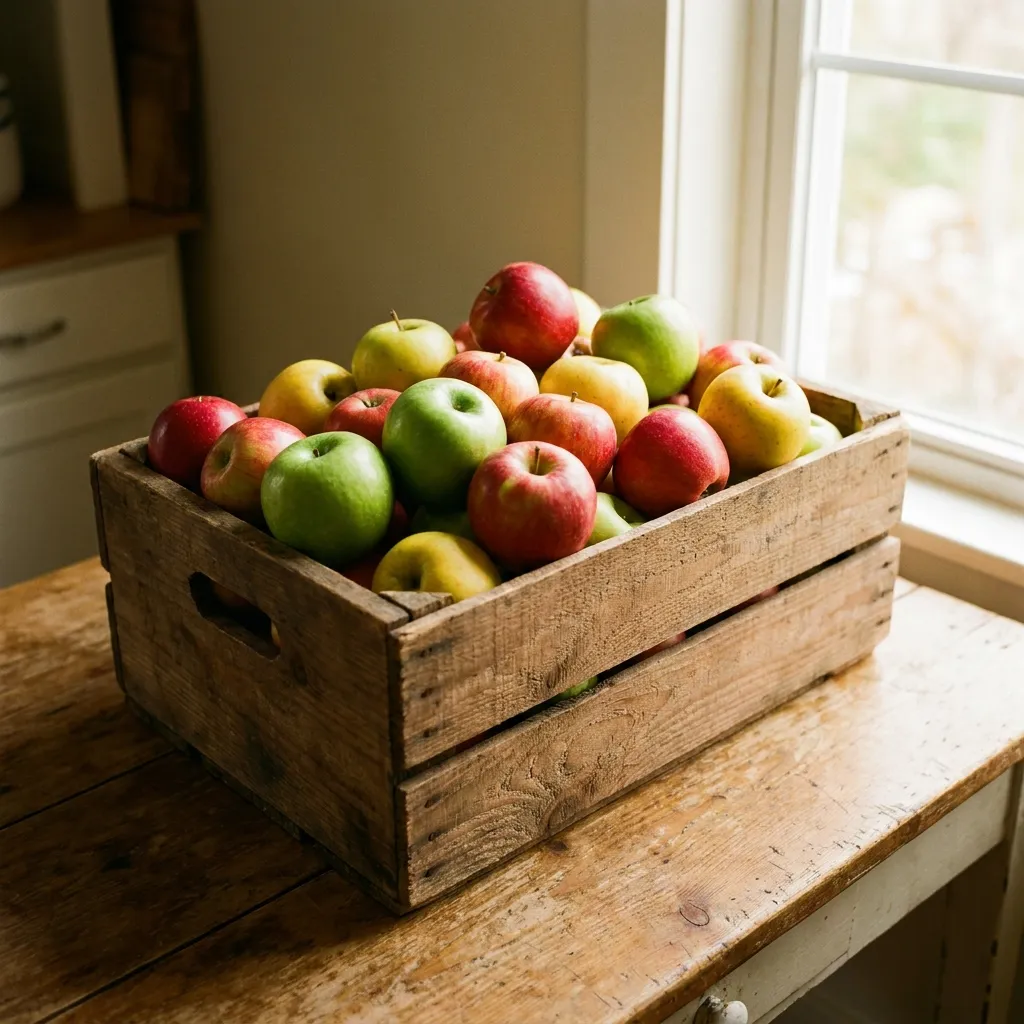
The fruit bowl is overflowing. The kids ask for the third time today: "Can we have apple cake again?" And you're standing in the kitchen wondering whether the next six weeks really have to be nothing but apple cake.
Many families know this moment in autumn, when abundance suddenly feels like a problem. The good news: you don't need a professional kitchen or hours of time. You need a plan.
Quick takeaway
- More than 3 ways to process a big apple harvest: cook fresh, preserve, or use in savory dishes.
- Dried apple rings keep up to 12 months, preserved apple sauce 1 to 2 years (BZfE, 2023).
- Firm varieties like Elstar work in baked dishes, soft-fleshed ones like Boskop make perfect sauce.
- Wrinkled or bruised apples aren't waste—they often have the most intense flavor.
- A 3-week rhythm keeps apples from being forgotten and tossed out.
What Do I Do With Too Many Apples at Once?
If you have more apples than your family can eat in autumn, you have three paths: process them fresh (cook, bake, press), preserve them (can, dry, freeze), or stretch your supply by adding apples to savory dishes. Which path works depends on how much time you have, not on how many apples there are.
Short on time? Grab the damaged apples first and make a big pot of apple sauce in 30 minutes. Have a free weekend? Canning or drying is worth the effort—both last for months. Firm, unblemished apples can wait several more weeks in proper storage (cool, dark, airy, not stacked).
The most important sorting rule: wrinkled or bruised apples always go into the pot first. Firm, undamaged ones go into storage. Follow this consistently and you'll lose almost no apples.
Which Apple Varieties Work Best for What?
Soft-fleshed varieties like Boskop or Berlepsch break down when heated and are ideal for sauce and fillings. Firm varieties like Elstar or Jonagold hold their shape when baked and work better in casseroles and savory pan dishes. Acidity also matters: tangy varieties like Boskop need less sugar, sweeter ones like Jonagold benefit from a squeeze of lemon to balance the flavor.
Not every variety works for every dish—that's the simple rule. Once you understand that, you stop searching for "the best apple" and start asking instead: what do I want to cook today?
Soft-fleshed: Boskop, Berlepsch, Gravensteiner
These three almost fall apart on their own when cooked. Boskop is the classic for apple sauce and cake fillings because it's both tangy and aromatic. Berlepsch has a nutty flavor and makes creamy soups. Gravensteiner ripens early and should be processed first.
Firm-fleshed: Elstar, Jonagold, Cox Orange
Elstar and Jonagold keep their texture when baked and are great for casseroles, pan dishes, and apple rings. Cox Orange has a complex spiced flavor and is a pleasure both raw and cooked—it holds its shape better in the oven than its delicate appearance suggests.
Variety | Texture | Best Use | Acidity |
|---|---|---|---|
Boskop | Soft-fleshed | Sauce, fillings, cake | High |
Berlepsch | Soft-fleshed | Soups, sauce, juice | Medium |
Gravensteiner | Soft-fleshed | Sauce, fresh eating, harvest early | Medium-high |
Elstar | Firm-fleshed | Baking, casseroles, raw | Medium |
Jonagold | Firm-fleshed | Chutney, savory dishes, compote | Low-medium |
Cox Orange | Firm-fleshed | Raw, apple rings, pan dishes | Medium |
Canning, Freezing, or Drying: What Keeps the Longest?
Dried apple rings keep up to 12 months with proper storage, canned apple sauce 1 to 2 years, frozen apple pieces 8 to 10 months. The biggest freezing mistake: freezing apples without lemon juice, which leads to browning and flavor loss. According to BZfE (German Center for Nutrition), apples rank among the fruits best suited for food storage when processed early and by variety.
How to freeze apples correctly (step by step):
- Peel, remove the core, cut into even cubes or wedges.
- Immediately toss with 1 tablespoon lemon juice per 500 g apple pieces.
- Spread in a single layer on a baking sheet and freeze briefly (about 2 hours).
- Transfer to portion bags or containers and label (variety + date).
Pre-freezing prevents pieces from clumping into one solid mass. Later you can take out exactly the amount you need.
Canning: Apple sauce and apple compote differ in texture and use. Sauce is fully puréed and goes with oatmeal, pancakes, or as a base for cakes. Compote keeps its chunks and works better as a side or dessert. Both are ladled hot into sterilized jars and sealed immediately.
Drying: In the oven at 60–70°C (convection, door slightly ajar), apple rings 5 mm thin take 6 to 8 hours. A food dehydrator works more evenly and is more efficient for large quantities.
Method | Shelf Life | Effort | Equipment |
|---|---|---|---|
Freezing | 8 to 10 months | Low | Freezer bags, freezer |
Canning (sauce) | 1 to 2 years | Medium | Mason jars, large pot |
Drying (rings) | Up to 12 months | Medium-high | Oven or food dehydrator |
Cool storage (whole) | 4 to 8 weeks | Very low | Cool, dark room |
Why Do Apples Disappear Faster When You Cook Savory Recipes?
In FamFood's experience, families who discover savory apple recipes use their harvest noticeably faster because apples suddenly appear in almost every meal, not just breakfast or dessert.
The principle is simple: apple acid and natural sweetness balance rich or strong flavors. That's why this combination has worked in German cooking for centuries—apple-red cabbage with roast is just the most famous example.
4 savory ideas that even kids enjoy:
- Apple-red cabbage: The classic that nearly makes itself. Add apple chunks (soft-fleshed) straight to the pot, no canning needed.
- Apple-onion chutney: Cook Jonagold or Elstar in vinegar and sugar with onions and mustard seed. Keeps in a jar 3 to 4 months and goes with cheese, cold cuts, or grilled chicken.
- Apple soup with ginger: Berlepsch or Boskop puréed with broth, fresh ginger, and a splash of cream. Ready in 25 minutes—surprisingly popular with kids ages 4 and up.
- Chicken with apple-mustard sauce: Quickly pan-fry firm apples, deglaze the pan with chicken broth and a spoonful of Dijon mustard. The apple's acidity makes the sauce balanced.
The key: these recipes use apples in quantity without it feeling like "apples again."
How Do I Make Apple Sauce in 20 Minutes for Large Quantities?
For 1 kg finished apple sauce, you need about 1.3 kg fresh apples, 2 tablespoons water, and depending on variety a little sugar. Cook time: 15 to 20 minutes. If you want to can it right away, pour the hot sauce into sterilized jars, seal immediately, and let cool—that's enough for most quantities without fancy canning equipment.
The ratio of 1.3 kg fresh to 1 kg finished applies to soft-fleshed varieties. For firm varieties, the ratio is closer to 1.4:1 because they release less water.
Variations that make a difference:
- Plain (apples and water only), ideal for babies and as a baking ingredient.
- With cinnamon and a pinch of nutmeg—the winter classic.
- With fresh ginger (about 1 cm grated per 500 g apples)—fresh and slightly sharp.
- With vanilla—milder and sweeter, pairs well with pancakes.
At our house, leftover apple sauce almost always ends up in oatmeal the next morning or as a filling for pancakes. If you don't want to forget your favorite variation, jot it down right away before the next batch arrives.
What Do I Do With Bruised or Wrinkled Apples?
Wrinkled or bruised apples aren't waste—they often have more flavor intensity than freshly picked ones. Important: cut out the damaged area generously (at least 1 cm border), then they work beautifully for sauce, chutney, or apple chips, where looks don't matter.
When does an apple really need to go?
- Bruise (brown but firm): Cut it out, use the rest.
- Wrinkled but no mold: Perfect for sauce and chutney.
- Mold covering an area (even small spots): Discard the whole apple. Mold forms mycotoxins that penetrate deep into the flesh—just cutting it out isn't enough.
- Rot (soft, dark, bad smell): Toss it.
Food waste is a real issue here: according to BZfE, German households throw away about 78 kg of food per person annually, with fruit among the most commonly discarded categories. A bruised apple that ends up in sauce instead of the trash is a real contribution.
How Do I Plan the Apple Harvest So Nothing Gets Lost?
If you split the harvest into three waves—fresh eating, immediate processing, preservation—you'll get through peak season without stress. The biggest time trap: trying to do everything at once. A simple weekly plan prevents apples from being forgotten and rotting silently in the cellar.
A 3-week rhythm for a medium harvest (about 20–30 kg):
- Week 1: Process bruised and early-ripening apples right away (sauce, chutney, apple soup). Store firm specimens in a cool place.
- Week 2: Big canning session: apple sauce in jars, apple compote, possibly dried apple rings.
- Week 3: Use what's left. Whatever remains: freeze it or turn it into savory dishes.
Fitting this rhythm into your weekly plan helps tremendously. For more seasonal cooking ideas, check out FamFood's seasonal guide at FamFood: which ingredients go together when, what to buy now, what to store away.
Meal planning and seasonal cooking go hand in hand. Check in every Monday about what the week's apples need, and you'll lose almost nothing.
Frequently Asked Questions
How long do fresh apples keep if I store them correctly?
Fresh, unblemished apples keep 4 to 8 weeks with proper storage (cool, dark, 4–8°C, airy, not in sealed plastic bags), depending on variety. Early varieties like Gravensteiner keep only 2 to 3 weeks; late storage varieties like Boskop stay fresh up to 2 months. Never store apples near vegetables—they release ethylene and speed up ripening of other produce.
Can I freeze apples with the skin on, or do I have to peel them?
Apples can be frozen with skin on, but the texture becomes rubbery after thawing. For sauce, compote, or baking, peeling before freezing is worth it—the result after thawing is much better. For apple chips or eating right after thawing, the skin isn't a problem.
What spices go best with apples when canning?
Cinnamon is the classic—half a stick is enough for 1 kg apples. Vanilla makes the sauce milder and creamier. Ginger (fresh or dried) brings freshness and slight heat, pairs well with chutney. Star anise goes with savory apple dishes and red cabbage. Cardamom is less common but adds floral depth to sauce that pairs nicely with oatmeal.
How do I process apples quickly if I have little time?
The fastest method for large quantities: peel apples, roughly chop, add 2 tablespoons water to a large pot, simmer 15 minutes, purée, done. Pour the hot sauce straight into jars, seal, let cool. If you have even less time: peel apples, cut into wedges, mix with lemon juice, freeze. Both take under 30 minutes and handle big quantities effortlessly.
About FamFood: FamFood is the kitchen app for families who know the chaos of cooking and want simpler solutions. Save recipes, build weekly plans, cook seasonally—all in one place so there's more time for the table.




