Simple Cooking
Tips & Tricks
Inspiration
Simple Cooking
Tips & Tricks
Inspiration
Knives for Kids: When Is Each Blade Safe?
Knives for Kids: When Is Each Blade Safe?
FamFood
|
Knives for Kids: When Is Each Blade Safe?
Your heart stops when a child reaches for a knife. That instinct is human. It makes sense. And it costs kids years of kitchen skill they could have gained.
Fear isn't a lesson plan. Keeping a child away until they're "old enough" teaches them nothing but doubt. What kids need: a clear age-step plan, the right blade, and a grip technique that actually works. That's exactly what you'll find here.
Key Takeaways
Starting around ages 3–4, kids can try cutting under direct supervision if the grip fits their hand.
Dull knives aren't safer. They need more force, slip more often, and cause more accidents as a result.
The bear-claw grip is the single most effective technique before the first vegetable hits the board.
Regular weekly tasks lock in cutting skill much faster than random, one-off jobs. (BZfE, Motor Development in Childhood)
At what age can kids really start using a knife?
Around ages 3–4, kids can try their first cutting tasks under direct supervision with a dull child's knife, as long as the grip fits their hand. By ages 6–7, a sharp, child-sized knife is actually safer than a dull one because it won't slip as much.
That sounds backward, but it isn't. A dull knife requires more force, slides off smooth surfaces, and then hits fingers instead of food. A sharp knife glides through a carrot before the child even builds up pressure. The German Federal Centre for Nutrition (BZfE) encourages introducing kids to kitchen tasks early, but stresses that motor maturity matters far more than the number on the birthday cake.
Three developmental signs are more reliable than age alone: Can the child open a jar with a lid (hand strength)? Do they stay focused on a craft project for five minutes (attention span)? Can they follow a two-step instruction without asking why (rule comprehension)? If all three are true, the child is ready, whether they're four or six.
Age Groups at a Glance
Age | Knife Type | Tasks | Supervision |
|---|---|---|---|
3–5 Years | Nylon or serrated child knife | Soft fruits halved, strawberries, banana | Always nearby |
6–9 Years | Small stainless vegetable knife (4.7–5.5 in, finger guard) | Cucumber, mozzarella, cooked potato | In the room, eye contact |
10+ Years | Child-sized chef's knife (sharp, proportional) | Most vegetables, herbs, julienne cut | On call |
Which knife is right for which age?
For 3- to 5-year-olds: nylon or serrated child knife with a rounded tip. For 6- to 9-year-olds: small vegetable knife with a finger guard (roughly 4.7–5.5 inches). For 10+: a regular chef's knife in kid size, sharp but proportional to hand size.
The most common buying mistake is a cheap knife with a pointed blade and a narrow handle. A narrow handle is the problem because a child's hand can't get enough surface to grip while cutting. The handle must rest in the whole hand, not pinched between thumb and index finger. Non-slip grip materials (rubber, textured plastic) aren't a luxury here.
Parents should also avoid the "one knife does everything" trap. That thinking leads kids to work with a knife that's too big or too small, and they build bad habits fast.
Knife Type | Age | Blade | Handle | Advantage |
|---|---|---|---|---|
Nylon child knife (e.g., Opinel Le Petit Chef) | 3–5 Years | Serrated, plastic | Wide, colored | No stabbing risk, still functional |
Small stainless vegetable knife with finger guard | 6–9 Years | 4.7–5.5 in, smooth edge | Non-slip, kid-sized | Clean cuts without strain |
Child-sized chef's knife | 10+ Years | 5.9–6.3 in, sharp | Proportional to hand | Bridge to adult tools |
The Bear-Claw Grip: How One Hand Position Changes Everything
The so-called bear-claw grip—fingers curled in, knuckles forward—is the single technique with the biggest safety payoff. Teach it to kids before the first carrot hits the board, and you stop the most common accident: the blade slipping forward.
Here's how it works: the hand holding the food makes a claw, all fingertips point down toward the palm, the second row of knuckles faces forward and guides the blade. The knife rests against the knuckles. It can't slip forward because the knuckles form a stop.
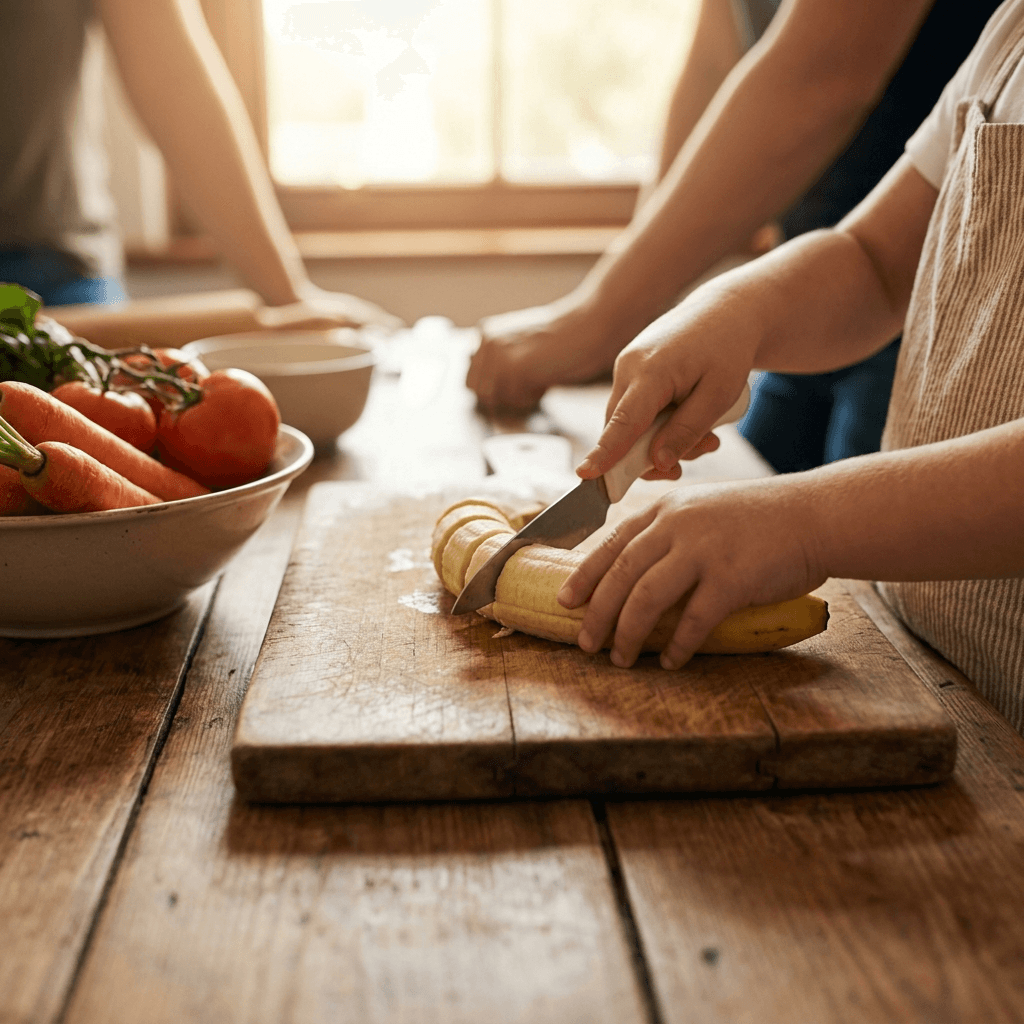
Practice this with kids first without a knife. Make the hand into a claw, tap it up and down on the board, get the rhythm into the body. Only then add the knife—on something soft like a banana or strawberry. Soft food needs no force, mistakes happen slowly.
Common mistake: kids stretch their index finger without meaning to, because it feels more familiar. You can fix this without making them jump: just curl your own hand into a claw and say, "Look, my hand looks like this." No scolding, just a mirror.
What we see all the time at FamFood: once kids truly lock in the bear-claw grip, they use it on new foods without being asked. The technique lives in the body, not just the head.
What foods are best for starting out—and what counts as advanced?
Soft, flat foods are the best entry point: bananas, strawberries, cooked potatoes, mozzarella. Round, hard vegetables like carrots or beets are dangerous for kids under 7 without adult help—they roll away and need too much force.
The deciding factor is stability. Food that rolls away forces the child to hold it. Holding and keeping up the bear-claw grip at the same time overwhelms beginners. The fix: stabilize the food first. Split a carrot lengthwise and lay it flat side down. Halve zucchini lengthwise. Give a whole cucumber a small cut in the middle so it won't roll.
Starting Foods
Food | Why It Works | Starting Age |
|---|---|---|
Banana | Soft, won't slip, gives with pressure | 3–4 Years |
Strawberry | Small, stable, needs no force | 3–4 Years |
Mozzarella | Soft, won't roll | 4–5 Years |
Cooked Potato | Stable, won't slide | 5–6 Years |
Cucumber (halved lengthwise) | Flat surface, medium firmness | 6–7 Years |
When Your Child Wants to Go Further
Once cucumber and potato click, the next steps follow: raw zucchini, then bell pepper, then prepared carrot. Well-coordinated kids around 11–12 can learn the julienne cut—thin, even strips. If you build step by step, you'll never need more than a quick walkthrough for each new vegetable type. Helpful kitchen tricks and stabilizing tips are in our guide to hacks that save your day.
How do you set up a safe cutting station?
A safe cutting station needs four things: a non-slip board, work height at the child's eye level (a step stool if needed), a clear work surface with no distractions, and the firm rule that the knife always gets put down when the hand lets go.
The step stool isn't a comfort thing—it's a safety thing. Kids looking up at a board can't control the blade movement. Kids looking down at the board see the knuckles, see the blade, see the food: three pieces of information at once. That's the difference between control and guessing.
The board should be heavy and not slide around. One simple trick: put a damp cloth underneath. Rubber feet work too, but not reliably on all surfaces.
One more often-overlooked point: no distractions while learning. No pot boiling next to them, no radio, no sibling demanding attention. Concentration during cutting isn't optional—it's the foundation.
What if something does happen? First aid, short and clear
Small cuts bleed a lot but look worse than they are. Immediate action: hold the wound under running water, then press firmly, don't wipe. A bandage and rest are usually all any kitchen cut needs.
The German Federal Institute for Risk Assessment (BfR) tracks household accidents in children systematically. Cuts from kitchen utensils are among the most common and usually heal without a problem. Often, your reaction afterward matters more than the bandage itself.
Three immediate steps:
Water: Hold the wound under clear, running water for at least 1–2 minutes.
Pressure: Press a clean cloth or bandage firmly, don't rub.
Bandage and pause: Cover the wound, take a short break, stay calm.
See a doctor if the wound gapes open and won't close on its own, if bleeding doesn't stop after 10 minutes of pressure, or if it's a deep puncture wound.
Your reaction decides whether your child will want to cut again next time or develop fear. Stay calm, take the injury seriously without making a drama out of it. "That happens sometimes, let's take care of it" says more than any explanation.
How do you turn cutting into a real routine—without explaining it every single time?
Repeating the same task is the fastest learning path. If a child cuts the salad cucumber every Tuesday, the technique sticks in four weeks. Parents who assign different jobs each time see much longer learning curves than parents who give kids one fixed responsibility.
The idea is called an "assigned task": each child has one fixed, age-right cutting job per week. The cucumber, the berries for breakfast, the herbs for pasta. That job belongs to the child, not the parent.
Making progress visible motivates more than praise ever will. What does your child cut today? What should they try next month? A simple list on the fridge does it. Kids love checking things off.
The BZfE confirms what many parents already know intuitively: kids eat more and enjoy what they've made themselves. So cutting isn't just safety training—it's teaching taste.
If you want to save recipes with child-friendly cutting steps and pull them up when you cook next time, check out FamFood: you can store step-by-step instructions for every age group so you don't start from scratch each time. We also have quick kid-friendly recipes perfect for family cooking.
Common Questions About Safe Cutting With Kids
At what age can a child use a knife alone without me standing right there?
Kids shouldn't cut completely unsupervised until around 10–11 years old, and only then if they've mastered the bear-claw grip and already have several months of regular cutting practice. Until then: stay in the room, even if you're not hovering.
Are nylon child knives really safe or just marketing?
Nylon child knives make sense for 3- to 5-year-olds because they have no pointed tip and won't cause deep wounds if misused. By age 6, though, they're too dull and raise the slipping risk. They're a good start, not a permanent tool.
How do I explain to my child why the knife always gets put down?
Use concrete language, not abstractions: "The knife sleeps on the board while your hand sleeps." Kids understand metaphors faster than rules. Practice the putting-down rule separately, without cutting—just laying it down and picking it up. A few repeats and the motion becomes automatic.
My child is scared of the knife. What can I do?
Fears often come from too much warning talk beforehand. Start with a nylon knife on a banana, no explanations, just do it. Parents who hold a knife safely and calmly pass that calm to the child. Small wins build confidence way faster than any talk.
What cutting board is best for kids?
Heavy, non-slip, light colored (so the child can see the blade). Wood or plastic boards with rubber feet are ideal. Glass boards don't work: the blade slides. Minimum size: 12 x 8 inches, so the child can't accidentally push it off the edge.
About FamFood: We're a small team of parents, home cooks, and food lovers who know exactly how messy the kitchen gets with kids. FamFood helps you save recipes, store cutting steps, and turn everyday cooking into something your whole family actually wants to eat.
Knives for Kids: When Is Each Blade Safe?
Your heart stops when a child reaches for a knife. That instinct is human. It makes sense. And it costs kids years of kitchen skill they could have gained.
Fear isn't a lesson plan. Keeping a child away until they're "old enough" teaches them nothing but doubt. What kids need: a clear age-step plan, the right blade, and a grip technique that actually works. That's exactly what you'll find here.
Key Takeaways
Starting around ages 3–4, kids can try cutting under direct supervision if the grip fits their hand.
Dull knives aren't safer. They need more force, slip more often, and cause more accidents as a result.
The bear-claw grip is the single most effective technique before the first vegetable hits the board.
Regular weekly tasks lock in cutting skill much faster than random, one-off jobs. (BZfE, Motor Development in Childhood)
At what age can kids really start using a knife?
Around ages 3–4, kids can try their first cutting tasks under direct supervision with a dull child's knife, as long as the grip fits their hand. By ages 6–7, a sharp, child-sized knife is actually safer than a dull one because it won't slip as much.
That sounds backward, but it isn't. A dull knife requires more force, slides off smooth surfaces, and then hits fingers instead of food. A sharp knife glides through a carrot before the child even builds up pressure. The German Federal Centre for Nutrition (BZfE) encourages introducing kids to kitchen tasks early, but stresses that motor maturity matters far more than the number on the birthday cake.
Three developmental signs are more reliable than age alone: Can the child open a jar with a lid (hand strength)? Do they stay focused on a craft project for five minutes (attention span)? Can they follow a two-step instruction without asking why (rule comprehension)? If all three are true, the child is ready, whether they're four or six.
Age Groups at a Glance
Age | Knife Type | Tasks | Supervision |
|---|---|---|---|
3–5 Years | Nylon or serrated child knife | Soft fruits halved, strawberries, banana | Always nearby |
6–9 Years | Small stainless vegetable knife (4.7–5.5 in, finger guard) | Cucumber, mozzarella, cooked potato | In the room, eye contact |
10+ Years | Child-sized chef's knife (sharp, proportional) | Most vegetables, herbs, julienne cut | On call |
Which knife is right for which age?
For 3- to 5-year-olds: nylon or serrated child knife with a rounded tip. For 6- to 9-year-olds: small vegetable knife with a finger guard (roughly 4.7–5.5 inches). For 10+: a regular chef's knife in kid size, sharp but proportional to hand size.
The most common buying mistake is a cheap knife with a pointed blade and a narrow handle. A narrow handle is the problem because a child's hand can't get enough surface to grip while cutting. The handle must rest in the whole hand, not pinched between thumb and index finger. Non-slip grip materials (rubber, textured plastic) aren't a luxury here.
Parents should also avoid the "one knife does everything" trap. That thinking leads kids to work with a knife that's too big or too small, and they build bad habits fast.
Knife Type | Age | Blade | Handle | Advantage |
|---|---|---|---|---|
Nylon child knife (e.g., Opinel Le Petit Chef) | 3–5 Years | Serrated, plastic | Wide, colored | No stabbing risk, still functional |
Small stainless vegetable knife with finger guard | 6–9 Years | 4.7–5.5 in, smooth edge | Non-slip, kid-sized | Clean cuts without strain |
Child-sized chef's knife | 10+ Years | 5.9–6.3 in, sharp | Proportional to hand | Bridge to adult tools |
The Bear-Claw Grip: How One Hand Position Changes Everything
The so-called bear-claw grip—fingers curled in, knuckles forward—is the single technique with the biggest safety payoff. Teach it to kids before the first carrot hits the board, and you stop the most common accident: the blade slipping forward.
Here's how it works: the hand holding the food makes a claw, all fingertips point down toward the palm, the second row of knuckles faces forward and guides the blade. The knife rests against the knuckles. It can't slip forward because the knuckles form a stop.
Practice this with kids first without a knife. Make the hand into a claw, tap it up and down on the board, get the rhythm into the body. Only then add the knife—on something soft like a banana or strawberry. Soft food needs no force, mistakes happen slowly.
Common mistake: kids stretch their index finger without meaning to, because it feels more familiar. You can fix this without making them jump: just curl your own hand into a claw and say, "Look, my hand looks like this." No scolding, just a mirror.
What we see all the time at FamFood: once kids truly lock in the bear-claw grip, they use it on new foods without being asked. The technique lives in the body, not just the head.
What foods are best for starting out—and what counts as advanced?
Soft, flat foods are the best entry point: bananas, strawberries, cooked potatoes, mozzarella. Round, hard vegetables like carrots or beets are dangerous for kids under 7 without adult help—they roll away and need too much force.
The deciding factor is stability. Food that rolls away forces the child to hold it. Holding and keeping up the bear-claw grip at the same time overwhelms beginners. The fix: stabilize the food first. Split a carrot lengthwise and lay it flat side down. Halve zucchini lengthwise. Give a whole cucumber a small cut in the middle so it won't roll.
Starting Foods
Food | Why It Works | Starting Age |
|---|---|---|
Banana | Soft, won't slip, gives with pressure | 3–4 Years |
Strawberry | Small, stable, needs no force | 3–4 Years |
Mozzarella | Soft, won't roll | 4–5 Years |
Cooked Potato | Stable, won't slide | 5–6 Years |
Cucumber (halved lengthwise) | Flat surface, medium firmness | 6–7 Years |
When Your Child Wants to Go Further
Once cucumber and potato click, the next steps follow: raw zucchini, then bell pepper, then prepared carrot. Well-coordinated kids around 11–12 can learn the julienne cut—thin, even strips. If you build step by step, you'll never need more than a quick walkthrough for each new vegetable type. Helpful kitchen tricks and stabilizing tips are in our guide to hacks that save your day.
How do you set up a safe cutting station?
A safe cutting station needs four things: a non-slip board, work height at the child's eye level (a step stool if needed), a clear work surface with no distractions, and the firm rule that the knife always gets put down when the hand lets go.
The step stool isn't a comfort thing—it's a safety thing. Kids looking up at a board can't control the blade movement. Kids looking down at the board see the knuckles, see the blade, see the food: three pieces of information at once. That's the difference between control and guessing.
The board should be heavy and not slide around. One simple trick: put a damp cloth underneath. Rubber feet work too, but not reliably on all surfaces.
One more often-overlooked point: no distractions while learning. No pot boiling next to them, no radio, no sibling demanding attention. Concentration during cutting isn't optional—it's the foundation.
What if something does happen? First aid, short and clear
Small cuts bleed a lot but look worse than they are. Immediate action: hold the wound under running water, then press firmly, don't wipe. A bandage and rest are usually all any kitchen cut needs.
The German Federal Institute for Risk Assessment (BfR) tracks household accidents in children systematically. Cuts from kitchen utensils are among the most common and usually heal without a problem. Often, your reaction afterward matters more than the bandage itself.
Three immediate steps:
Water: Hold the wound under clear, running water for at least 1–2 minutes.
Pressure: Press a clean cloth or bandage firmly, don't rub.
Bandage and pause: Cover the wound, take a short break, stay calm.
See a doctor if the wound gapes open and won't close on its own, if bleeding doesn't stop after 10 minutes of pressure, or if it's a deep puncture wound.
Your reaction decides whether your child will want to cut again next time or develop fear. Stay calm, take the injury seriously without making a drama out of it. "That happens sometimes, let's take care of it" says more than any explanation.
How do you turn cutting into a real routine—without explaining it every single time?
Repeating the same task is the fastest learning path. If a child cuts the salad cucumber every Tuesday, the technique sticks in four weeks. Parents who assign different jobs each time see much longer learning curves than parents who give kids one fixed responsibility.
The idea is called an "assigned task": each child has one fixed, age-right cutting job per week. The cucumber, the berries for breakfast, the herbs for pasta. That job belongs to the child, not the parent.
Making progress visible motivates more than praise ever will. What does your child cut today? What should they try next month? A simple list on the fridge does it. Kids love checking things off.
The BZfE confirms what many parents already know intuitively: kids eat more and enjoy what they've made themselves. So cutting isn't just safety training—it's teaching taste.
If you want to save recipes with child-friendly cutting steps and pull them up when you cook next time, check out FamFood: you can store step-by-step instructions for every age group so you don't start from scratch each time. We also have quick kid-friendly recipes perfect for family cooking.
Common Questions About Safe Cutting With Kids
At what age can a child use a knife alone without me standing right there?
Kids shouldn't cut completely unsupervised until around 10–11 years old, and only then if they've mastered the bear-claw grip and already have several months of regular cutting practice. Until then: stay in the room, even if you're not hovering.
Are nylon child knives really safe or just marketing?
Nylon child knives make sense for 3- to 5-year-olds because they have no pointed tip and won't cause deep wounds if misused. By age 6, though, they're too dull and raise the slipping risk. They're a good start, not a permanent tool.
How do I explain to my child why the knife always gets put down?
Use concrete language, not abstractions: "The knife sleeps on the board while your hand sleeps." Kids understand metaphors faster than rules. Practice the putting-down rule separately, without cutting—just laying it down and picking it up. A few repeats and the motion becomes automatic.
My child is scared of the knife. What can I do?
Fears often come from too much warning talk beforehand. Start with a nylon knife on a banana, no explanations, just do it. Parents who hold a knife safely and calmly pass that calm to the child. Small wins build confidence way faster than any talk.
What cutting board is best for kids?
Heavy, non-slip, light colored (so the child can see the blade). Wood or plastic boards with rubber feet are ideal. Glass boards don't work: the blade slides. Minimum size: 12 x 8 inches, so the child can't accidentally push it off the edge.
About FamFood: We're a small team of parents, home cooks, and food lovers who know exactly how messy the kitchen gets with kids. FamFood helps you save recipes, store cutting steps, and turn everyday cooking into something your whole family actually wants to eat.