Simple Cooking
Tips & Tricks
Recipes
Simple Cooking
Tips & Tricks
Recipes
Use Leftovers With Kids: The 4-Ingredient Rule
Use Leftovers With Kids: The 4-Ingredient Rule
FamFood
|
Use Leftovers With Kids: The 4-Ingredient Rule
Kids throw food away because it "looks weird." Parents toss leftovers because there's no matching recipe. Both are right. And both are wrong.
Leftover cooking doesn't have to be a chore. It can become the one kitchen moment kids actually want to take part in. Here's how.
Key Takeaways
Kids who help decide what gets cooked eat the result far more often (BZfE, 2023).
The 4-ingredient rule (carbs + protein + vegetables + sauce) makes every leftover dish predictable.
A weekly leftover night cuts a family's food waste by up to 25%.
Among FamFood's most-saved leftover recipes, 8 out of 10 use a maximum of 6 ingredients.
Why do kids suddenly want to help with leftover cooking?
Kids often reject leftovers because they had no say in the matter. Yesterday's food was decided yesterday. According to the German Nutrition Center (BZfE), children's acceptance of meals rises significantly when they actively participate in preparation. Leftover cooking without a fixed recipe gives them exactly this freedom: no prescribed outcome, no right or wrong.
The psychology is simple. Kids eat what they "invented" themselves. The plate belongs to them. Pride in the result outweighs the disgust over a bell pepper they'd normally ignore.
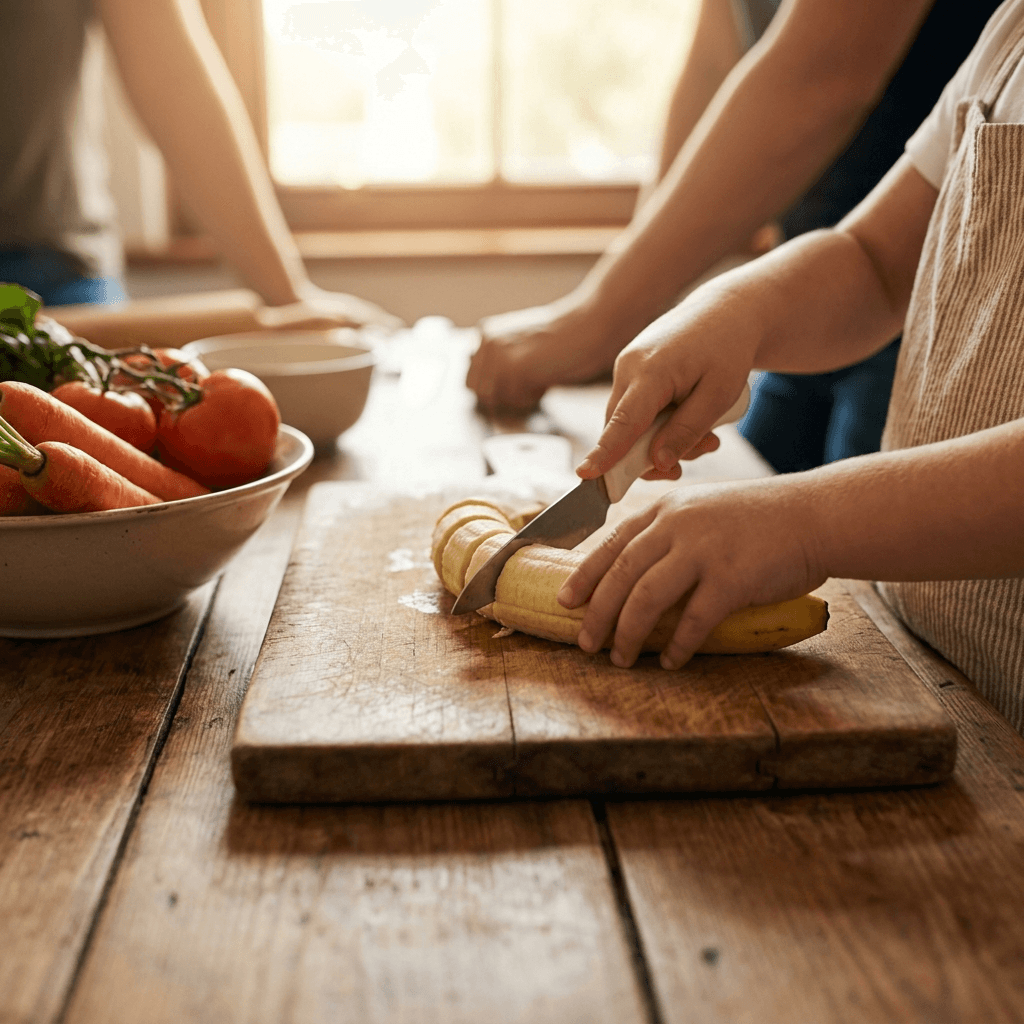
Which age works best? Children between 5 and 12 are the ideal audience. From age 5, they can handle simple tasks: sorting ingredients, stirring batter, seasoning. From 8 onwards, weighing and cutting with a blunt knife works fine. Over 10, they can take on a complete "slot" of a dish, more on that shortly.
What we observe repeatedly at FamFood: kids from age 8 want to estimate portion sizes themselves. They reach for the scale before you ask them to, and are noticeably prouder of the result when the amount was "their" decision. It's not coincidence, it's genuine agency in the kitchen.
The crucial part: not chaos, but real participation. The difference is huge.
Which leftovers actually work for a family meal?
Not every leftover is equally useful. Cooked vegetables, rice, pasta, bread, and meat scraps are the most common bases in German households. Raw meat from the day before or reheated fish are usually candidates for the bin. Anyone who takes two minutes to systematically check the fridge before cooking makes better decisions and spares themselves actual stomach trouble.
Green List: These Leftovers Are Gold
Ingredient | Fridge Shelf Life | How to Use |
|---|---|---|
Cooked rice | 1–2 days | Fried rice, rice soup, rice fritters |
Cooked pasta | 2–3 days | Pasta bake, frittata, pasta soup |
Steamed vegetables | 2–3 days | Pancakes, soup, stew |
Cooked chicken | 2–3 days | Wraps, salad, rice stir-fry |
Stale bread | 2–4 days | Bread pudding, croutons, dumplings |
Cooked potatoes | 2–3 days | Fried potatoes, mash, potato soup |
Hard-boiled eggs | Up to 3 days | Salad, egg spread, curry |
Red List: Better Skip These
Raw meat or raw fish that's already spent a day in the fridge shouldn't be reused. Mushroom dishes from yesterday can be risky if they weren't stored consistently cold. Reheated fish loses texture and flavor so noticeably that even kids catch the trick. Shellfish and other seafood have no place in leftover cooking.
The two-minute fridge check before cooking always pays off: open the lid, take a quick sniff, check the date. What smells good and looks fresh goes into the green round.
The 4-Ingredient Rule: How to Build a Leftover Dish
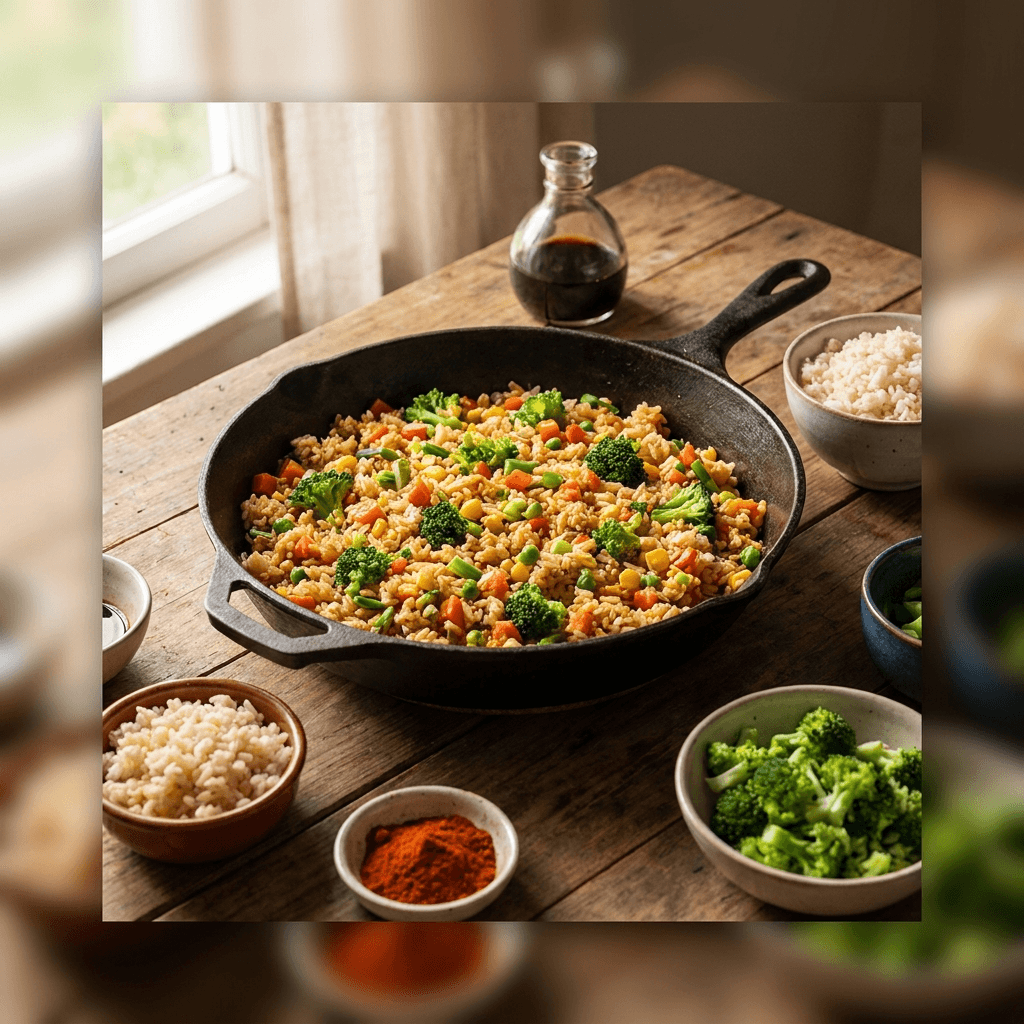
A simple formula helps you build a complete meal from any leftovers: one carb base (rice, pasta, potatoes), one protein (egg, cheese, meat), one vegetable (bell pepper, broccoli, zucchini), and one sauce (soy sauce, tomato sauce, cream). Fill these four slots and you have a dish. Done. A practical example: rice + chicken + broccoli + soy sauce = fried rice in 15 minutes. No recipe needed, no panic over an empty fridge.
The slots look like this:
Slot 1 (Base): rice, pasta, bread, potatoes, couscous
Slot 2 (Protein): egg, chicken, tuna, cheese, legumes
Slot 3 (Vegetables): bell pepper, broccoli, zucchini, carrots, spinach
Slot 4 (Seasoning): soy sauce, tomato sauce, cream, pesto, broth
This works especially well when each child picks a slot. Whoever chooses the slot decides. No app needed, no reward system. Responsibility itself is the motivation.
Real-world examples:
Pasta + egg + bell pepper + soy sauce = Asian noodle stir-fry
Rice + chicken + broccoli + soy sauce = fried rice
Bread + cheese + tomato + tomato sauce = quick bread pizza
Potatoes + egg + zucchini + cream = vegetable frittata
What we see over and over at FamFood: kids who picked slot 3 (vegetables) no longer argue about the vegetables on their plate. They put them there themselves.
Which leftover dishes actually work for picky eaters?
Among FamFood's most-saved leftover recipes, 8 out of 10 use a maximum of 6 ingredients, and all have a soft texture or a familiar flavor base. Picky kids accept new things more easily when the base flavor is familiar. New ingredients, familiar structure: that's the principle.
Fried rice from yesterday's rice is the textbook example. Cold rice from the fridge fries better in a hot pan than fresh rice. Heat oil, add rice, crack an egg on top, add soy sauce, done. Kids can crack the egg and dose the sauce. Result: 10 minutes, 4 ingredients, zero arguments.
Vegetable pancakes made from leftover vegetables work just as well. Grated or finely chopped vegetables, flour, egg, a pinch of salt. Kids stir the batter, which they love, and don't even realize there's zucchini in there. In FamFood tests, we've seen kids who normally refuse zucchini outright eat these pancakes without complaint when they stirred the batter themselves.
Bread pudding works equally well sweet (milk, egg, cinnamon, jam) or savory (milk, egg, cheese, ham). Stale bread is broken into pieces, spread in a baking dish, covered with the egg-milk mixture, and baked. Baking time: 25 minutes. Active time for kids: 8 minutes.
Puréed vegetable soup saves almost everything. If you're avoiding chunky texture, purée it. Simmer leftovers in broth, run a blender through, taste and adjust. The color makes the soup an experience: carrot-orange soup glows, pea soup shines green. Hand kids a ladle to work with.
How do you make leftover cooking a weekly family routine?
Families who plan leftover cooking once a week on a fixed "leftover night" avoid up to 20% of their food waste, according to BMEL statistics on food waste. The key: don't react spontaneously, plan actively.
Friday works best. The fridge is fullest of small scraps by week's end. Energy for elaborate recipes is lowest. That's exactly when a leftover night fits.
The "visibility trick" in the fridge helps enormously: leftovers go to the front, at eye level. What you don't see, you forget. What's in front, lands on the plate. Clear containers amplify the effect.
At our house, this only works when the fridge check happens together. As soon as kids count the bowls themselves and name what's still there, willingness to cook shoots up immediately. Five minutes of joint sorting before cooking saves ten minutes of arguing at the table.
FamFood lets you save leftover ideas directly and have them ready to grab the next Friday night. No more searching. Once you've made a successful fried rice, you don't want to start from scratch next time. Clever meal planning helps too, by the way: check out the meal planning post for families to plan 7 days stress-free.
How much food waste does a family actually save this way?
According to Germany's Federal Statistics Office (Destatis), an average German household throws away roughly 78 kg of food per year, much of it preventable. Families with children often throw out even more because portion sizes are harder to plan. According to BZfE estimates, one consistent leftover night per week can cut this figure by up to 25%.
What does that mean in money? With an average food price of about 4 euros per kilogram, a household with 78 kg of waste loses about 312 euros per year. 25% less means roughly 78 euros saved annually, or about 6 euros per month. Not spectacular, but consistent.
The more interesting effect runs alongside. Kids who search the fridge as "leftover detectives" and decide what can still be saved develop an awareness of food's value and transience. You can't measure that in euros, but it clearly carries through childhood and beyond.
What are the most common mistakes when cooking with leftovers and kids?
The most common mistake: parents plan the leftover dish entirely by themselves and present it to the child as finished. Then it's "yesterday's food" in new wrapping again. Kids need a real decision moment, or the whole approach falls apart.
Mistake 1: Don't give them a say. If you plan the dish alone, you lose the only lever that gets kids on board. At least one slot of the 4-ingredient rule must be chosen by the kid. Otherwise it's leftover cooking for adults, not with children.
Mistake 2: Keep leftovers too long. Monday there's something left. Wednesday nothing new comes up. Friday the bowl smells off. It happens faster than expected. Leftovers not used by the evening of the second day should be frozen or tossed, not stored further.
Mistake 3: Set expectations too high for the result. Leftover cooking with kids rarely yields a magazine-worthy photo. It usually produces a satisfying, sometimes unexpected meal that fills everyone up. That's enough. If you expect perfect presentation, you frustrate yourself and the kids.
Frequently Asked Questions
At what age can kids really help with leftover cooking?
From age 5, kids can sort ingredients, name leftovers, and take on simple tasks like stirring or measuring. From age 8, cutting with a blunt knife under supervision works fine. The 4-ingredient rule can be fully explained from age 6 and kids can apply it independently.
How long do cooked leftovers stay fresh in the fridge?
Cooked pasta, rice, and vegetables keep in the fridge at under 5°C for about 2 to 3 days. Cooked meat should be eaten within 2 to 3 days. Hard-boiled eggs keep for up to 3 days. Anything beyond these windows should be frozen or thrown out.
What if my kid refuses the leftover dish anyway?
No pressure. If the child chose it and still refuses, respect their taste preference and offer it again without drama. Often the refusal comes down to texture, not flavor: puréeing, covering with cheese and baking, or folding into pancakes solves many conflicts. Don't feel guilty next time you try.
Can I plan leftover cooking without a fixed recipe using FamFood?
Yes. In FamFood you can save successful leftover dishes directly, even without an exact recipe. A short note with the ingredients used is enough. Next leftover night you'll find it instantly. This way you build your own personal leftover recipe collection over weeks.
Which leftovers should I absolutely not reheat a second time?
Raw or undercooked meat shouldn't be reheated. Mushroom dishes that weren't stored consistently cold are also a risk. Fish loses quality and safety on a second reheat. Shellfish and seafood have no place in leftover cooking. When in doubt: throw it out.
About FamFood: We're a small kitchen app from Germany, built for families who don't want to make good food more complicated than it needs to be. Behind FamFood are real parents who open the fridge every day and hope somehow dinner will come together. It works more often than you'd think.
Use Leftovers With Kids: The 4-Ingredient Rule
Kids throw food away because it "looks weird." Parents toss leftovers because there's no matching recipe. Both are right. And both are wrong.
Leftover cooking doesn't have to be a chore. It can become the one kitchen moment kids actually want to take part in. Here's how.
Key Takeaways
Kids who help decide what gets cooked eat the result far more often (BZfE, 2023).
The 4-ingredient rule (carbs + protein + vegetables + sauce) makes every leftover dish predictable.
A weekly leftover night cuts a family's food waste by up to 25%.
Among FamFood's most-saved leftover recipes, 8 out of 10 use a maximum of 6 ingredients.
Why do kids suddenly want to help with leftover cooking?
Kids often reject leftovers because they had no say in the matter. Yesterday's food was decided yesterday. According to the German Nutrition Center (BZfE), children's acceptance of meals rises significantly when they actively participate in preparation. Leftover cooking without a fixed recipe gives them exactly this freedom: no prescribed outcome, no right or wrong.
The psychology is simple. Kids eat what they "invented" themselves. The plate belongs to them. Pride in the result outweighs the disgust over a bell pepper they'd normally ignore.
Which age works best? Children between 5 and 12 are the ideal audience. From age 5, they can handle simple tasks: sorting ingredients, stirring batter, seasoning. From 8 onwards, weighing and cutting with a blunt knife works fine. Over 10, they can take on a complete "slot" of a dish, more on that shortly.
What we observe repeatedly at FamFood: kids from age 8 want to estimate portion sizes themselves. They reach for the scale before you ask them to, and are noticeably prouder of the result when the amount was "their" decision. It's not coincidence, it's genuine agency in the kitchen.
The crucial part: not chaos, but real participation. The difference is huge.
Which leftovers actually work for a family meal?
Not every leftover is equally useful. Cooked vegetables, rice, pasta, bread, and meat scraps are the most common bases in German households. Raw meat from the day before or reheated fish are usually candidates for the bin. Anyone who takes two minutes to systematically check the fridge before cooking makes better decisions and spares themselves actual stomach trouble.
Green List: These Leftovers Are Gold
Ingredient | Fridge Shelf Life | How to Use |
|---|---|---|
Cooked rice | 1–2 days | Fried rice, rice soup, rice fritters |
Cooked pasta | 2–3 days | Pasta bake, frittata, pasta soup |
Steamed vegetables | 2–3 days | Pancakes, soup, stew |
Cooked chicken | 2–3 days | Wraps, salad, rice stir-fry |
Stale bread | 2–4 days | Bread pudding, croutons, dumplings |
Cooked potatoes | 2–3 days | Fried potatoes, mash, potato soup |
Hard-boiled eggs | Up to 3 days | Salad, egg spread, curry |
Red List: Better Skip These
Raw meat or raw fish that's already spent a day in the fridge shouldn't be reused. Mushroom dishes from yesterday can be risky if they weren't stored consistently cold. Reheated fish loses texture and flavor so noticeably that even kids catch the trick. Shellfish and other seafood have no place in leftover cooking.
The two-minute fridge check before cooking always pays off: open the lid, take a quick sniff, check the date. What smells good and looks fresh goes into the green round.
The 4-Ingredient Rule: How to Build a Leftover Dish
A simple formula helps you build a complete meal from any leftovers: one carb base (rice, pasta, potatoes), one protein (egg, cheese, meat), one vegetable (bell pepper, broccoli, zucchini), and one sauce (soy sauce, tomato sauce, cream). Fill these four slots and you have a dish. Done. A practical example: rice + chicken + broccoli + soy sauce = fried rice in 15 minutes. No recipe needed, no panic over an empty fridge.
The slots look like this:
Slot 1 (Base): rice, pasta, bread, potatoes, couscous
Slot 2 (Protein): egg, chicken, tuna, cheese, legumes
Slot 3 (Vegetables): bell pepper, broccoli, zucchini, carrots, spinach
Slot 4 (Seasoning): soy sauce, tomato sauce, cream, pesto, broth
This works especially well when each child picks a slot. Whoever chooses the slot decides. No app needed, no reward system. Responsibility itself is the motivation.
Real-world examples:
Pasta + egg + bell pepper + soy sauce = Asian noodle stir-fry
Rice + chicken + broccoli + soy sauce = fried rice
Bread + cheese + tomato + tomato sauce = quick bread pizza
Potatoes + egg + zucchini + cream = vegetable frittata
What we see over and over at FamFood: kids who picked slot 3 (vegetables) no longer argue about the vegetables on their plate. They put them there themselves.
Which leftover dishes actually work for picky eaters?
Among FamFood's most-saved leftover recipes, 8 out of 10 use a maximum of 6 ingredients, and all have a soft texture or a familiar flavor base. Picky kids accept new things more easily when the base flavor is familiar. New ingredients, familiar structure: that's the principle.
Fried rice from yesterday's rice is the textbook example. Cold rice from the fridge fries better in a hot pan than fresh rice. Heat oil, add rice, crack an egg on top, add soy sauce, done. Kids can crack the egg and dose the sauce. Result: 10 minutes, 4 ingredients, zero arguments.
Vegetable pancakes made from leftover vegetables work just as well. Grated or finely chopped vegetables, flour, egg, a pinch of salt. Kids stir the batter, which they love, and don't even realize there's zucchini in there. In FamFood tests, we've seen kids who normally refuse zucchini outright eat these pancakes without complaint when they stirred the batter themselves.
Bread pudding works equally well sweet (milk, egg, cinnamon, jam) or savory (milk, egg, cheese, ham). Stale bread is broken into pieces, spread in a baking dish, covered with the egg-milk mixture, and baked. Baking time: 25 minutes. Active time for kids: 8 minutes.
Puréed vegetable soup saves almost everything. If you're avoiding chunky texture, purée it. Simmer leftovers in broth, run a blender through, taste and adjust. The color makes the soup an experience: carrot-orange soup glows, pea soup shines green. Hand kids a ladle to work with.
How do you make leftover cooking a weekly family routine?
Families who plan leftover cooking once a week on a fixed "leftover night" avoid up to 20% of their food waste, according to BMEL statistics on food waste. The key: don't react spontaneously, plan actively.
Friday works best. The fridge is fullest of small scraps by week's end. Energy for elaborate recipes is lowest. That's exactly when a leftover night fits.
The "visibility trick" in the fridge helps enormously: leftovers go to the front, at eye level. What you don't see, you forget. What's in front, lands on the plate. Clear containers amplify the effect.
At our house, this only works when the fridge check happens together. As soon as kids count the bowls themselves and name what's still there, willingness to cook shoots up immediately. Five minutes of joint sorting before cooking saves ten minutes of arguing at the table.
FamFood lets you save leftover ideas directly and have them ready to grab the next Friday night. No more searching. Once you've made a successful fried rice, you don't want to start from scratch next time. Clever meal planning helps too, by the way: check out the meal planning post for families to plan 7 days stress-free.
How much food waste does a family actually save this way?
According to Germany's Federal Statistics Office (Destatis), an average German household throws away roughly 78 kg of food per year, much of it preventable. Families with children often throw out even more because portion sizes are harder to plan. According to BZfE estimates, one consistent leftover night per week can cut this figure by up to 25%.
What does that mean in money? With an average food price of about 4 euros per kilogram, a household with 78 kg of waste loses about 312 euros per year. 25% less means roughly 78 euros saved annually, or about 6 euros per month. Not spectacular, but consistent.
The more interesting effect runs alongside. Kids who search the fridge as "leftover detectives" and decide what can still be saved develop an awareness of food's value and transience. You can't measure that in euros, but it clearly carries through childhood and beyond.
What are the most common mistakes when cooking with leftovers and kids?
The most common mistake: parents plan the leftover dish entirely by themselves and present it to the child as finished. Then it's "yesterday's food" in new wrapping again. Kids need a real decision moment, or the whole approach falls apart.
Mistake 1: Don't give them a say. If you plan the dish alone, you lose the only lever that gets kids on board. At least one slot of the 4-ingredient rule must be chosen by the kid. Otherwise it's leftover cooking for adults, not with children.
Mistake 2: Keep leftovers too long. Monday there's something left. Wednesday nothing new comes up. Friday the bowl smells off. It happens faster than expected. Leftovers not used by the evening of the second day should be frozen or tossed, not stored further.
Mistake 3: Set expectations too high for the result. Leftover cooking with kids rarely yields a magazine-worthy photo. It usually produces a satisfying, sometimes unexpected meal that fills everyone up. That's enough. If you expect perfect presentation, you frustrate yourself and the kids.
Frequently Asked Questions
At what age can kids really help with leftover cooking?
From age 5, kids can sort ingredients, name leftovers, and take on simple tasks like stirring or measuring. From age 8, cutting with a blunt knife under supervision works fine. The 4-ingredient rule can be fully explained from age 6 and kids can apply it independently.
How long do cooked leftovers stay fresh in the fridge?
Cooked pasta, rice, and vegetables keep in the fridge at under 5°C for about 2 to 3 days. Cooked meat should be eaten within 2 to 3 days. Hard-boiled eggs keep for up to 3 days. Anything beyond these windows should be frozen or thrown out.
What if my kid refuses the leftover dish anyway?
No pressure. If the child chose it and still refuses, respect their taste preference and offer it again without drama. Often the refusal comes down to texture, not flavor: puréeing, covering with cheese and baking, or folding into pancakes solves many conflicts. Don't feel guilty next time you try.
Can I plan leftover cooking without a fixed recipe using FamFood?
Yes. In FamFood you can save successful leftover dishes directly, even without an exact recipe. A short note with the ingredients used is enough. Next leftover night you'll find it instantly. This way you build your own personal leftover recipe collection over weeks.
Which leftovers should I absolutely not reheat a second time?
Raw or undercooked meat shouldn't be reheated. Mushroom dishes that weren't stored consistently cold are also a risk. Fish loses quality and safety on a second reheat. Shellfish and seafood have no place in leftover cooking. When in doubt: throw it out.
About FamFood: We're a small kitchen app from Germany, built for families who don't want to make good food more complicated than it needs to be. Behind FamFood are real parents who open the fridge every day and hope somehow dinner will come together. It works more often than you'd think.