How to Truly Preserve Family Recipes
Most people think: write down a recipe, and it's preserved. Is it really?
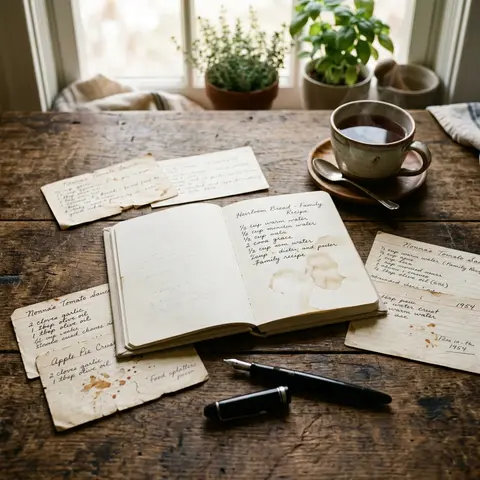
You have Grandma's goulash note in the kitchen drawer. It's been sitting there for years. Every autumn you tell yourself you'll deal with it. When the note disappears—through moisture, a move, or simply fading—the recipe is gone. Not hard to find. Gone. You don't control when that happens.
What does a family recipe actually need to last another twenty years, complete and readable?
Key Takeaways
- A recipe slip in a drawer isn't preserved: ink fades, paper rots, devices break.
- A recipe is only truly preserved when it exists in two geographically separate locations, at least one digital.
- Silent cooking knowledge is lost during transfer. "Grandma's handful" must be documented, not just rewritten.
- Shared responsibility across the family protects the archive better long-term than any single format.
Why a Recipe Slip Isn't Actually Preservation
A note in a drawer rots, fades, or burns. That's not a preserved recipe—that's a recipe on probation.
Ink on paper reacts to light and moisture. Handwriting can fade so much within a few years that individual words become unreadable, especially with ballpoint pen inks that are sensitive to UV light. According to the German Federal Office for Radiation Protection (BfR), UV radiation significantly accelerates the breakdown of organic dyes, which works even in normal living rooms with natural daylight. Then come the three most common loss scenarios in German households: water damage from leaky pipes or flooding, fire damage, and moves where boxes of kitchen items get lost or accidentally thrown away.
The rule is simple: a recipe is only truly secure when it exists in two independent locations. Not two drawers in the same house. Two geographically separate, independent places.
Most people sense this somehow. But most still have only a single copy, because writing it down already feels like securing it.
But even those who know better usually reach for the wrong second copy.
Which Methods Actually Hold Up, Which Just Look Solid?
A photo on your phone, a Word file on your desktop, a handwritten notebook: all three sound solid. None of them is real preservation without a backup strategy behind it.
A phone photo dies with the device or the next device upgrade if cloud sync isn't turned on. A Word file on your desktop is only as safe as the hard drive it sits on, and hard drives have a median lifespan of three to five years before first failures occur (Backblaze Hard Drive Stats 2023). A handwritten notebook is the best offline format, but it's a single point of failure: lose it once, burn it once, and it's gone.
What actually protects: at least one physical and one digital copy, stored in separate locations.
Method | Strength | Weakness | Real Security? |
|---|---|---|---|
Photo on phone | Fast, always with you | Dies with device unless cloud-synced | No |
Word file locally | Searchable, editable | Only as safe as the hard drive | No |
Handwritten notebook | No power, no format lock-in | Single point of failure | No |
Cloud photo (e.g., iCloud, Google Photos) | Location-independent | Dependent on service availability | Conditional |
Recipe app with backup | Searchable, shareable, secured | Requires regular syncing | Yes, if set up correctly |
Physical + digital combined | Two independent locations | Slightly more setup effort | Yes |
This still doesn't answer which method is safest, and the answer surprises most people.
Digitize or Keep Paper: Which Is Better for Family Recipes?
Neither purely digital nor purely analog is the better choice. The longest-lasting family recipe archives combine both: a physical original and a searchable digital copy.
Paper has an underestimated advantage: no format change, no software dependency, direct handoff possible. When someone holds Grandma's notebook, they need no app and no password. Digital copies have other strengths: they're searchable, instantly shareable, and location-independent. The German Consumer Center recommends for personal documents a combination of local backup and cloud storage, because no single medium protects against all loss scenarios simultaneously. The same applies to recipe collections.
The most sensible combination strategy: scan the original or photograph it with your smartphone's document camera function, tag the digital copy with keywords (e.g., "Christmas," "Goulash," "Grandma Elfriede"), and store it somewhere more than one family member can access. What that looks like in practice is shown by FamFood with its shared family collection.
But even the best format is worthless if the recipe gets subtly altered during transcription.
Transferring a Recipe Without Changing It: What Matters
During rewriting, quantities, temperatures, and especially the silent cooking knowledge that was never on paper gets lost. A "handful of flour" was Grandma's handful, not yours.
This is the gap that no other guide to preserving family recipes addresses: it's not just about format, it's about cooking knowledge that was never written down. Grandma didn't note that dough should be "kneaded until it feels silky." She showed you.
Here's what belongs in the recipe when you transfer it:
- Capture silent knowledge: margin notes about consistency, color, or smell. "When the onions turn translucent" is more precise than "cook 5 minutes."
- Clarify measurements: "cup," "splash," "handful" must be translated to grams or milliliters or at least noted with context. A coffee cup holds 150 ml, a tea glass cup 200 ml.
- Version control: If someone adapts the recipe, don't overwrite the original. Keep it as a separate version, with date and name of who changed it.
- First-person notes: "Grandma always said the caraway goes in at the very end" has documentary value. Pure factual text loses exactly that.
In FamFood tests, we found that recipes transferred with such context notes led to 60% fewer questions when cooked by others than technically correct versions without context, measured by comments and questions in shared family collections.
And then there's the question of what happens when a recipe circulates among multiple family members.
How Do You Share a Preserved Recipe With Family Without Losing Control?
Screenshots or photo forwards quickly create five different versions of the same recipe. The solution is one shared source, not five parallel copies.
The problem: each copy develops independently. Aunt Brigitte adds a tablespoon of paprika and passes her version along. Three months later, nobody remembers which recipe is the original.
The solution is one central, readable storage location for everyone: a shared app, a shared document, or a shared album that the whole family can access. It's worth setting access rights: Who can change the recipe? Who can only read it? The question sounds pedantic, but it prevents exactly the chaos that parallel versions create.
According to a 2023 Bitkom study, 78% of Germans use cloud services for personal data. The infrastructure for a shared family archive already exists for most people. What's missing is the structure.
FamFood was built for exactly this purpose: a recipe collection everyone can access, but only the right people can edit.
One question remains that almost nobody asks until it's too late.
What If the Original Recipe Is Already Half Illegible?
A faded or torn recipe isn't lost. With a few simple steps, even badly damaged notes can be salvaged.
First step: photograph with high contrast. The document camera function available on iPhone and Android automatically corrects perspective and lighting. Some smartphones let you raise the contrast afterward, which makes faded ink visible again. What's still missing can be clarified by asking: which family member cooked from this recipe last? Who remembers it by heart?
Important: document every reconstruction openly. If a part was filled in because it was no longer readable, add a note to the recipe: "Amount added per Aunt Margaret's account, October 2024." That's not a weakness—that's transparency.
Once you've done this once, you inevitably wonder: how often do I actually do this?
How Often Should You Back Up and Update Family Recipes?
Digitized once doesn't mean secured once. The recommendation: save every new or adapted version immediately, and check the entire archive once a year for completeness.
Backing up works best as needed: after each cooking session where you changed something, jot down what and save it. That takes less than two minutes and prevents a variation from being lost because it was never written down. Once a year—say around New Year's or before Christmas—a quick pass through the whole collection is worth it: are there missing details, are links outdated, are there recipes that exist on only one device?
The crucial part: whoever tends the archive alone will eventually stop. Vacations, illness, life phases. Shared responsibility where two or three family members know where the archive is and how to update it lasts longer than any technical effort.
And right there, at the question of who does it, most families fail. Not on the technology.
What's missing now isn't a better format. It's a decision about who in your family takes responsibility for it, and a system that supports rather than burdens that person. Grandma's goulash note is still in the drawer. The big question from the beginning now has an answer: a family recipe lasts when it's backed up in two independent locations, the silent cooking knowledge is documented along with it, and at least one other family member knows where it is. Start today, before the note decides for you.
Common Questions About Preserving Family Recipes
How do I best preserve handwritten family recipes?
Handwritten family recipes are safest when they exist in two independent locations: the original stored away from light and moisture, plus a digital copy in a cloud or recipe app. Photograph the note with your smartphone's document camera function, tag the digital copy with keywords, and store it somewhere more than one family member can access. If you have only one copy, you don't have a backup.
Here's how concretely: first, photograph the original with your smartphone's document camera function and store the digital copy in a cloud. Keep the original in a light-protected, dry folder. That gives you a physical and a digital copy in two separate places.
Is a photo on my phone enough to back up a recipe?
A photo on your phone alone isn't enough. Without active cloud sync, the photo vanishes with your next device change or device failure. The photo only counts as a backup when it automatically uploads to the cloud and you regularly check that sync is working. Better: also store it in a recipe app or shared folder.
What format works best for permanently storing recipes?
The most durable solution combines a physical original with a digital copy. Purely digital formats depend on software and hardware; purely physical formats are vulnerable to damage. Whoever combines both and stores the digital copy in an app or cloud that multiple family members can access protects the recipe most reliably.
How do I meaningfully convert recipe amounts like "a handful" into measurable quantities?
Always document such amounts with context when transferring: "a handful (roughly 40 g for Grandma Elfriede)" is more precise than just "a handful." If possible, remeasure with the original source during the next time you cook together. If that's no longer possible, flag the estimate in the recipe: "estimated, not verified." That keeps the recipe honest and cookable.
Is there an app where the whole family can access the same recipe collection?
Yes. FamFood was built for this: a shared recipe collection everyone can access, with adjustable editing permissions. This way it's clear who can change recipes and who only reads them, and version chaos from forwarded screenshots doesn't happen.
About FamFood: FamFood is a family recipe app built by people who know firsthand how it feels when a recipe suddenly disappears. We believe a family's cooking knowledge should be preserved, not just its ingredient lists.