Uncoated Pan Sticking? Why Pancakes Fail—And How to Fix It
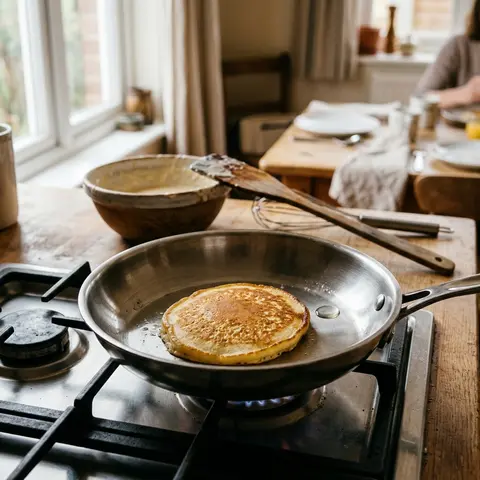
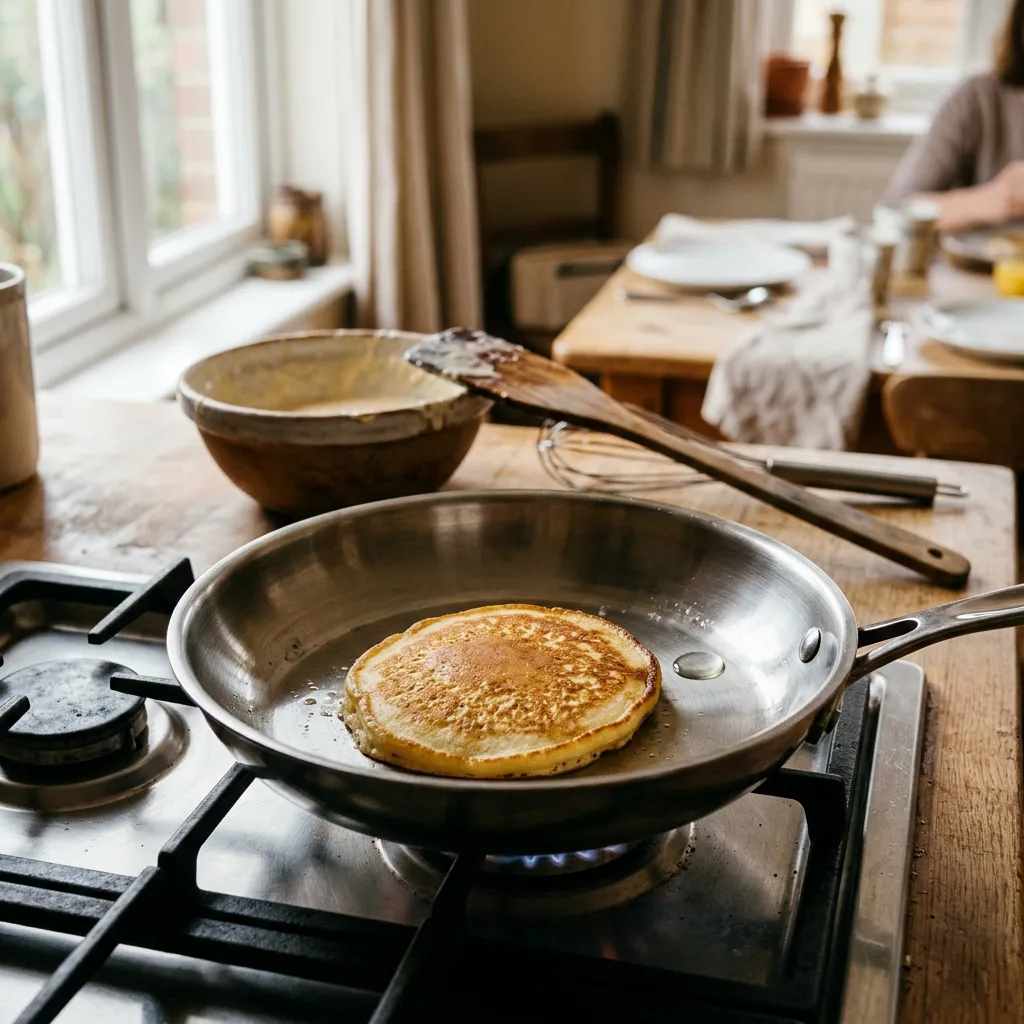
Sunday morning, three hungry kids at the table, and for the first time the new uncoated pan sits on the stove. The batter is mixed. Forks are already in hand. The first pancake sticks, and most people think the same thing in that moment: stainless steel just isn't made for eggs or pancakes, right?
After the third torn pancake, the new pan lands in the cupboard. The old nonstick one comes back out. With it goes more than a breakfast, because the plan to switch disappears right along with it. If you give up after the first failed attempt, you rarely try a second time.
That's why it's worth taking a close look at one single question: Is stainless steel actually unsuitable for eggs and pancakes, or are you doing something in the first two minutes that you don't see?
Key Takeaways
- Food sticks in stainless steel almost always because the pan isn't hot enough yet or you flip too soon. The material is rarely the problem.
- The water droplet test shows you the right heat: if a bead rolls across the bottom, the fat goes in.
- PTFE nonstick coatings are part of the PFAS group, according to Consumer Protection Centers in Germany. An uncoated pan is the precautionary choice.
Why does everything stick in a stainless steel pan?
Food sticks in stainless steel almost always for two reasons: the pan isn't hot enough when you add the food, or you move it too soon. In lukewarm metal, protein bonds with the bottom instead of cooking. More oil helps very little. If you preheat until the pan reaches the right temperature and then wait, you need neither coating nor tricks.
The material is not the problem.
It's about temperature and timing.
In a properly preheated pan where a water droplet beads up, protein forms a crust. And that crust releases by itself once you wait long enough.
Look at Sunday morning again. The pan came cold with oil on the stove. The batter went in as soon as the oil looked warm somehow. It was flipped after a few seconds because everyone was watching. Three small decisions, and each one encouraged the sticking.
What happens: stainless steel looks smooth but has fine bumps. In a lukewarm pan, runny batter flows into them and sticks to the metal. When the pan is hot, moisture underneath evaporates instantly, the protein curdles, and the solid layer lifts away all by itself eventually. No magic involved, just heat.
At our house, the first pancake stuck every Sunday. Until we waited two minutes longer before the batter went in. Same pan, same batter, same oil.
So how do you know the pan is hot enough? Without a thermometer.
How do you know when the pan is hot enough?
The simplest test is the water droplet. After two to three minutes on medium heat, drop a few drops of water into the dry pan. If they sizzle and evaporate right away, it's still too cold. If the droplet rolls as a bead across the bottom, you've reached the right temperature. Then turn the heat down slightly, add the fat, wait a moment, then add the food.
Behind this is the Leidenfrost effect. Explained in kid-friendly terms: the bottom is so hot that a tiny steam cushion forms under the droplet instantly. The water bead dances on this cushion instead of touching the bottom. That's the moment you're looking for.
In our own test rounds for FamFood, the wait time until the first bead was 2.5 to 3.5 minutes on induction and gas at medium heat. Almost everyone had started after about a minute. Those missing two minutes are the whole difference between sticking and sliding.
The Water Droplet Test Step by Step
- Place the dry pan on medium heat. No oil, nothing yet.
- Wait two to three minutes. Stainless steel stores heat well; you don't need high.
- Flick a few drops in with wet fingertips.
- If the droplet beads, turn heat down one notch and add the fat.
- Once the fat shimmers slightly and flows thin, the food goes in. If it smokes, you've waited too long.
A good moment for kids to join in: they can watch and call out what the droplet does. Stand one arm's length from the pan—you do the flicking.
What the Droplets Tell You
What the droplet does | What that means | What you do |
|---|---|---|
Lies flat and bubbles slowly | Pan far too cold | Keep waiting |
Sizzles loudly and evaporates right away | Still too cold, even if it sounds hot | Wait another 30 to 60 seconds |
Rolls as a single bead across the bottom | Right temperature | Turn heat down slightly, add fat |
Shatters into many tiny droplets | Very hot | Move pan off heat briefly, turn heat down |
The droplet that sizzles misleads most people. It sounds hot, so the batter goes in too early.
Sounds simple. But another mistake waits after this one, and that's where most first attempts fail.
When are you allowed to flip the egg?
Only when it releases itself. A fried egg or pancake sticks to the bottom for the first 30 to 90 seconds. Once the crust has formed, it slides with a light shake of the pan. If you push with the spatula beforehand, you tear the crust and create the sticking you were trying to avoid.
The shake test replaces the spatula. Grab the pan by the handle and push it back and forth once quickly. If the pancake moves with it, it's ready. If it's stuck, you wait more. Don't help it along, don't lift it.
Why is this so hard? Because impatience sounds reasonable. You're afraid it will burn, so you want to step in. But the sticking at the beginning isn't a sign of a problem. It's part of the process.
What we count in FamFood recipes that use a pan: about 7 out of 10 follow-up questions are about flipping, not ingredients. Hardly anyone asks how much flour goes in the batter. Many ask why it tears when they turn it over.
On tools: wooden and stainless steel spatulas both work. Stainless steel is tough; scratches on the bottom are only cosmetic here.
With eggs it works fast. With pancakes and kids at the table, there's one more factor.
Which dishes work best when you're starting out?
Start with dishes that bring their own fat or want a crust: home fries, ground meat, pan vegetables, meat patties. Then pancakes, last of all fried eggs. Sugary batters brown faster and stick more easily, so use a bit less heat. This builds feel for the pan before you tackle the most delicate dish.
The factor missing from almost every guide is sugar. Banana or apple pancakes are popular with kids, but fruit sugar caramelizes early. The bottom browns before the crust sets. So: water droplet test as always, then one notch less heat than regular batter.
Week | Dish | Difficulty | What to watch |
|---|---|---|---|
1 | Home fries, ground meat | Easy | Flip only when they release |
1 | Pan vegetables, meat patties | Easy | Don't overcrowd the pan |
2 | Pancakes without fruit | Medium | Droplet test, shake test |
2 | Banana or apple pancakes | Medium | One notch less heat |
2 | Fried eggs | Challenging | Patience, don't push |
For fat, use lard or refined canola oil. Refined oils handle much higher heat than cold-pressed, as the German Center for Nutrition (BZfE) explains. Lard withstands more than butter because water and milk protein are removed. Butter itself burns faster. It goes in at the end for flavor.
One bonus that no nonstick pan delivers: the browned bits from ground meat become the base for sauce. Pour in some broth, scrape it up, done.
And if something does burn anyway, many reach for a scrubbing sponge. Of all things, that damages the pan.
How do you get burned-on food off?
Pour water into the still-warm pan and let it boil briefly. The browned bits usually come off with a wooden spatula. For stubborn bits, a tablespoon of baking soda with water, simmered for ten minutes, helps. Rainbow discoloration wipes away with a splash of vinegar. You don't need steel wool or scouring powder—they scratch the surface—and avoid the dishwasher.
Deglazing beats soaking overnight. Warm residue comes off in minutes; cold, dried-on stuff needs elbow grease. That means: straight after the meal, a quick pour of water while the kids clear the table.
The colored rainbow spots scare many people. They're purely cosmetic and happen from heat on the surface. A splash of vinegar, rub it in quickly, rinse. The Stiftung Warentest, Germany's leading consumer test organization, also recommends gentle hand washing for pans so bottoms and handles last longer.
So you don't have to hunt for the baking soda trick and the droplet test next time, you can save your recipes and tricks in FamFood.
After the first week comes almost always the same question: is all this effort worth it?
Is switching to an uncoated pan worth it?
Yes, from a health precaution perspective. PTFE nonstick coatings belong to the PFAS group. Particles shed from scratched coatings—their effects on the body are not yet fully understood—and above about 360 degrees Celsius, toxic fumes develop. According to the German Consumer Protection Centers, an empty heated pan reaches this temperature in 2 to 5 minutes. Uncoated pans made of stainless steel, iron, or cast iron don't have this problem.
The German Federal Institute for Risk Assessment describes how PTFE forms decomposition products when overheated. That scratched coatings release plastic particles during cooking is shown by research in Science of the Total Environment. What these particles do in the body is an open question. That open question is enough for us to recommend the uncoated pan.
And "PFOA-free"? That's no all-clear. PFOA, once used in manufacturing, has been classified by the IARC since 2023 as cancer-causing for humans. It was often replaced by other fluorine compounds like GenX.
Pan | Coating | Strength | Our recommendation |
|---|---|---|---|
Stainless steel | None | All-rounder, stores heat, lasts for years | Recommended |
Carbon steel | None, patina from seasoning | Gets very hot, ideal for home fries | Recommended |
Cast iron | None | Holds heat a very long time, heavy | Recommended |
Nonstick with PTFE | PTFE (PFAS) | No real strength. Effects of shed particles unknown | Not recommended |
Still have a nonstick pan? Then only wooden or silicone tools, never heat it empty, and throw it out if it gets scratched.
That's why it all starts with a test you can do tonight before you buy anything new.
So is it the pan?
No. The answer to the question from Sunday morning: stainless steel is suitable for eggs and pancakes. What you don't see in the first two minutes is the temperature. Cold pan, batter right in, flipped too soon, and it sticks. Hot pan, beading droplet, patience on the flip, and the pancake slides.
Tonight, before dinner: dry pan on medium heat, water droplet in, and watch what it does. What you see then decides whether the pancake holds tomorrow.
Frequently Asked Questions
Why do fried eggs stick in a stainless steel pan?
Fried eggs stick because the pan is too cold when you add them or you push too soon. The egg white bonds to the metal until a crust forms after 30 to 90 seconds. Do the water droplet test first, wait until the egg slides with a shake, and only then flip.
Do you have to season a stainless steel pan?
No, you don't have to season a stainless steel pan. What matters is proper preheating before each use: dry pan on medium heat, water droplet test, then fat. Carbon steel and cast iron pans need seasoning because a protective patina builds there that gets better over time.
Which oil works best for a stainless steel pan?
Lard and refined canola oil work well because both handle higher temperatures. Add the fat to the preheated pan, not cold. Butter burns faster, so it goes in at the end for flavor. If the fat smokes, the pan is too hot.
Can you make pancakes in a stainless steel pan?
Yes, pancakes work well in a stainless steel pan if it's properly preheated and you flip only when the batter releases itself. With banana or apple pancakes, set the heat one notch lower because fruit sugar browns faster and sticks more easily.
Can a stainless steel pan go in the dishwasher?
Many manufacturers allow it, but hand washing is better. The pan stays shinier and handles and rivets last longer. Usually warm water right after cooking is enough. For stubborn bits, a tablespoon of baking soda with water, simmered for ten minutes, helps. You don't need steel wool.
About FamFood
We cook every day for families, with kids watching, helping, and sometimes impatient for the first pancake. In FamFood, you save your family recipes in one place, including little tricks like the water droplet test, so they're ready to go at your next Sunday breakfast.