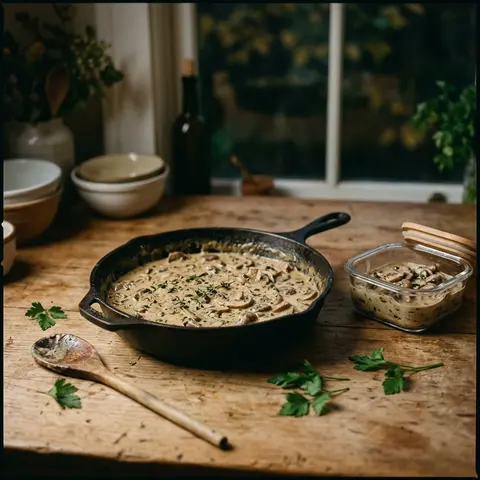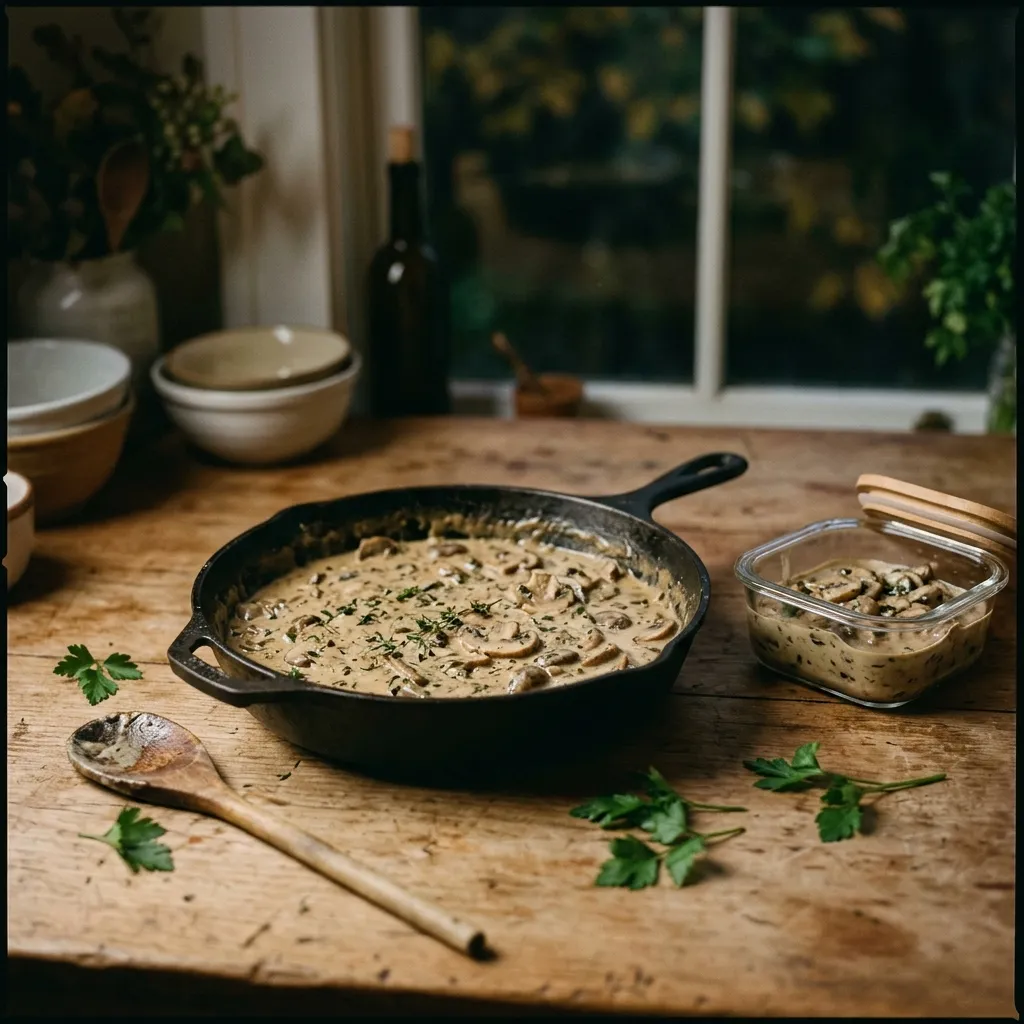
"You can't reheat mushrooms," Grandma said every fall when the pan of creamy mushrooms was still half full. Now it's Sunday evening, the kids need to get to bed, and that exact half-full pan is sitting warm on your stove. Tomorrow it could be a ready-made dinner. Or it lands in the trash because you won't serve your kids anything spoiled. And every hour it sits there counts.
So: is Grandma's rule right—that you should never reheat mushrooms? Or does it protect against a danger that today lies somewhere completely different?
The essentials
- Reheating mushrooms is allowed: cool quickly, refrigerate, eat within one to two days, heat once to at least 70°C (BZfE).
- The real risk is the hours the dish sits warm on the stove. After two hours maximum, it belongs in the fridge (BfR).
- Sauces and stews work great the next day. Pan-fried mushrooms are better repurposed instead.
Can you reheat mushrooms, or is it dangerous?
Yes, you can reheat mushrooms. According to the German Federal Centre for Nutrition (BZfE), you can reheat mushroom dishes if you cool them quickly after cooking, store them in the fridge, eat them within one to two days, and heat them thoroughly to at least 70°C once. It becomes dangerous when the dish sits warm on the stove for hours. Then bacteria multiply, and the mushroom's protein breaks down quickly.
Most people expect one of two things at this point. Either the clear ban: mushrooms become toxic when reheated. Or the casual shrug: no big deal.
Neither is quite right.
According to the BZfE, reheating itself is not the problem.
The risky part is the hours before, when the dish sits lukewarm on the stove.
Grandma's rule was correct. For a kitchen without a refrigerator.
Think of the kitchen where she learned to cook. Food stayed on the stove after lunch, covered, until evening. Cool storage meant a pantry. If someone reheated yesterday's mushrooms in that kitchen, they often ended up with a spoiled dish. The rule was smart protection, just based on the wrong reason.
It's also striking that you hear the same warning about rice and spinach. Three completely different foods, one rule. That doesn't point to something inside the mushroom itself. It points to storage.
If reheating isn't the risk, where exactly does it happen on a normal family evening?
Where does the real mistake happen with a mushroom dish?
The most common mistake happens between dinner and cleanup: the pan stays on the stove with the lid on until the kids are in bed. According to the German Federal Institute for Risk Assessment (BfR), bacteria multiply best in the range between roughly 10 and 60 degrees Celsius. Cooked food should cool quickly and go into the fridge after two hours at most. Mushrooms are protein-rich and water-filled—they spoil faster than many vegetable dishes.
At home, that's exactly the trap we fall into. Getting the kids to bed is planned for "ten minutes." Then comes another glass of water, one more book, one more question about kindergarten. Suddenly it's half past nine, and the pan has been sitting in the warm kitchen for over two hours.
There's also a detail hardly anyone thinks about: the lid that's meant to keep dust out mainly traps heat inside. The pan cools slower and stays longer in the danger zone.
Here's how to speed up cooling:
- Transfer leftovers to a shallow container right after eating. The thinner the layer, the faster it cools.
- Set the pan in a sink filled with cold water for a few minutes.
- Leave the lid off until the dish stops steaming.
- After two hours maximum, everything goes in the fridge.
That saves the evening. The next morning brings its own question—one that matters most to the smallest people at the table.
Can children eat reheated mushrooms?
Yes, if storage rules are followed, children can eat reheated cultivated mushrooms like button mushrooms or king oyster mushrooms. What matters is that the dish is heated through completely—hot all the way to the center, not just around the edges. With wild mushrooms, children need caution regardless of reheating, because depending on the region they can be contaminated with radiocaesium.
The difference between cultivated and wild counts here. Cultivated mushrooms grow on controlled substrate. Wild mushrooms from some regions, especially in southern Germany, still absorb radiocaesium today. The German Federal Office for Radiation Protection (BfS) points this out regularly. For children, that means wild mushrooms only occasionally and in small amounts. If you're just starting to cook mushrooms with kids, button mushrooms are the easiest entry point.
Two situations deserve special attention:
- Microwave: It heats unevenly and leaves cold spots in the center. Stir halfway through and keep heating until it steams everywhere.
- Daycare container: Mushroom sauce goes in only boiling hot into a preheated thermos. We skip a cold version with mushroom sauce in a lunchbox entirely because it would sit unrefrigerated in the bag for hours.
And then there's the question that hardly any guide addresses: which mushroom dishes are even worth eating the next day?
Which mushroom dishes still taste good the second day?
Mushroom dishes with plenty of liquid or a binder hold up best the second day: mushroom sauce, mushroom stew, mushroom soup, and mushroom risotto with a splash of broth. Pan-fried mushrooms, on the other hand, become rubbery when reheated and lose their roasted flavors. For skillet dishes, repurposing is often better than reheating, because you get a new dish instead of a tired repeat.
We see this in FamFood too. Of the mushroom recipes families save there with a leftovers note, about 7 out of 10 are sauces, stews, or soups. Pan-fried mushrooms don't even make up one in ten. Families have already figured it out through trial and error: what swims in sauce forgives the second day.
Mushroom dish | Second day | Better this way |
|---|---|---|
Creamy mushrooms, mushroom sauce | Good | Warm slowly with a splash of milk so it doesn't curdle |
Mushroom stew | Very good | Heat with broth, serve with dumplings or pasta |
Mushroom soup | Very good | Bring to a boil, add fresh parsley only at the end |
Mushroom risotto | Fair | Loosen with broth or form into risotto fritters |
Pan-fried mushrooms | Weak | Add to omelets, quiches, or pasta sauce |
Stuffed mushrooms | Weak | Chop fine and use as filling for pancakes |
The rule of thumb behind it: the drier a mushroom dish, the more it becomes something new the next day.
And then there's the plan to simply freeze the leftovers. It works, but not the way most people do it.
Can you freeze cooked mushrooms?
Yes, cooked mushroom dishes can be frozen. Freeze them as soon as they've cooled, not days later in the fridge. At minus 18 degrees, bacteria don't multiply, but quality declines over time. We eat frozen mushroom leftovers within about three months. Thaw them in the fridge or put them frozen directly in the pot, heat thoroughly, and don't refreeze after that.
Here's where most people get it wrong. Many freeze only when it's clear nobody wants the leftovers anymore. By then the dish has already spent days in the fridge, and the freezer preserves exactly that state. Cold stops bacteria—it doesn't kill them. That's why the BfR recommends using thawed food quickly and heating it thoroughly.
The three months isn't a safety limit—it's our experience with taste: after that, cream sauces taste flat and the mushrooms get watery.
A few simple steps save headaches later:
- Portion by meal, not by container: Freeze what your family eats in one evening.
- Cream sauces often separate: Stir vigorously when reheating, or add a spoonful of sour cream or milk if needed.
- Label it: A strip of masking tape and a marker are enough.
Once you've done this a few times, you notice that the mushroom evening can be planned differently—starting right at the store.
How do you plan mushroom leftovers from the start?
Cook mushroom sauce or stew intentionally in double the amount and plan the second day right in: day one with pasta or dumplings, day two as a filling, soup, or casserole. That way you use the whole container of mushrooms, nothing wilts in the veggie drawer, and you only have to really cook once on a weekday. The important part: the second half goes into the container right after eating.
An example for two days:
- Sunday: Creamy mushrooms with semolina dumplings. Half the sauce goes into the shallow container right after dinner.
- Monday: The sauce becomes mushroom soup with a splash of broth and milk, or fills pancakes you top with cheese and bake.
So you don't have to figure it out fresh each time, save your mushroom recipe along with a leftovers variation in the FamFood family app. Then Monday is set when you shop on Sunday. And once mushrooms work this way, you can plan the whole week using the same principle.
And Grandma's rule? It protected her family from a problem you solve today with a shallow container and a refrigerator. Reheating itself was never the danger—it was the long evening on the stove.
The half-full pan from Sunday is in the fridge. Only one question remains: does it stay sauce tomorrow, or become a filling? Pull the container out at 6 p.m. and decide then.
Common questions about reheating mushrooms
How many times can you reheat mushrooms?
You should reheat mushrooms only once. According to the BZfE, one thorough heating to at least 70°C is fine if the dish cooled quickly beforehand and was stored in the fridge. Each new cooling and reheating gives bacteria another chance. So only reheat the portion you're actually eating.
How long do cooked mushrooms keep in the fridge?
Cooked mushrooms keep in the fridge for one to two days. The condition is that they cool quickly after eating and are put away after two hours at most, as the BfR also recommends. If the dish smells sour or looks slimy, throw it out. If you want to plan further ahead, freeze the leftovers the first evening.
Can you reheat mushrooms in the microwave?
Yes, the microwave works for reheating mushrooms, but it heats unevenly. Stir halfway through and keep heating until the dish steams everywhere and is hot all the way to the center. That's especially important for kids' portions because cold spots can go unnoticed.
Why do people say you shouldn't reheat mushrooms?
The rule comes from a time before refrigerators. Mushroom dishes sat warm in the kitchen for hours back then, and spoiled during that time. The reheating itself doesn't make mushrooms toxic. You hear the same warning about rice and spinach because storage was the problem there too.
Can children eat mushroom sauce from the day before?
Yes, children can eat mushroom sauce from the day before if it's made with cultivated mushrooms, cooled quickly, and stored in the fridge. Heat it once thoroughly to at least 70°C and stir while doing so. For the daycare lunchbox: only boiling hot in a preheated thermos, never packed cold or lukewarm.
About FamFood: We're a small crew of family cooks who face the same question every evening: what happens to the leftovers? FamFood is our digital family cookbook, where Grandma's classics live side by side with the kids' new favorite recipes. What we write here, we've tested at our own stoves.