Simple Kids' Plates: The 2-Minute Dinner Every Night
Tuesday, 6 p.m., plating dinner for the kids. Pasta and broccoli are bubbling on the stove. In your head, there's that Pinterest bear-shaped rice plate. You have two minutes. Most parents think a kids' plate has to look like a work of art for their child to eat even one floret of broccoli. Is that actually true?
Your four-year-old is already at the table. If it goes sideways, the vegetables end up in the trash. Dinner turns into a negotiation. And you're sitting there feeling like you haven't done enough. Tomorrow at 6 p.m., the same scene plays out again.
So the real question: if fancy plating isn't necessary, what exactly needs to be different on the plate so that broccoli eventually gets eaten?
Key Takeaways
- Children often need 8 to 15 tasting contacts with a new food before they accept it (Netzwerk Gesund ins Leben, BZfE).
- A simple plate you can pull off every night creates more contacts than an elaborate design.
- Fixed sections, a tasting portion, and mild cooking matter more than decoration.
- For children under four: quarter grapes and cherry tomatoes, avoid nuts (BfR).
Does a kids' plate have to be fancy for your child to eat?
No. According to Netzwerk Gesund ins Leben and BZfE, children often need 8 to 15 tasting contacts before accepting a new food. A themed plate that takes half an hour appears on the table maybe once a week. A simple, recognizable plate that takes two minutes appears every night. Creative plating in real life means: fixed structure, small portions, clear separation, and one food your child already knows.
And now the math shifts.
Children need a new food 8 to 15 times.
The fanciest presentation doesn't count more. Every single time counts.
The key is a plate you can repeat every evening, not a one-off design.
You know the bear plate—it works once, then your child refuses it the second time. The effort itself prevents repetition. Do the math: with one themed plate per week, reaching 8 to 15 contacts takes two to almost four months. With an everyday plate four evenings a week, it's two to four weeks.
What we often see in FamFood families: parents who switch from themed plates to everyday plates suddenly offer new vegetables multiple times a week. Not because they're more disciplined. But because the plate doesn't exhaust them. Save the dinosaur-nuggets jungle for special occasions. Right now, we're talking about Tuesday.
So what does a plate actually look like when you can genuinely pull it together every evening in two minutes without it feeling boring?
Plating a kids' meal in 2 minutes: what does that really look like?
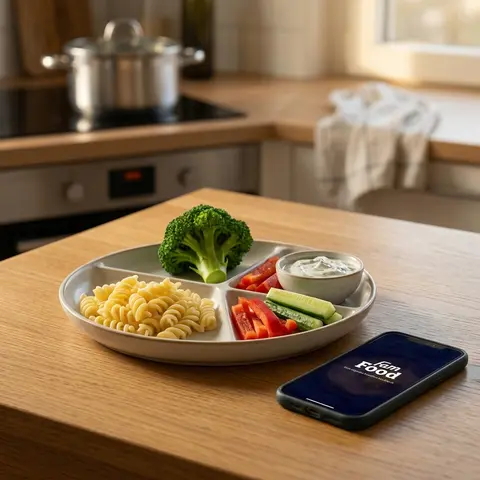
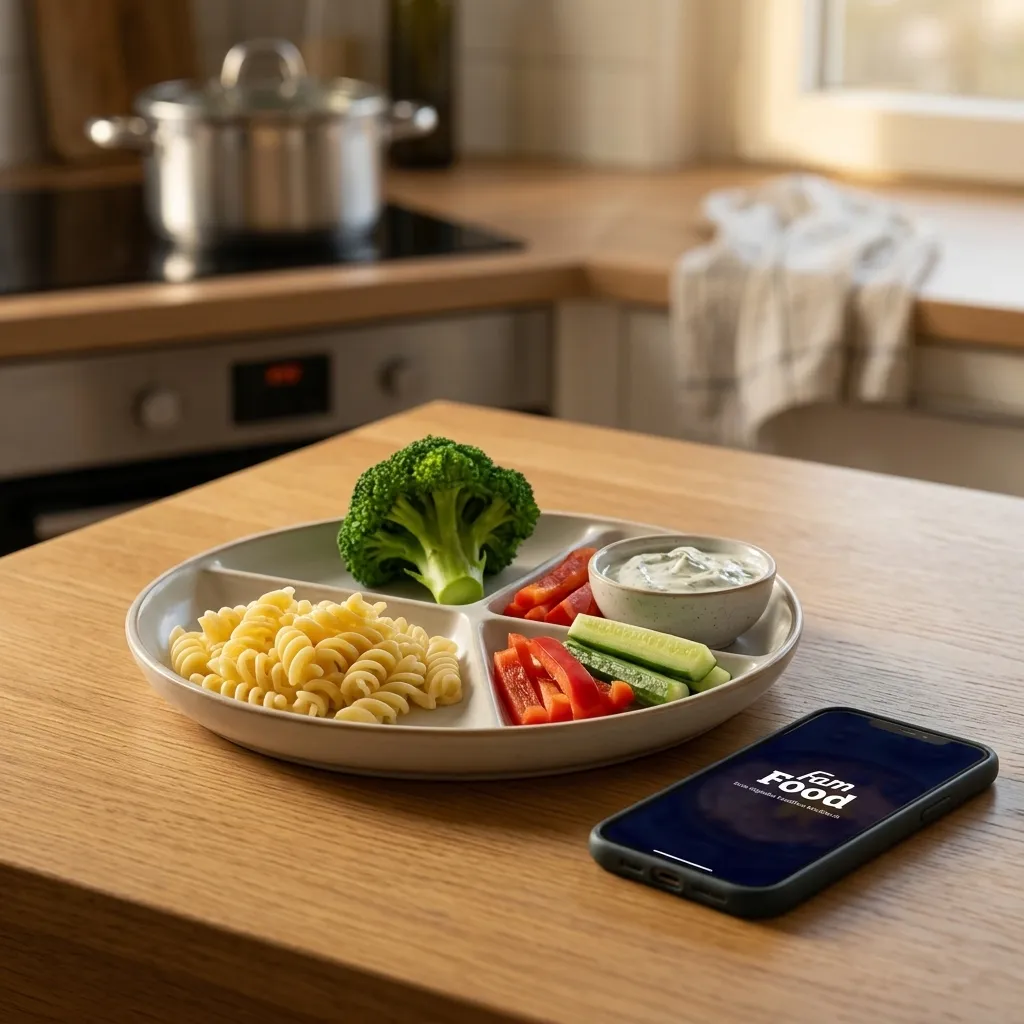
The 2-minute plate follows a fixed grid: three to four separate sections. One is always a safe food your child likes. One is the new or rejected food, in tasting size. Add a color that's otherwise missing. A compartment plate or a large flat plate with space between sections works fine. The grid stays the same, the contents change. That way, your child recognizes the order and only has to negotiate one new element.
Section | Example Tuesday | Purpose |
|---|---|---|
Filling side | Pasta with a little butter | Fills them up, removes pressure |
Safe section | Cucumber strips | Trust: I know everything here |
Tasting section | One broccoli floret | One contact with something new |
Color section | Red bell pepper strips | Visible variety without effort |
Separated, not mixed—that's the most important rule. Many children reject mixed dishes because they can't see what's inside. When everything sits side by side, your child gets to choose what to touch first.
The safe section
Something your child eats almost every time goes here. Bread, cucumber, pasta, a piece of cheese. This section isn't a compromise. It ensures nobody leaves the table hungry and lowers the barrier for everything else.
The tasting section
One floret, not a handful. The small amount says: you don't have to finish this, you're just allowed to look at it. Eating doesn't happen the first time. Seeing, smelling, touching—those are contacts too.
Sounds simple, and this is where most parents make a mistake that has everything to do with portion size and nothing to do with how it looks.
Broccoli for kids: why does cooking method matter more than shape?
Broccoli contains bitter compounds that many children taste more intensely than adults do. Broccoli cooked until mushy smells sulfurous and becomes soggy—both lower acceptance. Steamed briefly or roasted in the oven stays bright green, stays firm, and tastes milder to slightly nutty. One floret arranged as a little tree helps only if the taste is right. Cooking comes first, then the shape.
The mistake from the last section? Too much broccoli, cooked too long. A pile of gray florets looks like a task to a child. The tree often fails in the pot, not in the design.
Here's how it works:
- Steaming: 4 to 5 minutes in a steamer basket over boiling water. Stays bright green after.
- Roasting: Florets with a little oil on a baking sheet with parchment paper, or in a stainless-steel or cast-iron pan. The edges brown slightly and lose their bitterness.
- Dip as a bridge: A dollop of yogurt with herbs on the side. Sweet sauces mask the flavor; yogurt just softens it.
At home, our broccoli only got touched when it moved from the pot to the baking sheet. Same shape, same plate, different smell. And don't throw the stem away: how to use it is in our piece on cooking with broccoli stems.
Even the best broccoli sits untouched if a certain sentence gets said at the table—the one nearly every parent means well by.
How do you motivate kids to eat without pressure?
Children eat more variety when they get to decide whether and how much to try. BZfE advises against using food as reward or punishment—like dessert for an empty plate. You decide what comes to the table; your child decides how much they eat. Letting them serve themselves, letting them touch the food, and eating together work better than persuading.
The sentence is: "Just one more bite, then you get pudding." It's well-meaning. But it teaches that broccoli is something to get through to reach something good.
What works instead:
- Self-service: Your child puts the floret in their tasting section themselves. People who choose tend to try.
- Role modeling: You eat the same thing, visibly and without comment.
- Calm: If the floret is still there at the end, you clear it away. No sighs, no renegotiating.
We've already written about how touching and playing with food pave the way to trying it. But for toddlers, there's a line where creativity on the plate becomes risky—and it has nothing to do with taste.
What shapes are risky for young children?
Small, round, firm pieces like whole grapes, cherry tomatoes, nuts, or hard raw vegetables can enter the airway in children under four. The Federal Institute for Risk Assessment (BfR) recommends quartering such foods or cooking them soft, and avoiding nuts entirely. For creative plating, that means: quarter grapes lengthwise, carrots as soft sticks rather than hard coins, and skip ball shapes.
Themed plates often love balls: grape eyes, tomato noses, pea pearls. For children under four, those are exactly the wrong shapes.
Food | Risky Form | Safe Form Under 4 |
|---|---|---|
Grapes | Whole | Quartered lengthwise |
Cherry tomatoes | Whole | Quartered |
Nuts | Whole or pieces | Avoid entirely |
Carrots | Hard raw coins | Soft cooked sticks |
Broccoli | Hard stem pieces | Soft steamed florets |
Strips instead of balls—that's the simplest rule. And no matter what the plate looks like: eating happens sitting down and under supervision.
There's one last hurdle where even the best plan falls apart: the time between stove and table.
Fitting the everyday plate into your week
Plan your tasting section for the week ahead: one new vegetable, served at several meals in small portions, always next to a safe favorite food. That way your child builds contacts without you having to reinvent dinner every evening.
Concretely: this week it's broccoli, offered four times. Steamed on Tuesday, roasted on Thursday, with dip on Saturday. Note when your child touches it, licks it, or eats it. In FamFood, you can add that as a note right on the recipe, and your tasting section lands straight in your weekly meal plan.
That answers the big question. What needs to be different isn't the look. What needs to be different is how often it appears. A plate you can pull together in two minutes comes often enough that somewhere between that 8th and 15th contact, that floret actually gets eaten.
Count it this week: at what contact does that floret finally stop sitting at the edge of the plate?
Frequently asked questions
How many times does a child need to try a vegetable before they like it?
Often 8 to 15 times. According to Netzwerk Gesund ins Leben and BZfE, children frequently need that many tasting contacts before accepting a new food. Seeing, smelling, or touching all count as contacts. Offer the vegetable several times a week in small amounts, without pressure.
How do I make food look nice for kids when I barely have time?
Use a fixed grid with three to four separate sections: a filling side, a safe food, a tasting portion, and a color. It takes about two minutes. Because children often need 8 to 15 contacts, a plate you repeat every evening counts more than an elaborate design.
How do I get my child to eat broccoli?
Through how you cook it. Steam broccoli just 4 to 5 minutes or roast it in the oven—it stays green and tastes milder. Put a single floret in the tasting section with a yogurt-herb dip alongside. Offer it several times a week, because children often need 8 to 15 contacts.
Should I motivate my child with dessert to finish their food?
No. BZfE advises against using food as reward or punishment. Dessert for an empty plate teaches that vegetables are something to endure. Better: you decide what comes to the table, your child decides how much they eat. Role modeling and letting them serve themselves work stronger than persuasion.
At what age can children eat whole grapes or cherry tomatoes?
Around four and up. Younger children can have small, round, firm foods enter their airway. The BfR recommends quartering grapes and cherry tomatoes until then and avoiding nuts entirely. Even older children eat safest sitting down and under supervision.
About FamFood: We're a small crew of parents and home cooks who stand at the stove every evening wondering what goes on the kids' plates. FamFood is our digital family cookbook: save recipes, add notes, plan your week. For Tuesday nights, not for Instagram.