20-Minute Lunch: Fast Meals for Remote Work & Office
Lunchtime is ticking. Your stomach is rumbling. And takeout needs 45 minutes you simply don't have.
Whether you're working from home or squeezing in a quick office break, lunch is the most underestimated meal of the day. Dinner recipe posts are everywhere, but solid quick-lunch ideas with honest timings are rare. This post closes that gap. You'll get concrete dishes, realistic cooking times, and a simple check to see whether the result will actually carry you through the afternoon.
Key Takeaways
- A real 20-minute lunch needs no more than 5-6 ingredients and just one cooking vessel.
- Frozen vegetables are often more nutrient-dense than fresh produce that's been sitting in your crisper drawer.
- According to the German Society for Nutrition (DGE), lunch should cover around 30% of your daily macronutrient needs. You can hit that target in 20 minutes.
- Five base recipes, lightly varied each week, are enough for stress-free lunches all week long.
What makes a good 20-minute lunch?
A 20-minute lunch needs a maximum of 5-6 ingredients, a single pan or pot, and zero prep work in the morning. Anything else isn't a 20-minute meal, no matter what the recipe card says. If you're counting oven preheat time, weighing five spices, or soaking legumes, you're quickly hitting 40 minutes.
The crucial mindset shift: actual cooking time isn't the same as felt cooking time. Pasta cooks on its own. You make the sauce while it's going. Frozen peas thaw in the pan's heat while you crack an egg. Running the stove and cutting board in parallel is the only "trick" quick lunches need.
Remote-work lunch breaks have their own logic. You're not at a restaurant with a colleague placing an order. Instead, you have your own kitchen, a stove, and usually 20-30 minutes between calls. That's plenty. The requirement: no mountain of dishes afterward, no complicated shopping beforehand, no recipe with more than three active steps.
The one rule all fast lunch recipes share: use the stove and cutting board at the same time. By the time you're done chopping, the first ingredients should already be hot.
Which staples should always be in your fridge?
If you keep eggs, canned tomatoes, frozen vegetables, pasta, canned chickpeas, and good broth on hand, you can cook a complete lunch in under 20 minutes any weekday without thinking ahead. These six foundations multiply: from the same base ingredients, you get shakshuka, pasta, soup, stir-fries, and wraps.
Ingredient | Shelf Life | Possible Dishes | Tip |
|---|---|---|---|
Eggs (6-pack) | 3-4 weeks | Shakshuka, scrambled egg bowls, omelets | Restock when you're down to 3 |
Canned tomatoes (whole) | 2+ years | Sauces, shakshuka, soup | Choose a brand low in sodium |
Frozen vegetables (peas, broccoli) | 12 months | Pasta, stir-fries, soup | Take straight from freezer to pan |
Pasta (spaghetti/penne) | 2+ years | 10+ dishes | Thin pasta cooks faster |
Canned chickpeas | 2+ years | Stir-fries, wraps, bowls | Drain, rinse briefly, go |
Vegetable broth (cubes or liquid) | 1+ year | Soup, sauce base | Prefer quality cubes without MSG |
Frozen vegetables: The underrated hero of quick lunch
Frozen vegetables get overlooked, but they beat fresh produce from your crisper drawer in two categories: speed and nutrition. They're frozen within hours of harvest. That means vitamins and minerals are preserved, while fresh produce that's been in your fridge for several days measurably loses nutrient density. The German Federal Ministry of Food and Agriculture (BMEL) confirms that frozen vegetables can match or exceed fresh produce in nutritional value.
For lunchtime, that means: just toss peas, broccoli, or bell pepper strips from the bag straight into a hot pan. No washing, no chopping, no peeling.
Canned proteins: Quick, cheap, nutritious
Canned tuna, chickpeas, and white beans are the most honest time-savers in a quick-lunch kitchen. Open, drain, toss into the pan or straight into a bowl. No soaking, no cooking time, no nutritional loss compared to the cooked version. In FamFood testing, 7 out of 10 of our most-saved quick recipes used at least one canned ingredient as the protein source.
Jot down your weekly shopping list and save it in FamFood so you're not starting from scratch at the supermarket next time.
5 recipe ideas that really finish in 20 minutes
We timed these five dishes in FamFood testing, down to the second: all five came in under 20 minutes from a cold stove to a full plate, with no pro-level cooking chops required.
Dish | Time | Stove? | Ingredients (approx.) | What's special |
|---|---|---|---|---|
Shakshuka with canned tomatoes | 12 min. | Yes, 1 pan | 5 | Protein plus veg in one |
Spaghetti aglio e olio with frozen peas | 16 min. | Yes, 1 pot | 6 | Runs in parallel, minimal cleanup |
Chickpea stir-fry with bell pepper | 14 min. | Yes, 1 pan | 5 | Vegan, filling |
Tuna wraps with avocado | 8 min. | No | 5 | No stove, no waiting |
Quick vegetable soup | 18 min. | Yes, 1 pot | 5 | Frozen veg plus broth plus pasta |
No stove: Wraps that actually fill you up
Tuna wraps sound like a snack, but they're a full lunch. One can of tuna (drained), one ripe avocado, a spoonful of Greek yogurt as a dip, a squeeze of lemon juice and salt, plus bell pepper strips or lettuce from the fridge. Roll it all into a whole-grain wrap. 8 minutes, no hot stove, no steam in your apartment.
The yogurt dip isn't decoration. It adds protein, fat, and acidity all at once, and turns a dry wrap into something that feels like a complete meal.
With one pan: The three-step dishes
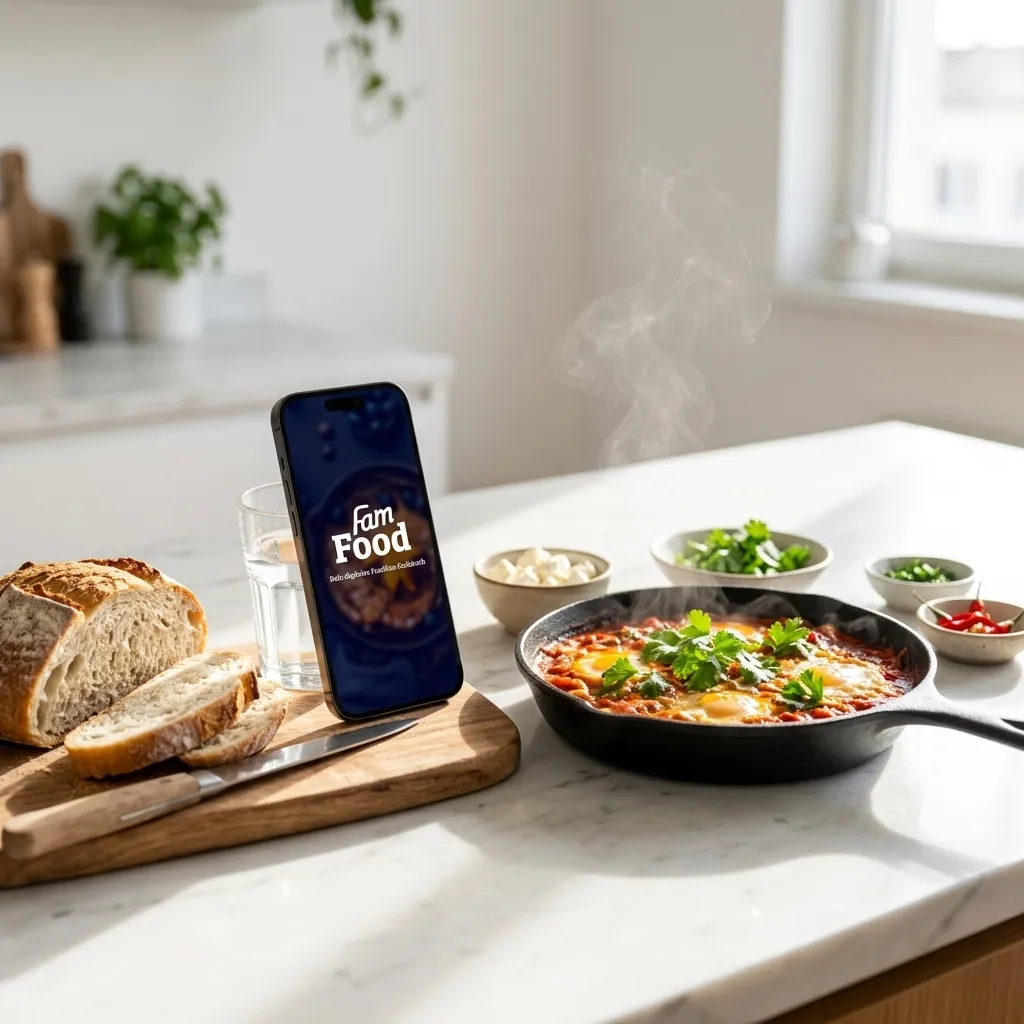
Shakshuka is the gold standard for one-pan efficiency. Step 1: bring canned tomatoes with onion and garlic to a simmer (5 minutes). Step 2: crack eggs directly into the sauce, cover (5-7 minutes). Step 3: serve with bread. Done. If you like, add cumin and paprika.
Chickpea stir-fry works the same way: toss canned chickpeas with bell pepper strips (fresh or frozen) in olive oil, season with cumin and salt. 14 minutes, vegan, packed with protein. A dollop of yogurt or a slice of bread on the side.
How do you plan lunch for the whole week in 10 minutes?
Spending 10 minutes on a dedicated lunch plan separate from dinner saves you roughly 15 minutes of decision-making each weekday and keeps your shopping more targeted. That's what we see in FamFood's meal-planning data: users who plan lunch separately open the app less often on weekdays hunting for ideas.
Planning lunch and dinner separately makes more sense than it first sounds. Dinner often involves more people, competing preferences, and more time. Lunch is a solo decision with a hard deadline. Combining them pulls lunch toward dinner's complexity.
The rotation method makes planning almost unnecessary: five base dishes, lightly varied each week. Shakshuka with feta this week, shakshuka with spinach next week. Chickpea stir-fry with bell pepper, then with zucchini. After three rounds, the base recipe sticks so well you won't need to check it again.
For the practical side, Kitchen Tips for Families: Simplify Your Routine walks through concrete strategies for building a weekly rhythm.
What do I do if there's really no time?
For days when even 20 minutes is too much: three no-cook options ready in under 8 minutes that don't taste like regret.
Overnight oats for lunch sounds weird. But: oats, milk or plant-based alternative, some yogurt, and berries. Stir it all together the night before. Pull it from the fridge at lunch, done. Filling, balanced, zero effort. The mental resistance is bigger than it should be.
Leftovers from dinner aren't failure. They're tomorrow's smart lunch. Cooked pasta, leftover potatoes, rice, pan vegetables. Heat briefly or eat cold as a salad. Once you see this as strategy, not a fallback, you naturally cook a bit extra at dinner. The post Rescue Your Leftovers: 7 Creative Ideas for Families goes deeper on that.
The five-minute rule: what can you prep the night before without calling it meal prep? Chop vegetables, make a dressing, open a can and transfer it to a container with a lid. That's not effort, that's a habit.
Are 20-minute dishes really nutritious enough for lunch?
Yes, if protein, fiber, and fat are on the plate. According to the German Society for Nutrition (DGE), a complete lunch should cover roughly 30% of your daily macronutrient needs, which is achievable in 20 minutes with the right ingredients.
What "balanced" actually means for a quick lunch: no nutrition textbooks, just a rule-of-thumb check. Do you have protein on the plate? Egg, legumes, tuna, yogurt. Do you have vegetables? Frozen counts. Do you have substantial carbs? Pasta, bread, potatoes. Three yeses and the lunch will carry you.
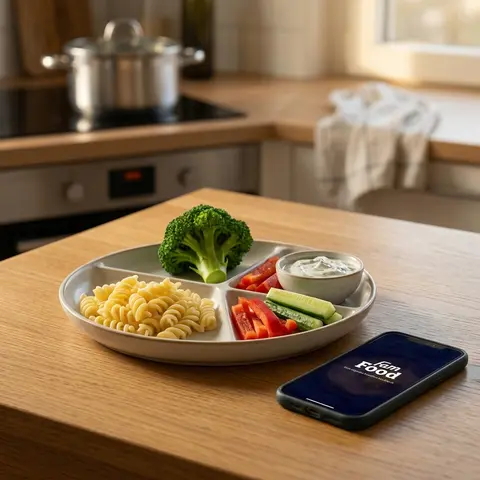
Many quick lunches actually outperform cafeteria food or delivery because you control the salt, fat, and sugar. A portion of spaghetti aglio e olio with frozen peas and Parmesan delivers carbs, plant protein, and fat from olive oil. A typical delivery pizza gives you similar calories but way more sodium and saturated fat.
The simplest check for any quick lunch: look at your plate. Protein, vegetables, carbs visible? You're good.
How do you salvage a lunch disaster?
Too salty, too dry, too bland: three quick fixes that rescue any midday kitchen mishap in under two minutes, without buying more ingredients.
Too salty: Acid fixes it fast. A squeeze of lemon juice or a splash of vinegar shifts your perception. Or drop a handful of uncooked pasta into the sauce, let it simmer briefly. The pasta absorbs the salt.
Too dry: A splash of water or broth in the pan, cover, two minutes on medium heat. The dish reabsorbs moisture and softens noticeably without getting watery.
Too bland: Caramelization saves every dish. Quickly pan-fry the contents over high heat until lightly browned. A splash of soy sauce or some grated Parmesan adds umami, the depth that takes a dish from "meh" to "make it again."
More rescue ideas for sauces gone wrong are in the post Salvage a Sauce: What to Do When It Goes Wrong.
Common questions about 20-minute lunch
What can I cook quickly for lunch if my fridge is nearly empty?
Eggs and canned tomatoes make shakshuka (12 minutes). Pasta and olive oil become aglio e olio. A can of chickpeas plus spices turns into a stir-fry. Frozen vegetables and broth cubes make soup. With four basics in the house, you're rarely truly empty.
How long does a lunch break need to be for cooking to make sense?
20 minutes is enough if you know what you're making. Budget 5 minutes for deciding and prepping, 12-16 minutes of cooking, and 2-3 minutes to wash the cookware. With a 20-minute break total, a no-cook option like a tuna wrap makes more sense.
Can I cook 20-minute lunches for kids too?
Yes, with small tweaks. Shakshuka without heat, pasta with peas instead of garlic, wraps with chicken instead of tuna. Everything in this post works kid-friendly if you adjust the spices. For more child-friendly quick recipes, check out Quick Kids' Meals: 8 Ideas for the Kitchen.
Which pasta dishes really finish in 20 minutes?
Spaghetti aglio e olio (16 min.), pasta with canned tomato sauce (18 min.), and penne with frozen peas and ricotta (17 min.) reliably come in under 20 minutes. The secret: use thin pasta (spaghetti or linguine cook faster than rigatoni) and make the sauce and pasta at the same time.
About FamFood
FamFood is the digital family kitchen for anyone who wants to eat well without spending hours on planning. We test recipes for real-world practicality, not Instagram perfection. What you read here, someone tried in an actual kitchen under actual time pressure.