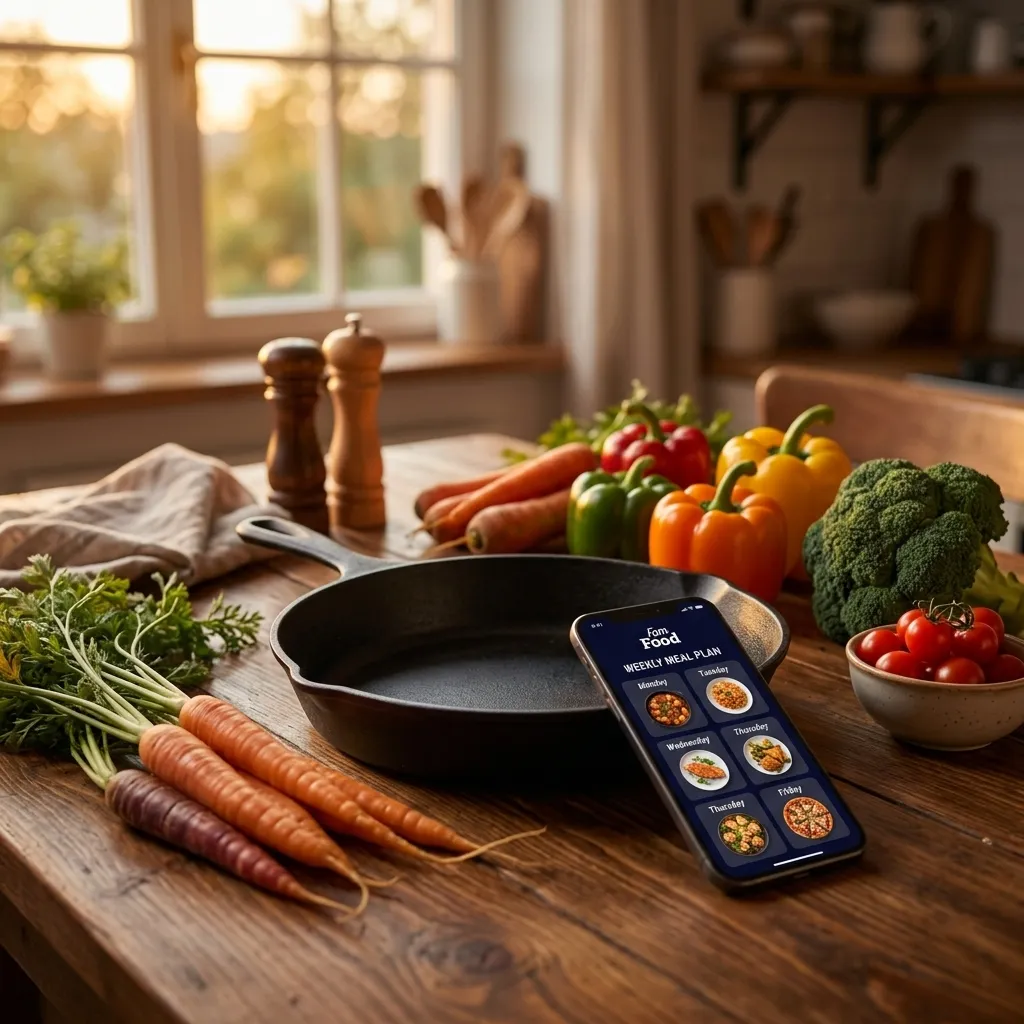
Monday, 6 p.m. You open the fridge. You close it. The kids ask for the third time what's for dinner. And you have no idea.
Most people think the same thing in that moment: I just don't have time to cook in the evenings. But is that actually true? What's really missing—and is it actually time?
Key Takeaways
- Time pressure, not lack of cooking skill, is the #1 reason families turn to processed food on weekdays, according to GfK research (2022).
- Just 15 minutes of batch prep per week keeps weeknight cooking consistently under 30 minutes.
- The 4-component formula (base + protein + vegetables + seasoning) makes recipes optional—you become the system.
- Three emergency recipes you know by heart save every plan-collapse moment.
Why do 30-minute dinners so often fail on Mondays?
According to a GfK study (2022), time pressure is the most cited reason families resort to processed food during the week—not lack of skill.
But here's where expectations flip.
The problem almost never lies in the cooking itself. It lies in the moment just before it. No decision made. No ingredients ready. No energy for one more choice. Researchers call it "decision fatigue": after making decisions all day, you reach for whatever's easiest at night. Monday is the weakest point in the weekly rhythm—no leftovers from the weekend, no prep done, complete exhaustion.
The time was there. The system wasn't.
If you fix three meal categories for the week and keep basic ingredients on hand, you won't have to make a single real decision in the evening. The actual cooking takes 30 minutes.
The antidote isn't a new recipe—and it doesn't take the ten minutes you're imagining.
What does batch prep actually deliver when you only have 30 minutes?
Batch prep doesn't mean standing at the stove for three hours on Sunday. Just 15 to 20 minutes of prep, once a week, can push actual weeknight cooking time consistently under 30 minutes because chopping, measuring, and deciding are already done.
What's worth prepping: wash and chop vegetables, make a sauce base from tomatoes and onions, cook chickpeas or lentils, prepare rice or quinoa as a neutral foundation.
What's not worth prepping: fresh pasta (gets soggy), fresh herbs (wilt), eggs (lose quality), salad greens (get watery).
What we see in FamFood: recipes with seven or fewer ingredients get cooked three times more often on weekdays than recipes with more than ten ingredients. Not because the longer ones taste worse, but because the mental effort before you start cooking is simply smaller. Fewer ingredients means fewer decisions, less shopping hassle, less leftover management afterward.
Batch prep works best as a fixed time slot, not a spontaneous action. Ten minutes on Sunday, refrigerator organized, done.
That leaves the question: what exactly happens in those 30 minutes, and which four slots decide whether the dish succeeds or flops?
The 4-component formula for every quick family dinner
Every dinner that hits the table in 30 minutes follows one simple pattern: a carbohydrate base, a protein source, quick-cooking vegetables, and a seasoning element. Master these four slots, and you stop needing recipes as a starting point. The formula becomes the recipe.
Slot | Options (under 12 min.) | Why it works |
|---|---|---|
Carbohydrate base | Pasta, couscous, tortellini, flatbread | Filling, cheap, always on hand |
Protein | Eggs, canned chickpeas, frozen salmon, sliced chicken breast | Cooks fast, no thawing needed |
Vegetables | Frozen broccoli, cherry tomatoes, spinach, bell pepper strips | No chopping time with frozen |
Seasoning | Harissa, soy sauce, crème fraîche + lemon, tomato paste | Lifts the dish from mediocre to memorable |
The seasoning component is the game changer. The same pasta with eggs and spinach tastes Asian with soy sauce and creamy-Mediterranean with crème fraîche and lemon. Two dishes, one foundation.
Which combos always work, and which never do?
Always: couscous + canned chickpeas + bell peppers + harissa. Pasta + egg + spinach + Parmesan. Frozen salmon + rice + broccoli + soy sauce.
Never (or rarely): flatbread + eggs + raw onions without a binding element—that's not a dish, that's a snack plate. And tortellini with harissa is bold, but your kids will look at you like you're an alien.
How to adjust the formula for picky kids
The trick: serve the seasoning component separately. Harissa goes on the adult plate, kids get crème fraîche or plain butter. Keep the protein separate—chickpeas beside the pasta, not mixed in. When kids can see the components, they feel in control, and that dramatically reduces resistance.
The formula is set—but the tool that determines how fast you execute it is probably still gathering dust in your drawer next to that spiral vegetable slicer.
Which kitchen tools actually save time, and which don't?
A sharp blade and a large cutting board save more time in real tests than any electric food processor because there's no setup or cleanup. If you still want to upgrade: a nonstick wok-style pan and a pressure-cooker lid for regular pots are the two best investments under €40.
Tool | Time saved | Worth it? |
|---|---|---|
Sharp kitchen knife (regularly honed) | 4–6 min. per dinner | Yes, always |
Large cutting board | 2–3 min. | Yes, immediately noticeable |
Nonstick wok pan (28 cm+) | 3–5 min. | Yes, under €30 |
Pressure-cooker lid | 8–12 min. for legumes | Yes, for batch prep |
Spiral slicer | 0 min. net | No, stays in the drawer |
Avocado tool | 0 min. net | No, a knife does it |
Large food processor | 3–5 min. (after 8 min. setup) | Rarely |
A good knife isn't an equipment investment—it's an investment in every single evening. Learn more in our Pans for Families guide: What you actually need.
The right tools are ready. Now you need the plan that keeps you from standing in front of the fridge on Wednesday reinventing dinner from scratch.
How do you plan five dinners in 10 minutes without repeating yourself?
The fastest method: pick three fixed category days—say, pasta, stir-fry, and soup—and fill the other two days with leftovers or wildcard recipes. You'll make no more than three decisions per week, and your family still won't know what's coming.
Day | Category | Example meal | Time needed |
|---|---|---|---|
Monday | Pasta | Pasta with egg, spinach, Parmesan | 20 min. |
Tuesday | Stir-fry | Frozen salmon, rice, broccoli, soy sauce | 25 min. |
Wednesday | Leftovers | Pasta bake from Monday's extras | 15 min. |
Thursday | Soup/stew | Lentil soup with flatbread | 30 min. |
Friday | Wildcard | Tortellini with jarred sauce, salad | 15 min. |
Your shopping list almost builds itself from this structure. Pasta day needs pasta, eggs, spinach. Stir-fry day needs frozen protein, frozen vegetables, soy sauce. Once you know the categories, you know what must always be in the house.
In the FamFood app, you can assign recipes directly to category days and adjust your weekly plan with one tap. The matching shopping list generates automatically.
Why "leftover day" shouldn't be a backup—it should be a real slot
Wednesday is leftover day. Not a backup plan, not a compromise. It's strategy. If you cook four servings of pasta on Monday, you're already planning Wednesday. Creative leftovers aren't a last-resort solution—they're an efficiency principle that cuts food waste and halves your effort. See concrete ideas in our post Creative leftover ideas: 9 that actually work.
And just when the plan is solid, Monday at 5:30 p.m. rolls around and it all collapses—what then?
What do you do when the plan falls apart at 5:30 p.m.?
Every weekly plan breaks down at least once per week. That's not failure—that's normal life with kids. Three recipes you can cook from your pantry, with no thawing, in under 20 minutes: these are your safety net, and you should know them by heart.
Emergency recipe 1: Shakshuka from the pantry. Canned tomatoes + onions + eggs + cumin. Everything in one pan, 18 minutes, done. Serve with yesterday's bread.
Emergency recipe 2: Pasta aglio e olio. Pasta, olive oil, garlic, Parmesan. No sauce, no prep, 15 minutes. Kids love it because it doesn't taste "weird."
Emergency recipe 3: Scrambled egg bowl. Eggs + whatever the fridge has: cheese, leftovers, bell peppers, tomatoes. 10 minutes. Make it complete with rice or bread.
Mental reframe: Plan B isn't failure. Plan B is part of the plan. Three pantry recipes mean you don't have a bad night—you have a different night.
Three recipes save dinner—but that doesn't automatically mean it's balanced, at least not the way you probably think.
How do you keep a 30-minute dinner nutritionally balanced?
According to the German Nutrition Society (DGE), a family dinner should be about half vegetables or salad, a quarter protein, and a quarter carbohydrates. That sounds like theory, but the 4-component formula handles it automatically—no calorie counting needed.
The most common mistake in quick cooking: people skip protein because it "takes too long." But eggs take 3 minutes, canned chickpeas take zero, frozen shrimp take 5. Protein is what keeps both kids and adults full until bedtime. Skip it, and you're hungry again at 9 p.m.
Frozen vegetables are often nutritionally equivalent to fresh, sometimes better, because they're frozen right after harvest. The German Federal Ministry of Food and Agriculture (BMEL) confirms that shock-frozen vegetables often have higher vitamin content than fresh produce stored for days. Frozen broccoli isn't a compromise—it's a smart choice.
Frozen broccoli beats fresh on vitamins—what else are you getting wrong about quick cooking?
Common questions about 30-minute dinners
What can I cook if I'm out of time and the fridge is almost empty?
Three ingredients almost always work: eggs, canned tomatoes, and pasta or bread. Shakshuka (tomatoes + eggs, 18 min.), pasta with tomato paste and Parmesan (15 min.), or scrambled eggs with bread (10 min.) are real meals, not snacks. A small pantry stash of canned tomatoes, pasta, eggs, and chickpeas makes almost every "empty fridge" a myth.
How do I cook dinner in 30 minutes every night without eating the same thing over and over?
The 4-component formula (base + protein + vegetables + seasoning) gives you four variables, and you only change one at a time. The same basic structure with a different seasoning becomes a completely different dish. Three category days per week give you variety without planning overhead.
Is meal prep really worth it for families with kids, or is it more work than it saves?
Yes, but only the light version: 15 to 20 minutes on the weekend, not hours of batch cooking. Chop vegetables, make a sauce base, cook some legumes. Anyone who preps more usually loses more freshness than time gained. The benefit is clear when kids complain at dinnertime and you're too decision-fatigued to figure out what to buy.
What ingredients should I always have on hand for quick dinners?
The top ten pantry staples: pasta, couscous, canned tomatoes, eggs, canned chickpeas, frozen vegetables (broccoli or spinach), olive oil, garlic, soy sauce, Parmesan. With these ten, you can cook at least seven different complete dinners without shopping once.
How do I get my kids to try new quick meals?
Not through persuasion—through control. Serve new ingredients separately, never hidden. Kids eat better when they see what's on the plate and can choose what to try. Research shows it takes three to fifteen exposures before a new food is accepted. Offering once and giving up doesn't cut it.
About FamFood
FamFood is a recipe app for families, built by people who stand in front of the fridge at 6 p.m. on weeknights too. We create systems that make real weekday cooking possible, not Instagram cooking. No perfectionism, no effort that doesn't pay off.




