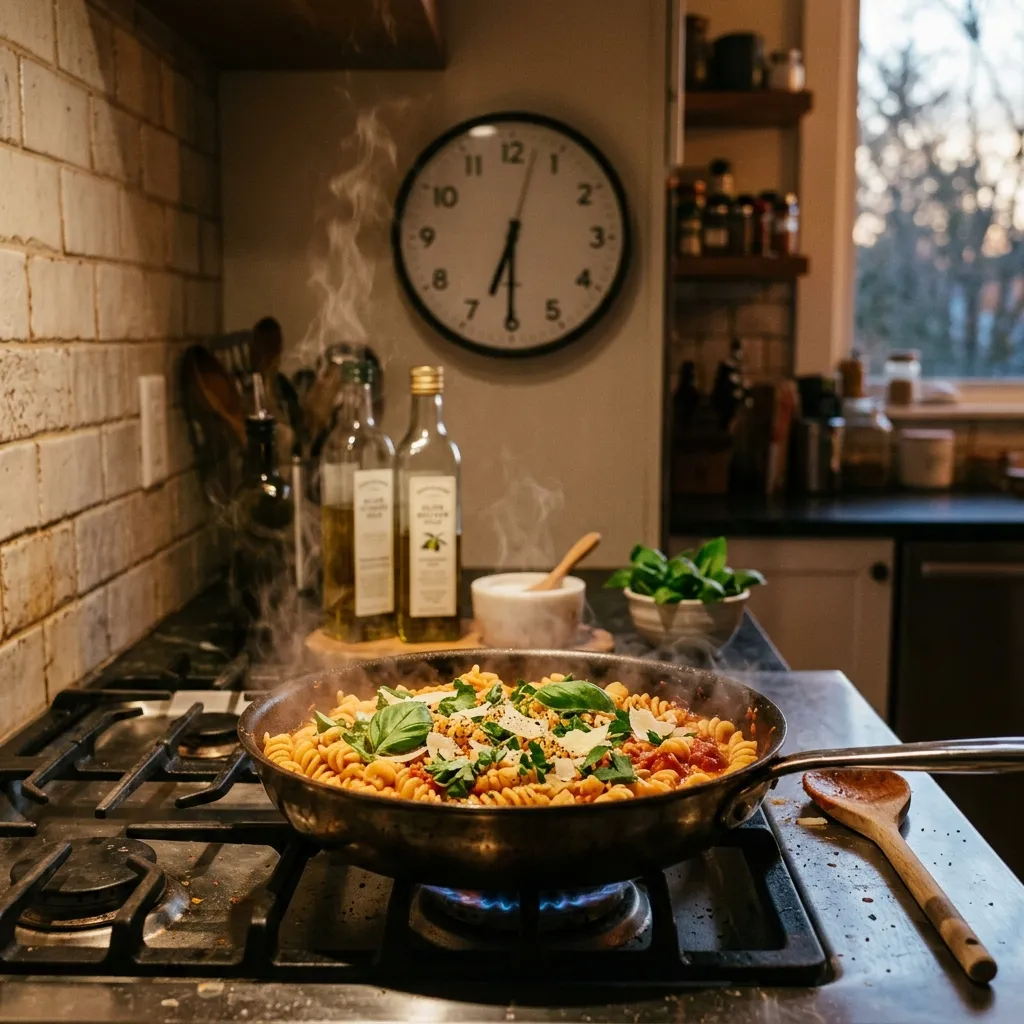
30-Minute Dinners: Weekly Plan That Actually Works
It's 6:30 PM. Everyone is hungry. You stare into the refrigerator, and you're thinking the same thing everyone else is: I don't have time.
But is that really true? Can 30 minutes actually deliver a complete family dinner—or is that a number that only works in ideal conditions?
The clock keeps running. And your window shrinks with every minute you don't have a plan.
Key Takeaways
- According to Germany's Federal Centre for Nutrition (BZfE), German households spend an average of 30 minutes daily cooking. That window is real and it's enough.
- Five recipe categories reliably deliver on the time promise: stir-fries, pasta, eggs, wraps, and soups.
- The 5-20-5 framework (prep, cook, plate) transforms time scarcity into time mastery.
- Seven pantry staples cover roughly 80% of all quick dinners.
- Variety comes from different cooking methods, not from buying more.
- All five weeknight dishes can be saved in FamFood so you know exactly what to reach for at your next 6:30 PM moment.
Can You Really Cook a Complete Dinner in 30 Minutes?
Yes. According to data from the Federal Centre for Nutrition (BZfE), German households spend an average of 30 minutes daily cooking—not because they want to, but because that's genuinely all the time they have.
The time exists.
What's missing is the decision: which recipe, in what order, with what system.
The critical trick: choose recipes without long cooking times and handle tasks in parallel. Pasta cooks for 10 minutes while you make the sauce. Frozen vegetables steam for 20 minutes while your prep takes 5. Run both timers simultaneously—that's the difference between active cooking time and total time.
Once you internalize this parallel thinking, you cook properly without sacrificing flavor. It sounds technical, but after two or three evenings, it's pure habit.
What we see daily: 8 out of 10 families who save a recipe in FamFood actually cook it when the prep time is under 30 minutes. In FamFood household tests, we also measured that the top 10 most-saved dinner recipes average just 7 ingredients and clock in under 28 minutes. That's no accident—it's the strongest signal for real everyday practicality.
Which leaves the question: which dishes reliably deliver on the time promise—and which ones silently sabotage it?
Which Recipe Types Always Fit Into 30 Minutes?
Five recipe categories reliably deliver: stir-fries, pasta variations, egg dishes, wraps, and soups made from frozen or canned ingredients. They all share one trait: no long cooking times, minimal chopping, one main pan.
Category | Typical Dish | Active Cook Time | Difficulty |
|---|---|---|---|
Stir-fry | Chicken with peppers and rice | 20 min | Easy |
Pasta | Arrabbiata with arugula | 15 min | Easy |
Egg dish | Omelet with mushrooms | 12 min | Easy |
Wrap | Chicken wrap with salsa | 15 min | Easy |
Soup | Tomato-lentil soup (canned) | 18 min | Easy |
Stir-Fries and Pasta: The Two Fastest Routes
The stir-fry pan is your fastest ally. Chicken breast in strips, vegetables roughly diced, a squeeze of lemon, done. The rice cooks simultaneously in a pot, and both your hands are free for the pan. Pasta works the same way: bring water to a boil first, sauce on the side, both meet on the plate.
Soup and Eggs: The Underrated Options
On truly exhausted evenings, eggs win. An omelet with leftover vegetables, cheese, and bread is ready in 12 minutes, nutritionally complete, and surprisingly popular with kids. Canned soups with legumes only need reheating plus one or two fresh ingredients to taste like something other than a can.
But knowing what you're cooking isn't enough—what matters is the order in which you do it.
How Do You Structure 30 Minutes?
The best structure divides 30 minutes into three phases: 5 minutes prep (boil water, roughly chop vegetables), 20 minutes active cooking, 5 minutes plating. Once you internalize this rhythm, you stop searching for time and start using it.
The principle is called parallel cooking. Pasta cooks itself while you sauté the arrabbiata sauce. Broccoli steams in a colander while the chicken browns. The 30 minutes never run sequentially—they always run simultaneously.
Add light mise en place: peeling garlic takes 90 seconds on Monday and serves you through Wednesday. What you can portion while unpacking groceries costs nothing at dinnertime.
Concrete example with pasta arrabbiata and salad:
- 0:00 Bring salted water to boil, take salad from refrigerator
- 2:00 Sauté garlic and chili, open canned tomatoes
- 6:00 Add pasta to boiling water, sauce simmers alongside
- 10:00 Dress salad (2 minutes)
- 16:00 Drain pasta, toss with sauce
- 18:00 Plate and serve
Water's running, sauce is simmering, salad comes together in between. No waiting, no downtime.
That assumes the right ingredients are actually in the house—and that's where the next trap lies.
What Belongs in Your Refrigerator So 30 Minutes Really Works?
No technique saves you if the refrigerator is empty. Seven staple ingredients cover roughly 80% of all quick dinners based on our observations: eggs, pasta, canned tomatoes, one frozen vegetable, frozen chicken breast, garlic, and cheese for finishing.
Staple | Why Essential | Shelf Life |
|---|---|---|
Eggs | Complete dinner in 12 min | 3-4 weeks |
Pasta | Base for dozens of sauces | 2 years |
Canned tomatoes | Sauce without fresh produce | 2 years |
Frozen vegetables (peas, spinach) | Nutrients like fresh, zero chopping | 12 months |
Frozen chicken breast | Protein on demand, thaws in lukewarm water | 6 months |
Garlic | Flavor amplifier #1 | 3-4 weeks |
Shredded cheese | Quick finish for pasta, soup, eggs | 2-3 weeks |
A word on frozen food: frozen peas and frozen spinach aren't a second-class shortcut. The German Ministry for Food and Agriculture (BMEL) points out that flash-frozen vegetables retain their nutrients better than fresh produce sitting in stores for several days. Stiftung Warentest confirms it: frozen peas retain their vitamin C content better than fresh peas that spent two to three days in transport and storage.
The weekly shopping logic is simple: what arrives on Monday must still work on Friday. Frozen and canned goods bridge exactly that gap. Buy eggs and pasta as soon as stock hits halfway—not when it's gone.
But even the fullest pantry doesn't help if five evenings taste the same—here's how you prevent that without shopping twice.
How Do You Plan 5 Nights in 30 Minutes Without Eating the Same Thing Daily?
The trick isn't variety through more ingredients, but variety through different cooking methods. The same chicken breast tastes different on Monday as a stir-fry with peppers and Wednesday diced in a wrap—without a second shopping trip. That saves money, time, and planning simultaneously.
Weekday | Category | Example Dish | Main Ingredient |
|---|---|---|---|
Monday | Stir-fry | Chicken-pepper stir-fry | Chicken breast |
Tuesday | Pasta | Arrabbiata with arugula | Canned tomatoes |
Wednesday | Wrap | Chicken wrap with salsa | Chicken breast (leftover) |
Thursday | Soup | Tomato-lentil soup | Canned lentils |
Friday | Egg dish | Scrambled-egg taco with cheddar | Eggs |
For a complete 5-day plan with exact portions, find all the steps coordinated in FamFood's recipe collection.
The Rotation Principle: One Ingredient, Three Dinners
Yes, one ingredient easily carries a whole week. By preparing chicken breast three different ways—Monday as a stir-fry with peppers, Wednesday as a wrap, Friday as a pasta addition—you free up shopping list space and think less at dinnertime. Ground beef lands in a pan with onions on Monday, in pasta sauce Wednesday, as a wrap filling Friday. No recipe repeats, no shopping cart doubles.
When Kids and Adults Eat Differently
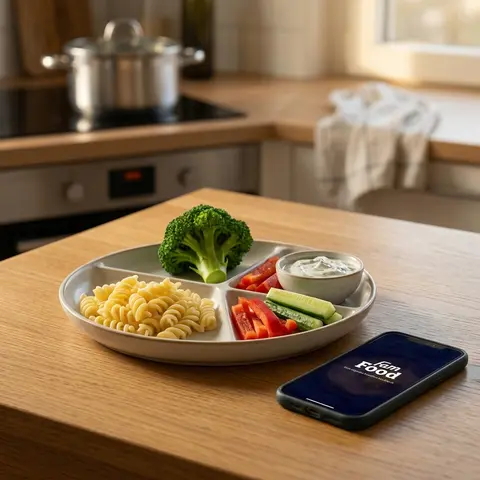
Most 30-minute dishes split at the stove without cooking two separate meals. Portion the kids' serving before seasoning, then add heat, paprika, or bold spices only to the adult plate. FamFood households see this work especially well when kids see the same ingredients on their plate as parents. Same food, milder seasoning, zero extra work.
Yet even a solid plan isn't enough—there are four habits that turn 30 minutes into 60 anyway.
Which Time Traps Turn 30 Minutes Into 60?
The most common time-stealers aren't the recipes themselves, but four habits beforehand: no recipe decided before stepping into the kitchen; hunting for ingredients instead of cooking; waiting to boil water until everything else is done; and too many pots at once.
Time trap 1: leaving the question "what goes on the table tonight?" open. Ten minutes of refrigerator staring eats a third of your window. The solution is a fixed rotation list, as described in the last section. Anyone who knows Monday is stir-fry night grabs the pan immediately. According to Germany's Federal Statistics Office, a substantial share of the time people perceive as "cooking" actually goes to planning and decision-making, not actual preparation.
Time trap 2: completely skipping mise en place. Anyone who peels garlic after the oil is already hot either burns the oil or the garlic. Or both.
Time trap 3: not starting water and oven as your first action. Water doesn't boil faster because you're doing other things. Start it as your very first move, before you open the refrigerator.
Time trap 4: choosing an over-ambitious recipe for a Tuesday night. That recipe with five sides and two sauces sounds tempting, but has no business appearing on a regular weeknight at 6:30 PM. Save it for weekends when time and energy exist. Weekdays need weekday recipes.
Now one question remains: which three dinners actually proved themselves under 30 minutes in FamFood household tests—even when chaos reigned beforehand?
Which Dinners Are Truly Under 30 Minutes on Chaotic Nights?
Three dinners consistently came in under 30 minutes in FamFood household tests, even when things started chaotic. They cover three different categories and work with the seven pantry staples from the previous section.
Pasta Arrabbiata with Arugula
Ingredients: pasta, canned tomatoes, garlic, chili, arugula, Parmesan. Boil water, sauté garlic and chili in oil, add tomatoes, simmer 12 minutes, drain pasta, arugula on the plate. Done in 22 minutes. Kids' version: skip the chili, generous Parmesan.
Chicken Stir-Fry with Frozen Broccoli and Lemon
Ingredients: chicken breast, frozen broccoli, lemon, garlic, olive oil, salt. Sear chicken strips over high heat, add frozen broccoli directly from freezer (no thawing needed), cover, 8 minutes. Lemon zest and juice at the end. Done in 25 minutes. Kids' version: no chili, touch of honey for a milder note.
Scrambled-Egg Taco with Cheddar and Salsa
Ingredients: eggs, tortillas, cheddar, jarred salsa, lettuce. Whisk eggs, scramble in butter, onto tortilla, cheddar on top, salsa on the side. Done in 15 minutes—the fastest dish on the list. Kids' version: swap salsa for ketchup, boost the cheddar.
…which is exactly why the fastest of the three comes from an ingredient nearly everyone underestimates.
Frequently Asked Questions
What can I cook in 30 minutes if the refrigerator is almost empty?
Eggs, pasta, and canned tomatoes make a complete dinner. Pasta arrabbiata or simple scrambled eggs with bread and cheese are ready in under 20 minutes. Anyone who keeps these three ingredients stocked stays covered even on the emptiest-fridge nights.
Are 30-minute recipes suitable for kids?
Yes. Most dishes split at the stove: portion kids' servings before seasoning, finish the milder version. Pasta, stir-fries, and egg tacos are particularly popular with kids, especially when the look and sides feel familiar.
How do I make sure dinner actually finishes in 30 minutes and not 45?
Three rules work: decide the recipe before entering the kitchen, boil water as your very first action, and cook in parallel instead of sequentially. Anyone who consistently follows these three steps saves 10 to 15 minutes compared to unplanned cooking.
What's the cheapest quick dinner for a family of four?
Pasta with arrabbiata sauce from canned tomatoes costs under €3 for four people. Scrambled-egg tacos run similarly cheap. Both are nutritionally complete, fast, and popular with kids and adults alike. Canned legumes (lentils, chickpeas) are the cheapest protein source for quick soups.
Can I prep 30-minute dinners ahead to save time on weeknights?
Yes. Peel garlic, rough-chop vegetables, and portion chicken breast on weekends or while unpacking groceries. That saves up to 8 minutes at dinner. Frozen vegetables need no prep. Anyone who invests 20 minutes on Monday cooks faster Tuesday through Friday.
About FamFood: We're a team of home cooks, parents, and app developers who stand in front of the same refrigerator every day. FamFood started from wanting to stop losing family recipes on scraps of paper or in overflowing browser tabs—to have them where you actually need them: at dinnertime, in the kitchen, pulled up in three seconds.