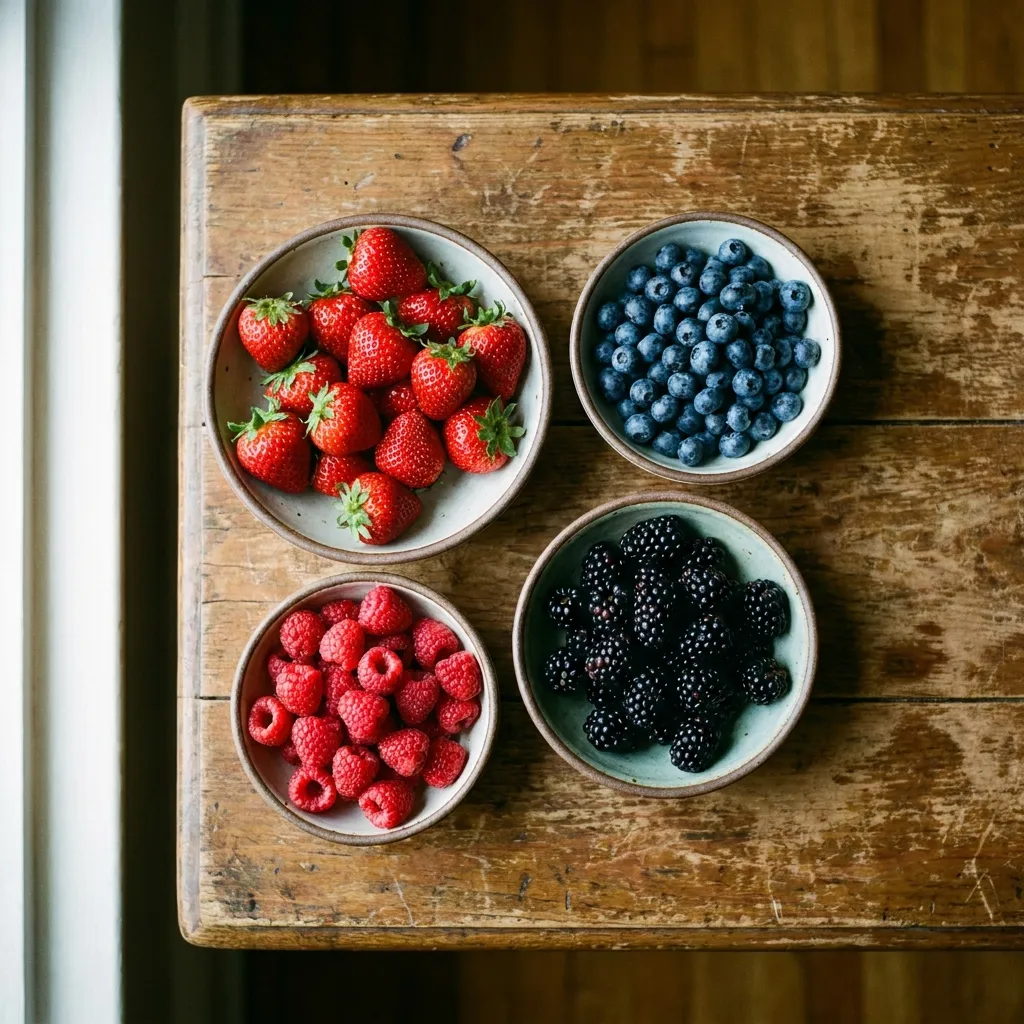
Berry Season: How to Preserve & Use Fresh Berries
A bowl of strawberries. Three days later: mushy, smelling of fermentation, gone. You had planned them for yogurt on Friday morning, for pancakes over the weekend, maybe for the kids' lunch boxes.
Those same berries could land on your breakfast table three months from now. No taste compromise, no hours of work. You just need the right method.
Key Takeaways
- Fresh berries last only 1 to 7 days depending on type; freezing extends that to up to 12 months.
- Berries retain up to 95% of their vitamins when frozen fresh, according to the German Consumer Center (Verbraucherzentrale).
- Overripe berries aren't waste—they're ideal for smoothies, purées, and jam.
- A four-person family covering 2–3 kg of berries during season keeps their supply stocked for about 3 months.
How long do fresh berries actually stay fresh?
Strawberries last 2–3 days in the fridge, raspberries only 1–2 days, blueberries 5–7 days, and currants 3–5 days. The exact shelf life depends on variety, storage, and ripeness at purchase. To really make the most of berry season, you have to act fast: store unwashed in the fridge, rinse just before eating, and process overripe ones immediately. Freezing stretches that short window to up to 12 months.
The biology is simple: berries are 80–90% water. Their cell walls are thin and collapse under pressure or heat. Mold spores need only moisture and a tiny break in the skin to spread. That's why you should wash berries just before eating, not when you get home from the store.
Peak season timing for common berries in Germany
Berry | Peak Season (DE) | Fridge Life | Freezes Well |
|---|---|---|---|
Strawberry | May–July | 2–3 days | Excellent |
Raspberry | July–August | 1–2 days | Good |
Blueberry | July–September | 5–7 days | Excellent |
Currant | July–August | 3–5 days | Excellent |
Blackberry | August–October | 2–3 days | Good |
The season in Germany runs from late May to late September, depending on region. If you don't act now, you'll pay three to four times as much in December for the same quality—if you're lucky.
Is freezing really the quickest method for busy families?
Yes, and it's also the most nutritious. Berries retain up to 95% of their vitamins when frozen fresh, according to the German Consumer Center, and keep up to 12 months. Active prep takes about 30 minutes; your freezer does the rest. No other method delivers this much shelf life with so little time invested.
The most common mistake: freezing wet berries. The moisture turns them into a solid block, and you can't portion individual servings later. Here's how to do it right:
- Rinse — quick splash under cold water, no soap.
- Dry — spread on a clean kitchen towel for 15–20 minutes.
- Flash-freeze — arrange berries in a single layer on a baking sheet, freeze for 2–3 hours.
- Pack — transfer to freezer bags or containers, squeeze out air, label with date and type.
For families, portion into 150-g units. That's one serving for two kids at breakfast, goes straight from freezer into yogurt, and thaws in 20 minutes at room temperature.
What we see over and over at FamFood: families that freeze berries in small portions actually reach for their stash daily. Those who freeze one massive block open it once, then leave it at the bottom of the freezer.
Here's something small that makes a big difference: at my house, 150-g portions only work if every bag gets labeled right away with the type and date. Without labels, the oldest portions sink to the bottom and get forgotten. Sounds obvious, but it happens in almost every family at some point.
Good options: standard zip-lock freezer bags or screw-top jars (don't fill to the brim—berries expand when frozen).
Jam or syrup: which method makes sense for your family?
Jam keeps up to a year, berry syrup 3–4 months in the fridge, and fruit purée without sugar can also be frozen. Which method works depends on how much time and how many berries you have.
Method | Shelf Life | Active Time | Sugar | Best For |
|---|---|---|---|---|
Freezing | 10–12 months | 30 min | None | Stockpiling, quick meals |
Jam | 12 months | 45–60 min | High (1:1 or 2:1) | Bread, breakfast |
Berry syrup | 3–4 months | 20–30 min | Medium | Drinks, desserts |
Fruit purée | 4–6 months (frozen) | 15 min | Low to none | Toddlers, yogurt |
Dried | 6–12 months | 4–8 hrs | Concentrated | Snacks, granola |
DIY berry syrup: basic recipe
For about 500 ml of syrup: 500 g berries, 250 g sugar, 200 ml water, juice of half a lemon. Combine everything, bring to a boil, simmer for 10 minutes, pour through a fine sieve into sterilized bottles. Kids can help push berries through the sieve. The syrup tastes great diluted with water, poured over pancakes, or as the base for homemade lemonade.
Jam formula as a rule of thumb: for strawberries and raspberries, 2:1 gelling sugar works best—so 500 g fruit to 250 g gelling sugar. This cuts the sugar and lets the berry flavor shine. Blueberries and currants have more natural pectin; they set reliably even with a 3:1 ratio.
Fruit purée for toddlers: no sugar, no stress
Just blitz 200 g berries with an immersion blender, strain through a sieve for smooth texture, pour into ice cube trays, and freeze. Each cube holds about 15–20 ml—perfect for baby food or yogurt. No preservatives, no added sugar, keeps in the freezer 4–6 months.
At FamFood, we notice that families with kids under 6 use berry purée in ice cube form about 30% more often than whole frozen berries. The portion size just fits smaller meals better, and toddlers like the soft texture.
Is drying or fermenting worth the effort?
Dried berries last 6–12 months and make a concentrated snack. But a dehydrator or oven takes several hours, and not every berry dries equally well.
For oven-drying: set temperature to 50–60°C on convection, crack the door slightly for moisture to escape. Blueberries dry in 6–8 hours into chewy, sweet dried fruit. Raspberries turn tough and bitter—barely worth the time.
Fermented berries, like blueberries pickled in apple cider vinegar, are a hidden gem for families who like to experiment. Let them sit in the fridge for two weeks, then use as a topping for porridge or pancakes. The flavor is complex, slightly tangy, and keeps without cooking.
Real talk: if you're short on weekday time, stick with freezing. Drying is a project for quiet fall weekends or school holidays when someone's around anyway. Fermenting needs almost no active work—just patience.
What do you do with overripe or mushy berries?
Overripe berries aren't garbage. They have the highest sugar content and work beautifully in smoothies, berry sauces, muffins, or as jam base. Only toss them if mold is visible.
Fastest use in 10 minutes: berry compote. Put overripe berries in a pot with a tablespoon of sugar and a squeeze of lemon juice, bring to a boil, simmer 5 minutes. It keeps in the fridge 4–5 days and works as yogurt topping, pancake sauce, or porridge companion.
For smoothie cubes: just blend overripe berries alone, no extras, pour into ice cube trays, and freeze. Two cubes in the blender tomorrow morning, you're done.
Important note on mold: if even one berry in a container shows mold, check all the others carefully. Mold spores spread through the air and by contact. Simply cutting off the moldy part doesn't help—you risk invisible spores. When in doubt, inspect the whole container and remove any contaminated berries decisively.
Here's a real job for preschoolers: sorting berries. Good ones on one side, soft ones for compote on the other, anything with white fuzz goes. Kids do this with enthusiasm and learn what fresh food actually looks like.
For more ideas if supplies run low, check out our guide on creative ways to use food scraps.
How do you plan berry season for your whole family?
If you buy or pick 2–3 kg of berries during season and freeze or preserve them right away, you'll have berry supplies from July through November with zero extra work once the plan is set.
Concrete math for a four-person family with two kids: realistically, such a family uses 300–400 g of berries per week (breakfast, snacks, one dessert). For 12 weeks of supply, that's about 4–5 kg of frozen berries plus 1–2 jars of jam and one bottle of syrup. In season, you buy 6–7 kg fresh, some gets eaten right away, the rest gets processed.
U-pick farms in Germany are not only cheaper but deliver fresher fruit than supermarkets. According to the German Federal Ministry of Food & Agriculture (BMEL), the share of direct farm sales for fruit in Germany keeps rising as consumers deliberately choose shorter transportation routes. Berries straight from field to freezer is the freshest option possible.
Price comparison summer vs. winter: a kilo of strawberries at the farmers' market costs €2–4 in July. In winter, imported supermarket berries run €5–9 with noticeably lower quality. If you buy 5 kg in summer and freeze, you save €15–25 in winter and get better fruit.
To make planning stick, we maintain a recipe collection at FamFood for jams, syrups, and purées so the next time you bring home a kilo of strawberries, you immediately know which recipe you made last time and what the kids actually loved. Find more on seasonal cooking as a whole approach in our seasonal guide on the website.
3 quick berry recipes kids will actually eat
The most popular berry recipes in families aren't complicated desserts. They're simple, reliable dishes that work with frozen berries and take under 20 minutes.
Recipe 1: Berry-yogurt parfait (5 min) No thawing needed: layer frozen berries in a glass, add Greek yogurt on top, granola as topping. Kids can assemble this themselves. Prep work: zero.
Recipe 2: Berry pancakes with frozen fruit purée (15 min) Make pancakes from your base recipe. Pop the berry purée cube directly from the ice tray into a small pot, warm it gently just before serving, pour over pancakes. Kids can stir the batter and slide the purée into the pot without anything going wrong.
Recipe 3: Berry oat porridge from your stash (10 min) Bring oats and milk (or water) to a boil, sweeten with a teaspoon of honey. Drop two frozen purée cubes or 150 g frozen berries right on top. Thawed in 5 minutes, the porridge keeps you full until lunch.
All three work equally well with fresh and frozen berries. That's the point: your summer stockpile makes these meals possible in October just as easily as in July.
Common questions about preserving berries
Can I use berries if just one has mold?
No. The moment mold appears on even one berry, inspect all others in that container carefully. Mold spores are microscopic and spread through air and contact. A single moldy berry in the middle is enough to invisibly contaminate neighbors. When in doubt: remove contaminated berries completely, process the rest right away.
Which berries freeze best?
Blueberries, strawberries, and currants freeze best. They hold shape and flavor well after thawing. Raspberries soften after freezing but work wonderfully in purées, smoothies, and sauces. Blackberries freeze well too—just dry them thoroughly before freezing.
How much gelling sugar do I need for homemade berry jam?
It depends on the gelling sugar type. With 2:1 gelling sugar, use 250 g sugar per 500 g berries. With 1:1, use 500 g sugar per 500 g berries. For families, 2:1 or 3:1 works better because less sweetness means more berry flavor and the jam still sets reliably.
Do berries lose vitamins when frozen?
Hardly any. Frozen berries retain up to 95% of their vitamins, according to the German Consumer Center, when frozen fresh. Vitamin C is heat-sensitive but cold-tolerant. The biggest loss comes not from freezing itself but from sitting at room temperature for hours before you freeze them.
Can I freeze berries straight from the farmers' market?
Absolutely—and it's the best option. Farmers' market berries usually come straight from local growers and are fresher than supermarket stock. Wash, dry, and freeze them the same day. The shorter the time between harvest and freezing, the more vitamins and flavor survive.
About FamFood: We're an app for families who want to make cooking simpler, not harder. Behind FamFood are people who stand at the stove with kids themselves and know that a good plan and a reliable recipe collection make the difference between stress and fun.




