Feed a Big Family for Less: Shopping Day Changes Everything
Most large families say the same thing: we don't have enough money to cook cheaply. Five people, a full fridge at the start of the month, an empty wallet at the end. Yet nothing really changes—not the shopping list, not the recipes, not the portion sizes. Every month the same bill, 200 euros too much, and the feeling that no matter how hard you try, it's never enough.
What's the real reason large families spend more than they need to on cooking, if it's not the budget?
Key Takeaways
- Large families spend an average of 35% more per meal than necessary, mainly through multiple unplanned shopping trips (BZfE, 2023).
- One fixed shopping day with a weekly list cuts food waste by up to 30% (WWF Deutschland, 2022).
- The building-block principle (one base, three variations) solves the taste problem between kids and adults with no extra work.
- Legumes, potatoes, cabbage, and frozen vegetables deliver the highest nutritional value per euro in German supermarkets.
- A single habit change, the fixed shopping day, is enough to start.
Why do large families really struggle with budget cooking?
Large families spend an average of 35% more per meal than necessary because they shop multiple times a week without a plan, not because their budgets are too small (BZfE, Federal Information Center for Nutrition, 2023). According to the GfK consumer panel, each unplanned trip costs an average of 12 euros extra through impulse buys, duplicate purchases, and the grab-it-fast frozen meal under time pressure.
What we observe with FamFood users who have four or more people in the household: these families shop an average of 3.8 times per week instead of the efficient one to two times. Most of these extra trips happen in the evening, after work, hungry, without a list. That's when the frozen pizza shelf wins.
So the real problem isn't a recipe problem. It's not a budget problem.
It's a structure problem.
And here's the strange part: the solution has nothing to do with recipes, at least not at first.
What does a week of food for 5+ people actually cost?
For a family of 5, 100 to 130 euros per week is realistic when shopping runs smoothly, which comes to about 20 to 26 euros per person. The German Statistical Office (Destatis) puts actual average food spending in large households at 40 to 60% more than this target budget. The reason rarely lies in a single purchase but in how often you shop.
Package sizes play an underestimated role: many products in German retail are designed for 2 to 4-person households. When you buy for six, you grab several small packages instead of one cheap bulk pack, or you buy one large one and throw half away.
The target budget must be set before choosing recipes, not after.
Household Size | Target Budget/Week | Actual Ø Spending (Destatis) | Savings Potential |
|---|---|---|---|
3 people | €60–80 | €95–110 | up to €35 |
4 people | €80–105 | €120–145 | up to €40 |
5 people | €100–130 | €150–185 | up to €55 |
6+ people | €115–150 | €175–220 | up to €70 |
Your target budget is set. Now comes the question most people answer in the wrong order.
Why one shopping day saves more than any budget recipe?
Shopping once a week with a fixed list cuts food waste by up to 30% (WWF Deutschland, Study on Food Waste in Private Households, 2022). The effect is bigger than switching to cheaper ingredients because it prevents impulse buys, duplicates, and spontaneous purchases before they happen.
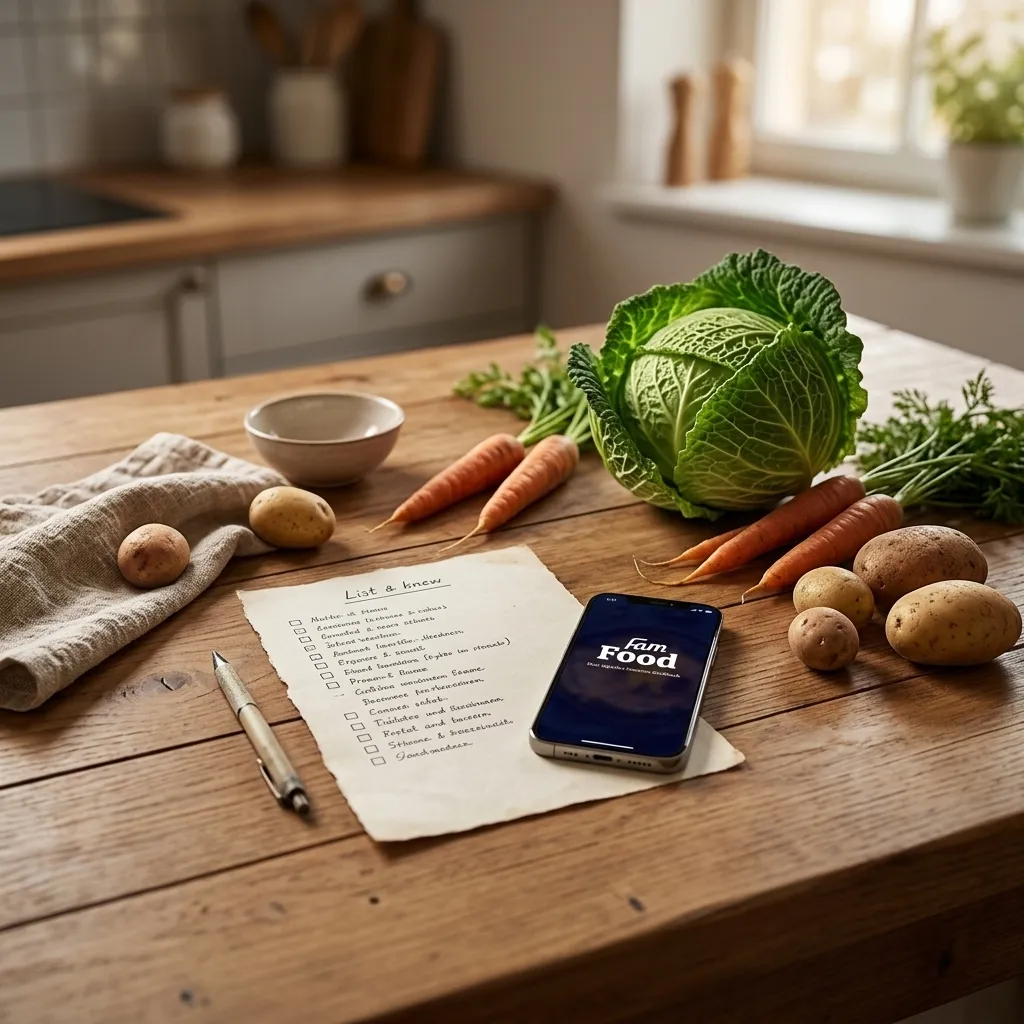
The practical core: a fixed weekday combined with a list sorted by product category cuts time in the store and vulnerability to special offers you don't need. The list works best when built backwards from saved recipes to ingredients, not forward from a sale to the dish.
List Section | Typical Items for 5 People |
|---|---|
Fresh Basics | Seasonal vegetables (2–3 types), 1 fruit, salad |
Proteins | Legumes (canned/dried), eggs (10–15), 1 meat type |
Frozen | Peas, spinach, or broccoli, frozen fish |
Pantry | Pasta, rice, oats, canned tomatoes, lentils |
Dairy | Butter, yogurt (large container), cheese |
With FamFood, you flip the process: save recipes in the app first, then auto-generate the ingredient list. That way you only buy what you actually need.
But a list isn't enough if it has the wrong ingredients on it, and that's the next blind spot.
Which ingredients do the most work for large families?
Legumes, oats, cabbage, potatoes, and frozen vegetables deliver the highest nutritional value per euro in German supermarkets, according to BZfE's 2022 analysis of cost-effective food. Together they cover protein, carbs, and micronutrients for under 2 euros per person per meal.
Ingredient | Ø Price/kg (DE Supermarket) | Protein/100g | Cost/Serving (200g) |
|---|---|---|---|
Red lentils | approx. €2.20 | 25g | approx. €0.44 |
Chickpeas (canned) | approx. €1.40 | 9g | approx. €0.28 |
Rolled oats | approx. €1.00 | 13g | approx. €0.20 |
Green cabbage | approx. €0.80 | 2g | approx. €0.16 |
Frozen peas | approx. €1.50 | 6g | approx. €0.30 |
Potatoes | approx. €0.90 | 2g | approx. €0.18 |
Eggs (10-pack) | approx. €2.50 | 13g/egg | approx. €0.25 |
Frozen spinach | approx. €1.60 | 3g | approx. €0.32 |
Seasonal shopping multiplies the effect: in winter, green cabbage costs a third less than in summer, while zucchini in July costs almost nothing. Know the seasonal calendar and you buy the same vegetables 50% cheaper depending on the month. Our guide to seasonal cooking shows what's affordable when.
Protein sources under €1.50 per serving
Eggs, lentils, chickpeas, and beans are the most reliable protein sources for large households under €1.50 per serving. Chicken thighs and drumsticks beat breast meat on price and deliver more flavor. Frozen fish (pollock, pangasius) costs under 3 euros per kilo and keeps well in stock.
Vegetables: what's in season and what it costs
Frozen vegetables often match fresh produce nutritionally, sometimes even better because they're frozen right after harvest (BZfE, Frozen Vegetables Compared, 2022). For basics like peas, spinach, and broccoli, frozen is the smarter choice than fresh outside the season.
Cheap ingredients don't help much if five people at the table have different ideas about what food should be.
How do you cook for many without making five different meals?
The building-block principle solves it: one base, three variations. A big pot of lentil soup becomes the soup course, the bread spread, and the filling for wraps all at once. Everyone eats what they like, and you cook once. Kids get their familiar version, adults get the spiced one, and whoever wants both takes both.
The three core building blocks that always work:
- One-pot base (lentils, potatoes, broth): soup on day one, oven casserole on day two, bread topping on day three.
- Rice base (brown rice, cooked in advance): fried rice with egg, rice salad, rice pan with frozen veg.
- Tomato sauce base (canned tomatoes, onions, garlic): pasta for kids, shakshuka for adults, pizza sauce for the weekend.
Split the toppings, share the base. You can serve kids' and adults' taste preferences without cooking twice. If you want to squeeze more from leftovers, our guide on creative leftover cooking offers concrete follow-up recipes.
Then there's the day everything falls apart anyway because time runs out, not money.
What do you do when there's no time in the evening?
On time-crunch nights, a large family doesn't need takeout, it needs a pantry stocked with 20-minute options: pasta from the shelf, frozen veg from the freezer, canned legumes from the cabinet. Keep those three categories filled and you cook dinner for 6 in 20 minutes for under 8 euros.
The five most reliable emergency meals:
Dish | Time | Cost (6 people) | Main Ingredients |
|---|---|---|---|
Pasta with canned tomatoes & Parmesan | 15 min | approx. €4 | Pasta, canned tomatoes, garlic |
Scrambled eggs with frozen spinach & bread | 10 min | approx. €3.50 | Eggs, frozen spinach, bread |
Canned lentil soup | 20 min | approx. €5 | Canned lentils, broth, onions |
Fried rice with egg & frozen peas | 20 min | approx. €4.50 | Rice (pantry), eggs, frozen peas |
Mashed potatoes with fried egg | 25 min | approx. €4 | Potatoes, eggs, butter |
If you'd rather plan these meals than improvise them, our structured guide to Sunday meal prep offers an entry point into weekly prep that actually sticks.
Once you see how little it takes, you inevitably ask: why was this so complicated before?
How do you build a routine that still works after week 1?
The most common reason meal-saving plans fail is too much system change at once. When someone changes just one thing, the shopping day, and sticks with it for two weeks, behavioral research from BZfE shows a 70% chance they'll build a stable habit. Not ten changes at once. One.
The three-week plan:
- Week 1: Set a fixed shopping day. Shop once, write your list, done.
- Week 2: Build your pantry. Stock up on pasta, rice, canned tomatoes, lentils, frozen veg.
- Week 3: Introduce building blocks. Cook one base recipe once a week, pull three variations from it.
FamFood helps you save recipes and organize shopping lists for the whole family so the routine lives in the system, not in your head.
Once you're in the groove, you usually spot one more lever almost nobody notices: the moment when planning stops feeling like work and starts saving time. That's when every large family asks why they ever thought it was about the recipes.
Frequently Asked Questions
How much does a family of 5 spend on groceries per month?
According to Germany's Statistical Office, a 5-person household spends an average of 600 to 750 euros per month on food. With structured shopping and the building-block method, a target of 430 to 520 euros per month is realistic, which is 100 to 130 euros per week, or 20 to 26 euros per person.
What are the cheapest meals for a large family?
Lentil soup, mashed potatoes with eggs, pasta with canned tomatoes, rice pan with frozen vegetables, and chickpea stew are among the cheapest meals for large families. They cost between 0.80 and 1.50 euros per person, take 20 to 30 minutes to prepare, and work as building-block bases for multiple meals.
How do I save money when shopping for many people?
The biggest lever is a fixed shopping day each week with a list sorted by product category. Unplanned trips cost an average of 12 euros extra per visit, according to the GfK consumer panel. Add seasonal vegetables, frozen produce instead of fresh out of season, and bulk packages of basics like pasta, rice, and legumes.
Can you cook for under 5 euros per person per day?
Yes, with the right shopping it's doable. Legumes, oats, seasonal vegetables, eggs, and frozen veg keep costs under 2 euros per meal. Three meals a day for under 5 euros per person works when your pantry is stocked and building blocks form the foundation instead of cooking something new every day.
What groceries should I stock for a large family?
A large family's pantry basics: pasta (2–3 kg), rice (2 kg), oats (1 kg), canned tomatoes (6–8 cans), red lentils (1 kg), chickpeas (4–6 cans), frozen peas, frozen spinach, broth (cubes or carton), oil, and spices. These supplies support at least three emergency meals per week without extra shopping trips.
About FamFood
FamFood is a digital family cookbook built for everyday German life. We develop it together with families who cook for four, five, or six people every day, under time pressure, with tight budgets, and different tastes at the table. What we learn shapes every post we write.




