Cabbage Season: The Family Veggie Nobody Wants
Most families reach for cabbage in winter because it's cheap. And most regret it afterward.
Three days after buying it, half the head sits untouched in the fridge. Nobody wants to touch it. Tuesday at 6 p.m., when the kids are hungry and the evening stretches ahead, it lands in the trash and the family orders pizza. The money is gone. So is the motivation to try again next week.
What if cabbage isn't the problem at all, but just the way nearly everyone cooks it?
Key Takeaways
- Cabbage varieties peak from October to March and cost up to 70% less than imported summer produce (German Federal Statistical Office, 2023).
- Cabbage odor develops only after 7 minutes at temperatures above 90 °C. Stay below that, and you avoid the smell entirely.
- Pointed cabbage is the most family-friendly variety for young children: mild, cooks quickly, minimal odor.
- Whole white cabbage keeps in the fridge for up to three weeks; cut cabbage lasts only 3-4 days.
- Cooking one cabbage dish per week from November to February lets your family try all the main varieties in a single season.
Why Does Your Family Buy Cabbage in Winter?
White cabbage, red cabbage, kale, and Brussels sprouts peak from October to March. At German markets, most of the supply comes from local farms, and the price difference compared to imported summer vegetables is dramatic: cabbage costs 60 to 70% less in winter than comparable amounts of zucchini, bell peppers, or eggplant. The German Federal Ministry of Food and Agriculture specifically lists cabbage as one of the most price-stable seasonal vegetables in the German winter. It's bought almost entirely for one reason: it's affordable.
Whether it actually gets eaten is a different story.
Cabbage Type | Peak Season | Flavor | Quick Cook Time |
|---|---|---|---|
White cabbage | October – March | mild, firm | 5-8 min. |
Red cabbage | October – March | slightly sweet | 15-20 min. braised |
Kale | November – February | robust, earthy | 10-15 min. |
Brussels sprouts | October – February | nutty | 5-7 min. |
Pointed cabbage | September – November | mild, tender | 3-4 min. |
Savoy cabbage | October – March | mild, soft | 5-8 min. |
But the real reason cabbage gets left behind has nothing to do with price. It has to do with smell, texture, and childhood memories. School cafeteria. Mushy vegetables. That smell in the stairwell. And that's exactly where almost every family makes the same mistake.
Is Cabbage Really Unpopular, or Does Nobody Just Cook It Right?
Cabbage smells harsh when cooked too long at too high a temperature. Sulfur compounds form only after roughly 5 to 7 minutes at temperatures above 90 °C. Cook cabbage below that, or eat it raw, and you have no odor problem, no bitter aftertaste, no unpleasant stairwell scenario. The problem isn't the vegetable. It's the cooking time: cabbage above 90 °C for more than 7 minutes activates the sulfur compounds. Below that, it stays mild, almost pleasantly sweet, and the smell stays away.
Cabbage doesn't need upgrading. It doesn't need disguising. It smells and tastes harsh because it's cooked too long.
Its bad reputation comes from generations of overcooked school cabbage: huge pot, lots of water, 20 minutes. Biochemically, that was sulfur gas production. Culinarily, it was a disaster. But cook cabbage for 4 minutes in a skillet instead, or make it raw with vinegar and oil, and you're eating a different vegetable entirely.
What FamFood users tell us again and again is their biggest mistake: they cook cabbage in the same pot as they did at home, with the same cooking time, then wonder why it tastes the same. The first step isn't a new recipe. It's a new timer.
Which brings us to the question of which variety actually suits your family—and that's less obvious than it sounds.
Which Cabbage Variety Fits Which Family?
For families with young children, pointed cabbage is the most accessible variety: milder flavor, cooking time of just 3 to 4 minutes, minimal odor during cooking. Kale is ideal for families focused on meal prep, since it actually gets sweeter after freezing. Red cabbage works best for weekends, because it needs time but requires little attention. According to a cabbage comparison from Stiftung Warentest, milder varieties like pointed cabbage and Savoy cabbage score particularly high with consumers who rarely prepare cabbage. Among the most-saved cabbage recipes in FamFood, 7 out of 10 use either pointed cabbage or Savoy—not white cabbage.
Pointed Cabbage and Savoy: The Mild Gateway Varieties
At FamFood, we observe this pattern regularly: families who try Savoy before white cabbage eat cabbage much more frequently afterward. It's about habit, not taste. Savoy is softer, milder, and forgives an extra minute in the skillet without turning harsh. Pointed cabbage can be sliced into fine strips and added almost invisibly to stir-fry dishes. Savoy works beautifully as a pasta substitute in casseroles—something kids often accept more readily than you'd expect.
For storage: both keep whole in the fridge for up to a week. Once cut, use them within 3 days.
Kale and Red Cabbage: For Those Ready for More
Kale needs frost, or at least cold, to break down its bitterness. Buy it in November, and you're buying it at the best time. Baked as chips in the oven (about 15 minutes at 150 °C), it's surprisingly accepted by kids as a snack—because the roasted flavors override the bitterness. Red cabbage benefits from acid: a splash of apple cider vinegar while braising, and its fibrous texture disappears completely.
Family Type | Suggested Variety | Why |
|---|---|---|
Toddlers (1-4 years) | Pointed cabbage | mild, soft, cooks fast |
School-age children | Roasted Brussels sprouts | roasted flavors appeal |
Meal-prep focused | Kale | freezes well, gets sweeter |
Sunday/extra time | Red cabbage | braised, minimal work |
Complete beginners | Savoy cabbage | versatile, forgiving |
But the best variety does nothing if your weekly plan doesn't include it.
How Do You Get Cabbage Into Family Meals Without Resistance?
The most direct path: introduce cabbage first in a role where it's not recognizable as "cabbage." Finely sliced pointed cabbage in ground meat stir-fries, Savoy as a noodle substitute in casseroles, kale in smoothies or as chips. Kids who meet cabbage as chips or with roasted flavors eat it far more often later in classic dishes—FamFood's community feedback shows this pattern consistently.
Three concrete entry points:
Pointed Cabbage Skillet: Slice finely, sauté for 3 minutes over medium heat with a little oil, then add cooked noodles and ground meat. The cabbage is there, but it doesn't announce itself.
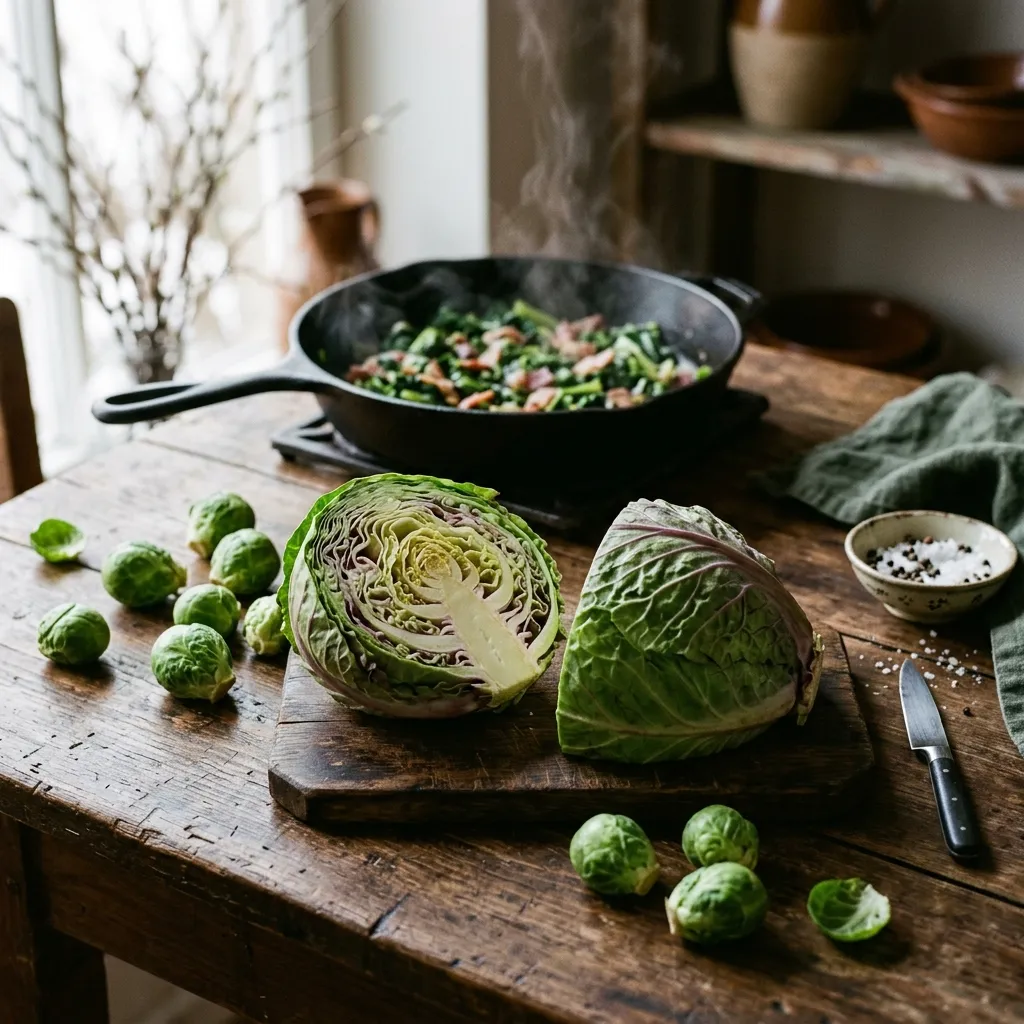
Brussels Sprouts from the Skillet: Halved, with butter and a teaspoon of honey in the pan. Not more than 7 minutes—then the cut sides caramelize. The small trick: Brussels sprouts with honey score surprisingly well with school-age kids because roasted flavors mask bitterness. Try it.
Kale Chips: Pluck leaves, toss with olive oil and salt, roast 15 minutes at 150 °C. Crispy, lightly salty. More snack than vegetable—and that's the point.
Cabbage also slices well ahead of time and keeps in the fridge. Pointed cabbage in strips lasts 2 days in a container, cutting your prep time on weeknights in half. Once you make it routine, you reach for the bowl without hesitation at dinner time. And once you know how to store cabbage properly, you stop throwing half of it away.
How Long Does Cabbage Keep, and What Do You Do With the Rest?
Whole white or red cabbage keeps in the fridge for up to three weeks. Cut cabbage lasts only 3 to 4 days. Savoy and pointed cabbage are more delicate: whole heads keep for a maximum of a week. Kale can be blanched and frozen, keeping up to 10 months without quality loss in soups and stews. According to the German Center for Nutrition (BZfE), vegetables stored poorly at home end up in the trash particularly often. Cabbage ranks among the most-wasted winter vegetables.
Cabbage Type | Fridge, Whole | Fridge, Cut | Frozen |
|---|---|---|---|
White cabbage | up to 3 weeks | 3-4 days | up to 12 months |
Red cabbage | up to 3 weeks | 3-4 days | up to 12 months |
Kale | 4-5 days | 2-3 days | up to 10 months |
Brussels sprouts | 4-5 days | — | up to 12 months |
Pointed cabbage | 5-7 days | 2-3 days | up to 8 months |
Savoy cabbage | 5-7 days | 2-3 days | up to 10 months |
Leftovers can almost always be repurposed: cabbage soup from what's left, a cabbage-and-egg skillet with potatoes, or cabbage rolls on the weekend. For more ideas on creative vegetable scraps, see the FamFood guide to using what's left over.
But what if your family still says "cabbage is cabbage" no matter how you prepare it?
Which Cabbage Recipes Actually Work on a Tuesday at 6 p.m.?
The three recipes below follow a single criterion: they work on a Tuesday at 6 p.m. with a tired adult and hungry kids. Under 30 minutes, one pan or one pot, ingredients that sit on every supermarket shelf in winter. And if you don't want to lose them, save them here.
Recipe 1: Pointed Cabbage Skillet with Ground Meat and Noodles (20 min.) Brown 300 g ground meat, add ½ pointed cabbage in fine strips, sauté for 3 minutes together, cook noodles separately and fold in. Salt, pepper, optionally a splash of soy sauce. Kid-friendly from 18 months. Vegetarian version: replace ground meat with chickpeas.
Recipe 2: Roasted Brussels Sprouts with Honey and Mustard (25 min.) Halve 500 g Brussels sprouts, toss with 1 tablespoon honey, 1 teaspoon mustard, oil, and salt. Roast at 200 °C for 20-22 minutes until the cut sides caramelize. Serve alongside bratwurst, potatoes, or rice. Kids who know this Brussels sprout version often ask for it unprompted.
Recipe 3: Kale Stew with Smoked Sausage or White Beans (30 min.) 200 g kale (fresh or frozen), 1 can white beans, 2 potatoes diced, 600 ml vegetable broth. Simmer everything together for 20 minutes. Add smoked sausage slices if you like. Filling, warming, uncomplicated. Naturally gluten-free.
Rotate these three dishes through the season, and after four weeks you'll have a family that knows cabbage. That's more than most accomplish in a whole winter.
How Do You Plan the Cabbage Season for Your Family Without Starting Over Each Winter?
The simplest way: plan one cabbage dish per week from November to February, rotating by variety. That's four varieties, four weeks, and your family knows each well enough after one season to develop favorites. Save the recipes digitally, and next year you won't have to search for recipes or cooking times again.
Week | Variety | Example Dish |
|---|---|---|
Week 1 | Pointed cabbage | Pointed cabbage skillet with ground meat |
Week 2 | Brussels sprouts | Roasted Brussels sprouts with honey-mustard |
Week 3 | Kale | Kale stew with beans |
Week 4 | Savoy cabbage | Savoy casserole with potatoes |
If you plan the way a Sunday meal-prep guide suggests, you skip the Tuesday rush entirely: the cabbage is already sliced, the recipe already saved. Cabbage isn't a compromise. It's a choice you make once and then don't regret.
Once you've done it once, next November you don't ask "what do I cook with cabbage" anymore.
Common Questions About Cabbage and Family
Which Cabbage Variety Do Kids Like Best?
Pointed cabbage is the most kid-friendly: it tastes noticeably milder than white or kale, needs only 3 to 4 minutes of cooking, and produces minimal odor. Roasted Brussels sprouts with a touch of honey appeal surprisingly well to school-age kids because roasted flavors mask the typical bitterness.
How Do I Prevent Cabbage from Smelling When I Cook It?
Cabbage develops its typical sulfur smell only after 7 minutes at temperatures above 90 °C. Stay below that threshold, or eat cabbage raw marinated in vinegar and oil, and you have no odor problem. The simplest solution: cook briefly over medium heat, not in a big pot with lots of water.
Can I Freeze Cabbage, and Does It Lose Nutrients?
Yes, cabbage freezes well. Blanch kale for 2 to 3 minutes before freezing; it keeps up to 10 months and loses almost no vitamin C or minerals. White and red cabbage also freeze well but become softer afterward, making them better for stews than skillets.
What's the Difference Between Savoy Cabbage and Pointed Cabbage?
Savoy has crinkled, dark-green leaves and a stronger, slightly nutty flavor. Pointed cabbage is lighter, has smooth leaves, and tastes milder and sweeter. Both work as gateway varieties. Pointed cabbage tolerates less cooking time and is slightly easier for beginners.
How Long Does Cut Cabbage Last in the Fridge?
Cut white or red cabbage keeps in the fridge for 3 to 4 days if well wrapped. Pointed and Savoy should be used within 2 to 3 days. Cover the cut surface with plastic wrap or store cabbage in a tightly sealed container.
Once you understand this, you buy cabbage next winter not out of necessity, but because you actually want it. And then you look for a place to keep your favorite recipes from getting lost.
About FamFood: We're a team of parents, home cooks, and tech enthusiasts driven by a single question: how does a family cook better during the week without reinventing dinner every night? FamFood is our answer—a digital family cookbook that grows with your kitchen.