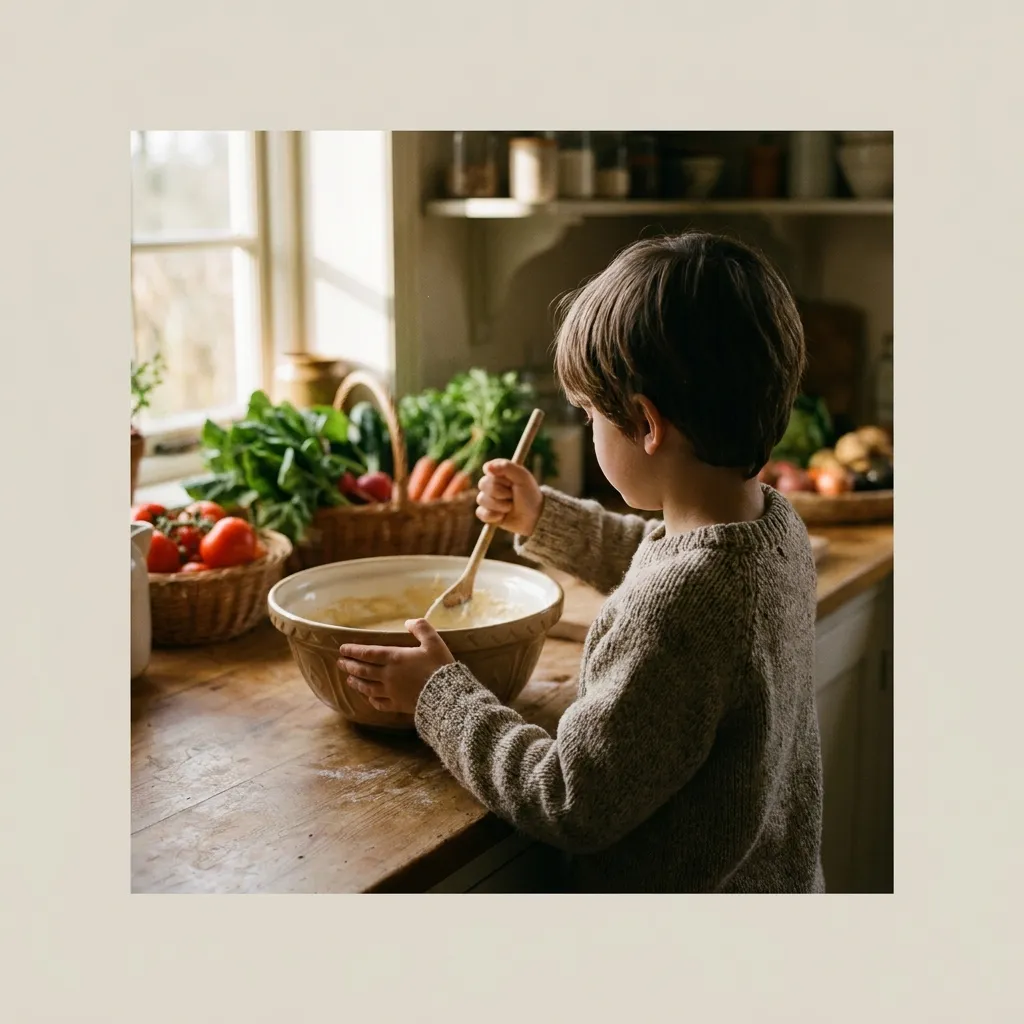
Cooking With Elementary Kids: What Actually Works
A 7-year-old can cook an omelet from start to finish by themselves. Stove, cracking the egg, stirring, done. It sounds bold, but elementary school teachers confirm it regularly: parents massively underestimate what their kids can actually do in the kitchen. And keep them out too long because of it.
This costs more than just time that could be used for practice. It costs confidence too, which directly affects whether kids will try something new.
The essentials at a glance
- According to the Federal Centre for Nutrition Education (BZfE), children measurably eat more of dishes they've prepared themselves. This "cooking effect" is especially strong in elementary school age.
- Tasks need to match development: 6–7 years, 8–9 years, and 10+ form three distinct stages with different motor and attention profiles.
- Age alone doesn't decide it—hand skills, focus span, and how much kitchen experience your child already has matter more.
- One regular cooking session per week beats sporadic cooking, even with picky eaters. That's what we see in the FamFood user community.
What can elementary kids really do in the kitchen?
Elementary kids aged 6–10 can do far more than most parents expect. The mistake is in how we measure it: many parents judge chopping and stirring against adult precision. That's the wrong standard.
The right standard: Which tasks build your child toward independence and show a tangible result in under 30 minutes? Dishes like homemade dip, salad, or simple scrambled eggs hit all three marks and stay safe under direct supervision.
According to the BZfE Food Literacy Report 2022, cooking skills in elementary school are a key fork in the road for later eating habits. What gets practiced now sticks long-term. Breaking this age group apart from toddlers and teenagers isn't arbitrary—it follows clear lines in motor development, focus, and rule understanding.
Why does this age group need its own category?
You can't lump elementary kids with toddlers or teens. A 6-year-old needs clear-cut roles: prep and measuring, not solo knife work at the stove. A 10-year-old has the motor skills and thinking to handle basic stovetop tasks—as long as an adult stays within arm's reach.
Developmental psychology draws sharp lines here. Motor skills, focus, and rule-understanding jump forward in bursts between 6 and 10, not smoothly. That's why the German Federal Ministry of Food and Agriculture (BMEL) recommends in its nutrition education guidelines that you match kitchen tasks to maturity, not to age alone.
Once hand skills, focus, and rule-understanding show real growth, many elementary kids can finish a simple dish on their own within their age group. Letting them choose the dish from a short list is an underrated motivation key.
Which tasks fit which age?
Between 6 and 10, clear patterns emerge: 6–7-year-olds master measuring and simple stirring reliably. 8–9-year-olds cut soft vegetables and cook pasta under supervision. 10-year-olds attempt their first stovetop work, with an adult present. These are developmental markers; real maturity beats age if hand skills, focus, and rule-understanding are clearly there.
Age Group | Fitting Tasks | Notes |
|---|---|---|
6–7 years | Measuring, stirring, washing salad, using a garlic press, simple peeling | Stovetop only under direct supervision, never knives alone |
8–9 years | Grating vegetables, cutting soft items with a child knife, cooking pasta, stirring simple sauces | Always move the knife away from your own hand |
10 years | First stovetop tasks: fried eggs, pasta, simple baking (supervised) | Aim for a finished dish in under 30 minutes |
In FamFood tests, we've seen that kids who cook regularly do one thing far more often than kids who cook now and then: they reach for snacks between meals much less. Add measurable gains in motor development and math skills (portions!), plus wider food acceptance—something research hasn't paid as much attention to as it deserves.
How do you motivate your child to actually join in?
The strongest motivation key is independence: your child picks the dish from a short list, not from your favorite recipes. That small choice power shifts the whole mood at the stove. A kid who chose what's cooking today stays longer and eats more of it afterward.
What if your child doesn't feel like it today? Don't push. Show one small, concrete step instead: a handwritten recipe list on the fridge, or a single ingredient your child can prep while you cook. Curiosity builds from watching, not asking.
The BZfE calls this the "cooking effect": kids who made a dish from start to finish eat measurably more of it, even if they're usually picky. This effect is especially reliable in elementary school because the success feeling is still tightly linked to the actual doing.
What we hear over and over from FamFood users: at first, parents often pick recipes that are too complex. The kid loses the thread after 20 minutes, the evening ends feeling like cooking together was more work than joy. That's not a kid problem—it's a recipe problem.
What safety rules apply when cooking with elementary kids?
Three core rules cover most of the risk: stove only under direct supervision, knives always cut away from your own hand, hot pots only adults touch. Once these three stick, you can decide a lot of the rest on the fly.
Fixed spots, fixed routines, and a visible result in under 30 minutes make cooking safer for elementary kids than any long explanation. Trying to cook together every night fails more often than needed. Building one reliable weekday beats daily spontaneous tries. Tested recipes sorted by age and effort live in the FamFood app.
What do the most-saved elementary recipes have in common?
Among the most-saved recipes in FamFood that were explicitly marked for 6–10-year-olds (analysis of roughly 1,200 saved recipes, spring 2025), 7 out of 10 had fewer than 8 ingredients. Compare that to general family recipes without age tags: just under 4 out of 10. Shorter ingredient lists aren't luck—they're the pattern behind cooking sessions that work.
Fewer ingredients cut prep time and keep focus within a doable window. We see it happen: once a recipe hits more than 10 ingredients, the child's involvement measurably drops in the second half. It's not a motivation problem—it's a thinking-power limit the recipe should respect.
Kitchen routine as a safety buffer: fixed spots for ingredients, one cutting board per person, a short tidy-up moment at the end. These three together work stronger than any single rule.
How do you build cooking into your weekly plan?
One set cooking session per week beats sporadic daily attempts, hands down. Friday or Saturday often work best because there's no school stress after. Less, but reliable: that's the formula that turns random tries into a real weekly ritual.
Three things help at the start: your child writes one ingredient on the shopping list (just one, enough for the beginning). Your child picks the dish from two or three choices. And: let your child repeat the same simple recipe—say, pancakes—for the first months until it feels solid. Safety comes from doing it again, not from variety.
Making progress visible works reliably: a photo wall in the kitchen, a tally of dishes made, or a small cookbook your child fills themselves. After three months of regular cooking, kids are noticeably safer in the kitchen than after a year of on-and-off help.
What does cooking actually give elementary kids?
Regular cooking builds three areas measurably in elementary kids: food acceptance (less picky eating), motor skills (cutting, stirring, pouring), and self-efficacy—the feeling that your own action creates a real result. According to the BZfE, kids who made a dish themselves eat measurably more of it, even if they're usually picky.
Cooking also trains math skills in ways no worksheet can: cutting amounts in half, timing intervals, weighing ingredients. The German Nutrition Counselling and Information Network (DEBInet) describes this kind of hands-on nutrition education as especially powerful because it links knowledge and experience at the same time.
And one more effect people often miss: kids who cook ask more questions about where food comes from and what it's made of. That's a gateway into nutrition education no school curriculum can replace. What gets practiced now eases the load in a few years when teens often stop wanting to cook together.
Frequently asked questions
At what age can elementary kids cook alone?
Around 10 years old, many kids can make simple dishes like scrambled eggs or pasta under supervision. Younger kids, 6–9 years old, reliably handle prep steps: measuring, stirring, and simple cuts with a child-safe knife. What matters isn't the birth date—it's whether hand skills, focus, and rule-understanding are clearly there.
What knife works for elementary-age kids?
Child-safe kitchen knives with rounded tips and good grip weight suit kids from age 7 on, best without serration. The cardinal rule: always cut away from your own hand. Find more on safety and age-fit tasks in the FamFood app, where recipes can be filtered by age group.
What can I cook with my 7-year-old?
At 7, vegetable dip, fruit salad, simple pancakes, or homemade smoothie work great. Quick rule: fewer than 8 ingredients, done in under 30 minutes, and something you can see and taste. Baking is another win, joining learning with fun. Easy muffins or cookies work reliably at 6–7.
How do you keep the kitchen clean when kids help cook?
Fixed spots for all ingredients, one cutting board per person, and a short tidy moment at the end. Kids brought into the cleanup from the start see it as part of cooking, not punishment after. A set weekday ritual helps here too: kids who know what comes when act safer and neater than during surprise sessions.
Bottom line: Start younger, explain less
Underestimating elementary kids in the kitchen is the most common mistake. Your child can do more than you think. All they need is the right task for their age, a weekday ritual that sticks, and a guiding hand instead of a taking-over one.
Start this week. One task. One dish. Then remember: what gets practiced now saves you serious time in a few years.
About FamFood
FamFood is a family cooking app from Germany, built by parents for parents. We save what works in real families, not what's in glossy cookbooks. Our recipes come with ages, times, and zero fuss.




