Cooking with Toddlers: Ages 2-3
Most parents think: it'll work better when they're four. The child is so small, the kitchen so dangerous, and in the end you do everything again anyway. So you wait.
And right then comes the question nobody says out loud: What tasks can a 2- or 3-year-old actually handle in the kitchen without it becoming dangerous or frustrating?
The answer is not "none." But it's not straightforward either, because it depends on what you expect from the child, and what you're willing to let go of yourself.
The essentials upfront
- Children between 18 months and 4 years are in the developmentally strongest phase for learning by imitation. The BZfE (German Federal Centre for Nutrition) explicitly considers kitchen involvement without access to stoves and knives as developmentally beneficial from age 2.
- 2-year-olds stay actively engaged for 4 to 7 minutes; 3-year-olds up to 12 minutes.
- A few repeated tasks build more routine than many different recipes.
- Children who help are calmer, not more restless.
Are 2- and 3-Year-Olds Really the Best Years to Start Cooking Together?
Children between 2 and 3 are in a sensitive phase for learning by imitation: everything an adult does, they want to repeat. The German Youth Institute describes this period as a phase when children actively integrate everyday routines into their self-image, meaning they don't just want to watch, they want to belong. Developmentally, the window between 18 months and age 4 is proven to be the strongest for basic motor skills and routine-building. Start here, and you'll face less resistance later, not more.
This sounds like more work. Here's the shift: Toddlers who regularly take on the same small task need less supervision while cooking the following week, not more.
They're occupied. They're included. They're not standing around restlessly demanding attention because they have nothing to do.
If you miss this window, you're not fighting lack of interest, you're fighting a habit that's by then established without the kitchen. The child eventually just stops asking.
Short time frames are completely adequate: 5 to 10 minutes per session isn't a compromise for 2-year-olds, it's developmentally appropriate. Fine motor skills and grip strength develop at exactly this age, and early positive kitchen experiences measurably reduce later picky-eating phases, when children consistently reject new foods, as the BMEL (German Federal Ministry of Food and Agriculture) confirms in its recommendations on child nutrition.
But what exactly should a 2-year-old actually do without the kitchen descending into chaos?
What Can 2-Year-Olds Really Do in the Kitchen?
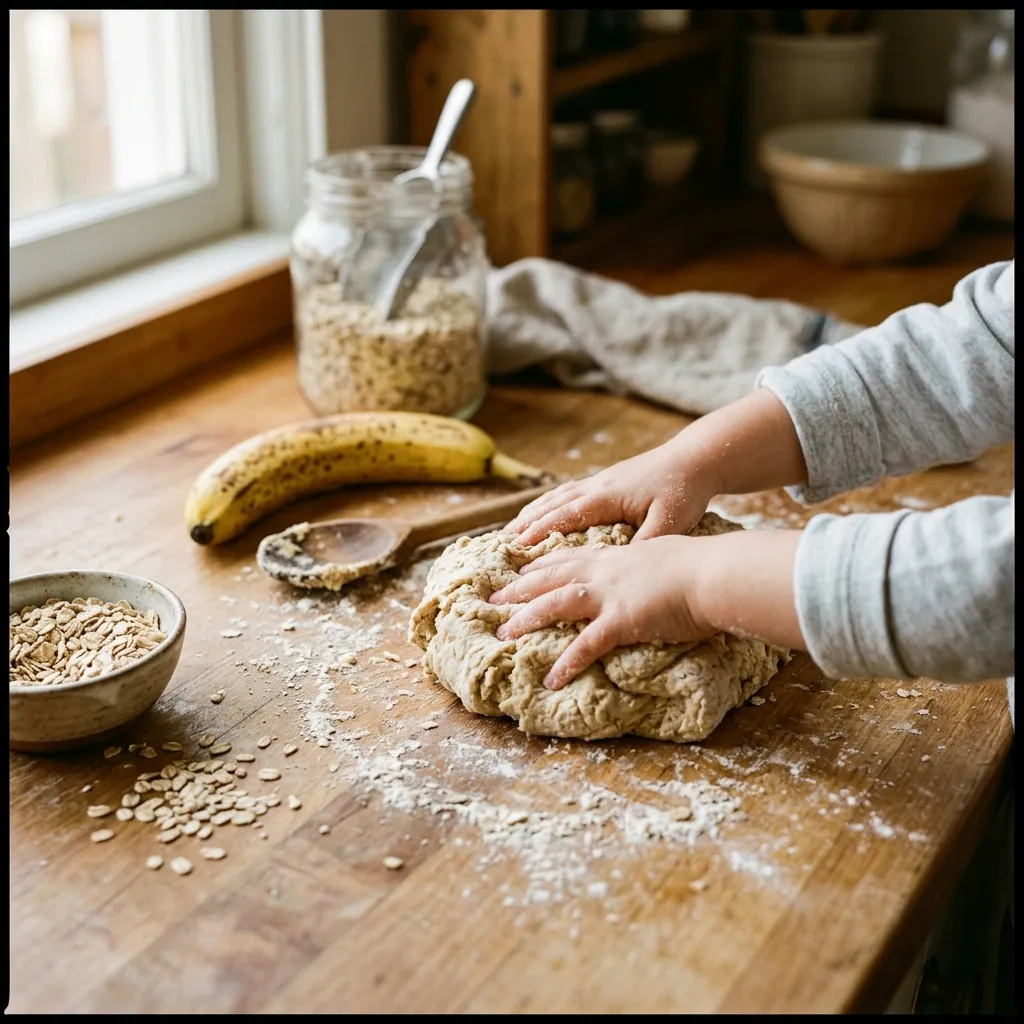
A 2-year-old can safely pour ingredients into a bowl, knead dough with their hands, mash soft foods like banana or cooked carrot, and measure water. This works even while you're preparing the rest of the dish, because the tasks don't demand constant supervision but clear boundaries. Tasks requiring precision, sharp tools, or heat stay off the table. The limit isn't age alone but attention span and grip strength. At 2 years old, that's actively 4 to 7 minutes.
Task | Safe at 2 years? | Why |
|---|---|---|
Pouring ingredients into a bowl | Yes | No risk, clear action |
Kneading dough with hands | Yes | Fine motor skill, no tools |
Mashing soft foods | Yes | Banana, cooked carrot |
Pouring water into measuring cup | Yes | With accompaniment |
Stirring with wooden spoon | Yes | In a stable bowl |
Measuring oats | Yes | With kitchen scale |
Cutting (even with dull knife) | No | Grip strength and coordination not ready |
Using a grater | No | Injury risk |
Operating the stove | No | Consistently off-limits |
Immersion blender | No | Too loud, too dangerous |
What we observe in the FamFood community: Among the most saved toddler recipes in the app, 7 out of 10 need fewer than 6 ingredients, and these are exactly the ones most often shared as "my recipe" with photos of the kids. Overwhelm usually doesn't come from the task itself but from too many tasks in a row. A 2-year-old who's mashed the bananas is done. They don't need a second task afterward, they need a clear ending.
At 3, the list already looks different, and the difference is bigger than most parents expect.
What Can 3-Year-Olds Do More Of, and Where's the Line?
A 3-year-old can already cut soft foods like bananas, strawberries, or cooked pasta with a child's knife with a dull blade, tear lettuce with their hands, stir ingredients with a whisk, and repeat simple recipe steps if they're always the same. This makes 3-year-olds reliable kitchen partners for short stretches, not chefs-in-waiting. The stove stays off-limits, regular knives too. Attention span rises to 8 to 12 minutes, and grip strength is noticeably more stable.
Task | Safe at 3 years? | Note |
|---|---|---|
Child's knife (dull, serrated) | Yes | Show finger grip, soft ingredients only |
Cutting bananas and strawberries | Yes | With child's knife and cutting board |
Using a whisk | Yes | In a deep bowl |
Tearing lettuce with hands | Yes | Classic starter task |
Repeating simple steps | Yes | The same recipe three times is worth more than three different ones |
Using a grater | No | Grip control not sufficient yet |
Immersion blender, hand mixer | No | Noise and injury risk |
Stove, oven | No | Consistently a parent task |
Pouring boiling water | No | Burn hazard |
A child's knife with finger guide, serrated edge, and 12-14 cm length is worth the investment. Cheap knives with smooth blades slip more easily than good dull ones. That's counterintuitive but true.
And repetition isn't a teaching trick, it's the principle: the same recipe three weeks running brings more than ten different dishes, because the child knows what's coming next and stays calmer and more focused as a result.
Which recipes actually work in practice without you spending half the time cleaning up afterward?
5 Recipes That Really Work with 2- and 3-Year-Olds
The best recipes for toddlers have three features: few ingredients (maximum 6), no heat tasks for the child, and a visible result in under 15 minutes. Too many steps overwhelm attention span and end in frustration on both sides. You can structure this before the child even sits down at the table.
The five recipes that prove themselves in practice:
- Banana bread batter (2-year-olds mash, 3-year-olds stir)
- Overnight oats layering (pouring as the main task, result visible instantly)
- Pizza dough kneading and topping (hands as the only tool, barely any mess on a smooth dough)
- Fruit skewers (no heat, instant result, pride guaranteed)
- Salad dressing in a jar (one task, 30 seconds, done)
Banana Bread with Toddler: Step by Step
Two ripe bananas on a plate, one fork, one bowl. The child mashes. That's the whole task for the first time. Then oats and an egg come in, and the child stirs with a spoon. If the child is 3, they get to cut the banana into pieces first with their child knife.
The parent bakes the banana bread alone. The child still has a result they recognize, and that's the core. In the FamFood app, you'll find several variations built on exactly this principle: few ingredients, one clear child task, one visible result.
Pizza Dough as the Classic: Why It Fits So Well
Pizza dough doesn't stick, it springs back, it looks like something's happening. Children between 2 and 3 can knead for 3 to 5 minutes, which almost exactly matches their active span. Topping it afterward is a second separate task that even a 2-year-old can handle without coordination problems: spooning tomato sauce, sprinkling cheese.
No knife. No stove. Big result.
Recipes are one thing, but what do you do when your child stops midway and walks off?
How Do You Handle It When the Toddler Loses Interest?
Toddlers stop activities when they're overwhelmed, tired, or simply done. That's not lack of cooking interest, it's normal development. Force it, and you burn the kitchen as a positive place. The solution: plan short units, create a clear ending moment, for example "Now you get to put the dough in the pan," and let the child go.
The average active participation span is around 5 minutes for 2-year-olds, around 10 minutes for 3-year-olds. That's not a problem, that's the plan.
What works well in the FamFood community: children who always take on the same closing task, for instance always putting the finished product in the pan or on the plate, stay engaged longer over several weeks. The ritual creates anticipation, and anticipation creates endurance.
No pressure on refusal. Try again next week. The imitation window doesn't close overnight, there's room to move.
And then there's the question almost all parents ask before they start but rarely say out loud.
Is Cooking with Toddlers Really Safe If You Set It Up Right?
Yes, if clear boundaries are established from the beginning. The BZfE (German Federal Centre for Nutrition) considers kitchen activities without stove and knife access safe and developmentally beneficial for children from age 2. The most common accidents don't happen during supervised cooking, they happen when kids reach unsupervised into kitchen cabinets. That means: structure protects, not absence from the kitchen.
Three safety rules toddlers actually understand:
- "Hot": say it consistently every time the stove is on. Don't explain, just name it.
- "Sharp": same for knives and graters. The child learns the category, not the theory.
- "Mom's/Dad's job": a fixed term for everything the child mustn't touch.
Stand stability is an underestimated safety issue: a learning tower or a wide step stool with a rail makes the difference between a child who can hold on and one who tips. Drawers with knives and graters need to be locked before you even start. Stiftung Warentest recommends drawer locks for kitchen child safety that children under 3 can't open themselves.
Safety covers one half, but how do you turn one-time trying into a real kitchen routine that doesn't blow up your daily life?
How Does One-Time Trying Become a Real Kitchen Routine?
Routine comes not from variety but from repetition. Same recipe on the same day of the week, same task for the child, same closing action. Parents who try a new recipe weekly report more rejection than those who bake the same thing for a month.
The simplest start: Saturday morning, one recipe, four weeks running. Only then switch.
The child doesn't need a new recipe. They need "their recipe." Once they feel they know what's coming and can make it work, willingness to help next time goes up.
If there are siblings of different ages, a clear task split helps: the younger one stirs, the older one measures or reads the amounts. Each needs a visible role, not a big one and a small one.
Once you've experienced that, you wonder why you didn't start earlier. And at exactly that point, it's worth saving the recipes somewhere so the child recognizes "their recipe" next time and says: I know this one.
Frequently Asked Questions
From what age can a child help in the kitchen?
According to the BZfE, kitchen activities without stove and knife access are safe and developmentally beneficial from age 2. Many children start stirring and pouring at 18 months if brought to counter height. Adult supervision remains complete until at least age 6.
Which kitchen tasks are safe for 2-year-olds?
Pouring, stirring with a wooden spoon, kneading with hands, mashing soft foods, and measuring water are safe starter tasks. Anything involving knives, graters, stoves, or heavy pots stays off the menu. Active attention span is 4 to 7 minutes.
Which child's knife is right for 3-year-olds?
A child's knife with a dull serrated blade, finger guide (a raised back for resting the index finger), and 12-14 cm length. Dull serrated blades grip soft ingredients better than smooth ones and slip less easily. Always use with a cutting board and direct supervision.
How long can a toddler stay actively involved in cooking?
2-year-olds typically stay engaged for 4 to 7 minutes on average; 3-year-olds 8 to 12 minutes. That's developmentally appropriate, not a shortcoming. Plan sessions shorter than your child's span and build in a clear ending moment, and you'll have far fewer dropouts and more enthusiasm for next time.
What do I cook with my 2-year-old that doesn't take forever?
Mashing banana bread batter, layering overnight oats, making fruit skewers, or shaking salad dressing in a jar. All four recipes need a maximum of 6 ingredients, no heat for the child, and finish in under 15 minutes. Your child gets a real task and a visible result.
About FamFood: FamFood is a digital family cookbook app for the German market. We collect what actually lands on the table, not what sounds theoretically healthy. Built by a family, for families.