Most parents think: too much salt is a cooking problem, over-seasoning, too many times reaching for the salt shaker. Really?
If you never touch the salt shaker, where does all that salt come from that breaks your child's daily limit?
Your child's palate gets permanently calibrated in the first few years of life. If you don't change course now, you miss the only window when that baseline can still be shifted. And the school lunch packed tomorrow morning decides whether your child has already hit their daily maximum by 8 a.m.
Key Takeaways
- Children aged 4–6 should eat no more than 3 g salt per day according to Germany's DGE; school-age kids aged 7–14 should eat no more than 5–6 g.
- Bread, processed meats, and ready-made products account for roughly 50% of kids' salt intake, before any cooking happens.
- The 10% rule: reduce salt slightly each week, and the new baseline sticks within a month.
- Products with more than 1.25 g salt per 100 g are classified as high-salt by Stiftung Warentest.
How much salt do children actually need?
Children aged 4–6 should consume no more than 3 g salt daily; school-age children (7–14 years) no more than 5–6 g. By comparison, the average German adult eats around 8–10 g daily, nearly triple the adult recommendation and more than double what a primary school child can handle. That's not a small margin—that's a gap that needs closing early.
Why are children more sensitive? Children's kidneys are smaller and work less efficiently than adult kidneys. Excess sodium can't be excreted quickly enough, which strains blood pressure and long-term affects the cardiovascular system. According to the German Society for Nutrition (DGE), persistently elevated blood pressure appears as early as school age and measurably raises later heart attack and stroke risk.
Age Group | DGE Salt Guideline/Day | Sample meal that hits the limit |
|---|---|---|
1–3 years | max. 2 g | 1 slice of toast with butter and cream cheese |
4–6 years | max. 3 g | 1 sandwich with ham sausage |
7–10 years | max. 4 g | 1 serving instant noodles |
11–14 years | max. 5–6 g | 1 frozen pizza (half) |
Adults | max. 6 g | 2 slices bread + cheese + soup |
The table shows: one meal alone can max out a day's salt budget. That changes where the real problem sits—not where most people look.
Where is the hidden salt in your child's daily routine?
Bread, processed meats, and ready-made products account for roughly 50% of children's daily salt intake, according to the German Federal Ministry of Food and Agriculture (BMEL), before a single pinch of salt goes into cooking. So the kitchen isn't usually the problem. The supermarket is.
A realistic scenario: breakfast with a slice of whole-grain bread and salami (about 1.5 g salt), school lunch with cheese (about 0.8 g), afternoon snack of a few salt crackers (about 0.6 g), dinner pasta with jarred pesto (about 0.9 g). That adds up to roughly 3.8 g without ever touching a salt shaker. And no ketchup.
Food | Average salt per serving | Why it matters |
|---|---|---|
Ham sausage (2 slices, 40 g) | ~1.2 g | Daily school lunch item |
Gouda 45% (2 slices, 40 g) | ~0.7 g | Seems healthy, high in sodium |
Wheat bread (2 slices, 80 g) | ~0.8 g | Base salt source, often underestimated |
Ketchup (2 tbsp, 30 g) | ~0.5 g | Kids' favorite sauce |
Whole grain crackers (about 30 g) | ~0.6 g | Healthy image misleads |
Jarred pesto (2 tbsp, 30 g) | ~0.8 g | Salt and fat bomb |
Particularly tricky: products with a health halo. Veggie chips, whole-grain crackers, rice cakes. They land in the shopping cart with a clear conscience yet bring plenty of sodium along. Checking the label always pays off.
What's never been explained: why this daily pattern rewires your child's palate for years to come.
Why does childhood permanently shape salt taste preferences?
Taste preferences get wired permanently between ages 3 and 5. Children who eat salty food early perceive less-seasoned dishes as bland later—a pattern research tracks into adulthood. This calibration is biological, not mere habit. The palate learns its baseline and sticks to it unless something corrects course.
The German Center for Nutrition (BZfE) describes this as gustatory imprinting: sensory impressions from early childhood set comparison standards against which later taste experiences are measured. Eat lots of salt as a kid, shift that baseline upward. Later you need more salt for the same satisfaction. The same mechanism works for sugar.
The good news: the baseline can shift back down. In our kitchen tests, families who consistently followed the 10% rule for two weeks showed two effects: kids reported that processed foods suddenly tasted too salty, and parents unconsciously reduced their own salt use. You could call it taste contagion.
That's not a restriction. That's an investment. Reduce now, and your family needs less salt permanently.
But how do you cut something kids shouldn't even notice—and have it actually work?
How do you reduce salt without kids complaining?
The most effective lever is gradual reduction: 10–15% less salt per week is barely perceptible to children but compounds within a month into noticeably lower overall intake. Behavioral researchers call this preference fading—small, invisible steps the palate doesn't register as loss.
Week | Concrete step | Expected effect |
|---|---|---|
1 | 10% less salt when cooking, remove salt shaker from table | Almost undetectable for kids |
2 | Reduce another 10%, swap 1 jarred sauce for homemade | Adaptation begins |
3 | Use herbs and acid as flavor enhancers strategically | Dishes taste rounder |
4 | New baseline established, table salt only for those who want it | Family hardly notices difference |
A basic rule: taste salt at the very end, not while cooking. Seasoning constantly mid-cook means losing track of total amount. Involve kids in measuring, not seasoning, so salt becomes tangible without becoming forbidden.
Herbs and spices that replace salt
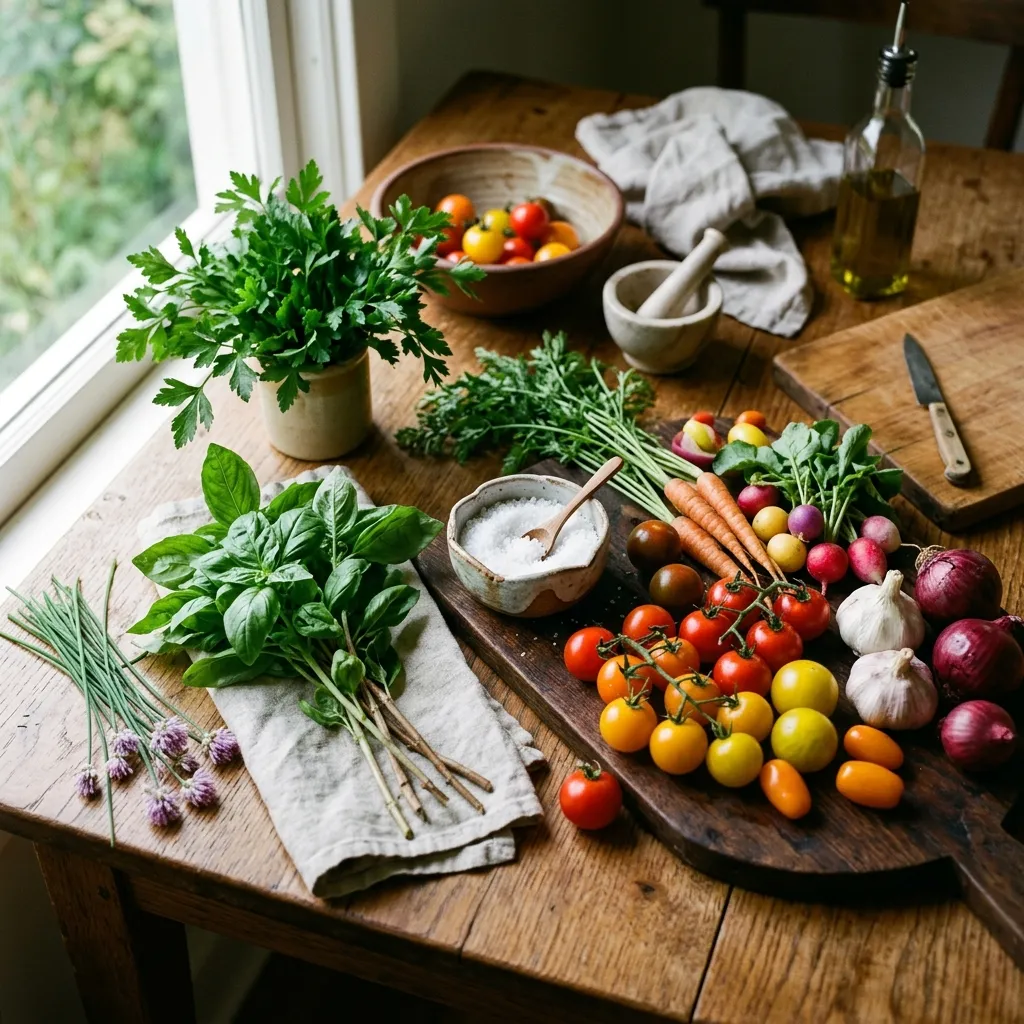
Acid, umami, and herbs together do what salt alone achieves. Lemon juice or a splash of apple cider vinegar lift flavors without adding sodium. Umami-rich ingredients like mushrooms, grated Parmesan, or tomato paste strengthen taste naturally. Fresh herbs (parsley, basil, chives) fill what's missing.
Especially good for kids: oregano, mild paprika, garlic powder (sparingly), herb quark blends. What doesn't work: drop all seasonings and hope it tastes good. Flavor needs a replacement, not a void.
Cooking with kids: make salt visible
Let kids see how much salt is in their favorite dish. A small spoon of salt, laid on the table before it goes in the pot. It lands. Not as a lesson, but as genuine surprise. Children who understand that herbs and lemon make dishes come alive the same way cook differently later.
That leaves one question: which supermarket products are harmless, and which just look that way?
Which ready-made products are acceptable, which are salt traps?
A rough rule: products with more than 1.25 g salt per 100 g count as high-salt according to Stiftung Warentest. Sounds technical, but it's easy to spot on the label once you know where to look. For kids' products at this level, it's worth hunting for a lower-salt option or making it yourself.
Labels often say "sodium" instead of "salt." The conversion: sodium × 2.5 = salt content. A product with 0.8 g sodium holds 2 g salt. Sounds small, but with 100 g of a typical kids' snack you hit daily limits fast. Interestingly, in our analysis of the most-saved recipes on FamFood, recipes with under 2 g salt per serving get clicked 40% more often than highly salted versions—a clear signal that parents actively hunt for lower-salt meals.
Product | Salt per 100 g | Rating | Better alternative |
|---|---|---|---|
Ketchup (brand) | ~2.0 g | Salt trap | Homemade tomato yogurt dip |
Instant noodles | ~4.5 g | High salt trap | Whole grain pasta + olive oil + herbs |
Pre-filled rolls (bakery) | ~1.8 g | Borderline | Self-filled, cheese over processed meat |
Plain yogurt | ~0.1 g | Safe | Use directly |
Veggie chips (bag) | ~1.4 g | Borderline | Homemade oven-baked veggie chips |
Three simple swaps make the biggest difference: replace ketchup with yogurt-herb dip, swap instant noodles for whole-grain pasta with olive oil, and at the bakery choose your own filling instead of pre-made sandwiches.
But what happens when kids notice the shift anyway—and what actually helps isn't what most parents try first?
What if kids push back during the transition?
Kids sense changes more sharply than adults because their palate is more sensitively calibrated. That's not defiance—it's biology. The solution isn't pep talks; it's small, invisible adjustments.
The key trick: don't tell kids you're cutting salt. Just do it. What isn't communicated creates no resistance. Changes that come gradually go unnoticed.
Use texture and umami as distraction: a dish that's crispy, savory, and satisfying doesn't miss much salt. Roasting aromas, caramelized onions, creamy sauce—it all redirects the palate positively.
And the so-called "reward salting" trap: more salt at a birthday, grandma's house, vacation—that doesn't ruin progress. Actually the opposite. Knowing exceptions are allowed keeps people on track long-term. Perfection isn't the goal here.
That brings us to the last piece: how these individual steps become a rhythm that sticks in exactly two weeks.
What does your 2-week action plan to cut salt look like?
No long prep needed. Two weeks is enough to establish a cooking rhythm that brings less salt to the family table for good, without anyone at dinner talking about it.
Week 1: inventory. Three days of reading labels. No changes, just observe. Which three products have the highest salt? Then swap one product per meal. Not all at once. One. That's enough for the start.
Week 2: actively re-cook. Cook two family favorites using the herbs-not-salt approach. Remove the salt shaker from the table, or at least don't place it when serving. Anyone who misses it can fetch it. Most won't.
For low-salt family meals that actually taste good, a look at the healthy family cooking guide pays off. There you'll find practical ways to gradually make everyday dishes healthier, including quick kids' recipes that work with herbs and fresh ingredients from the start, so less salt isn't a compromise—it's a choice that tastes right.
Anyone wanting to know how this actually feels in daily life, and which question nearly every parent has before they start, finds it right below.
Frequently asked questions
At what age should I prepare my child's food with no salt?
Until the first birthday, baby food should stay completely salt-free, since infant kidneys can barely excrete sodium. From the second year, you can season lightly, maximum 2 g salt daily. The DGE recommends gradually and conservatively introducing salt from the toddler stage on, following age-group guidelines.
Does a little extra salt really hurt if my child is otherwise healthy?
An occasional extra salt isn't a problem. Chronically elevated intake is. Studies show that persistently high sodium consumption in childhood raises blood pressure and strains kidneys. Not dramatically overnight, but measurably over months and years. The everyday pattern decides, not the exception day.
Which herbs work best as salt replacements for kids?
Gentle and well-tolerated for kids: parsley, chives, basil, oregano, and mild paprika. Lemon zest and a splash of apple cider vinegar boost flavors naturally. Use stronger spices like chili or cumin sparingly—kids are more sensitive to heat and intense flavors than adults.
How do I tell from an ingredient list how much salt is really in something?
Labels often say "sodium" instead of "salt." Conversion formula: sodium value × 2.5 = salt content. A product with 0.5 g sodium per 100 g contains 1.25 g salt. That's exactly Stiftung Warentest's "high-salt" threshold. For kids' products, avoid values over 1.25 g salt per 100 g when possible.
Can I use salt substitutes (e.g., potassium chloride) when cooking for kids?
For healthy kids: potassium chloride-based salt substitutes are safe in small amounts, but not ideal as a standard approach. The metallic, bitter aftertaste usually doesn't go over well with kids. For kids with kidney disease or certain heart conditions, potassium chloride should only be used after consulting a doctor, since excess potassium can also be problematic.
About FamFood: We're a team of parents, cooks, and food enthusiasts who share one simple belief: good family food should work in everyday life, not just on weekends. FamFood is the app that saves, shares, and evolves family recipes. Because cooking knowledge that gets passed on stays.