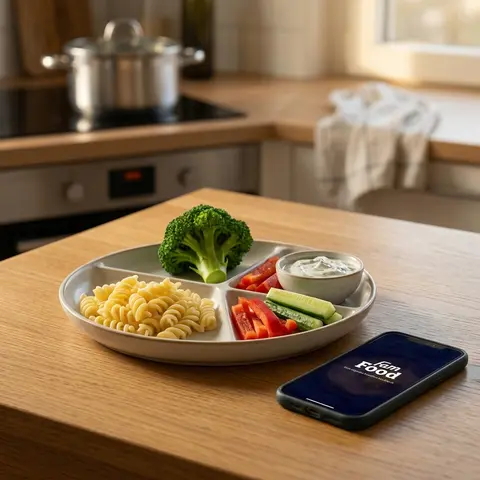
"Who's cooking today?" Three words. Every single day. And every evening that same quiet sigh.
Not because nobody wants to cook. But because the answer is somehow always the same. Always the same person standing in the kitchen while everyone else waits. That's not a personality problem. That's a structure problem. And structure problems can be solved.
This post shows you how a fair cooking schedule comes together—one that doesn't collapse after three days—and why the real secret isn't in the spreadsheet, but in the question before it.
Key Points at a Glance
- According to Destatis (Time Use Survey 2022), women in Germany perform on average 52% more unpaid household work than men, with meal preparation as the single largest category.
- A fair cooking schedule divides all three phases: planning, cooking, cleanup. If you only split cooking and leave planning to the same person, you've just shifted the burden, not solved it.
- No single model works for everyone. Fixed days, rotating systems, and responsibility kitchens have different strengths depending on family structure.
- Failure isn't a character flaw—it's a signal that your system is too rigid.
Why does cooking always land on the same person?
According to the Time Use Survey from the Federal Statistical Office (Destatis, 2022), women in German households perform on average 52% more unpaid household work than men. Meal preparation is the single largest item. This isn't a uniquely German problem, but it is measurable, concrete, and changeable.
How habit shapes the cooking schedule
Usually the imbalance doesn't happen by intention—it happens by habit. Once someone starts cooking, they're suddenly "responsible" for it. The other person doesn't volunteer the first time, doesn't volunteer the second time, and eventually nobody asks anymore. The system has stabilized itself.
The myth "I can't cook"
One myth persists stubbornly: "I can't cook." What's usually actually true is: "I was never seriously included." Cooking isn't an inborn skill. It's a practice. Someone who's never had the chance to take responsibility for the stove looks uncertain at first. That's normal, not a reason to keep that person permanently out of the kitchen.
The invisible burden of planning
What we hear most often from FamFood users isn't exhaustion from cooking itself, but exhaustion from endless deciding. What are we eating today? What's left in the fridge? Does the weather and mood match the meal? This invisible planning work is the real bottleneck, before the first pot even hits the stove.
What belongs in a fair cooking schedule?
A fair cooking schedule divides three clearly defined phases: planning (creating the meal plan, checking supplies, writing the shopping list), cooking (preparation, stovetop, oven times), and cleanup (dishes, drying, storing leftovers). If you only split cooking and leave planning to the same person, you've shifted the burden, not solved it. Only when all three phases have names attached does real relief happen for everyone involved.
The coordinating prep work needed before anyone picks up a spoon costs real time and mental energy. Writing the shopping list, checking what's on hand, deciding what fits the week's schedule: these tasks need space in the cooking schedule, just like chopping and frying do.
Children can take on meaningful tasks depending on age. From age 6: setting the table, measuring simple ingredients. From age 8: washing vegetables, making salad. From age 12: preparing simple complete meals independently. From age 14: running a full cooking evening. Planning this realistically eases the load on adults and gives children real responsibility, not theater.
Phase | What's involved | Who can handle it |
|---|---|---|
Planning | Meal plan, checking supplies, shopping list | Adults, older teens |
Shopping | Doing or ordering groceries | Adults, teens from 14 |
Cooking | Preparation, stovetop, oven times | Adults, children from 10 (supervised) |
Cleanup | Dishes, drying, storing leftovers | Everyone, from age 6 onwards sharing |
Planning and shopping as independent tasks
Planning and shopping often take longer than cooking itself. Whoever handles this phase invests real time and genuine mental work. This belongs in the schedule, explicitly and with names attached. The person who plans is planning for everyone, and that deserves recognition and relief elsewhere.
Cleanup: whoever cooks doesn't do dishes
A simple rule that works in many families: whoever cooked doesn't wash dishes. Period. That's not luxury—it's fairness. Cooking and cleanup together make for a long evening. Assigning both to the same person removes any incentive to stick to the schedule.
Which model fits your family?
There's no universal model. What matters is which model matches your actual weekly structure. Shift work, remote office days, and school schedules determine who can realistically cook when. A plan that looks balanced on paper but doesn't work in real life isn't a good plan.
Three core models have proven themselves in practice:
Model 1: Fixed days per person. Person A cooks Monday, Wednesday, Friday. Person B cooks Tuesday, Thursday. Clear responsibility, minimal coordination overhead. Works well when both adults have similar weekly rhythms.
Model 2: Rotating system. Week 1, Person A cooks the first half; Week 2, the second half. The pattern shifts every seven days. More flexibility, slightly more communication needed.
Model 3: Responsibility kitchen. Person A cooks. Person B plans and shops. Makes sense when one person enjoys cooking more and the other is better at organizing. Key: both do meaningful work, even though only one is at the stove.
Special case: teens. One evening per week, fully responsible. No menu given, just a budget and the expectation that everyone eats well. This builds pride and solid skills.
Model | Strength | Best for |
|---|---|---|
Fixed days | Clear responsibility, no debate | Families with steady weekly rhythms |
Rotating | Flexible, equal turns | Families with variable work schedules |
Responsibility kitchen | Uses different strengths | Households with very different cooking levels |
Teen evening | Builds independence | Families with children from age 13 |
Shared evening | Connection, no pressure | Weekend as family project |
What does a concrete 7-day family plan look like?
A working 7-day cooking schedule names one responsible person per day, a realistic time budget of 30 or 60 minutes, plus a fallback option for emergencies. Without a fallback, your plan is an ideal, not a tool.
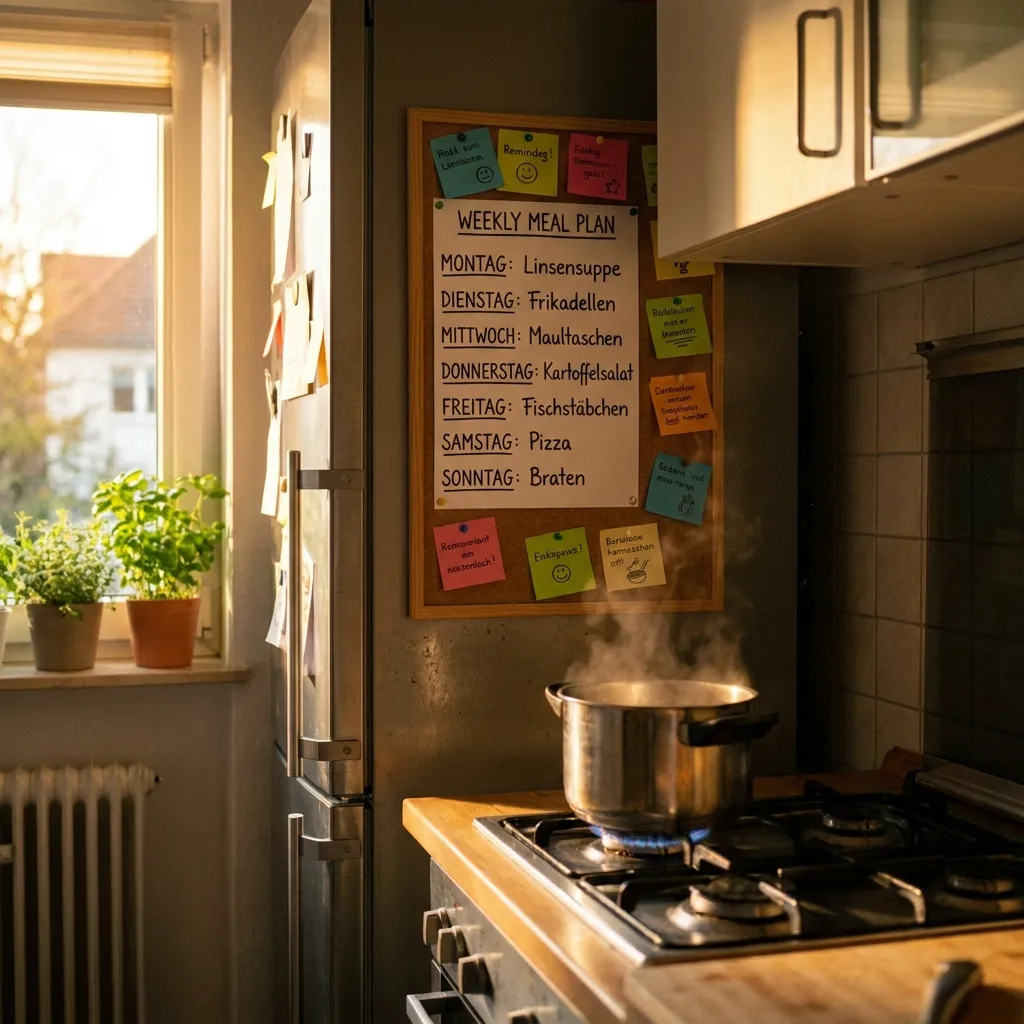
At least one day per week should be planned as a leftover day. This cuts food waste, gives the planner breathing room, and prevents the Sunday cooking marathon. Make the plan visible—on a refrigerator magnet board, in a shared family calendar, or in the family chat. Invisible plans don't get followed.
Children from age 8 can handle their own evening if the dish is discussed beforehand. Not cooking perfectly, but carrying responsibility. That's the difference.
Sample plan: family with school-age children
Day | Responsible | Dish (example) | Time budget | Fallback |
|---|---|---|---|---|
Monday | Parent A | Pasta with tomato sauce | 30 min | Frozen pizza |
Tuesday | Parent B | Vegetable stir-fry + rice | 40 min | Bread + cold cuts |
Wednesday | Child (12 yrs) | Scrambled eggs with vegetables | 25 min | Parent A steps in |
Thursday | Parent A | Vegetable scrap soup | 35 min | Leftovers from Tuesday |
Friday | Parent B | Self-chosen dish | 45 min | Takeout (exception) |
Saturday | Together | Weekend cooking | 60 min | No fallback needed |
Sunday | Leftover day | Use up leftovers | 20 min | Bread evening |
A structured introduction to weekly planning is available at FamFood with concrete templates ready to use.
Sample plan: single-parent household
In a single-parent household, the math looks different. There's no second adult to share shifts. That means: children need to be included earlier, more, and more seriously. A teenager who cooks Wednesday isn't filling a gap. They're a family member with real responsibility.
Splitting two cooking evenings per week with a child, planning two nights with very fast dishes under 20 minutes, anchoring one leftover day firmly, and marking one evening as "everyone makes their own thing": that's not failure, that's an honest plan.
What if the plan falls apart after three days?
The most common reason cooking schedules fail isn't lack of motivation—it's too much rigidity. If you throw out the entire system at the first deviation, you need a reset mechanism, not a new spreadsheet. According to studies from the Federal Center for Nutrition (BZfE), new daily routines often fail not from lack of will, but from missing safety nets.
Concrete reset rule: If someone has to skip, rule X kicks in automatically. For example: the next person in rotation steps in, and the person who skipped takes the next available evening. No discussion, no blame. Just move forward.
There's no room for blame here. A cooking schedule doesn't fail because a person is difficult. It fails because the system has no built-in flexibility. That's a planning mistake, not a character flaw.
A quick 5-minute weekly check instead of monthly big meetings: every Sunday, briefly clarify what the week brings and who can do what when. Five minutes of coordination prevents seven days of quiet frustration.
How do you motivate all family members to participate?
Having a say is the strongest motivator. Someone who gets to choose their own cooking evening's dish cooks more reliably and tries new things more readily. This isn't educational theory. In our data from FamFood families, we see: families where everyone chooses their own cooking evening's recipe plan meals three times more often in advance than families with set menus. That's no accident—it's psychology.
No critiquing the results. You learn to cook by cooking, not by fear of criticism. Someone who salts the rice wrong the first time will do better the next time. Someone who's told the rice didn't taste good might not cook a second time.
Small rituals around your own cooking evening help: favorite music on, favorite apron on, the kitchen belongs to this person for an hour. It sounds small. It isn't. Rituals create identity, and cooking identity lasts longer than any spreadsheet.
For families who want to integrate their favorite recipes directly into the cooking schedule: FamFood is built exactly for that. Saved family recipes can be assigned directly to each cooking-schedule day without anyone having to search for what Wednesday's dish was again.
What tools help you stick to the plan in daily life?
Paper works as long as everyone lives under the same roof and the plan stays simple. Once schedules, shopping lists, and recipes need to coordinate, a digital solution pays for itself. An analog board on the refrigerator is the fastest start. A shared calendar is the next step.
According to a Bitkom study, 38% of German households already use digital tools for everyday organization, with numbers rising. Families who combine cooking schedule and recipe collection in one app report significantly fewer "what are we eating today?" debates at dinner time.
The next logical step after the cooking schedule is structured meal planning: planning recipes ahead, automatically generating shopping lists, building in fallbacks. Those who want to implement this concretely for seven days will find ready-made templates directly in the app.
Common questions about the family cooking schedule
How do I divide cooking fairly if one parent works longer hours?
Fair division doesn't mean equal division. Someone who cooks less can plan more, shop more, or clean up more. What matters is that the overall load is balanced, not that each person stands at the stove the same number of evenings. Talking about this is the first and most important step.
At what age can my child handle their own cooking evening?
Children from age 10 can prepare simple dishes with supervision. From age 12, a complete simple dinner independently. From age 14, run a full cooking evening solo. More important than the exact age is that the dish gets discussed beforehand and there's no pressure to be perfect.
What if my partner doesn't want to cook?
Cooking is one of three phases. Someone with no cooking motivation can handle planning and shopping—that's just as much work. Someone who won't take on any of the three phases has an open conversation topic, not a cooking problem. It's worth addressing directly, without blame.
How many cooking evenings per week are realistic for working parents?
Two to three cooking evenings per week are realistic for full-time workers if a leftover day and a quick night under 20 minutes are firmly scheduled. More than four evenings of full cooking is too much long-term for most families, especially when planning work is included.
Does everyone in the family need to be an equally good cook for the plan to work?
No. The plan needs to match actual skill levels. Someone with less experience gets simpler dishes and more time. Someone who cooks well takes the more complex evenings. That's not a disadvantage—it's honest task division. Skills grow with practice, not pressure.
About FamFood
FamFood is a digital family cookbook for everyday German life. We help families collect recipes, plan cooking evenings, and shape the kitchen together so it doesn't all fall on one person. Built by people who know firsthand how it feels to ask "who's cooking today?" every single day.