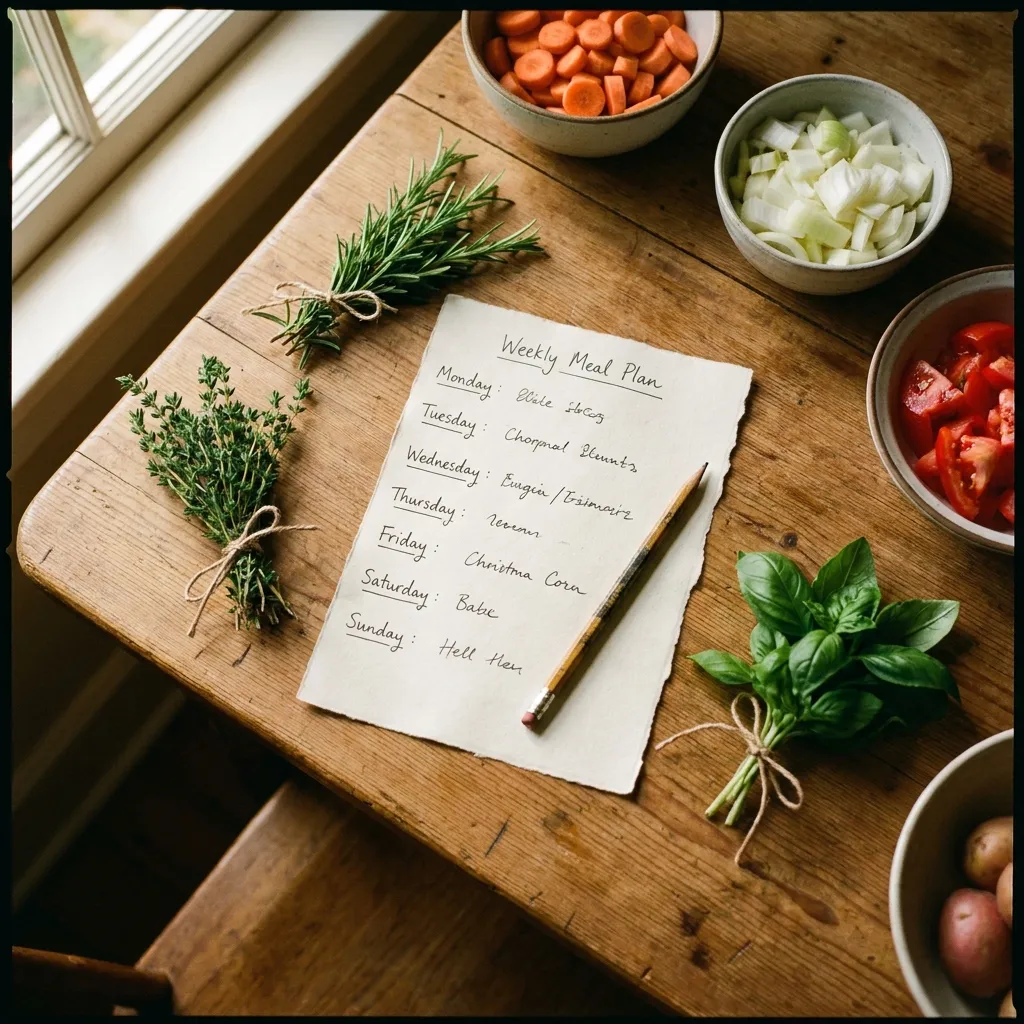
Build a Family Cooking Routine: Week 1
The plan sits on the table. Seven dinners, neatly written out, groceries bought. Monday runs great. Tuesday goes fairly well. Wednesday evening, practice runs late, everyone's hungry, no Plan B.
Most families think the same thing in that moment: it's about willpower—or is it?
What's the real reason a family cooking routine fails in the very first week—and what does one that actually lasts look like, day after day?
Key Takeaways
- A family cooking routine stands on three pillars: fixed planning time, clear task division, and a built-in buffer day.
- The first week needs no perfect menu, just a realistic pattern of 30-minute meals.
- The second week is the danger zone: the "One-Miss Rule" keeps a missed evening from breaking your whole routine.
- Kids participate more reliably when they choose their own task from a short list (Federal Center for Nutrition (BZfE), recommendations for meal planning).
What Is a Family Cooking Routine, and Why Does It Fail So Often in Week 1?
A family cooking routine is a fixed, repeatable pattern of planning, shopping, and cooking that the whole family carries together. It usually fails in week 1 not from lack of will, but from missing integration into daily life: expectations too high, no clear task division, and no Plan B for Tuesday when practice runs long and everyone comes home hungry and cranky. The difference from a rigid meal plan is exactly this: a meal plan says what gets cooked. A routine says who does what when, and what happens when the plan falls apart.
It isn't about willpower.
It's about a structure built for an ideal day that nobody actually has.
And the single most common mistake: too many new dishes at once.
FamFood user data shows the same pattern over and over: three familiar family meals plus two new ones doesn't overwhelm anyone. Seven new recipes on seven evenings almost always does. Among the most successful routines FamFood families built in their first four weeks, 8 out of 10 included at most two new dishes per week. The rest came from reliable kitchen classics that nobody needs a recipe card for anymore. That cuts mental load per evening dramatically and gives the routine a chance to take hold before daily life sweeps it away again.
Rituals and routines aren't the same thing. Rituals are long-term habits with emotional meaning. Here we're talking about the start, the first week, the week that decides everything after.
But knowing what goes wrong isn't the same as knowing what needs to hold it up—and it isn't the three pillars you might be guessing right now.
What 3 Core Pillars Does Every Working Family Cooking Routine Need?
Planning, task division, and a built-in buffer day: these are the three pillars a stable family cooking routine rests on. Missing even one, and the routine collapses under daily pressure, usually exactly when an unexpected appointment or sick child ruins the carefully planned evening.
Pillar | What It Means | Common Mistake |
|---|---|---|
Fixed planning time | 15 min. Sunday evening, always the same | "We'll do it sometime" leads to never |
Task division | Who cooks, who chops, who cleans | Everything hangs on one person |
Buffer day | 1 day per week with no fixed recipe | Chaos days wreck the whole week |
Set Your Planning Time
Not "sometime on the weekend," but a concrete slot. Sunday evening after dinner works well for many families because the week hasn't started yet and everyone's still together. Fifteen minutes is enough if you stick to familiar dishes.
Sort Tasks by Age
Who does what works best when you decide it once, not every evening anew. The Federal Center for Nutrition (BZfE) recommends involving children early and regularly in meal planning, as it increases their acceptance of new foods long-term. More on that in the age-group section below.
Plan Your Buffer Day Before You Need It
Thursday works well: mid-week tiredness is real. If it says "leftovers or frozen pizza," that's not failure, that's system. If you plan the buffer day ahead, you don't have to justify it.
How these three pillars look in a real family's actual life—not the ideal case, but Monday through Friday, with evenings that never go as planned.
Day by Day: What a Realistic First Routine Week Actually Looks Like
A first routine week needs no perfection, just repetition. Monday through Friday follow an alternating pattern of quick meals, cook-with-kids evenings, and a leftover-use day, framed by a fixed shopping day. Overall goal: never more than 45 minutes in the kitchen.
Day | Format | Time | Example |
|---|---|---|---|
Monday | Quick meal (familiar) | 25-30 min. | Pasta with tomato sauce |
Tuesday | Cook-with-kids evening | 35-40 min. | Make-your-own wraps |
Wednesday | New dish (just one!) | 40-45 min. | Lentil soup from recipe |
Thursday | Buffer day / leftovers | 10-20 min. | Whatever's in the fridge |
Friday | Family favorite | 30-35 min. | Pizza, pancakes, etc. |
Putting the cook-with-kids evening on Tuesday instead of Friday is no accident. By Friday everyone's exhausted, tolerance for accidents is low, and spilled sauce turns into an argument faster. Tuesday is fresher, kids are still engaged.
The leftover-use day on Thursday isn't a workaround, it's planning. If you make extra lentil soup on Wednesday, Thursday's already handled. That saves time and cuts food waste. For concrete ideas on how five days actually work, it's worth checking out FamFood's simple recipe collection.
What the plan doesn't yet show: how much of it depends on who you put to work when—and why the same evening runs differently with a four-year-old than with a teenager.
How Do You Bring Kids of Different Ages Into the Routine?
Kids between 4 and 14 can all have a fixed place in the cooking routine, but tasks must fit their age. Under 8s handle prep and stirring. From 10 onward, cooking one simple component on their own works. Teenagers don't need a task list, they need responsibility for a whole meal once a week.
Age Group | Right Tasks | Motivation |
|---|---|---|
4-6 years | Washing, stirring, measuring ingredients | Being there, not being perfect |
7-9 years | Making salad, kneading dough, simple cutting | Visible result ("I made that!") |
10-12 years | Cooking one component alone (rice, dip) | Independence and praise |
Teenagers | Plan and cook one dinner per week solo | Their choice, no micromanaging |
What we see again and again with FamFood families: kids join in more reliably when they choose their own task from two or three options. "Want to make the salad today or set the table?" works better than "Set the table." They have control, you have structure.
Teenagers need a different approach than elementary kids. No explaining, no oversight, no double-checking. A 13-year-old who cooks dinner for the family and gets praised comes back on their own. One who gets directed backs away.
Sounds doable—as long as week one holds. But right now, heading into week two, lurks the breaking point most don't see coming.
What If Your Routine Cracks in Week 2?
Week 2 is the danger zone: the initial motivation's gone, everyday life barrels back. If you have a rescue plan instead of bailing on the whole thing, you've already cleared the biggest hurdle. The German Institute for Nutritional Research (DIfE) shows in its research on eating behavior that the most common drop-off point isn't in week 1, but at the transition to week 2, when the novelty wears off and old patterns creep back.
A 2022 study in the International Journal of Behavioral Nutrition and Physical Activity backs this up (IJBNPA): families who plan an explicit "reset mechanism" for missed routine days maintain their eating habits significantly more often long-term than families without that buffer.
The One-Miss Rule is simple: one missed day doesn't break your routine. Two in a row does. That sounds strict, but it's the opposite. It takes pressure off a perfect start and gives you a clear boundary.
Three quick fixes if week 2 starts to derail:
- Simplify, don't quit. Instead of five planned dinners, plan three. Less is better than nothing.
- Introduce a reset evening. Pick an evening when the routine starts fresh. No drama, no guilt talk.
- Shorten the tasks. If planning takes too long, cut it to 10 minutes and three dishes. Structure beats completeness.
Simplification isn't defeat. It's method.
One question remains that almost everyone gets wrong: which tool makes the real difference—and it's not what you think right now.
Which Tools and Helps Actually Make Cooking Easier?
The most effective tool isn't an app feature, it's a visible weekly plan on the fridge door. Only once the analog foundation is in place do digital helpers make the next step easier. A magnetic board or whiteboard everyone can write on creates accountability in a way no app alone can replicate.
The shopping-list workflow belongs directly in the routine: Sunday evening planning, write the list right away, Monday shopping. Three steps, always in the same order. Once you've set that chain once, it feels like relief, not work.
According to Bitkom, 38 percent of German households with kids now use cooking apps regularly for shopping or meal planning. The advantage isn't feature breadth, it's integration: if you link recipe, shopping list, and meal plan in one step, you lose less momentum between planning and doing. FamFood makes exactly that possible: link recipes directly to a shopping list so your meal plan becomes your grocery list in one move.
What all this delivers shows up only when the routine stops feeling like work—and that's when a different question comes up.
Timeline: When Does a Routine Become a Real Habit?
Habit researchers say routines solidify after four to eight repetitions in the same context. That means: same time, same place, a small reward after cooking. The routine has to be small and painless enough that skipping it feels stranger than doing it.
The kitchen habit loop: Cue (it's Sunday evening, the weekly plan hangs empty on the fridge), Routine (15 minutes planning, write the list), Reward (make tea, evening off). The reward costs nothing and takes no time. It just has to be the same every time.
After four weeks, take a quiet look back: what worked? What annoyed the family? Which dishes never got made? Adjusting your routine isn't failure, it's the sign it's actually landed.
And the circle closes: that Wednesday-evening collapse was never a character flaw. It was a structure problem. A routine built for real evenings—with a buffer day, One-Miss Rule, and at most two new dishes per week—holds exactly when the plan breaks. Write it down. Stick it on the fridge. Start Monday.
Common Questions About Family Cooking Routines
How long until a new cooking routine runs smoothly?
Habit researchers talk about four to eight repetitions in the same context, which is roughly four to eight weeks with a weekly rhythm. What matters is consistency of timing and flow, not perfection on any single evening. If you're still at it after four weeks, you've cleared the hardest phase.
What if my kid refuses the cooking routine outright?
No force, no long discussions. Offer a minimal task: just be there, set the table, stir. Kids who don't feel pressured usually jump in on their own after a few weeks. When a child picks their own task from two options, refusal drops sharply.
Can a family cooking routine work with just one parent?
Yes, often better, because planning is simpler. Tasks divide between the parent and kids by age. The buffer day becomes even more important since no second adult can step in. A clear rhythm of three to four planned dinners per week is more realistic than five.
How many dishes should I plan per week to avoid overload?
Start with three to four planned dinners per week. The rest can come from leftovers, frozen food, or your go-to repertoire. Among the most-used meal plans in FamFood, the most successful first-month routines never exceed four fixed dishes; the rest stay flexible.
When's the best time of week to start the cooking routine?
Sunday evening for planning, Monday for shopping. Starting Monday lets you face the full week ahead with no missed evening hanging over you. Avoid Monday itself as your first cook evening if it's usually chaotic. For many families, Tuesday as the first "real" cook night works better.
About FamFood: FamFood is a digital family cookbook built by parents for parents. We know how unpredictable family life is, so everything we build aims for the real everyday with kids, not the perfect one. Try it at FamFood.




