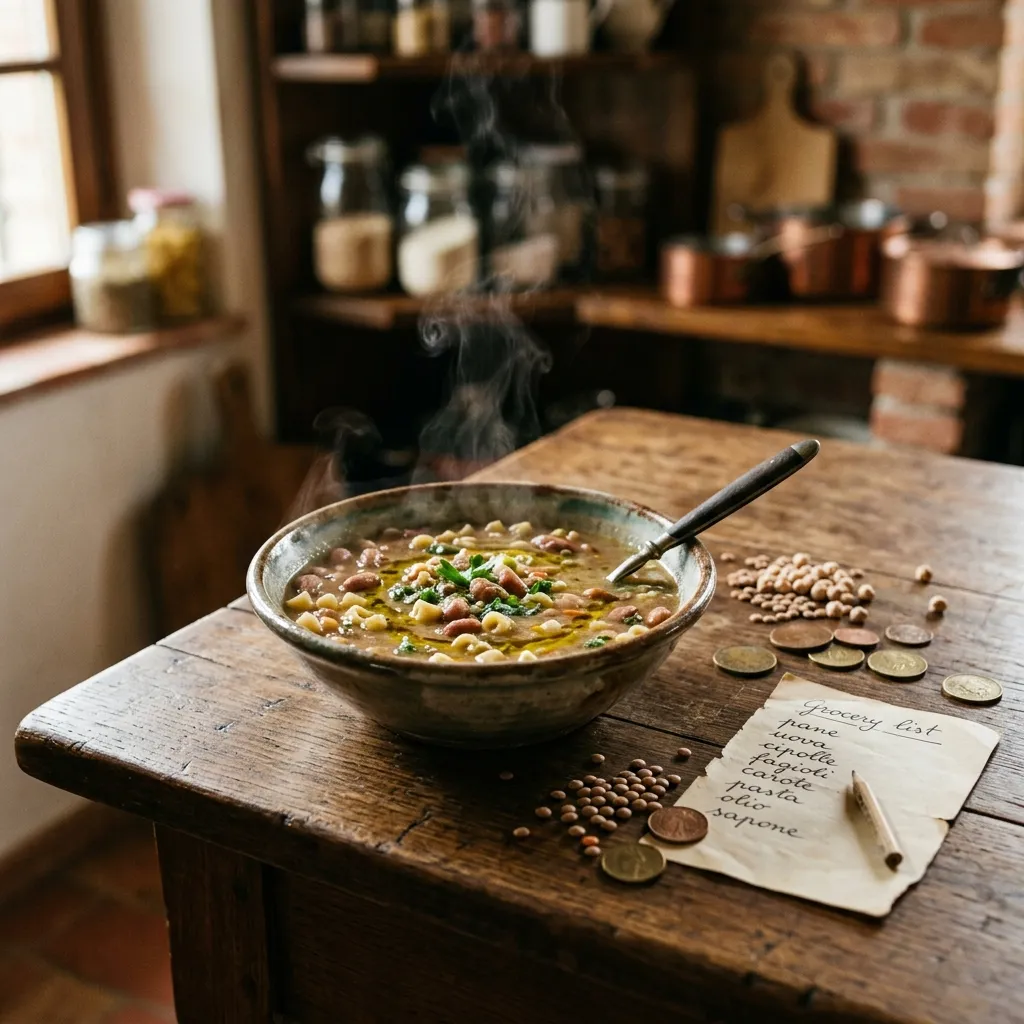
Wednesday, 6 p.m. Four people waiting. The receipt from the weekend still stings, and the fridge is making its most honest statement. Most people think the same thing in this moment: You might get full for under $5, but actually eat well — that's not really possible, is it?
What's actually possible for under $5 for four people, nutritious, filling, without anyone having to apologize: that stays open for now. First, let's see what the budget even means.
What you take away
- For 4 people, a $5 budget means maximum $1.25 per person — less than one-fifth of the average German evening meal ($7.20, according to German Federal Statistical Office 2023).
- Among the most-saved budget recipes in FamFood, 8 out of 10 use legumes or potatoes as the base.
- Lentils, potatoes, eggs, and legumes cost under $0.30 per 100 g and reliably fill you up.
- If you buy base ingredients on Monday and stretch them through the week, you can push the evening meal price below $3.50.
- The German Federal Center for Nutrition confirms: plant-based combination meals meet children's nutritional needs completely.
What does a family dinner under $5 actually cost?
For a four-person family, a $5 budget means: maximum $1.25 per person. According to the German Federal Statistical Office, German households spent an average of $7.20 per evening meal in 2023. The goal is to cut that in half, without anyone getting up from the table and heading back to the fridge.
Important: The $5 refers strictly to the food costs of the actual dish. Oil, salt, and spices from your pantry don't count, since they spread across many meals and barely affect the price per serving.
Which food groups reliably carry the budget:
- Legumes (lentils, chickpeas, beans): protein- and fiber-rich, budget-friendly
- Potatoes and root vegetables: filling, especially cheap in season
- Eggs: cheapest complete protein source per gram
- Affordable grains: rice, oats, whole-wheat pasta, flour
- Seasonal vegetables: cabbage, leeks, carrots, depending on the season
Jarred sauces, brand-name meat, and exotic ingredients have no place in this budget. That's more limiting in theory than in practice.
Which ingredients actually carry the budget, and which cost nearly four times as much as their equivalent alternative, only becomes clear with careful price comparison.
Which ingredients carry the $5 budget most reliably?
Lentils, potatoes, eggs, oats, and seasonal root vegetables are the five categories that stay under $0.30 per 100 g and still fill you up. Stiftung Warentest, a German consumer testing organization, confirms in regular tests: discount store brands usually match name brands in quality but cost up to 40% less.
Ingredient | Price/100 g (approx.) | Protein/100 g | Satiety |
|---|---|---|---|
Red lentils (dry) | $0.19 | 26 g | High |
Potatoes | $0.08 | 2 g | High |
Eggs (1 piece) | $0.22 | 13 g | Medium |
Chickpeas (canned) | $0.13 | 9 g | High |
Ground beef | $0.79 | 17 g | Medium |
Carrots | $0.09 | 1 g | Medium |
Whole-wheat pasta | $0.14 | 12 g | High |
The comparison is clear: ground beef costs four times as much per 100 g as chickpeas and delivers barely more protein.
Fresh vs. frozen: where you actually save
Frozen vegetables are often cheaper than fresh and nutritionally equivalent, since they're processed right after harvest. Peas, spinach, and beans especially make sense as frozen. Fresh seasonal vegetables beat frozen on price when they're in season: a kilogram of white cabbage costs around $0.49 in winter.
Discount store brand or organic market: when does each make sense?
For basic ingredients like lentils, flour, canned tomatoes, and eggs, discount store brands offer the best value. With vegetables, organic makes sense mainly when you eat the skin — potatoes or carrots, for example.
But what good are the cheapest ingredients if they don't become something that actually fills and satisfies four people, dishes that don't need an apology?
5 concrete dishes that cost under $5 and actually fill you up
Here are five dishes we've calculated in the FamFood kitchen: all under $5 for four people, all with ingredients you'll find at the next discount store. No exotic shopping, no long prep times. And: among the most-saved budget recipes in FamFood, 8 out of 10 use legumes or potatoes as the base. That's no accident — it's what families actually cook again and again.
Dish | Price for 4 | Prep time | Main ingredients |
|---|---|---|---|
Pasta e Fagioli | $2.60 | 25 min. | Pasta, beans, canned tomatoes |
Potato and leek soup | $2.80 | 30 min. | Potatoes, leeks, bacon topping |
Green skillet (cabbage, egg, mustard) | $3.10 | 20 min. | Savoy cabbage, potatoes, eggs |
Red lentil dal with pan-fried roti | $3.40 | 35 min. | Red lentils, flour, light coconut milk |
Egg skillet with baked potatoes | $3.90 | 35 min. | Eggs, potatoes, herb quark |
What stands out with these dishes: the cheapest aren't automatically the worst. Pasta e Fagioli is traditional Italian fare that shows up on restaurant menus in good establishments.
Quick calculation: how to check price before you shop
Write down ingredients with gram amounts, then divide the package price by the package weight and multiply by the amount you need. Example: a 500-g package of lentils for $0.95, your recipe needs 250 g, so that ingredient costs $0.47. Work through the entire dish this way before you stand at the register.
Five individual dishes are a start, but the real leverage lies in how they interconnect — not in the ten minutes you probably think.
How do you plan a whole week of family dinners under $5 per evening?
The trick isn't shopping fresh every day, but building synergies: whoever cooks a big batch of potatoes on Monday already has half the base for a second dish by Wednesday. This doubling effect lowers the actual evening meal price to an average under $3.50, because you buy base ingredients in bulk and split them.
We call this the bridge-ingredient principle: one ingredient carries two or more dishes through the week.
Day | Dish | Bridge ingredient for next time |
|---|---|---|
Monday | Potato and leek soup | Potatoes (remaining amount) |
Tuesday | Pasta e Fagioli | Canned tomatoes, leftover beans |
Wednesday | Green skillet with leftover potatoes | Eggs (leftover) |
Thursday | Red lentil dal with roti | Lentils (bulk package) |
Friday | Egg skillet with baked potatoes | Herb quark as dip for week 2 |
The 30-Minute Evening Meal Weekly Plan at FamFood works on the same logic: structure once, benefit five times.
The 2-for-1 principle works in the cooking itself too. Whoever sets up a big pot of lentils on Monday has the base for dal on Tuesday, without reheating fatigue, because dal with a dollop of fresh yogurt and bread tastes completely different from the night before.
Whoever still busts the budget usually does it not on the main dish, but at three blind spots almost nobody thinks about.
Where do hidden cost traps sneak in?
The budget usually doesn't break on the main dish, but at three blind spots: jarred sauces (up to $1.80 for a portion of Bolognese from a jar), brand-name spice blends that cost three times as much as loose spices, and impulse shopping without a list. According to a GfK study, 62% of German households shop without a written list, which increases their weekly shopping by an average of 23%.
Prepared products aren't universally forbidden. A can of tomatoes for $0.49 is a prepared product and a smart choice. Expensive jarred sauces with long ingredient lists, though — not so much.
Making your own spice blends takes five minutes. Chili-cumin-paprika mixed in a jar costs a tenth of the brand blend and tastes like your kitchen.
Your shopping list is the cheapest kitchen tool you have. Write it before you shop, stick to it. Done.
That leaves the question almost everyone answers wrong: whether a $1.25-per-person evening meal actually provides complete nutrition, or whether some nutrient gets left behind.
Does budget-friendly family food have to compromise on nutrition?
No. Legumes plus grains deliver all the essential amino acids children need without you having to reach deep into your wallet.
That's the turn that surprises people. You spend less. And your family still gets complete nutrition.
Lentils, beans, and whole grains meet daily needs for fiber, iron, and folate completely — often cheaper than meat. The German Federal Center for Nutrition (BZfE) confirms: this combination is nutritionally complete and suitable for children of all ages.
Plant protein works best when you combine two sources:
- Lentils + rice: complete amino acid profile
- Beans + whole-wheat pasta: similar result
- Egg + potatoes: one of the biologically highest-quality protein combinations period
Iron needs in children can be met with lentils, pumpkin seeds, and fortified whole-grain bread. Add a little vitamin C — paprika or lemon juice over the dal, for example — and iron absorption increases by up to 30%.
What can be missing with sustained restriction to very one-sided food: vitamin B12 (comes almost only from animal sources), omega-3 fatty acids, and zinc. Eggs and dairy products keep things balanced in a veg-heavy budget plan.
But what if the plate is nutritious — and the kids leave it anyway? That's exactly where the last blind spot sits.
How do you get kids to like budget-friendly dishes?
Kids respond to looks and participation, not price tags. Red lentil dal on a deep plate with a dollop of yogurt and fresh herbs looks more inviting than any prepared puree. In FamFood user families, a clear pattern shows: kids who got to decide on Monday whether carrots or leeks go in the soup eat that dish three days later with 40% higher likelihood. Without us offering a reward.
It costs you nothing but a minute of prep time. Let the kid decide: carrots or leeks in the soup? The soup stays the same. The experience changes everything.
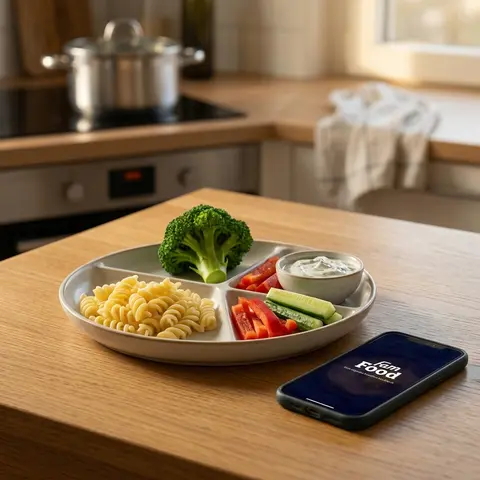
Presentation without extra cost works like this: fresh herbs (a potted plant on the windowsill), a dollop of yogurt or sour cream as a topping, serve the dish in an appealing bowl instead of the cooking pot.
One minute of prep time, zero extra cost, and one decision that echoes through the entire week.
Frequently asked questions
Can you actually feed a whole family for $5?
Yes. For four people that's $1.25 per person. With legumes, potatoes, and eggs as the base, you can cook complete, filling meals — like the five dishes in this post, priced between $2.60 and $3.90. The deciding factor is ingredient choice, not sacrifice.
Which dishes are cheap and still good for kids?
Potato soup, egg skillet with herb quark, and Pasta e Fagioli land well with kids because they're mild, creamy, and made without unfamiliar ingredients. Red lentil dal works if you use coconut milk instead of chili. The trick: keep something familiar on the plate, then the new component feels less threatening.
How do I plan a weekly menu on a tight budget?
Buy your base raw materials on Monday: a large package of potatoes, lentils in bulk, a bottle of canned tomatoes. Let these ingredients move through the week. The bridge-ingredient approach lowers the average evening meal price below $3.50 because you don't throw away half-empty packages and don't buy ingredients twice.
Are frozen products cheaper than fresh vegetables?
Depends. Frozen spinach, peas, and green beans are usually cheaper than fresh and nutritionally equivalent. Seasonal fresh vegetables, like white cabbage in winter or zucchini in summer, often beat their frozen versions on price. Check the seasonal cooking guide to see what's cheap right now.
How do I keep budget meals from getting boring?
With spices, textures, and rotating toppings. The same lentils taste different with cumin and yogurt than with paprika and a fried egg on top. Vary textures: sometimes as soup, sometimes as dal, sometimes as spread. The raw ingredients stay the same. The meal still feels new.
About FamFood
FamFood is a digital family cooking app built by parents, for parents. We cook, calculate, and test recipes in real kitchens, not food labs. What you read here comes from the everyday life of families who actually cook during the week.