Freezer System for Families: How to Turn Your Chest into a Treasure Chest
For many families, the chest freezer is a black hole. Leftovers disappear into it, resurface months later as unrecognizable ice blocks, and eventually land in the trash. But this freezer could actually be the most relaxed helper of your week.
With a concrete zone system, the chest freezer transforms from a chaotic storage depot into a quiet kitchen assistant that saves time during the week and stays organized. No expensive vacuum sealer. No perfect household budget. Just a clear system that you can actually stick with.
Key Takeaways
- Without a fixed system, up to 78 kg of food per person per year ends up in the trash (BZfE, 2023); a freezer system noticeably reduces this.
- The three-zone model (quick access, weekly reserve, long-term storage) makes the freezer practical for everyday life.
- Consistent labeling with three pieces of information saves about 15 minutes of search time per week.
- Reorganizing a chaotic freezer takes exactly 45 minutes.
Why Do Most Families Fail With Their Chest Freezer?
Without a fixed system, food ends up unsorted in the freezer, gets forgotten, and resurfaces months later as unrecognizable lumps. According to BZfE (Federal Center for Nutrition), German households throw away around 78 kg of food per person per year, and a large portion of that could be avoided through better storage practices.
The most common mistake is what we call the "just-toss-it-in" principle: whatever's left over goes in, no matter where. This leads to freezer burn, spoilage, and real search chaos. When you're looking for something for dinner at 6 p.m., you end up rummaging through half the freezer and give up in frustration.
Missing labels are the biggest single culprit. In FamFood user reports, this comes up repeatedly: "I don't remember what this is anymore." Is that ground beef or bolognese? From last month or last year?
There's also a psychological barrier that rarely gets mentioned. Many families see frozen food as a last resort, not a strategy. But when you understand freezing as an active step in your weekly plan rather than a reaction to leftovers, you think and act differently about it.
What Actually Belongs in a Family Freezer System?
A working family freezer system consists of three categories: home-cooked portions (soups, sauces, casseroles), raw basics (meat, vegetables, dough), and ready-made products as backup. When you intentionally fill all three categories, you have a real cooking foundation ready on five out of seven weekdays without needing to shop fresh every day.
Home-cooked portions are the most valuable and often the most underestimated category. Making a double batch of bolognese today means a stress-free dinner next week. Raw basics pay off especially when seasonal produce is cheap: berries in summer, squash in fall, peas in spring. When you reach for them in winter, you're paying a fraction of the regular price.
Ready-made products have their place as a conscious backup, not as the main strategy. Pizza and fish sticks for the day when nothing else is possible isn't a failure—it's planning.
What Can Be Frozen Without Worry
Category | Examples | Maximum Storage |
|---|---|---|
Home-cooked dishes | Soups, bolognese, casseroles, pancakes | 3-4 months |
Raw meat & fish | Ground beef, chicken pieces, salmon fillet | 3-6 months |
Vegetables (blanched) | Beans, peas, spinach, squash | 8-12 months |
Fruit | Berries, plum halves, mango pieces | 10-12 months |
Dough & baked goods | Bread dough, muffins, waffles | 2-3 months |
Ready-made products (unopened) | Pizza, fish sticks, frozen peas | per package |
What's Better Left Fresh
Not everything tolerates the freezer. Pure cream becomes grainy after thawing and separates. Raw, whole potatoes become mealy and inedible. Salad, cucumbers, and raw tomatoes lose their texture completely in the freezer. Mayonnaise, cream cheese, and yogurt curdle when frozen. If you want to preserve these foods anyway, freeze them as part of a finished dish rather than as individual ingredients.
The Zone Model: How to Divide Your Freezer Into Three Areas
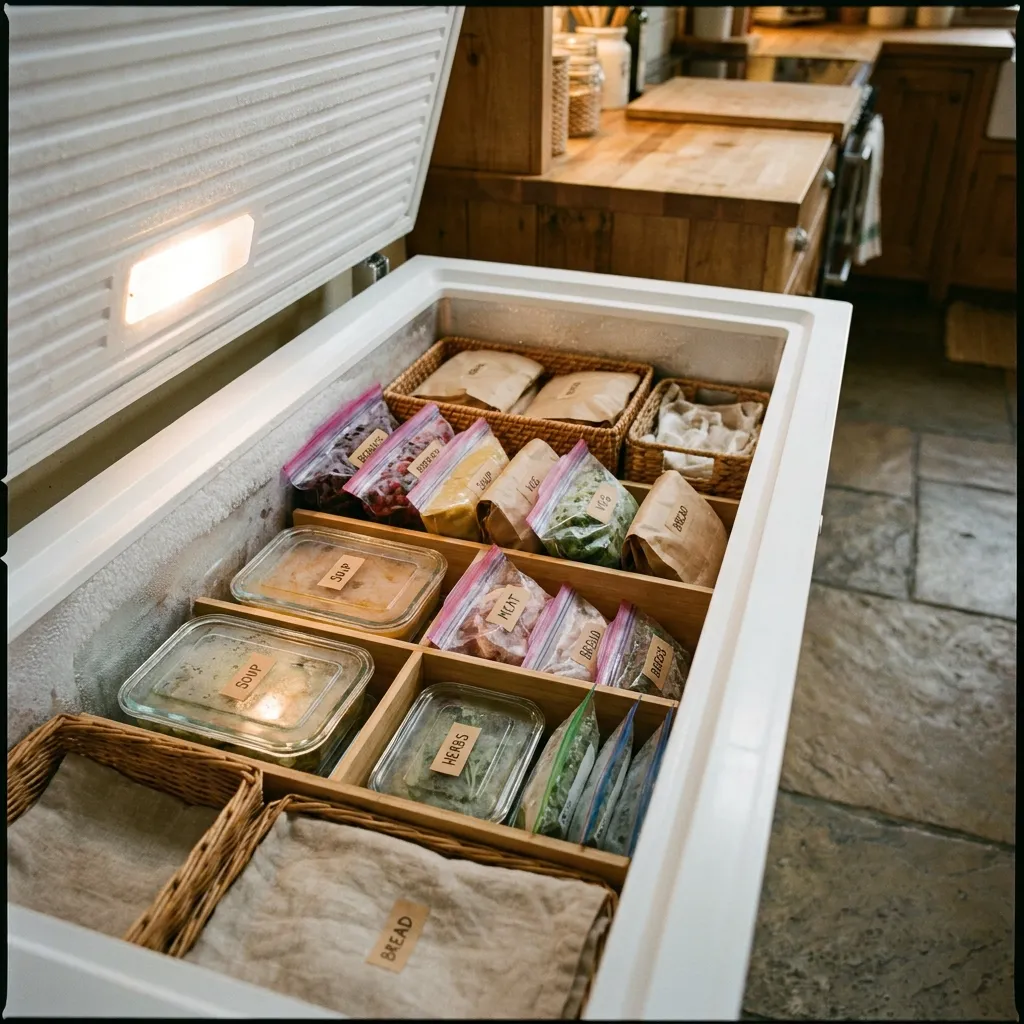
The zone model divides your chest freezer into three fixed sections: quick access (cook today or tomorrow), weekly reserve (planned meals), and long-term storage (seasonal supplies up to 12 months). These three zones prevent rummaging and make the freezer practical for everyday life, even when multiple family members are opening it.
Baskets or freezer bag holders from a home goods store cost just a few euros and cleanly separate the zones. If you're using a chest freezer rather than a freezer compartment, work best with labeled storage baskets that you can pull out.
Zone | Location in Freezer | Contents | Access |
|---|---|---|---|
Zone 1: Quick Access | Top / front | Thawed portions, leftover solutions | Daily |
Zone 2: Weekly Reserve | Middle | Planned meals for next 7 days | 2-3x per week |
Zone 3: Long-term Storage | Bottom / back | Seasonal items, bulk purchases, reserves | Monthly |
Zone 1: Quick Access
Zone 1 is your rescue zone for evenings when time runs out. Here lie portions that are already thawed or quickly ready to use: a bag of tomato sauce, a packet of ground beef, a few waffles from the weekend. Everything that should go on the table today or tomorrow belongs at the top or very front of the freezer.
Zone 2: Weekly Reserve
Zone 2 works hand in hand with your meal planning for the family. At the start of the week, you think about what you want to cook when, and place the corresponding ingredients or portions in Zone 2. That way, the answer to "What are we cooking today?" almost falls into place by itself.
Zone 3: Long-term Storage
Zone 3 is the depot for everything that can wait. Here you store blanched beans from your summer garden, that big bag of berries from a store sale, the lamb from the Christmas market. If you label this zone clearly with dates and check it every three to four months, you'll never lose track.
How Do You Label Everything So Your Partner Can Find It Too?
A label is only useful if it contains three pieces of information: contents, portion size, and freezing date. If you consistently fill in these three fields, you'll save on average 15 minutes per week just from eliminated search time and guessing games in front of an open freezer.
For labeling tools: chalk markers on glass jars are pretty, but impractical when you're changing contents frequently. Sturdy tape plus waterproof pen is cheap and holds even with condensation. If you want to manage everything digitally, note inventory and freezing dates in a simple notes app or directly in a family recipe app.
For families with children, a color system works especially well: a red mark on the label means meat, a green mark means vegetables, a blue mark means dessert or fruit. Children around age seven and up can then grab something from the freezer on their own without asking.
The Weekly Freezer Rhythm: When to Freeze, When to Thaw?
The most efficient rhythm for families is the so-called Batch Friday principle: Friday or Saturday you review the week, freeze leftovers, and move next week's freezer supply to Zone 1. Tuesday or Wednesday evening, start thawing the next batch so it's safely thawed in the refrigerator by Thursday.
The most common freezing mistake is waiting. Leftovers that sat in the fridge for two days can still be frozen, but quality suffers noticeably. What gets frozen right after cooking and cooling tastes almost fresh after thawing.
For thawing: 12 to 24 hours in the refrigerator is the safest method. Room-temperature thawing works for smaller portions but carries a hygiene risk with meat and fish. Quick thawing in cold water is acceptable if the bag is tightly sealed.
If you couple batch cooking on Sunday with freezing, you save the most time. A double batch of soup, twice a pancake recipe, three extra portions of sauce: the extra effort is minimal, but the effect during the week is enormous. Always check your freezer inventory before your weekly grocery shopping so you don't buy double what you already have. And if you still need a concrete seven-day plan: the guide to meal planning for the family shows how to coordinate your freezer and shopping list together.
Which Containers Are Actually Worth It for a Family Freezer System?
For families, flat, stackable containers made of freezer-safe plastic or glass are the most space-efficient choice. Freezer bags in standing position, propped up with a cardboard support in the freezer, save up to 30 percent more volume than round containers and can also be frozen flat.
Container Type | Cost | Space | Handling | Best For |
|---|---|---|---|---|
Reusable freezer bags | Low | Very good (stores flat) | Simple | Soups, sauces, fruit |
Flat plastic container | Medium | Good (stackable) | Simple | Casseroles, ready meals |
Freezer-safe glass | Medium-high | Medium (heavier) | More involved | Sauces, solid dishes |
Vacuum sealer + bags | High | Very good | Complex | Not necessary for families |
Pay attention to these points when shopping: BPA-free, explicitly labeled as freezer-safe, lids with secure seals. Round containers waste space in a square freezer. Expensive vacuum sealers aren't worth it for normal family households—the time investment far outweighs the benefit.
When filling, think in three standard portion sizes: single serving (one person), couple serving (two people), and family serving (four people). If you always freeze everything in large quantities, you end up with no flexibility for quick single meals.
How Do You Get Started If Your Freezer Is Already Full of Chaos?
The reset takes exactly 45 minutes: pull everything out, throw away anything without a date or that's no longer recognizable, then reorganize by zones. Only when you start from a clean slate do you actually stick with the system afterward.
Phase 1 (15 min) – Empty out: Everything comes out, in coolers or on the floor insulated with newspaper.
Phase 2 (15 min) – Sort: No date? Out. Not recognizable anymore? Out. The rule is strict, but it protects you from months more of chaos.
Phase 3 (15 min) – Reorganize: Zone 1 on top, Zone 2 middle, Zone 3 bottom. Use baskets or plastic bins as separators.
Schedule this reset every three to four months as a fixed calendar appointment, ideally with your seasonal rotation: In spring, winter stock moves to the background; in fall, seasonal supplies come in.
Frequently Asked Questions
How Long Do Home-Cooked Dishes Last in the Freezer?
Home-cooked soups, sauces, and casseroles last between three and four months at minus 18 degrees Celsius without noticeable quality loss. High-fat dishes like ragù or braised meat barely suffer from freezing. Starchy dishes like potato casseroles become a bit softer after thawing but are still very edible. According to consumer protection guidance: use sooner rather than storing too long.
Can I Freeze Dishes With Potatoes?
You shouldn't freeze whole or diced raw potatoes—they become mealy after thawing and fall apart. Potatoes in finished dishes, like in casseroles or soups, tolerate freezing well, even though the texture becomes a bit softer. Puréed potatoes in soups are fine to freeze.
How Much Freezer Space Does a Four-Person Family Need?
As a rule of thumb: 100 liters per person for full freezer provision, so about 300 to 400 liters for a four-person family. In practice, a family does well with 200 to 250 liters if the zone system is used consistently and supplies are regularly used up. A chest freezer almost always beats a freezer compartment on a regular refrigerator in terms of capacity.
Is a Chest Freezer or Freezer Compartment Better for Families?
For families with four or more people, a separate chest freezer is usually the better choice. It offers more volume, maintains temperatures longer during power outages, and is often more energy-efficient than a combo unit. If you don't have much space, you can start with a freezer compartment and still create order with the zone model, though you'll hit the capacity limit sooner.
About FamFood
FamFood is the digital place where family recipes don't get lost and weekly meal plans actually work. We cook ourselves, test with real families, and only share what actually works in everyday life. Visit us at famfood.app.