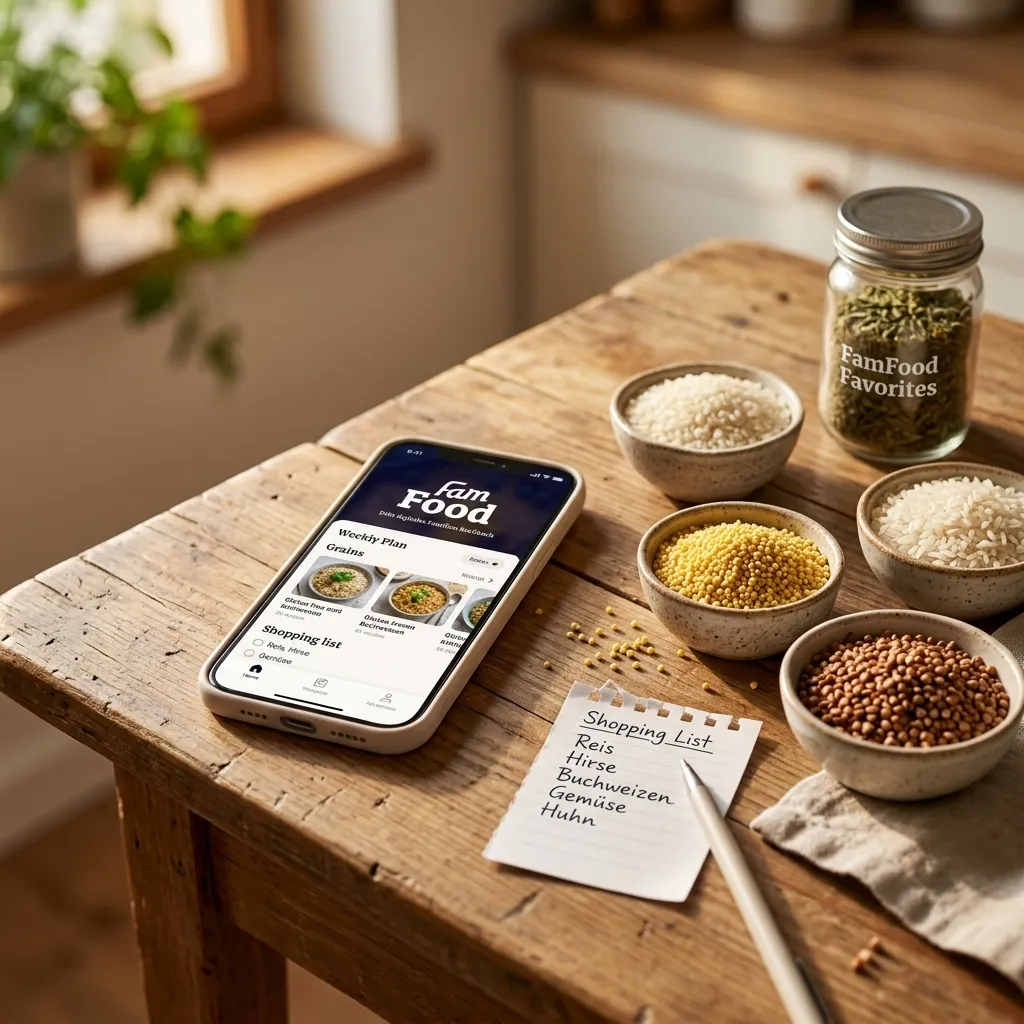
Gluten-Free Cooking: The Oat Myth Nobody Mentions
Most families cooking gluten-free think they're doing everything right, don't they?
Gluten-free bread. Gluten-free pasta. No wheat, no rye, no spelt. Yet your child still has stomach pain, gets tired after eating, sleeps poorly. Weeks pass. You start doubting yourself.
If your family already cooks gluten-free, why does your child still have symptoms?
The answer isn't in the cookbook.
Key Takeaways
- Conventional oats are officially gluten-free but trigger an immune reaction in roughly 5% of celiac patients (German Celiac Society).
- Cross-contamination begins at around 50 mg of gluten daily, equivalent to a single breadcrumb.
- The "gluten-free core" principle lets you cook one meal the whole family can eat without modification.
- Among the most-saved recipes in FamFood, 7 out of 10 have fewer than 8 ingredients, making gluten-free cooking far simpler.
Why Does Gluten-Free Cooking Often Fail in Daily Life?
Gluten-free cooking fails in everyday routine not because of willpower, but because of one false assumption: that "gluten-free" automatically means safe and complete. Oats, for example, many people treat as a gluten-free alternative, but they contain avenin, which triggers the same immune reaction as gluten in about 5% of celiac patients. If you don't know that, you'll spend weeks guessing at symptoms.
It doesn't fail because of effort.
It fails because of a single ingredient that's officially labeled gluten-free and yet isn't safe for some people affected: conventional oats.
The German Celiac Society documents this in their clinical guidelines. Avenin in oats is structurally similar enough to gluten protein to trigger the same inflammatory response in the small intestine of sensitive celiac patients. The clues were there all along: oats appear on gluten-free products. They hide in cereals, rice cakes, and baby porridges. Your family ate them daily, certain you were doing everything right.
Other common stumbling blocks: regular soy sauce contains wheat, "starch" on labels often means wheat starch, and "gluten-reduced" under EU regulation allows up to 100 mg/kg of gluten, not zero. That's enough to trigger a reaction.
And that's exactly what almost every shopping list overlooks.
Which Ingredients Are Actually Gluten-Free and Which Aren't?
Under current EU standards (Regulation EC 41/2009), only products with less than 20 mg/kg gluten count as safely gluten-free. Naturally gluten-free staple ingredients include rice, potatoes, millet, buckwheat, amaranth, quinoa, corn, all fresh meat and fish, and legumes. Problematic choices remain conventional oats, spelt, rye, many ready-made sauces, and wheat-based baking powder.
Category | Examples | Rating |
|---|---|---|
Safe | Rice, millet, buckwheat, potatoes, corn, amaranth, quinoa, fresh meat, legumes | ✅ Gluten-free by EU standard |
Check carefully | Conventional oats, soy sauce, bouillon cubes, ketchup, cornflakes, baking powder, starch | ⚠️ Often hidden gluten |
Off-limits with celiac | Wheat, spelt, rye, barley, regular beer, wheat bran | ❌ Clearly contains gluten |
What the gluten-free logo on a package actually means: it confirms less than 20 mg/kg gluten in the final product. That doesn't rule out oats. If you want to be on the safe side, look for "oat-free" products or choose certified gluten-free oats from dedicated growing and processing facilities.
The Federal Consumer Association regularly points out that allergen labeling on processed foods remains hard to read for parents, since ingredient lists use technical terms like "hydrolyzed wheat protein" that even careful shoppers miss.
But your shopping list isn't done yet, because what goes in the pot is decided before you even start cooking.
How Do You Plan a Gluten-Free Family Kitchen Without Extra Work?
The biggest time drain in gluten-free cooking isn't the cooking itself, but unplanned trips back to buy specialty ingredients. One simple rule helps: build your weekly meal plan around three gluten-free grains, and 80% of all meals become possible without extra effort.
The 3-grain rotation looks like this:
- Rice (Mon/Tue): rice stir-fries, rice soups, fried rice with egg
- Buckwheat (Wed/Thu): buckwheat porridge, pancakes, salad with buckwheat kernels
- Millet (Fri/Sat): millet porridge, millet patties, millet as a side in stews
Meal-prep logic: if you cook a larger batch of rice and millet on Sunday, sides are ready Monday through Wednesday. Everything else is just assembly.
What often gets underestimated: gluten-free cooking doesn't mean the affected child eats something different. With meal planning for the family, you can plan from the start which meals the whole family can eat without any changes. That cuts down daily decision-making every single day.
But planning alone doesn't help if breakfast and snacks are where the system first leaks.
What Do Kids Eat Gluten-Free for Breakfast and Snacks?
Gluten-free breakfast for kids doesn't have to be expensive or complicated: rice flake porridge with fruit, buckwheat pancakes, cornbread from the toaster, or plain yogurt with millet cover your child's energy needs in under 5 minutes of prep. Important: squeeze pouches, chocolate granola bars, and many "natural" grain products for kids hide gluten.
5 Breakfast Ideas in Under 10 Minutes:
- Rice flake porridge with banana and cinnamon
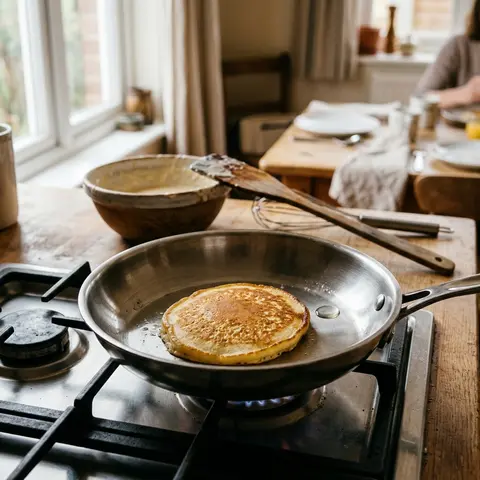
- Buckwheat pancakes with applesauce (mix batter ahead, chill)
- Cornbread from the toaster with avocado
- Plain yogurt with millet and berries
- Rice cakes with almond butter, only if the package says "oat-free facility"
For on-the-go: fresh fruit, hard-boiled eggs, homemade millet bars, or rice cakes from a safe facility. Grab-and-go bars for kids: almost always check for oats first.
The companion piece on FamFood: Gluten-Free Cooking for Kids goes deeper into snack ideas by age group.
Once breakfast and snacks are sorted, dinner becomes the easy part, but with one catch.
How Do You Cook Gluten-Free When the Rest of the Family Wants "Normal" Food?
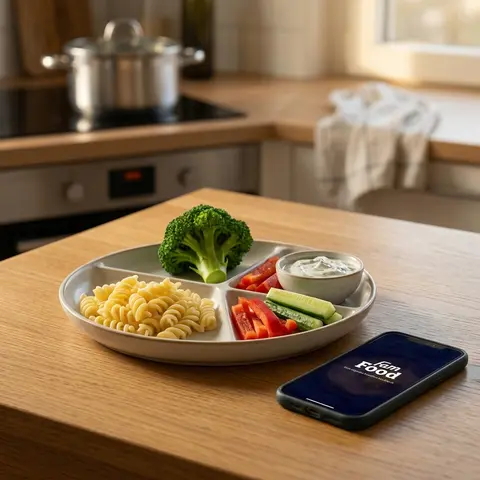
Cooking separately costs double: double the time, double the shopping, double the stress. The smarter solution is the so-called "gluten-free core": you cook the main dish gluten-free and offer gluten-containing sides separately, like regular bread or pasta. The whole family eats the same dish, just with different sides.
The principle in practice:
- Lentil curry over basmati rice: naturally gluten-free. Some add naan, others don't.
- Potato soup: gluten-free as long as you don't thicken it with a wheat-based roux. For some, a roll on the side; for your affected child, gluten-free toast.
- Risotto or stew: naturally gluten-free, zero extra effort.
In FamFood testing, the core method cut mealtime prep by roughly a third. Not because less gets cooked, but because the question "who cooks what extra" disappears.
Cross-contamination remains the open question: your own cutting boards for gluten-free bread, a separate colander for rice cooking, and your own toaster for your affected child aren't overkill.
That leaves the question most families ask too late: how risky is a kitchen that does both at once?
How Dangerous Is Cross-Contamination in a Family Kitchen?
Cross-contamination is the underestimated risk in the gluten-free family kitchen. According to the German Celiac Society, just 50 mg of gluten daily is enough to cause measurable damage to the gut lining in celiac patients. That's roughly one breadcrumb. Shared cutting boards, pasta colanders, and toasters are the most common sources.
Kitchen Tool | Risk | Solution |
|---|---|---|
Toaster | Very high, crumbs stick | Dedicated toaster for gluten-free products |
Pasta colander | High, gluten trapped in pores | Separate colander, gluten-free pasta only |
Wooden cutting board | High, cracks hold protein | Own board, color-coded or marked |
Non-stick pan | Medium | Wash thoroughly before use |
Oven/baking sheet | Low to medium, if wiped | Own parchment paper or wipe sheet |
Butter in shared container | Overlooked | Own portion butter or separate spread |
When strict separation makes sense: always with diagnosed celiac disease. With non-celiac gluten sensitivity without autoimmune reaction, the threshold might be individually higher, but a doctor should assess that.
Once you understand this, you suddenly want to know which recipes tie it all together without turning dinner into a double shift.
Which Gluten-Free Family Recipes Actually Work Every Day?
The most reliable everyday recipes are those that don't need specialty gluten-free products: rice stir-fry with vegetables and egg, potato soup, lentil curry over basmati rice, stuffed peppers, or cornbread. They're ready in 30 minutes, don't need a specialty aisle, and taste good to the whole family.
Among the most-saved recipes in FamFood, 7 out of 10 have fewer than 8 ingredients. That's no accident: simplicity is the most reliable way to get a dish on the table every single day.
Recipe | Prep Time | Ingredients | Gluten-Free? |
|---|---|---|---|
Rice stir-fry with egg and vegetables | 15 min | 6 | ✅ Naturally |
Potato soup | 25 min | 7 | ✅ Naturally |
Lentil curry over basmati rice | 30 min | 8 | ✅ Naturally |
Stuffed peppers with rice | 35 min | 7 | ✅ Naturally |
Cornbread (from cornmeal) | 20 min | 5 | ✅ With label check |
How to adapt your existing favorite recipes: wheat flour can usually be swapped 1:1 in most recipes with a blend of rice flour and tapioca starch (2:1). This works really well for pancakes and quick breads. For yeast dough, you'll need more liquid and xanthan gum as a binder.
Find the right 5-day plan with simple recipes for the week directly in FamFood, including a shopping list that auto-generates from your plan.
What follows is no new diet. It's a system that keeps the myth from repeating and brings the whole family along.
Frequently Asked Questions About Gluten-Free Family Cooking
What Can I Eat Gluten-Free if I Have Celiac Disease?
With celiac disease, all naturally gluten-free foods are allowed: rice, potatoes, corn, millet, buckwheat, amaranth, quinoa, fresh meat, fish, eggs, legumes, and most dairy products. Buy processed products only if they carry the gluten-free logo and don't contain conventional oats.
Is Oat Gluten-Free?
Conventional oats count as gluten-free under EU law (under 20 mg/kg) but contain avenin, which still triggers an immune reaction in roughly 5% of celiac patients. Safer is certified gluten-free oats from dedicated growing and processing that have been specifically tested for avenin tolerance. If unsure, skip them and discuss with your doctor.
How Do I Spot Hidden Gluten on Food Labels?
Look for these terms in the ingredient list: wheat starch, wheat protein, wheat germ oil, malt extract, barley malt, hydrolyzed wheat protein, triticale, and spelled flour. "Starch" without origin information might be wheat starch too. "May contain traces of gluten" warnings must be taken seriously with celiac disease.
Can I Cook Gluten-Free for My Family Without Cooking Everything Twice?
Yes, with the "gluten-free core" principle: cook the main dish gluten-free, and serve gluten-containing sides like bread or regular pasta separately. Risotto, stews, curries, and grain-based stir-fries are gluten-free anyway, so you don't need a parallel kitchen.
Which Gluten-Free Flours Work Best for Baking with Kids?
Rice flour is mild and easy to combine. Cornmeal works for dense doughs and corn pancakes. Buckwheat flour has a stronger taste, binds well, and makes fluffy pancakes. For cake batter, blend rice flour and tapioca starch (2:1), add a pinch of xanthan gum to keep the batter from falling apart.
About FamFood
FamFood is a digital family cookbook app that brings recipes, weekly meal planning, and shopping lists together in one place. We develop our content close to real family kitchens because generic tips rarely survive the real week. If you have questions about gluten-free family cooking, you'll find recipes, meal plans, and guidance on famfood.app that are built for actual weekdays.