Grandma's Apple Cake: Mistakes, Fixes & Real Recipe
No store-bought apple cake hits the mark. No Pinterest recipe hits it. Yet every time you're in the kitchen trying again, because you know it exists: that flavor. The one from Grandma.
What makes her version different, exactly? And why do recreations fail at the same three spots every time? That's what we'll untangle here, with the complete recipe, error diagnosis, and fixes that actually work.
Key Takeaways
- Tart apples like Boskoop or Elstar are your best bet: they hold their structure during baking (German Federal Office for Agriculture and Food (BLE), 2024).
- A soggy base is 90% preventable when shredded apples are mixed with sugar for 10 minutes first, then the liquid is drained.
- Among the most-saved recipes in FamFood, 7 out of 10 contain fewer than 8 ingredients. Grandma's apple cake fits this pattern perfectly.
Why doesn't Grandma's apple cake ever taste quite like the original?
Grandma's apple cake tastes different because three variables work together that no recipe fully writes down: apple variety, batter consistency, and baking-time feel. Ignore one of them, and you get a good cake, but not the original. The "secret" lives in details Grandma never consciously noted, because she never consciously learned them. She just did them.
That's the core of the problem. A written recipe gives you amounts. But there's no word for how the batter should feel when it hits the right consistency. No word for what smell tells you the cake's done before the timer rings. This hand-knowledge lives in the body, not on paper.
The three main error sources are identifiable. They are: wrong apple variety (too soft, too watery, too sweet), a batter that can't support the apple layer, and a baking time that runs either too short or too long. Know all three, and you can switch them off on purpose.
Which apple variety actually belongs in apple cake?
For juicy apple cake without a soggy filling, tart varieties like Boskoop or Elstar work best. They keep their structure while baking and balance the sweet batter. Goldrenette is the classic grandmother pick in many German regions. According to the German Federal Office for Agriculture and Food (BLE), it counts among traditional German heritage varieties that are showing up more often at farmers' markets again.
Apples from September onward deliver the best bite. Water content is still low after harvest, natural flavor is concentrated. Shop fresh from regional markets, and you'll notice the difference immediately. More on how to work with apples when they're in season.
A practical tip many recipes skip: mix two varieties. One tart for structure, one milder for depth. That gives a filling with more complexity.
Variety | Acidity | Texture After Baking | Recommendation |
|---|---|---|---|
Boskoop | High | Firm, holds shape | Very good |
Elstar | Medium | Pleasantly soft, no mush | Good |
Goldrenette | Medium-high | Slightly mealy, classic | Good |
Gala | Low | Softens quickly | Less suitable |
Golden Delicious | Low | Falls apart while baking | Not recommended |
The Base Recipe: Grandma's Apple Cake Step by Step
A classic grandma apple cake rests on simple creamed batter, a thick apple layer, and barely more than six ingredients. Prep time is 20 minutes, baking time 45 to 50 minutes at 350°F (175°C) with both top and bottom heat. Use convection, and you risk a dried-out crumb, because the batter seals too fast from outside. Top and bottom heat lets moisture move evenly through.
Ingredients at a Glance
For one 10-inch springform pan:
- 250 g all-purpose flour (Type 405)
- 200 g soft butter
- 150 g sugar
- 3 eggs (medium)
- 1 packet baking powder (about 15 g)
- 1 kg apples (e.g., Boskoop and Elstar mixed)
- 1 tsp cinnamon (optional, but classic)
- 1 pinch salt
Step-by-Step Instructions
1. Mix the batter. Cream butter and sugar until the mixture is pale and fluffy. This takes at least 3 minutes with a hand mixer. Then fold in eggs one at a time. Mix flour, baking powder, and salt separately, then fold in by the spoonful, don't beat. The batter should be thick-creamy, not liquid.
2. Let batter rest. Here comes the step most recipes skip. Let the batter sit covered for 10 minutes. In FamFood tests, we've consistently seen the cake get a noticeably better crumb when the batter rests briefly. The gluten relaxes, the batter spreads more evenly.
3. Prep the apples. Peel, quarter, slice thin or cut into coarse shreds. Toss with 1 tablespoon sugar and let sit 10 minutes. Pour off the liquid that rises. This step is crucial for a dry base.
4. Layer. Spread batter into a greased and floured pan. Distribute apples densely on top, press gently. Love cinnamon? Sprinkle it now.
5. Bake. At 350°F (175°C) with both top and bottom heat (preheated), middle rack, 45 to 50 minutes. Toothpick test: comes out clean? Done. Still has moist crumbs? 5 minutes more.
6. Cool. Leave the cake in the pan for 15 minutes, then let it cool completely on a wire rack. Cut too early, and the apple layer will slide.
Why does the apple cake get soggy or too dry?
A soggy base happens almost always from too much moisture from the apples. Shred your apples, toss with a bit of sugar, let them sit 10 minutes, then drain the liquid: that kills the problem 90% of the time. The second-most common reason is a batter that's too thin and can't hold up the apple weight.
The three most common mistakes at a glance:
Mistake 1: Apples cut too thick. Fat pieces release moisture slowly and unevenly. They soften on the outside while water gets trapped inside. Fix: Slice or shred apples to no more than 1/8 inch thick.
Mistake 2: Batter too thin. Liquid creamed batter can't hold apples. It soaks up moisture and stays raw underneath. Fix: Finished batter should drop heavily from a spoon, not flow. If it flows, add 1 or 2 tablespoons flour.
Mistake 3: Out of the oven too early. The toothpick test gets skipped because the top looks brown. Brown on top doesn't mean done inside. Fix: Always test. Always.
Quick fix for next time: Sprinkle a thin layer of breadcrumbs or ground almonds on the raw batter before topping with apples. They absorb extra moisture without changing the flavor.
What variations exist: crumble, glaze, or plain?
The three most common grandma variations are: plain apple cake with cinnamon sugar, apple cake with butter crumble, and apple cake with vanilla custard glaze. All three build on the same base batter but differ in effort and flavor profile. Plain is fastest, glaze is most involved, but also most impressive at coffee time.
Variation | What Makes It | Effort | Traditional In |
|---|---|---|---|
Plain with Cinnamon Sugar | Simplest form, pure apple taste | Low | All regions |
Butter Crumble | Butter-flour-sugar (1:2:1), work cold | Medium | Southern Germany, Bavaria |
Vanilla Custard Glaze | Pour over warm cake after baking | Medium-high | Northern Germany |
For crumble: ingredients must be cold, otherwise they melt into a sheet in the oven instead of crunchy bits. Quick chill, then rub with fingertips, don't knead.
Bring kids into apple cake baking: how to make it work
Kids age 4 and up can slice apples with an apple cutter, stir batter, and rub crumble together. It turns the cake into a family moment, not just a baking chore. According to research from the German Center for Nutrition Education (BZfE), kids accept foods much more readily when they've actively helped prepare them.
A simple task breakdown:
- Age 3+: Mix cinnamon and sugar, lay apple slices in the pan.
- Age 5+: Stir batter with a spoon, rub crumble with fingers.
- Age 8+: Peel apples with supervision, run the toothpick test yourself.
Baking together also lowers the barrier to trying unfamiliar ingredients. If they helped, they'll taste it. Want to learn how to turn baking into a real learning moment? Check out how to let kids bake without it ending in chaos.
How do you save and share the family recipe so it doesn't disappear?
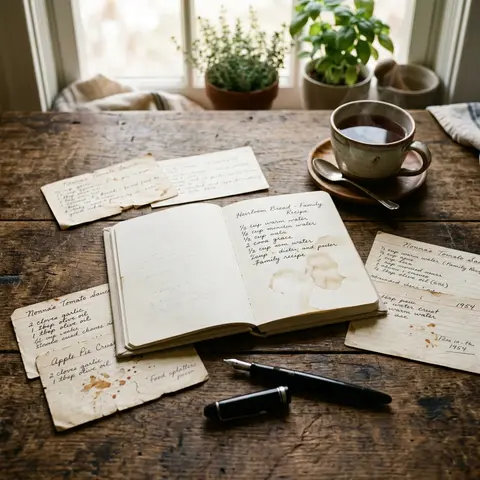
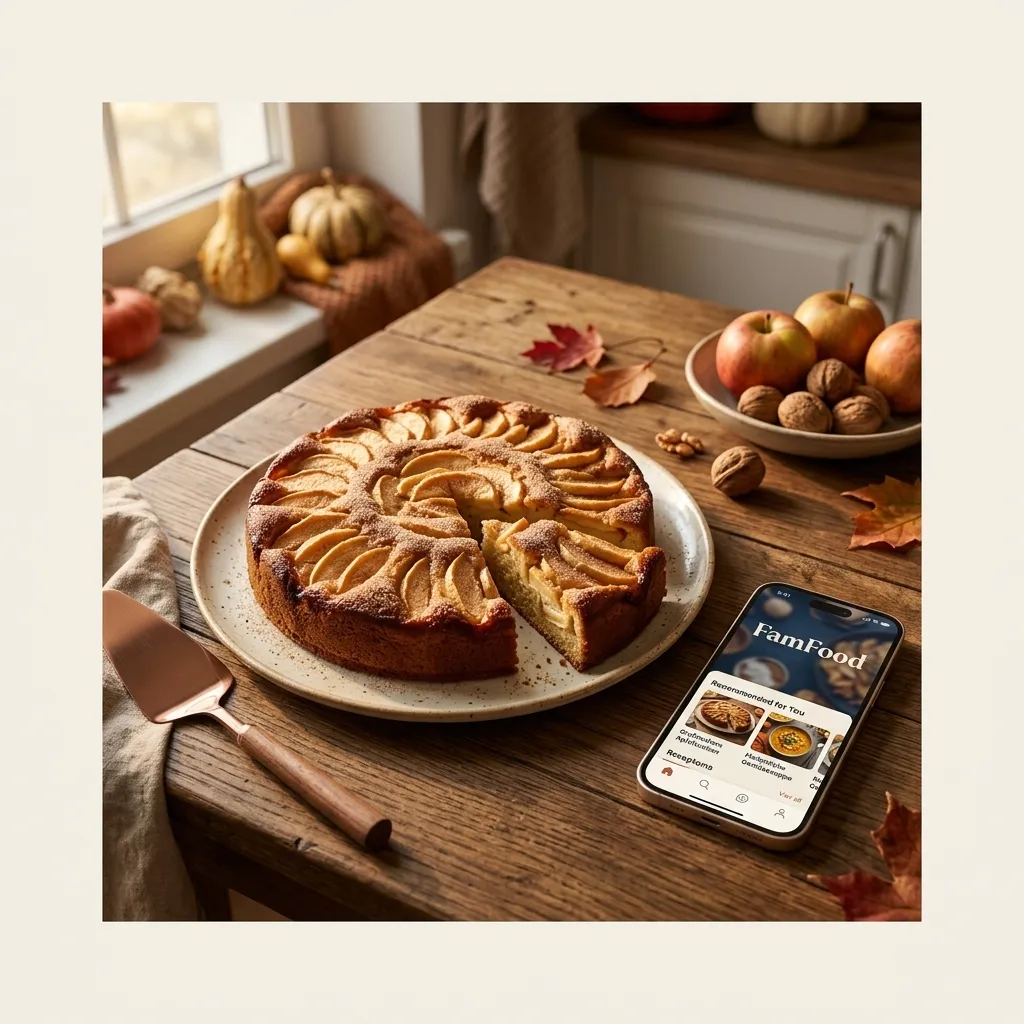
A handwritten recipe on a slip of paper can vanish, fade, or get lost in a move. Once you lock it in digitally, you have it for every generation and can share it in seconds with everyone. That sounds obvious, but most family recipes exist in only one physical copy.
Among the most-saved recipes in FamFood, 7 out of 10 contain fewer than 8 ingredients. Grandma's apple cake hits exactly this pattern: manageable ingredients, complex result. These are the recipes that should pass from generation to generation, not mold on a kitchen shelf.
Learn how to rescue old family recipes for good and make them accessible to everyone in the FamFood guide to digitizing Grandma's recipes.
Frequently Asked Questions About Grandma's Apple Cake
Which apple variety is best for apple cake?
Boskoop and Elstar are your most reliable choice. Both have enough tang to balance the sweet batter and enough firmness to survive baking without collapsing. Goldrenette is the classic grandma apple if you find it at the market. Gala or Golden Delicious turn too soft.
How do I keep the apple cake base from getting soggy?
Toss cut apples with 1 tablespoon sugar, let sit 10 minutes, and drain the liquid that comes out. For extra insurance, spread a thin layer of breadcrumbs or ground almonds on the raw batter base. It acts as a moisture buffer, stopping dampness before it soaks through.
Can I freeze Grandma's apple cake?
Yes, and it freezes well. Cool the cake completely, cut into pieces, wrap each piece in plastic wrap, and put everything in a freezer bag. Lasts up to 3 months. To thaw, unwrap at room temperature. Don't use the microwave; it turns the crumb gummy.
How long does homemade apple cake keep?
At room temperature under a cake dome or covered: 2 to 3 days. In the fridge: up to 5 days, though the crust gets less crisp. Cake with glaze or custard topping should always go in the fridge.
What's the difference between apple cake and apple strudel?
Apple cake is built on creamed or shortbread dough and baked in a pan. Apple strudel uses paper-thin stretched dough or puff pastry rolled around the apple filling. Apple cake is Germany's everyday version, apple strudel has deeper roots in Austrian and Bavarian baking.
About FamFood
FamFood is the digital family cookbook app for people who don't want to keep recipes on scraps of paper anymore. We save what really gets cooked, from Grandma's classics to quick Wednesday night dinners. Our mission: no good recipe ever disappears.