Grandma's Swabian Recipes: Tradition Worth Rescuing
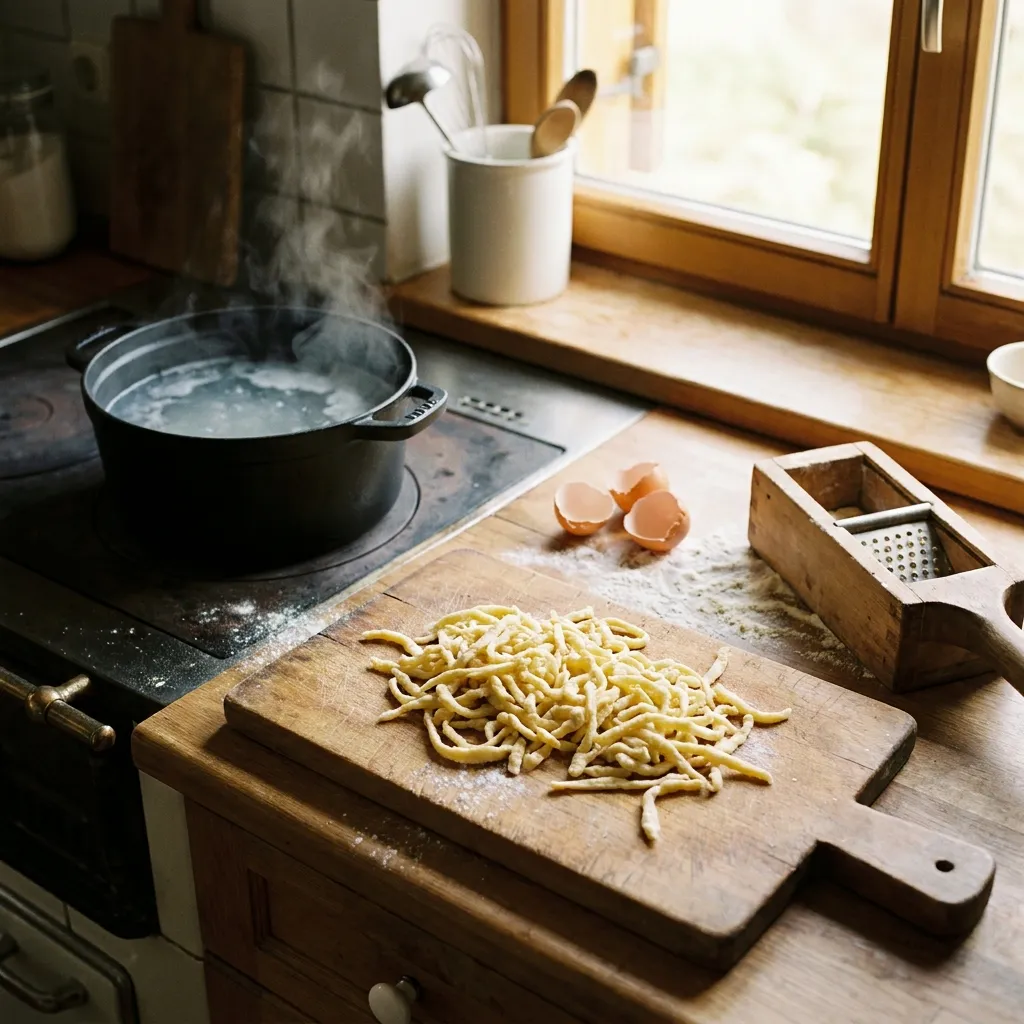
Most family recipes from Swabia exist nowhere on paper. They live in a grandmother's head, in the movement of her hands as she scrapes Spätzle dough from a wooden board into boiling water. If you've never cooked alongside her, you won't find these recipes online. And if you wait until you have time, you often wait too long.
Swabia cooks differently. Not better or worse than the rest of Germany, but from a principle worth understanding.
The essentials at a glance
- Swabian cuisine builds on flour, eggs, and potatoes. Meat is a side dish, not the main event.
- Maultaschen, Spätzle with lentils, Gaisburger Marsch, and Onion Roast are the four cornerstones of every Swabian family kitchen.
- With Spätzle, everything depends on dough consistency: it must bubble when beaten, or the texture falls apart.
- Many Swabian desserts like Ausgezogene or Ofenschlupfer have almost vanished outside the region.
- To preserve these recipes, you must stand beside the cook and cook along, not just write things down.
What makes Swabian cuisine so distinctive?
Swabian cuisine is one of Germany's most economical and most satisfying regional kitchens. Flour, eggs, and potatoes form the foundation; meat stays a side dish rather than the star. This formula grew from the economic hardship of the 19th century, when Baden-Württemberg was a poor agricultural region, and became regional identity. According to the German Federal Ministry of Food and Agriculture (BMEL), around 60% of households in southern Germany still prepare traditional pasta dishes at least once a week. In FamFood's data from Baden-Württemberg, Spätzle and Maultaschen dominate 8 out of 10 saved family recipes from the region.
The historical background is quickly explained: Baden-Württemberg was long a poor agricultural area. Swabians earned their reputation for thrift; the saying "Schaffe, schaffe, Häusle baue" (work, work, build a house) didn't come from nowhere. From this frugality emerged a clear design philosophy in the kitchen: few ingredients, high technique.
Folding Maultaschen by hand, scraping Spätzle from a board, properly soaking lentils—these aren't simple everyday dishes. They demand practice and patience. That's exactly what sets Swabian cuisine apart from Bavarian (which leans more heavily on meat and beer) and Badish (influenced more by French cuisine).
What we consistently observe at FamFood: users from Baden-Württemberg save grandma recipes with far more handwritten notes than users from other regions. Phrases like "until it feels like an earlobe" or "when the dough shines" appear where other recipes simply list grams. That's no accident. It's proof that the real knowledge of Swabian cooking is physical, not written.
Which dishes appear on every Swabian grandmother's table?
Maultaschen, Spätzle with lentils, Gaisburger Marsch, and Onion Roast are the four dishes no Swabian family kitchen can do without. Know these, and you know Swabia.
Dish | Type | What makes it special | Difficulty |
|---|---|---|---|
Maultaschen | Everyday & Sunday | Stuffed pasta, traditionally filled with meat or spinach | Medium to high |
Spätzle with lentils | Everyday dish | Mountain lentils from the Swabian Alps, thin sausages on the side | Medium |
Gaisburger Marsch | One-pot stew | Potatoes, beef, Spätzle all in one pot | Easy to medium |
Onion Roast | Sunday dish | Pan-fried onion rings on seared beef | High |
Each dish has its own story. Gaisburger Marsch, for example, began as a stew where soldiers from the Stuttgart district of Gaisburg would fill their bowls with every available scrap. Today it's prized as festive comfort food for cold days and big appetites.
With Onion Roast, even experienced home cooks regularly stumble: the meat hits the pan too early, the onion rings brown too lightly, and the sauce loses depth. The key is patience. Let the onion rings turn truly dark brown, almost to the point of caramelization. Only then does the meat go in.
Maultaschen: Why is there actually meat in the dough?
Maultaschen are called "Herrgottsbescheißerle" in folk speech—literally, "God-tricker"—because the meat filling hides inside the pasta dough, staying out of God's sight on meatless Fridays. The Friday-abstinence logic: what you can't see doesn't sin. Whether that holds theological water is another question.
Spätzle with lentils: More than student food
Spätzle with lentils are seen as cheap and simple. That's true for ingredients, not for preparation. Mountain lentils from the Swabian Alps need 8 to 12 hours of soaking and a generous splash of vinegar at the end to balance acidity. Without that final step, they taste flat.
How do you really cook Spätzle like grandma?
True Swabian Spätzle need no food processor. Dough made from flour, eggs, salt, and a splash of water, then scraped into boiling water using a board and knife: that's the method Swabian grandmothers have used for generations. No machine replaces the feel for the right dough.
The deciding factor is dough consistency. The dough must bubble when you beat it with a wooden spoon. This bubbling shows that enough air has been worked in and the gluten structure is right. Dough that's too stiff yields tough Spätzle. Dough that's too soft falls apart in the water.
Board vs. press vs. ricer: an honest comparison without false nostalgia:
- Board and knife: yields irregular, thicker Spätzle with more bite. Traditional, but time-consuming.
- Spätzle press: faster, more uniform, suited to everyday cooking. yields round Spätzle.
- Ricer: a compromise between the two. Good option for medium quantities.
As for flour: never durum wheat semolina. Ever. Swabian Spätzle need wheat flour type 405 or 550, ideally spelt flour type 630 for more intense flavor. Durum wheat semolina makes the dough too grainy and the Spätzle tough in the wrong way.
Cheese Spätzle as a variation: alpine cheese for intense flavor, Emmentaler for milder versions. Mixing both usually pleases everyone at the table.
After draining, a short rest period helps. Spätzle that go straight from cooking into the pan tear easily. Wait two to three minutes, then toss in butter.
Why do Maultaschen burst? And how Swabian grandmothers prevent it
The key to intact Maultaschen lies in the filling: stale bread, spinach, and ground meat in the right ratio, plus a pinch of nutmeg. Leave out the bread, and the filling becomes too moist and tears. The stale bread binds the liquid from spinach and meat without overpowering the flavor.
The pasta dough follows the rule: 1 egg per 100g flour, plus a small splash of water and salt. Rest for at least 30 minutes, wrapped in plastic. If you're cooking ahead, the dough keeps covered in the fridge for up to 24 hours, and you can use trimmed pieces directly for noodle strips.
With the filling: fresh spinach gives more intense flavor, frozen spinach is more convenient but must be thoroughly wrung out. Any liquid residue destroys consistency. The traditional meat-to-bread ratio is about 2:1.
The vegetarian Friday version works with more bread, grated hard cheese, and toasted onions instead of meat. It satisfies just as much if the bread ratio is right.
The best reheating trick: poach Maultaschen in broth, not in the pan. Pan-fried Maultaschen are crispy but lose their tender dough structure. In broth, they stay soft and absorb extra flavor. If you want both, poach them first, then pan-fry briefly.
According to BZfE (German Nutrition Center), homemade pasta made from eggs and flour ranks among the most nutrient-dense comfort food options, especially when high-quality ingredients like free-range eggs are used.
Which Swabian desserts does hardly anyone know anymore?
Beyond the well-known Ofenschlupfer, there are Swabian Poor Knights, Ausgezogene (schmaltz pastries), and the steamed dumplings Buchteln with vanilla sauce—desserts that have nearly disappeared outside the region. These sweets don't turn up in standard recipe blogs about Swabian cuisine, and that's no accident: they're labor-intensive, not particularly photogenic, and require knowledge that only comes from making them yourself.
Dessert | Main ingredient | What makes it special | How well-known |
|---|---|---|---|
Ofenschlupfer | Stale bread, apples | Swabian cousin to bread-and-butter pudding | Known regionally |
Ausgezogene | Yeast dough, schmaltz | Schmaltz pastry for celebrations, rarely made today | Almost forgotten |
Steamed dumplings | Yeast dough | Two schools: salty crust or sweet, a genuine dispute | Known regionally |
Buchteln | Yeast dough, vanilla sauce | Barely known outside Baden-Württemberg | Largely unknown |
The steamed dumpling dispute is real: the sweet school serves them with vanilla sauce or wine foam. The salty-crust school creates a golden, lightly salted crust on the pot bottom. Both camps have passionate followers, both are "original." Regionally: in Württemberg the salty crust wins; heading toward Bavaria, the sweet version dominates.
Ausgezogene are yeast-dough fritters pulled apart in hot schmaltz until they have a thin center and thick edges. The edges soak up the fat, the middle stays almost crispy. Almost no one under 60 knows this pastry today. A real loss.
Ofenschlupfer: The recipe step by step
- Slice stale white bread or rolls thin.
- Peel and core apples, slice them thin. Toss with a little sugar and cinnamon.
- Layer bread slices and apple slices alternately in a buttered baking dish.
- Whisk together 3 eggs, 400 ml milk, 2 tablespoons sugar, and a pinch of vanilla. Pour over the dish.
- Let sit for 10 minutes so the bread absorbs the liquid.
- Bake at 350°F (175°C) with fan for 35 to 40 minutes until the top is golden brown.
Serve warm, with a scoop of vanilla ice cream or plain. No sauce needed.
How do you rescue Swabian family recipes before they're lost?
Most Swabian grandma recipes exist only in someone's head or on yellowed notes. Writing them down once isn't enough: quantities are often missing, technique lives in the cook's head. To truly preserve a recipe, you must stand beside the cook and cook along. And record while you do.
The concrete method: start a voice recording during the shared cooking. Not a video, which distracts. Just audio. The grandmother explains as she cooks, unconsciously revealing the implicit knowledge that never makes it onto a recipe card. "Enough flour" means something different to her than to you. You can reconstruct that difference from the recording later.
What often goes missing are phrases like "until it sounds right," "when the dough feels like an earlobe," "when the smell is right." It sounds vague, but it's precise. Record these sentences, and you have more than a recipe. You have a lesson.
With FamFood, you can dictate voice notes directly into your digital cookbook and link them to the recipe. That way, implicit knowledge doesn't disappear even when the paper eventually fades.
What belongs in a Swabian kitchen pantry?
To cook Swabian style, you mainly need: spelt flour type 630, fresh eggs (at least 6 per household week), mountain lentils from the Swabian Alps, beef broth meat, and a good bone broth cube for emergencies. With these five things on hand, you can spontaneously cook three of the four Swabian foundations.
Ingredient | Use | Tip |
|---|---|---|
Spelt flour type 630 | Spätzle, Maultaschen dough | Buy from regional mill if possible |
Fresh free-range eggs | Dough, egg custard | Plan for at least 6 per week |
Alps mountain lentils | Lentil dish | Soak 8-12 hours, don't skip this |
Beef broth meat | Gaisburger Marsch, broth | Order from butcher, not prepackaged |
Bone broth cube | Emergency base for sauces | Quality varies widely, check ingredients |
The Swabian Alps mountain lentils make a flavor difference you can taste. Slow Food Germany has listed the Alb lentil as an "Ark of Taste" product because it nearly vanished for decades. Now farmers on the Swabian Alps are growing it again. They cook softer than green lentils and have a nuttier aroma.
When shopping by season: savoy cabbage arrives in fall and winter, green cabbage keeps long and works well as filling for Maultaschen, leeks dominate from October through March. Shop seasonally, and you'll pay less and cook with more flavor.
Frequently asked questions about Swabian grandma recipes
What's the difference between Maultaschen and Schlutzkrapfen?
Maultaschen come from Swabia, are larger, and are made with a meat-spinach-bread filling. Schlutzkrapfen come from the Tyrol and South Tyrol, are smaller, half-moon shaped, and typically filled with spinach and ricotta. Both are pasta packets, but dough thickness, filling, and how you serve them differ significantly.
Can you prep Spätzle dough the day before?
Yes, but with limits. Spätzle dough keeps covered in the fridge for up to 24 hours. It pulls in a little liquid and needs to come back to room temperature before you work with it. If you give cold dough to boiling water, you'll get uneven Spätzle. Stir vigorously again right before scraping.
What meat do you use for Gaisburger Marsch?
Traditionally you use beef shank or chuck, cuts with lots of connective tissue that become tender from long cooking. The meat gives the broth depth. If you work with broth meat from the butcher (mixed cuts), you'll get similar results. Don't rush it: cook low and slow for at least 90 minutes.
Why are Maultaschen called "God-trickers"?
The name comes from Catholic fasting practice. On meatless Fridays, eating meat was forbidden. Hiding the filling inside pasta dough was seen as a trick to "fool" God because the meat was invisible from outside. The name is humorously irreverent and belongs firmly to Swabian folk culture, even though fasting rules constrain almost no one today.
How do you freeze homemade Maultaschen properly?
Best to freeze them raw: arrange them on a flour-dusted baking sheet and freeze individually (about 2 hours), then transfer to freezer bags. That way they don't stick together. Take them straight from the freezer into boiling salted broth; don't thaw. Cooking time increases by about 3 to 4 minutes compared to fresh Maultaschen.
About FamFood: FamFood is the digital family cookbook for anyone who doesn't want to lose recipes. We've felt firsthand how hard it is to capture the implicit knowledge from grandma's kitchen, so we build tools that make it possible. Not for professionals, but for families who want to eat well.




