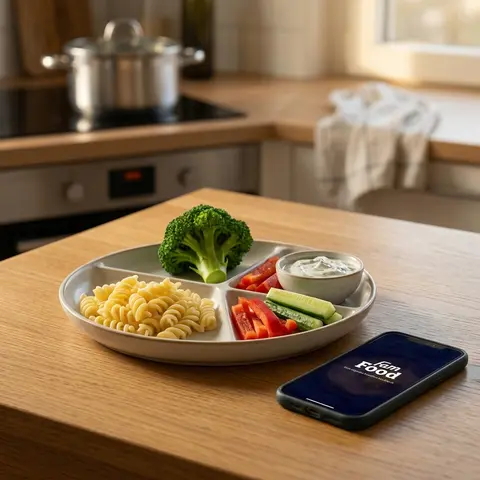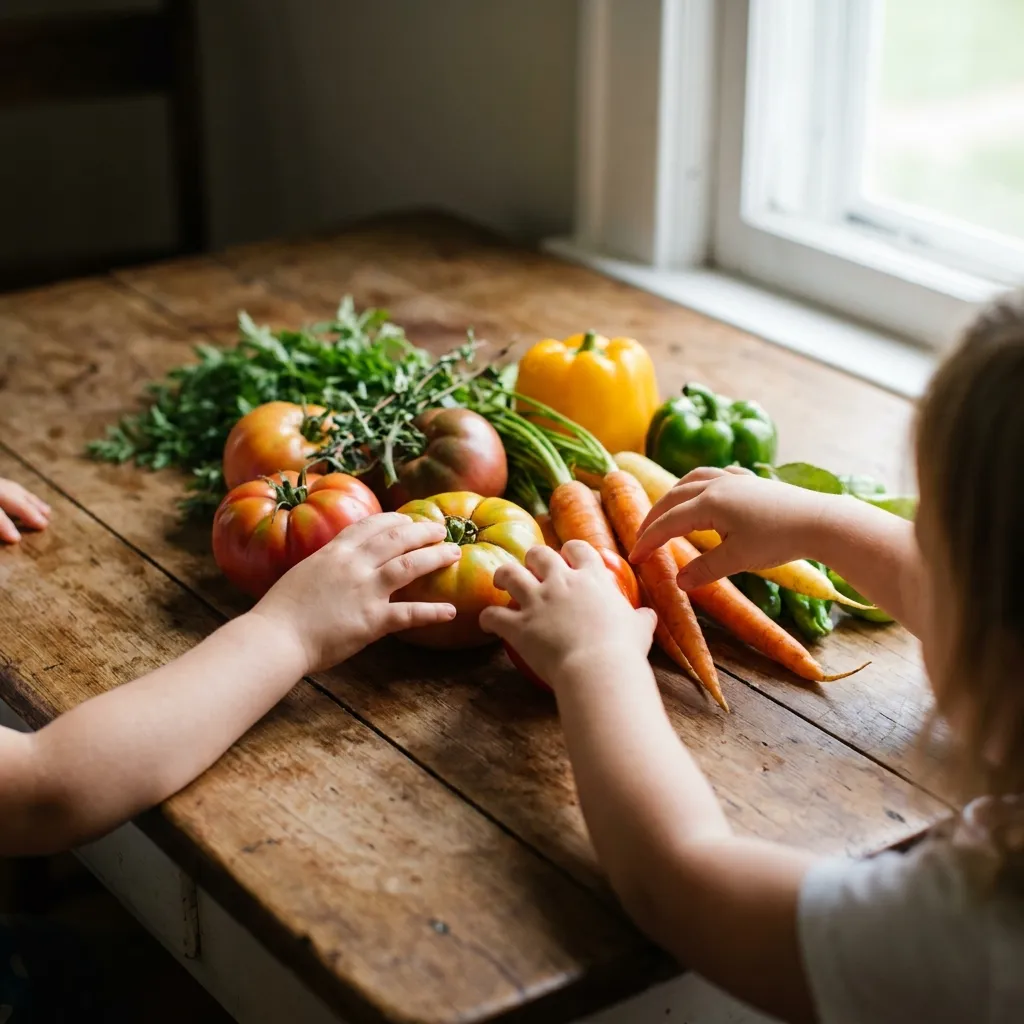
The plate sits on the table. Your child stares at it like a stranger just walked in. You know what's coming.
No drama, no defiance, no failure. What you're watching right now has a name and an evolutionary reason. This post explains why food rejection is biologically normal in kids, and shows you what you can do differently this week.
Key Takeaways
- Food neophobia between ages 2 and 6 is inborn, not stubbornness.
- According to BZfE, children need 10 to 15 neutral exposures before they'll try a new food.
- Food chaining and bridge foods are the strongest evidence-based methods for home use.
- Simple recipes with 5 ingredients or fewer reduce overwhelm for children with neophobia.
- Hiding foods and pressure reward tactics raise the barrier instead of lowering it.
Why Do Kids Actually Reject New Foods?
Food neophobia, the inborn wariness of unfamiliar food, peaks in children between ages 2 and 6. It's an evolutionary safety mechanism, not defiance. At a time when toddlers become increasingly mobile and might put anything in their mouths, this distrust of the unknown protected them from potentially toxic plants. The brain is simply doing what it was built to do.
Neophobia is not the same as sensory processing disorder. With neophobia, a child rejects unfamiliar foods in certain situations. With genuine sensory issues, they react to specific textures, sounds, or smells persistently and intensely across many everyday situations. Knowing the difference matters because the solutions are different.
In conversations with FamFood users, a consistent pattern emerges: parents report that rejection drops sharply once kids start school. That's not coincidence—it's development. Parents aren't responsible for their child's neophobia. But they can shape the environment where the child feels safe trying something new.
How Many Exposures Does a Child Need Before Accepting a New Food?
10 to 15 exposures to a new food are needed before children will try it. According to BZfE (German Center for Nutrition Education), this isn't a threat—it's relief: trying is not liking, and liking comes later, if at all. Every single neutral exposure counts, whether the child looks, touches, or simply sits near the food. Parents don't have to wait for eating to measure progress.
The exposure model describes how acceptance builds in stages. Each stage counts as an exposure:
The Four Exposure Stages: From "Looking" to "Eating"
- Seeing and naming – The food sits on the table. Your child doesn't have to touch it. They're learning anyway.
- Touching and smelling – Washing, cutting, or smelling together. No tasting required.
- Having it in the mouth without swallowing – Spitting is explicitly allowed. No commentary.
- Swallowing and rating – This happens naturally over time once the earlier stages repeat frequently enough.
Why Pressure Raises the Barrier, Not Lowers It
"Just try it once" sounds harmless. For a child with neophobia, it feels like coercion. Research shows that mealtime pressure intensifies neophobic reactions and damages trust at the table. A brief "You don't have to" signals safety, and safety is what curiosity needs.
Which Introduction Methods Actually Work?
Three approaches have the highest success rate in controlled studies and family life: using bridge foods, cooking together, and food chaining from familiar to new. All three rely on voluntary choice and repetition instead of persuasion at dinner.
Method | Principle | Example |
|---|---|---|
Bridge foods | From known taste/texture to new | Mashed potatoes → mashed parsnips |
Food chaining | Gradual variations on accepted food | Fries → oven fries → baked parsnip fries |
Cooking together | Contact through prep, not eating | Child peels zucchini without having to eat it |
Exposure without expectation | Food sits on table, no comment | Cauliflower is simply there |
What doesn't work: hiding foods (trust suffers once the child finds out), reward pressure ("If you eat the broccoli, you get dessert"), and force. All three methods shift motivation outward and train the opposite of self-directed curiosity.
Food Chaining: Small Steps From Familiar to New
Food chaining starts with what your child already eats and moves forward in tiny steps. The principle: each change is so small the brain doesn't sound an alarm. Example chain for a child who loves fries:
Fries (fried) → oven fries (baked) → diced oven potatoes → diced oven parsnips → parsnip purée.
Each step can take weeks. That's not going backward.
Cooking Together as an Exposure Method
Whoever handles food knows it. Slicing zucchini, grating carrots, or shaping dough build familiarity without requiring a single bite. Cooking together is one of the most effective ways to move through exposure stages without the child even realizing they're practicing.
What Does a Realistic Introduction Plan Look Like?
A 3-week rhythm with 2 to 3 low-pressure exposures per week is realistic and doable. That's up to 9 intentional encounters without disrupting family life. No food needs attention every day.
Week | Goal | Possible Actions |
|---|---|---|
Week 1 | Seeing and naming | Let child hold food at store, place on table, look together |
Week 2 | Touching and cooking together | Child cuts with (dull) knife, smells, peels, stirs in bowl |
Week 3 | Tasting without expectation | Small piece on plate, explicitly: "You don't have to eat." |
Success here means: Did an exposure happen? Not: Did the child eat? A child who licks and spits in Week 3 has made progress.
Simple recipes with 5 ingredients or fewer reduce overwhelm for children with neophobia. Less is more, especially at the start.
If after several months of consistent effort there's no change and the child's diet is severely limited, it's worth checking with a pediatric nutritionist or doctor. That's not failure—it's a smart next step.
Which Foods Work Best for Picky Eaters?
Foods with mild flavor, soft texture, and flexible forms have the best shot: cauliflower, parsnips, white beans, zucchini. They can take shapes kids know (purée, nuggets, sticks) and don't smell overpowering while cooking. BZfE recommends starting with mild, slightly sweet vegetables because kids naturally prefer sweetness and reject bitter, intense flavors first.
Food | Why It Works as Starter | Common Prep |
|---|---|---|
Cauliflower | Mild smell, white color, shapeable | Puréed, baked as "popcorn," in chunks |
Parsnips | Slightly sweet, similar to carrots | Oven sticks, purée, soup |
White beans | Soft texture, neutral taste | In pasta sauce, spread on toast |
Zucchini | Almost no flavor, high water content | Grated in batter, baked as sticks |
Peas (frozen) | Sweet, familiar shape | Plain, in rice, in soups |
Corn | Sweet, crispy, individual kernels | Plain off the cob, in salads |
In contrast: bitter vegetables like Brussels sprouts, arugula, or broccoli come later. Strong cooking smells (red cabbage, celery) raise the barrier further.
Why Texture Matters More Than Taste
Kids process texture before taste. Soft food that melts in the mouth triggers less resistance than something firm with unknown chew. That's why many children accept puréed versions of foods they reject raw. Once texture feels familiar, the window opens for taste.
What If Nothing Works?
If a child eats extremely limited foods after months of consistent effort and it affects daily life—school, activities, or family meals—check for ARFID. ARFID (Avoidant/Restrictive Food Intake Disorder) is a recognized eating disorder and goes far beyond normal neophobia.
The difference: with neophobia, a child rejects new foods but eats from a wide enough range of familiar ones. With ARFID, the range is so narrow that malnutrition and social limits result. A pediatrician or pediatric nutritionist can diagnose this.
Normal neophobia resolves on its own by school age for most children. BMEL (German Federal Ministry of Food and Agriculture) offers parents further information and resources. You don't have to figure this out alone.
What Do Parents Ask Most?
At what age is neophobia normal in kids?
Food neophobia typically starts between ages 2 and 3 and peaks between 2 and 6. It's developmentally normal at this age and doesn't reflect parenting mistakes. After age 7, it drops noticeably for most children, often without deliberate intervention.
Should I hide new foods in meals?
No. Hiding works short-term but damages things long-term. Once your child realizes something you didn't tell them about was in their food, they lose trust in the meal and in you as the cook. Direct contact with visible food builds real acceptance. Hiding skips this learning process.
How do I respond if my child gags when trying something?
Stay calm, no comment, no pressure. Gagging on unfamiliar textures is a normal protective reflex, especially in younger kids. Say briefly: "That's okay, you don't have to." Then the conversation moves on. Overreacting either way (alarm or encouragement) puts focus on the gagging and strengthens its link to the food.
How many foods should a school-age child know?
There's no minimum. As a guideline: a school-age child eating from 20 to 30 different foods across all groups (vegetables, fruits, grains, protein) is well-fed. More important than the number is variety across groups. If a whole group is missing, talking to the pediatrician makes sense.
About FamFood
FamFood is a digital family kitchen built by people who cook every day. We collect what actually works: in real life, with kids, without perfection. If you want to save, plan, and share recipes, visit famfood.app.