That first spoonful of puree sounds harmless. But for many parents it feels like a test without study notes. When is the right moment? What if the baby spits everything out? What if it's too early?
Good news: there are clear markers to guide you. And you don't need to be afraid of that first spoonful.
What we see over and over at FamFood: babies who are part of family meals from the start, sitting at the table when everyone eats, quickly develop their own appetite for food. The curiosity doesn't come from the spoon, it comes from being involved. That makes a bigger difference than most guides admit.
Key Takeaways
- Most babies are ready for solids between months 5 and 6. Starting earlier than month 4 poses health risks (BZfE).
- Three physical readiness signs matter: stable head control, interest in what others eat, no tongue thrust reflex.
- Honey is absolutely off-limits until the first birthday, no exceptions.
- Refusal is normal. Children need up to 15 tries before accepting a new food.
- Baby-led weaning and puree feeding work together without problems.
When can a baby start eating solids?
The optimal window for starting solids is between months 5 and 6. Most German pediatricians recommend exactly this timeframe. The WHO advises exclusive breastfeeding up to month 6. Before month 4, the digestive system and kidneys aren't mature enough for solid food. After month 7, iron stores empty, milk alone isn't enough anymore, and babies become noticeably less willing to accept new textures. Starting between months 5 and 6 fits every guideline.
The Federal Centre for Nutrition (BZfE) names month 5 onwards as the realistic entry point for German families. Both boundaries, earliest month 4 and latest month 7, are medically sound, not arbitrary.
Early start before month 4: Digestive system and kidneys aren't mature. The risk of food allergies and overweight increases measurably.
Late start after month 7: Iron stores empty, milk alone doesn't meet needs anymore. Plus, babies struggle more with new textures and flavours the later they begin.
Premature babies: Use the corrected age, not the birth date. A baby born six weeks early starts solids six weeks later than peers. Your paediatrician decides this individually.
What signs show your baby is really ready?
Three physical signs together signal readiness: your baby holds its head up stably without support, shows genuine interest in what others are eating, and the tongue thrust reflex that pushes out foreign objects has faded. All three must be present at the same time, not just one. This happens in most babies between months 4 and 6. If only one sign is there, it's worth waiting two to three more weeks and checking again.
A common mistake: teething looks like interest in food. The baby grabs at everything, chews on fingers, drools. That's not a readiness sign for solids, it's teething discomfort. The difference: genuine interest shows when the baby follows the spoon with its eyes, opens its mouth, and reaches deliberately for the plate.
Three questions to ask yourself:
- Can my baby sit safely and upright, even without support?
- Does it open its mouth when I eat, and watch intently?
- Does it still reflexively push things out of its mouth?
If you're unsure, it's worth talking to your paediatrician at the next check-up appointment, or at the U5 visit (from month 6 onwards).
What should I start with for the first puree?
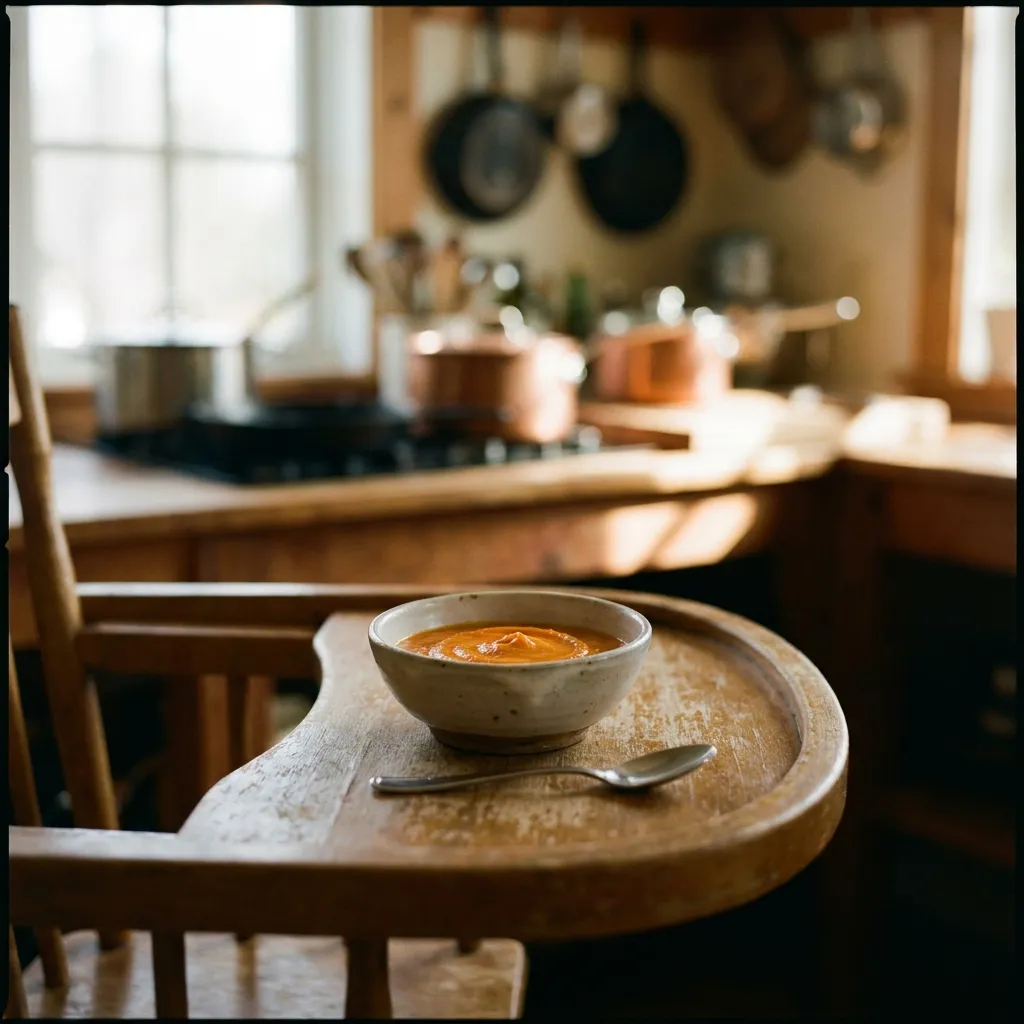
Classic starting point according to the BZfE nutrition plan: a lunch puree with one single vegetable, for example carrot or parsnip, with no salt, sugar, or spices. One single food per introduction week makes it easier to spot intolerances. After seven days with no issues, the next ingredient comes in.
The classic sequence follows a clear principle: vegetables first, then potato or lean meat (for iron), then grains. Grains contain gluten, which is introduced a bit later, after month 4, but not after month 7. This lowers coeliac disease risk.
Which vegetables work best as a first food?
Sweet, mild-tasting varieties have the best chance: carrot, parsnip, squash, courgette. Cruciferous vegetables like broccoli or cauliflower come a bit later; they can initially cause bloating. Spinach and beetroot contain lots of nitrate and shouldn't appear until after month 6.
How fine does the puree really need to be?
Weeks 1 and 2: very finely pureed, no lumps, smooth like yoghurt. From months 7-8: slightly thicker consistency, small soft pieces are okay. From months 9-10: soft finger-food pieces can be added. Your baby guides the pace with its reactions.
In FamFood trials, we've noticed that babies approach soft carrot pieces from month 9 onwards much more curiously than puree. Texture makes a bigger difference than most parents expect.
Weekly plan: your first three weeks of solids
Week | Food | Preparation | Amount |
|---|---|---|---|
Week 1 | Carrot only | Finely pureed, no additions | 2-3 teaspoons |
Week 2 | Carrot + potato | Pureed, slightly creamier | 4-6 teaspoons |
Week 3 | Carrot + potato + rapeseed oil | Creamy, 1 tsp oil for fat | 6-8 teaspoons |
The oil in week 3 isn't a nice extra. Fat-soluble vitamins like beta-carotene from carrot are barely absorbed without fat. Rapeseed oil also supplies beneficial omega-3 fatty acids.
What has no place in puree, and why?
Honey, salt, sugar, raw eggs, and certain fish are off-limits for babies under 12 months. Honey can contain Clostridium botulinum spores, which are life-threatening to infants. The risk isn't a myth: the Robert Koch Institute documents cases of infant botulism in Germany each year. Heating doesn't destroy the spores reliably, which is why the boundary stays until the first birthday, no exceptions.
Salt and sugar overload still-immature kidneys and shape taste buds in a direction that can later lead to overweight. Babies who get used to salty food early prefer it long-term.
Forbidden list for the first year
Food | Reason | Limit |
|---|---|---|
Honey (even heated) | Botulism risk from spores | Until 1st birthday |
Salt | Overloads kidneys, shapes taste | No salt in puree |
Sugar | Shapes taste, cavity risk | Avoid when possible |
Raw eggs | Salmonella risk | Always cook fully |
Cow's milk as main drink | Too much protein, too little iron | Only from 12 months |
Large predatory fish (tuna, swordfish) | High mercury contamination | Use very sparingly |
Whole nuts | Choking hazard | Earliest from age 3 whole |
Allergens like peanuts, eggs, wheat, and fish, however, shouldn't be deliberately avoided. Current research shows: deliberate early introduction lowers allergy risk. Talk to your paediatrician about which order to follow.
Baby-led weaning or puree: what fits your family?
Baby-led weaning (BLW) and puree feeding don't exclude each other. Many German families combine both: soft finger-food pieces to grab and puree for secure nutrient intake. What matters isn't the method, but that your baby gets enough iron and energy. Both approaches can deliver that if done well. The German Society for Paediatrics and Adolescent Medicine (DGKJ) sees both methods as equally valid if nutrient supply is secured.
Advantages of baby-led weaning:
- Your baby controls pace and amount itself, which builds self-regulation
- Fine motor skills and chewing develop early
- The child sits at the family table from day one and eats together
Advantages of classic puree feeding:
- Nutrient intake is more controllable, especially iron
- Choking risk in the first weeks is lower
- Portion sizes are easier to estimate
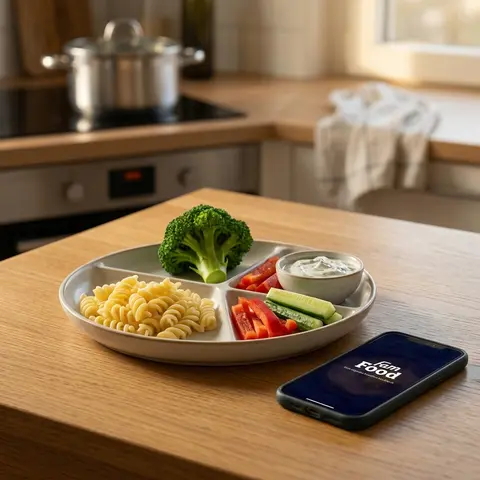
The hybrid approach for German family life: Lunch is puree, securing iron and calories. At dinner the baby sits at the table and gets soft finger-food pieces to explore: cooked carrot sticks, soft banana piece, cooked pasta pieces. This way you learn both methods without dogma.
Important: know the difference between gagging and choking. Gagging is loud, the baby coughs, turns red, recovers itself. That's normal and safe. Silent choking is the emergency. Never leave a baby alone with finger food, always keep baby in upright sitting position.
If you're looking for specific family recipes you can all share at the table, you'll find lots of ideas at FamFood.
When does solids replace milk, and how fast does that happen?
The solids phase typically runs from month 5/6 until the end of the first year. Breast milk or infant formula stays the most important food throughout this entire time. Only after the first birthday does it step into the background. Solids complement milk, they don't replace it.
The BZfE rhythm suggests three purees:
- Months 5-6: Lunch puree (vegetable-potato-meat)
- Month 7: Evening puree (grain-milk)
- Months 8-9: Morning puree (grain-fruit)
The remaining milk feeds are replaced by these purees step by step, never all at once.
From month 6 onwards, water can be offered, always with meals, never instead of milk. Open cups or spouted cups without valves are better suited than classic training cups with teats. Chewing muscles and speech development benefit from open drinking.
What if your baby refuses the puree?
Refusal in the first weeks is normal and doesn't mean your baby isn't ready yet. Studies show that children need to try a new food up to 15 times before accepting it. Pressure creates resistance, the same with solids as with two-year-olds. Forcing the baby risks long-term aversions.
'Don't like it' or 'Not ready yet'? The difference lies in behaviour. A baby that turns its head away, keeps its mouth shut, or cries sends a clear signal. A baby that pushes the puree out while looking curious is still practising coordination.
The most effective trick: shared table from the start. Babies are social learners. When they see everyone else eating, willingness grows. Seat your baby with you when the family eats, even if it doesn't eat anything yet.
Three-day break rule: With stubborn refusal of a particular food, a three-day break helps. Then it comes back on the spoon, completely relaxed. No comment, no bargaining.
When is refusal a real warning sign?
- The baby is noticeably losing weight
- It shows no more interest in milk
- It seems generally sluggish, restless, or ill
In these cases, see your paediatrician straight away. Everything else: patience, repetition, sharing meals at the table.
More ideas for playfully introducing children to new foods are in our Seasonal cooking: year-round guide.
Frequently asked questions about solids
From which month can a baby eat solids?
Earliest at the end of month 4, recommended from month 5 to 6. Before month 4, the digestive system and kidneys aren't mature. From month 6 onwards, parents should definitely have started solids so that iron needs are met.
Can I wait until my baby is 7 months old to start solids?
Better not. From month 6 onwards, your baby's iron stores deplete. Breast milk alone isn't enough anymore. Starting solids after month 7 also makes getting used to new textures and flavours harder, because the window for optimal acceptance is slowly closing.
What's the difference between solids and baby-led weaning?
Solids means everything fed alongside milk, so purees and solid food. Baby-led weaning (BLW) is one method within solids: the baby brings solid pieces to its mouth itself, instead of being spoon-fed. Both terms don't exclude each other.
Can my baby have spices in the puree?
Yes, in moderation. Mild herbs like parsley or a hint of cinnamon are fine from month 6 onwards. Salt, hot spices, and ready-made spice mixes stay off-limits in the first year. Honey is absolutely forbidden until the first birthday.
How much puree does a baby need per meal at the start?
In the first days, 2-3 teaspoons is enough. That sounds small, but it's perfectly adequate. Milk still supplies most of the energy. After three to four weeks, the amount slowly rises to 80-150 ml per meal. Never force it, always follow your baby's lead.
About FamFood: We're a team of parents, cooks, and food enthusiasts who want to make family cooking more digital and stress-free. On famfood.app you collect recipes, plan meals, and cook with what you've got on hand. For every family phase, including the one with the little puree-eater at the table.