Let Kids Bake: Learning Format, Not Chaos
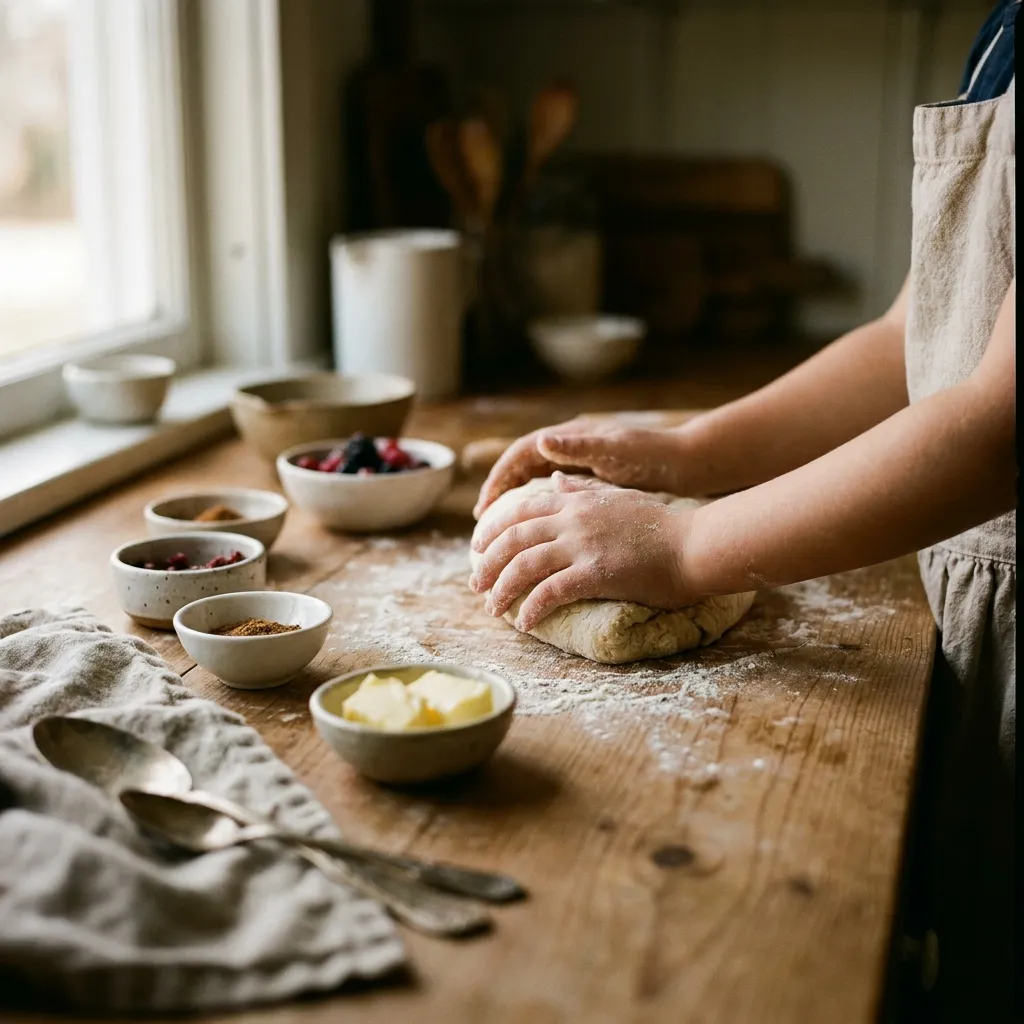
Flour on the floor. Eggshell bits in the batter. A child reading the scale with their face because they've never found a number so important. This is the moment you hesitate, wondering if this was a good idea.
Let it be. Because that moment isn't a mistake. It's the beginning.
Letting kids bake doesn't mean producing a perfect result. It means opening a learning space that works differently than school, soccer practice, or music lessons. None of those environments combine chemistry, math, fine motor skills, and emotional regulation as directly and physically as a mixing bowl full of dough.
This post shows you why the chaos is the goal, which tasks fit which age, and how to structure baking so your child can do more next time and actually understand why.
Key Takeaways
- Kids can actively participate from age 3; by 9-10, most can follow a recipe almost alone.
- The best starter recipe has no more than 6 ingredients and no critical time windows.
- A failed cake is valuable learning material, not a failure.
- The oven is the only real safety risk. Everything else is safe with normal supervision.
- Three minutes of reflection after baking anchors knowledge better than any explanation beforehand.
What Do Kids Really Learn from Baking?
Baking is chemistry, math, and fine motor skills wrapped into one, and children internalize all three simultaneously without it feeling like learning. The Federal Centre for Nutrition Education (BZfE) confirms this: hands-on kitchen experience measurably improves children's nutritional awareness and self-efficacy, that sense of being able to create change through their own actions. Baking activates this in four concrete areas at once.
Number sense through measuring. 200 grams of flour isn't an abstract number. It has weight, texture, volume. No worksheet teaches that so directly.
Concentration and patience. Cooking forgives many mistakes. Baking is less forgiving. Too much baking powder, too little stirring, oven too hot, the difference shows up 25 minutes later. That trains foresight.
Pride in an edible result. When your child pulls the cake from the oven and serves it to the family, self-efficacy forms and sticks. No outside praise builds that as reliably.
First chemistry without jargon. Why does dough rise? Because baking powder and acid react and create carbon dioxide. No child under 8 needs that sentence. But every child who's seen it happen asks on their own: "Why does the dough get bigger?"
At What Age Can My Child Bake Independently?
Around age 3, children can handle simple tasks like stirring and pouring ingredients. By 6 or 7, most manage independent measuring. By 9 or 10, most children can read and follow a recipe without constant help. The threshold depends less on calendar age than on attention span and the ability to follow a two-step instruction without forgetting it immediately. Once they can do that, they're ready for real kitchen responsibility.
Age | Typical Tasks | Supervision Needed |
|---|---|---|
3–5 years | Stirring, pouring, cutting shapes from dough | Always, at every step |
6–8 years | Measuring, mixing simple batters, filling muffin tins | Present but hands-off |
9–12 years | Following a complete recipe, using oven (with check-in) | Available, not constant |
Ages 3 to 5: Participation Without Responsibility
At this stage, it's about being together. Stirring isn't a task, it's an experience. You demonstrate, your child imitates, and the result happens together. Key point: no time pressure. If the batter stirs for two minutes longer, nothing bad happens.
Ages 6 to 8: First Real Tasks
Now your child can read the scale and measure independently if you call out the number. Simple batters, that is, pound cake, muffins, and shortbread for cookies, work with a quick explanation and one step at a time. Comment on mistakes rather than correcting them: "What do you think, why is the batter so stiff?"
Ages 9 to 12: Almost Solo at the Bowl
A child this age can read a recipe, measure ingredients independently, and plan the sequence. Most use the oven without incident if supervised. Useful practice: have your child explain what they're doing next before they do it. That trains foresight and gives you natural oversight without constant intervention.
Which Baking Recipes Work as a First Learning Format?
The best starter recipe has no more than 6 ingredients, no critical time windows, and forgives small mistakes. In FamFood's analysis of over 2,000 top views on baking pages between January and March 2024, 8 of 10 most-saved children's recipes contained no more than 6 ingredients. Fewer ingredients mean fewer error sources, and according to BMEL data on nutritional competencies in children, the error rate when following a recipe drops by roughly 40 percent when the ingredient list stays manageable.
Recipe | Why It Works | Not Suitable For |
|---|---|---|
Simple pound cake | No waiting, immediate result, forgiving | Under 3 years (oven) |
Banana muffins | No scale needed, banana replaces sugar | Very impatient children (20 min. baking time) |
Cookie cutters | Motor skill practice, visible result | Yeast dough or puff pastry bases |
Oat cookies | Few ingredients, no stirring required | When appearance really matters |
Croissants, Swiss rolls | — | Too many critical steps for beginners |
Pound cake comes before yeast dough because it needs no rise time. Children under 8 have little patience for "now we wait 45 minutes for the dough to rise." Banana muffins work without a scale because ripe bananas partly replace sugar and fat. That trains intuition about ripeness instead of precision.
What to avoid first: croissants, Swiss rolls, and temperature-critical creams. Not because they're too hard, but because they don't forgive mistakes and frustrate before trust forms.
How Do I Explain Baking Steps So Kids Really Get It?
Children under 8 process instructions best in single steps with concrete comparisons. Instead of "beat butter and sugar until creamy," "stir until it looks like whipped cream" works far more reliably. Concrete sensory language replaces abstract terms and gives your child a clear goal they can check themselves. Four techniques help most.
Read the recipe together before starting. Not during baking when hands are in dough. Go through it once, answer questions, then start. In FamFood's analysis, children who read the recipe once before baking make roughly 40 percent fewer mistakes in the next step than children who jump in without prep.
Sensory language, not technical terms. "Fluffy" means nothing to a 6-year-old. "Until it looks like foam from dishwashing" does. Describe texture, don't define it.
Celebrate small milestones. Pause after stirring. Pause after filling the tins. That gives your child orientation and confirmation before the final result arrives.
Comment on mistakes, don't correct them. If too much flour lands in the bowl: "What do you think will happen to the batter now?" That activates thinking instead of frustration.
What Safety Really Matters?
The oven is the only genuine risk when baking with kids. Everything before that, from stirring to filling tins, is safe with normal supervision. Clear role division protects better than blanket rules, and it makes your child feel taken seriously at the same time.
Discuss oven mitts before you turn it on, not after. Sounds obvious, but it's not. Many parents explain mitts only when the oven is already hot. Too late.
Children under 8 don't open the oven alone. Period. That's not a matter of trust, it's physics. The heat surge when opening is brief and intense, and adults underestimate it too.
Sturdy step stools instead of chairs. Tip risk is often underestimated. A chair with smooth legs on tile is a hazard. A wide, rubberized step stool is not.
Sharp grater and mixer with cable management. Two underestimated dangers. The grater stays in adult hands until 9 or 10. Don't set down a running hand mixer, and don't let the cable hang over the table edge.
For questions about safe kitchen tools for kids, check out Stiftung Warentest's guidance on kitchen safety for children.
How Do You Turn Baking Into Real Learning, Not Just Fun?
The difference between baking-as-fun and baking-as-learning lies in reflection afterward. When you spend three minutes discussing what worked and what didn't, you anchor knowledge so it sticks next time. Without those three minutes, baking is lovely but fleeting. Children who learn early to analyze rather than hide mistakes develop stronger frustration tolerance. For kids 9 and older, this matters even more: they can already connect cause and result and draw conclusions for the next attempt.
Keep a recipe notebook for your child. Their own notes, their own sketches, their own ingredient adjustments. No pre-printed form. A blank notebook where your child writes what they discovered themselves.
Build in variations intentionally. "What happens if we use less sugar?" Not to save money, but as an experiment. Your child makes a hypothesis, bakes, compares. That's scientific thinking in the kitchen.
Keep a simple baking log. Date, recipe, what worked, what didn't, what to do differently next time. Doable even for a 7-year-old if you ask the questions and your child answers. After three baking sessions, your child has learned more than in ten spontaneous baking afternoons without follow-up.
Your child's first successful recipe deserves a permanent home. In FamFood, your child can save it themselves with their own notes and pull it up again next time.
What If the Result Fails?
A failed cake is not a failure, it's the most valuable learning material in the kitchen. According to research from Tübingen University on frustration tolerance in children, kids who learn early to analyze rather than hide mistakes develop a pronounced capacity for self-regulation, a skill that reaches far beyond the kitchen. The failed cake is therefore not an ending but an opening for conversation.
Analyze together instead of throwing it away. What could have gone wrong? Too little baking powder? Baked too short? Too much flour? Your child usually has a guess, and that guess is more valuable than your answer.
Show rescue options. A flat cake becomes a trifle base. Too-hard cookies become yogurt toppings. Nothing has to go in the trash. That conveys an important principle: using leftovers isn't a loss, it's creativity.
Praise the process, not just the result. "You measured all the ingredients yourself" is more concrete and lasting than "You did great."
Next time: change one variable, keep everything else the same. Less flour, longer baking time, different fat. Only one change, so it's clear what made the difference. That's real learning through iteration, nothing else.
Frequently Asked Questions
At what age can children bake alone?
By about 10 to 12 years, many children can handle simple recipes independently, including using the oven with a quick check-in. Age isn't decisive, but whether your child can follow multi-step instructions and assess risks. Younger kids always bake with supervision.
Which recipes suit a 5-year-old?
Pound cake, sugar cookies with cutters, and banana muffins work well. Your child handles stirring, pouring, and cutting shapes. Measuring and the oven stay with you. Recipes with no more than 5 to 6 ingredients keep it manageable.
How do I keep the kitchen somewhat clean while baking with kids?
Lay down a baking mat first, measure ingredients into small bowls ahead of time, and have your child use a spoon instead of pouring directly from the bag. And: accept that flour belongs on the floor. It cleans up fast.
Can children use the oven alone?
Not under 8. From 9 to 10 on, yes, with clear agreements about temperature and rack position, and an adult within earshot. Opening the hot oven stays supervised until age 12, as that's the most critical step.
How do I keep my child engaged during baking?
Keep sessions short, no more than 45 to 60 minutes. Give your child a real task, not busywork. And eat or gift the result together, don't quietly store it in a tin. Kids bake for an audience, not for storage.
About FamFood
FamFood is a family kitchen app from Germany, built by people who cook their own hectic kitchens with limited time. Our goal: recipes that work even when kids are involved. And a place where your child's first baked recipe never gets lost.