Learning to Season: The Beginner's Guide
The dish smells good. It looks good. Then comes the first bite, and the moment you've been waiting for collapses into nothing. No spark, no flavor, just a vague memory of what the food should have been. Your family sits at the table. That moment can't be undone.
What's actually missing, and why doesn't adding more seasoning help in the end?
Wrong seasoning. Or no seasoning at all. That's almost always the answer, but it leads straight into the next misconception.
Key Takeaways
- Salt is not a flavor, it's an amplifier: without enough salt, every aroma stays silent.
- Five basic spices cover 80 percent of all family dishes.
- Layering seasoning during cooking creates more flavor than any finishing salt at the table.
- Dried herbs go into the heat early, fresh herbs only at the end.
- Taste buds can be trained; after four to six weeks of conscious tasting, you'll notice real progress.
Why Does My Food Taste So Flat?
Flat food almost always has the same cause: too little salt, seasoned too early or too late, or both at once. Salt isn't a flavor in itself, it's an amplifier. Without enough salt, all other aromas stay muted, no matter how many herbs you add. That's chemistry, not opinion. According to the German Federal Center for Nutrition (BZfE), the fear of too much salt when cooking at home is usually unfounded, because homemade dishes contain far less sodium than industrially processed foods.
Salt that you sprinkle at the table only fixes the surface, not the inside.
Salt sticks to the surface instead of spreading evenly through the dish. The result is a slightly salty outside and a bland interior. No salt shaker in the world changes that.
In our testing, we found: families that season in layers reach for the salt shaker far less often at the table than those who add everything at once at the end. Those who season early, deliberately, and in multiple rounds need less overall, not more. Seasoning isn't guesswork either. Professional chefs develop a feel for it over years, but they start with the same basic rules you're learning now.
That leaves the question of what you actually need to get started, and the answer is much shorter than most beginners hope.
What Do You Really Need to Start?
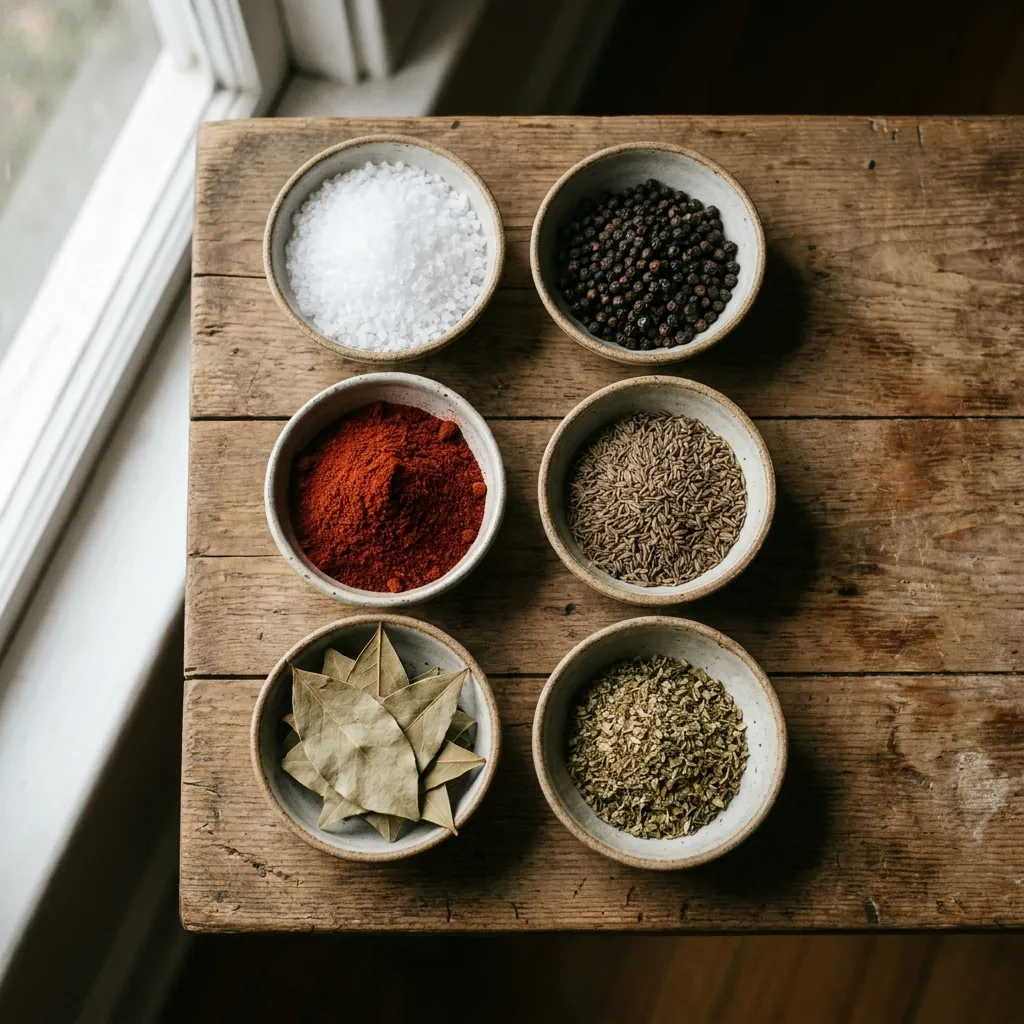
You need just five basic spices to begin: salt (fine and coarse), black pepper from a grinder, mild paprika powder, cumin, and bay leaf. With these five, you can confidently season 80 percent of all family dishes. An overstuffed spice rack is the most common beginner trap: if you buy 30 spices and don't really know any of them, you're seasoning randomly instead of deliberately. Conscious selection beats quantity every time.
Better to really understand and use five spices before you expand your shelf.
Spice | Use | Quality Tip |
|---|---|---|
Fine sea salt | Pasta water, doughs, dressings | Iodized salt for everyday use |
Coarse sea salt | Meat, grilled vegetables | Let the grains stay textured |
Black pepper | Almost everything | Whole peppercorns only, grind fresh |
Mild paprika powder | Braised dishes, soups, sauces | Deep red, sweet-smelling |
Cumin | Legumes, ground meat, carrots | A small amount goes a long way |
Bay leaf | Soups, broths, pot roasts | Buy dried, keep whole |
Salt: Which One for What?
Fine salt dissolves quickly and works for seasoning pasta water, doughs, and sauces. Coarse sea salt or fleur de sel, you sprinkle over meat or roasted vegetables at the end. The grains stay textured and give a little crunch. Two salts in your rack, each with a clear job. Stiftung Warentest, a leading German consumer testing organization, showed in comparison tests that there's barely a measurable flavor difference between simple iodized salt and expensive specialty salt in pasta water. Save expensive fleur de sel for the finish, use cheap iodized salt for everything else.
Pepper: A Grinder Isn't a Luxury
Pre-ground pepper loses its essential oils within days, oils that carry the typical peppery flavor. A simple five-euro grinder from the supermarket makes a noticeable difference. Buy whole black peppercorns, fill the grinder, and always grind fresh. This isn't a pro trick, it's the standard approach.
Knowing five spices is one thing, but using them so flavor actually emerges is entirely different, and not the way most people intuitively do it.
How Does Layered Seasoning Work?
Layered seasoning means: you season the dish at several points while cooking, not just once at the end. Onions get a pinch of salt right in the pan. Vegetables are seasoned as they brown. The sauce is tasted before the meat goes in. This way, flavor builds layer by layer, and the result is rounder, deeper, and more complete than any finishing salt at the table.
A concrete example: a simple tomato sauce.
- Sauté the onions (minute 1-3): Add onions to oil, immediately sprinkle a small pinch of salt. The salt draws water out of the onions, they soften faster and caramelize better.
- Add garlic and tomatoes (minute 4): Now add the paprika powder directly into the heat. Stir briefly so it doesn't burn. Controlled heat activates the flavor compounds in paprika.
- Simmer (minute 5-15): Add bay leaf, let the sauce reduce. No more seasoning now.
- Taste before serving (minute 16): Only now do you taste again. What's missing? Usually it needs another pinch of salt and a small squeeze of lemon juice.
Finishing salt at the table doesn't replace this process. Those who add salt at the table only improve the surface, not the inside. Layered seasoning builds depth; finishing salt only adds saltiness to the surface. Those are two fundamentally different things.
The most common mistake in this process isn't the order, but a single step that almost everyone forgets.
What Mistakes Do Almost All Beginners Make?
The three most common seasoning mistakes: first, too little salt out of fear; second, tossing herbs into a hot pan too early; and third, adding all spices at once at the end. All three can be avoided with a simple sequence.
According to an analysis by the German Federal Ministry of Food and Agriculture (BMEL), home-cooked food contains significantly less sodium on average than industrially processed foods. So the fear of oversalting when cooking at home is usually unfounded, as long as you work deliberately and in layers.
Mistake | Why It Happens | How to Avoid It |
|---|---|---|
Too little salt | Fear of unhealthy eating | Season in layers, not all at the end |
Fresh herbs too early | Thinking: the longer, the more flavor | Basil, parsley only at the end |
Forget acid | Nobody explains it | Lemon or vinegar as the final step |
All spices at once | Unknown order | Aromatics first, then dried, then fresh |
The most underrated step is acid. A small squeeze of lemon juice or a teaspoon of white vinegar at the end lifts the entire dish. No acid, and it tastes flat, even if salt and herbs are right. Try it once in a direct comparison—that's the most convincing experiment you can do in your kitchen.
If a dish is over-seasoned or oversalted despite everything, you'll find helpful rescue options in our article on oversalted sauces and rescue tips.
And then there's the question almost no one asks: fresh or dried, and when exactly does it matter?
Fresh or Dried Herbs: What Goes When?
The simple rule: dried herbs go into the heat early, fresh herbs go in at the end or straight onto the plate. Thymol and rosemary from the jar can simmer and release their aroma over time. Basil and parsley lose their aroma instantly with heat and belong only in the finished sauce or finished dish.
Herb | Fresh or Dried? | Timing |
|---|---|---|
Thyme | Both | Early, let it simmer |
Rosemary | Both | Early, in the pan |
Bay leaf | Dried | Early, remove at the end |
Oregano | Dried preferred | Midway through cooking |
Basil | Fresh | At the very end or scattered on top |
Parsley | Fresh | At the very end, never cooked |
Chives | Fresh | Straight onto the plate |
A small potted herb on the windowsill sounds like a nice idea, but it's harder than it seems with many herbs. Basil and coriander need lots of light and die in most German kitchens after two weeks. Rosemary and thyme, on the other hand, are robust and survive even a windowsill with little direct sun.
Frozen herbs are a practical compromise for everyday cooking. Parsley and chives from the freezer keep their aroma better than dried versions and save the time of buying and prepping fresh herbs. Not a perfect solution, but an honest one.
The rule works, but you don't develop a secure feel for it through reading; you do it through something that takes far less effort than most think.
How Do You Train Your Taste Memory?
Taste isn't innate; it's trained. If you taste consciously twice a week, tasting briefly before and after each seasoning round and asking yourself what's missing, within four to six weeks you'll have a noticeably more confident sense of salt, acid, and heat. The method costs nothing and needs no equipment. Just attention.
The method is simple: taste, season, taste again. No step is skipped.
The "What's missing?" test follows a fixed order: first check for salt. Then acid (missing lemon or vinegar?). Then heat. Then sweetness. There's a reason for this order: salt affects everything else, so it comes first. If you reach for acid before the salt is right, you can't judge the result properly.
What we observe at FamFood: families who taste together and speak aloud about what they perceive ("That still tastes too bland" or "I think it needs something sour") cook with far more confidence after a few weeks. Shared tasting turns the cooking process into a conversation. That's not just educational; it's also more fun.
What happens when children join in often surprises people most.
Seasoning with Children: How Do You Do It Safely?
Children can help taste dishes from elementary school age on. It trains their palate and makes them more curious about food. Important: let them taste small amounts, hold off on heat first, and take their opinion seriously.
Unproblematic spices for children include mild paprika powder, herbs like parsley and basil, and mild oregano. Heat—chili and hot pepper in larger amounts—better to leave out or offer separately.
Introducing tasting as a small family ritual is worth it. Everyone in the circle gets a spoon, tastes, and says what they think. Children take this task seriously when you take them seriously. And whoever learns as a child to distinguish aromas has a real advantage in the kitchen as an adult.
What gets asked most often in practice, and what those answers reveal about seasoning overall, comes next.
What Questions About Seasoning Do Beginners Ask Most Often?
How Much Salt in Cooking Is Too Much?
A rule of thumb: pasta water should taste "of the sea"—salty but not biting. For soups and sauces, start with 1 gram of salt per 100 milliliters of liquid, then taste. Homemade food contains significantly less sodium on average than ready-made dishes, according to the BMEL. Layered seasoning almost always prevents oversalting.
Can I Freeze Spices?
Fresh herbs like parsley, chives, and basil freeze well, best in small portions or in ice cube trays with a little oil. Dried spices and seeds don't belong in the freezer: they're already shelf-stable and lose their aroma faster when cycling between frost and room temperature.
Why Does Restaurant Food Always Taste Better Than Mine at Home?
Three reasons: more salt, more fat, and more heat than most home cooks use. Professional chefs season in layers, use butter or oil generously, and work with high temperatures that create roasting flavors. Plus: fresh, often higher-quality ingredients. The single biggest factor is still consistent layered seasoning. That's something you can do right at home. For more kitchen tricks that save everyday cooking, find them in the article Kitchen Tricks: 10 Tips That Save the Day.
Which Spices Go with Which Meat?
Beef tolerates bold flavors: black pepper, rosemary, thyme, garlic. Pork likes sweet notes: paprika, marjoram, cumin. Chicken is neutral and takes almost everything, especially lemon, thyme, and paprika. Lamb needs rosemary, garlic, and cumin. For the exact mistakes that make meat tough despite good seasoning, see the article Why Does Steak Get Tough? 7 Mistakes and Their Fixes.
What's missing when food tastes flat? Usually it's not a single spice, but the moment you add it. Season in layers, start early, don't forget the acid. That's the answer. And you can try it tonight.
But which spices you really need, and which ones just clutter the shelf, is a different question—and the answer surprises most people.
About FamFood
FamFood comes from genuine passion for cooking with family, not a marketing department. We collect what actually works: in small kitchens, under time pressure, and with kids who sometimes aren't hungry. If you want to sharpen your seasoning sense week by week, you'll find the recipes and tips for it at FamFood.