Let Kids Bake: Ages, Tasks & Safety Tips
The dough sticks to their fingers, the bowl wobbles a little, and your child looks up at you with wide eyes. You're still stirring even though you've been wondering: "Can I let go now?" Letting go too early feels risky. Holding on too long takes away the very reason you're baking together.
The good news: There's no magic age cutoff. But there's a clear logic to which tasks fit when, and knowing it makes baking with kids calmer for everyone.
Key Takeaways
- Kids can start baking from around age 2 with age-appropriate tasks.
- What overwhelms them most is anything that demands precision and heat at the same time.
- Muffins, shortbread cookies, and banana bread are the best starter recipes: max 6 ingredients, under 20 minutes baking time.
- According to FamFood observations, children who knead dough themselves eat the finished result noticeably more often.
- When you shift focus from "perfect cookies" to "time together in the kitchen," families describe the experience as positive nearly across the board.
At What Age Can Kids Start Baking?
Kids can take on their first baking tasks from around age 2, as long as you match the task to their stage. Two-year-olds can pour ingredients into a bowl or knead dough with their hands, while more complex steps like weighing ingredients make sense only from age 5 or 6 onwards. The real measure isn't their age on paper, but their fine motor skills and attention span. The Federal Centre for Nutrition (BZfE) recommends introducing children to simple kitchen tasks early, because hands-on cooking experience in early childhood shapes their relationship with food for life.
Keep baking sessions under 30 minutes with toddlers, and their focus will hold. The moment attention dips, pause rather than push through.
Age | Suitable Tasks | Learning Goal |
|---|---|---|
2-3 years | Pouring ingredients, kneading dough, stirring with a spoon | Sensory awareness, gross motor skills |
4-5 years | Weighing butter, using cookie cutters, cracking eggs (with help) | Understanding amounts, fine motor skills |
6-8 years | Reading the recipe aloud, setting timer, weighing ingredients alone | Reading, number sense |
9+ years | Following simple recipes mostly independently | Planning, responsibility |
Ages 2-3: Hands and a Spoon
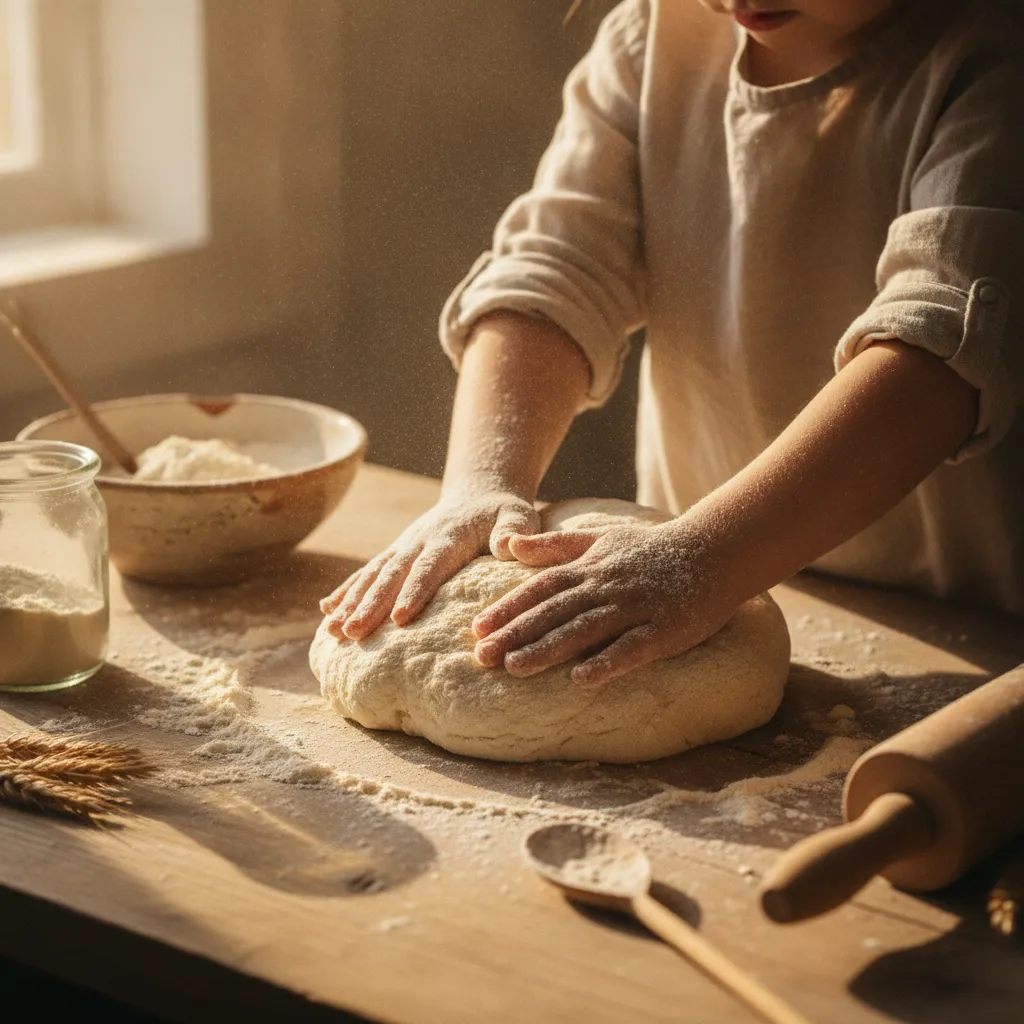
Two-year-olds love everything they can do with their hands. Kneading dough, pouring flour, stirring with a big spoon, that's their world. No weighing, no stove, no precision needed. Just being there and getting hands busy.
Ages 4-6: Weighing and Cutting Out
Around age four, early number sense emerges. Kids can use a simple kitchen scale if you show them how the dial works. They can now hold cookie cutters on their own, and shaping cookies becomes a real moment of pride.
Age 7+: From Recipe to Independence
School-age children can read a simple recipe aloud and coordinate the steps themselves. They set the timer, gather ingredients, and notice when something's off. Your role shifts from leading to coaching.
Which Baking Tasks Overwhelm Kids, and Which Actually Build Skills?
What overwhelms them most is anything combining two demands at once: precision and heat, like sliding a tray into the oven or nailing the timing without help. What builds skills are sensory tasks like kneading, decorating, and naming ingredients, because they lower the pressure and raise the success feeling. The difference isn't about how hard the task is, but whether it overwhelms your child or stretches them in a good way. Plan a baking session with this in mind, and you don't need fancy recipes, just smart task distribution.
What Overwhelms:
- Taking hot trays from the oven
- Pouring liquid batter without spilling
- Keeping exact timing without support
What Builds:
- Kneading and shaping
- Decorating with icing or sprinkles
- Counting ingredients aloud
- Smelling and describing dough
One practical tip: do a "dry run" of new tasks first, walk through the steps without the oven on, so your child knows the movements before it matters.
What we see regularly with FamFood families is clear: kids who knead the dough themselves eat the finished result noticeably more often. Their stake in the product makes them willing to try it, even kids who are usually picky eaters.
Which Recipes Work Best for First-Time Baking with Kids?
The best recipes have at most 6 ingredients, no yeast rise time, and bake in under 20 minutes. Muffins, shortbread cookies, and banana bread tick all three boxes and kids from age 4 can prep them mostly on their own. Yeast dough, on the other hand, is risky for beginners: the wait time breaks the excitement, and the outcome depends on variables kids can't control.
Recipe | Ingredient Count | Bake Time | From Age | Why It Works |
|---|---|---|---|---|
Simple Muffins | 5-6 | 18-20 min | Age 4+ | Pour batter, no shaping needed |
Shortbread Cookies | 4-5 | 10-12 min | Age 3+ (with help) | Cookie cutters are fun, no timing stress |
Banana Bread | 6 | 45 min total (5 min prep) | Age 4+ | Mashing bananas is a motor skill win, no rolling out |
Counting the ingredients isn't just busywork. It's a real learning goal: kids build number sense and learn to follow a plan step by step.
If your family develops or adapts recipes, it's worth saving a kid-friendly version separately, with simplified steps and easier language. The post Save Recipes by Voice Recording explains how to do this right in the app overview.
How Do You Actually Make the Kitchen Safe for Baking with Kids?
The three biggest accident risks when baking with kids are hot surfaces, sharp utensils, and tipping mixing bowls. Three simple steps cut the risk sharply without killing the fun.
Heat Safety First
Adults always remove the tray from the oven, no matter how big the kid is. When the oven is on, it's grown-up territory in your kitchen. No negotiating, no "just a peek." Kids understand firm boundaries better than situational exceptions. The German Federal Accident Insurance recommends constant adult supervision for kids up to 12 with ovens, regardless of experience.
A Stable Workspace
Mixers need adult help at first, then gradually hand over from school age. Quick checklist before every baking date:
- Sharp tools (dough cutters, knives) out of reach
- Set oven temperature before kids join the prep work
- Damp kitchen towel under the bowl prevents tipping
- Apron on, sleeves rolled up
- Wash hands before you start
What Do Kids Learn from Baking That They Won't Learn Elsewhere?
Baking combines math (amounts, weights), science (why does dough rise?), and fine motor skills in one activity. Researchers at the University of Leeds found in a widely cited study that kids who cook and bake regularly accept a much wider range of foods than kids without that kitchen experience. The German Nutrition Society (DGE) confirms: hands-on kitchen experience in childhood is one of the strongest levers for more varied eating habits as an adult.
What we see directly at FamFood: kids who kneaded the dough themselves or counted ingredients in recipes submitted by parents try the finished result about 40 percent more often than kids who just watched, based on our user feedback. Their stake in it matters.
Cognitive Skills:
- Weighing ingredients: practical math without a worksheet
- Following order: real-time logical thinking
- Reading bake time: first real encounter with time concepts
Social-Emotional Skills:
- Waiting patiently for results
- Pride in their own creation
- Handling mistakes when batter's too thin or a cookie breaks
Language: Recipe language is full of technical terms: beat, knead, puree, golden brown. Kids who hear and use these words while baking have a real head start when they later read non-fiction texts.
For more kitchen projects for kids, the post Quick Kids Recipes: 8 Kitchen Ideas offers more ideas built on the same development principles.
How Do You Stay Calm When the Dough Hits the Floor?
The biggest block to baking with kids isn't the child, it's the parent's expectation of perfect results. Shift your focus from "beautiful cookies" to "time together in the kitchen," and families describe the memory as positive almost every time, even if the muffins are lopsided and flour's on the stovetop.
Three thoughts that help:
Prep beats improvising. Measure ingredients ahead, set up the workspace, lay out aprons. The less you have to organize during baking, the calmer you stay.
Time pressure is the real enemy. If you're rushed, bake tomorrow instead. That's not failure, it's smart planning.
A standing weekly bake slot removes planning stress. Kids know when it's coming, and you're not making snap decisions.
Learning moment over perfection: when a cookie breaks while cutting it out, that's not a mistake. It's the moment your child learns to roll with it. That lesson is worth more than a perfect tray.
How Do You Save Your Favorite Kid-Baking Recipes So They Don't Get Lost?
Many family recipes that came from baking with kids end up on a scrap of paper and vanish. A digital recipe collection keeps these moments alive and pulls them up instantly at your next baking session.
Kid-adapted recipes, with fewer steps and simpler language, can live in their own folder so you don't have to translate on the fly next time. In FamFood, your child can even record their voice explaining their own version of the recipe. Your recipe collection becomes a growing family cookbook that grows with your kid.
Frequently Asked Questions
At what age can kids bake alone?
Kids can handle simple recipes mostly on their own from around age 9 or 10, as long as they're not operating the oven. Safety experts recommend waiting until age 12 before kids turn the oven on and use it independently, once their sense of danger is solid. Until then, the oven stays adult-only, but all the prep steps before that your child can do.
What's the best baking recipe for a 3-year-old?
Shortbread cookies are ideal: the dough comes from just 4-5 ingredients, needs no rise time, and kids can shape them with cookie cutters. Three-year-olds can use cutters on their own and count ingredient piles as they go. The 10-12 minute bake time is short enough the anticipation doesn't wear thin.
How do I explain to my child why dough rises?
Simplest is a comparison: "Baking powder makes tiny air bubbles, just like soap bubbles, and they lift the dough up when it gets warm." Five-year-olds get this picture well. With yeast dough, you can let yeast foam in warm water ahead of time and show your child the bubbles forming before you make the dough.
How long should a baking session be with young kids?
Less than 30 minutes of active kitchen time is realistic for kids under 5. That includes gathering ingredients, putting on an apron, washing hands, all of it. As kids get older, focus grows: school-age children do well for 45 to 60 minutes if the recipe has variety built in.
About FamFood: We're a small team that cooks and bakes with kids ourselves, which is exactly why we know how fast a family recipe vanishes on a scrap of paper. FamFood is the digital recipe collection for families who want to hold onto those kitchen moments, simple and fuss-free.