Why Your Meal Plan Fails by Wednesday—and How to Fix It
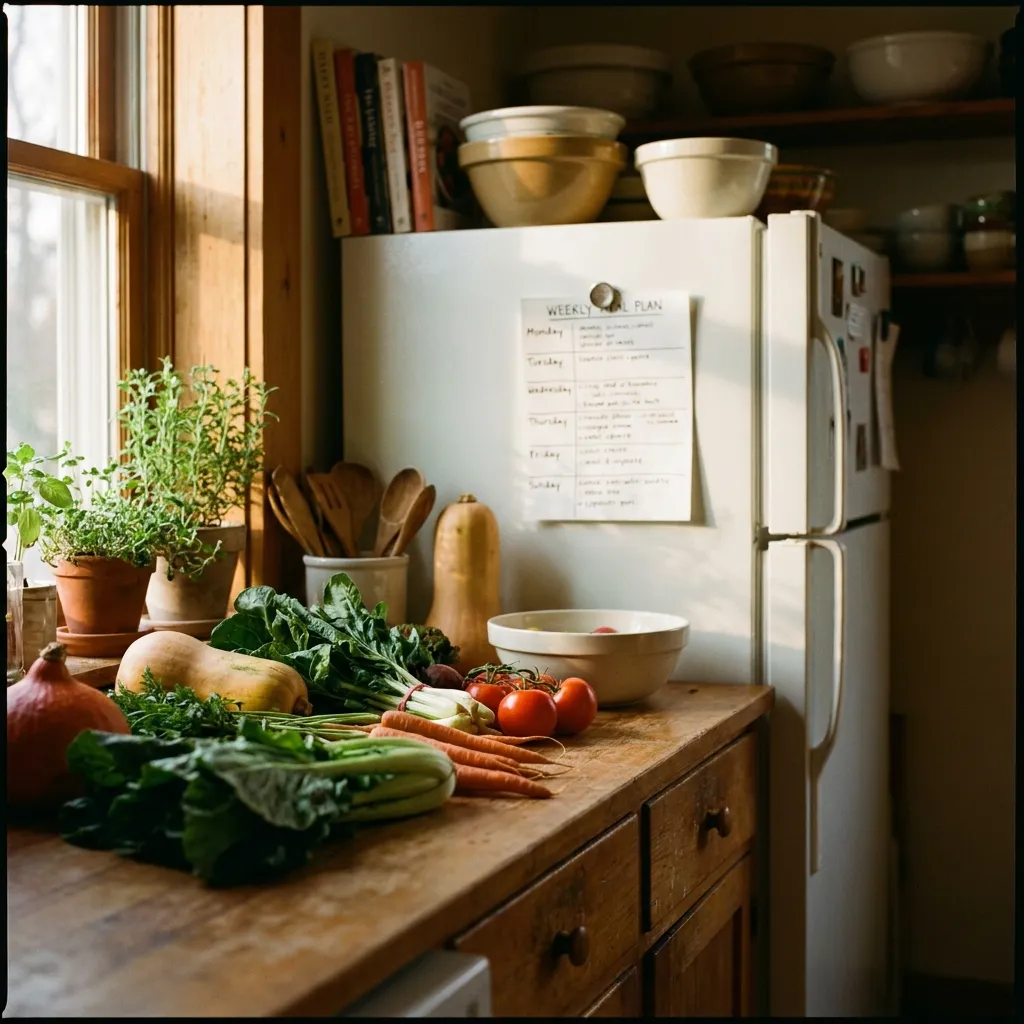
The weekly plan hangs on the fridge. Looks perfect. Monday: lentil soup. Tuesday: roasted vegetables. Wednesday: pasta with tomato sauce.
Wait. Wednesday was supposed to be chicken curry.
Almost every family knows this moment. Not because the willpower is missing, but because the system is broken. This article shows you why weekly meal plans collapse after two days, what a stable family plan actually needs, and how to build one step by step without spending hours on it.
Key Takeaways
- Most plans fail due to structure, not willpower: seven planned evenings with no buffer is a trap.
- The 5+2 Rule (5 fixed evenings, 2 wildcard slots) is the backbone of every stable family meal plan.
- Backward planning from Friday's fridge cuts food waste in half, measurably.
- According to the German Federal Ministry of Food and Agriculture (BMEL), 78 kg of food per person per year lands in the trash in German households. Consistent planning reduces this significantly.
- Children who get one choice per week eat more willingly what's on the table.
Why Do Most Family Meal Plans Collapse After Two Days?
Most weekly meal plans don't fail from lack of willpower—they fail from poor structure. Anyone planning seven days without buffer for spontaneity, leftovers, and kid moods sets a trap. By day three the whole thing falls apart because life gets in the way: a child suddenly won't eat curry, someone stays late at work, the peppers in the fridge are shriveled.
The insidious part: failing on day 3 demoralizes more than never starting at all. Psychologically, it creates the feeling of "failing again," even though the problem was structural, not personal.
Common mistakes at a glance:
- Too ambitious: Five new recipes in one week overwhelm any family.
- Too rigid: No single buffer day for spontaneous guests or leftover use.
- No space for scraps: The extra vegetables from Monday have nowhere to go by Wednesday.
What we see at FamFood: the most-saved meal plans contain five fixed evenings maximum, not seven. Two slots stay open. That's not a planning gap—that's the plan. In our test families, the same pattern shows up repeatedly: those who plan with wildcard slots from the start stick with it through Friday. Those starting with seven fixed days usually quit by Wednesday, because the first unexpected evening topples the whole structure.
A realistic family plan is intentionally incomplete. It leaves room. It knows its own limits.
What Does a Family Meal Plan Actually Need?
A stable family meal plan works by one simple rule: 5+2. That means five concretely planned evenings plus two wildcard slots where your family decides flexibly. The 5+2 Rule is the backbone of every working plan because it sets realistic boundaries and still leaves space for spontaneous leftovers or exhausted days. Add these: a handful of reliable signature recipes that work without much thinking, maximum 15 minutes of planning time per week, and a pinch of voice for the kids. That's all it takes to build a plan that still stands on Thursday.
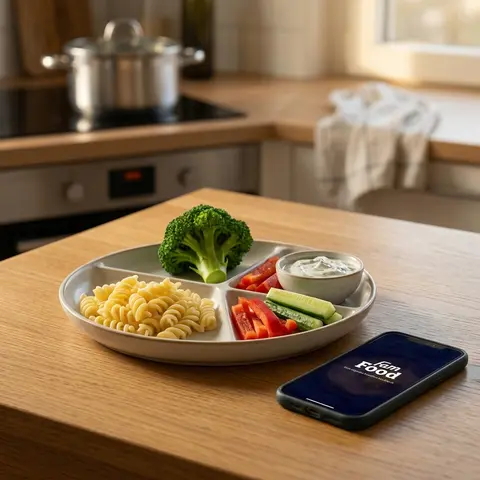
On the two wildcard evenings, whatever's left over gets used, whatever's convenient, or whatever no one feels like cooking: a classic like pasta with tomato sauce, a leftovers dish, a frozen night without guilt.
Signature recipes are underrated. Most families have 8 to 12 dishes that always work. Kids eat them willingly, the shopping list almost writes itself. Use these recipes as the backbone of the plan, not as gap-fillers. Save new recipes for the weekend, when time and energy are there.
Involve kids early without blowing up the plan. Not with open questions ("What do you want to eat this week?"), but with clear options: "Thursday—pasta or potatoes?" One choice per week is enough to create a sense of agency without sabotaging the planning.
Digital tools, like FamFood, help keep signature recipes at your fingertips and share the plan with the whole family without printing or explaining.
How Do You Build Your Weekly Plan Step by Step?
Start with the end of the week: What's in the fridge on Friday? Planned backward, a leftover-rotation pattern emerges automatically, cutting food waste and keeping shopping manageable. This principle is missing from most planning guides, yet it's the strongest lever against throwing food away. The four steps below take less than 15 minutes total.
Step | Action | Time |
|---|---|---|
1. Fridge check | What's left? What needs to go? | 3 min. |
2. Seasonal anchor | Pick 1 seasonal vegetable as the week's theme | 2 min. |
3. Sort recipes | Mon–Tue quick (under 25 min.), Thu–Fri more time | 5 min. |
4. Shopping list | Derive it from the plan, not the other way around | 5 min. |
Finding the Right Planning Time
Sunday evening is the natural planning moment for many families: the week is still open, the fridge is manageable after the weekend, and 10 to 15 minutes can usually be found. Planning mid-week, say Thursday for next week, has the advantage of including weekly grocery store specials.
What matters isn't the day—it's consistency. A fixed slot keeps planning from disappearing in the daily shuffle.
Derive the Shopping List Directly from the Plan
The most common mistake: shop first, plan later. Then too much lands in the cart, much of it spoils. The reverse works better: finish the plan, then the list. Every ingredient you need for the five planned meals goes on the list. Ingredients that work for two dishes (say, a can of tomatoes) get noted once. That keeps the list short and shopping focused.
Which Recipes Work Best for Weekly Planning?
Recipes with a maximum of 8 ingredients and under 30 minutes prep time dominate every stable family meal plan. Among the most-saved recipes in FamFood, 7 out of 10 contain fewer than 8 ingredients. This pattern is no accident: fewer ingredients mean shorter shopping lists, fewer leftovers, and less decision-making after a long day.
Category | Prep Time | Typical Days | Examples |
|---|---|---|---|
Quick meals | up to 20 min. | Monday, Tuesday | Omelet, wraps, skillet dish |
Classics | up to 35 min. | Wednesday, Thursday | Pasta bake, lentil soup, potato soup |
Weekend dishes | no time limit | Sunday | Roast, quiche, elaborate soups |
Plan at least one batch-cooking dish per week. That's a meal that yields two servings the first time: a big batch of Bolognese, a pot of split pea soup, a sheet pan of roasted vegetables. That fills one of your wildcard slots automatically, with no extra cooking.
Seasonal planning isn't luxury—it's a money decision. Seasonal vegetables cost less, taste better, and are easier to find. Let one seasonal vegetable become the "week's theme": in squash season, everything revolves around squash; in spring, asparagus or radishes. That gives the plan direction without complicating it.
How Do You Actually Save Time and Money with Meal Planning?
According to the German Federal Ministry of Food and Agriculture (BMEL), German households throw away an average of 78 kg of food per person per year. Those who plan weekly typically cut this in half within months, because spending and consumption finally align. According to analysis by the German Federal Association of Consumer Organizations (vzbv), households without fixed shopping plans spend about 25 percent more on food than those with a clear weekly strategy.
The time savings come less from cooking itself and more from eliminated decision fatigue. Instead of running through the supermarket three times a week on impulse, buying more than needed, you make one focused shop. That saves money and the mental energy spent daily on "What are we cooking tonight?"
The emotional payoff is often underestimated. Families who plan consistently report fewer dinnertime arguments about food and a noticeable drop in frustration right before cooking. The answer to "What's for dinner?" is already there before it's asked.
For additional guidance on food waste in households, the German Federal Centre for Nutrition (BZfE) offers more context.
How Do You Keep the Plan Flexible When Life Happens?
Flexibility isn't plan failure—it's part of a good plan. When you build in two wildcard slots and always keep a frozen backup, you can handle surprise evenings without the whole system collapsing. The plan doesn't break if it leaves room for the unexpected.
Define your wildcard slots concretely—say, Wednesday and Saturday. On those evenings, decide last-minute: leftovers from the night before, frozen pizza, quick egg scramble. That's not failure, that's where the plan meets real life.
The frozen backup should be a fixed part of every family plan. Always freeze two or three portions of something you've already cooked. That way, on a surprise evening with guests, a sick kid, or simple exhaustion, something's always ready.
What if a child suddenly rejects the planned dish? No mealtime showdown. Fall back on a signature recipe that always works, and shift the planned meal to the next wildcard evening. Storing the plan digitally helps: instead of rewriting, a quick update in the app does it.
How Do You Get Your Family to Co-Plan?
Children who help plan are more willing to eat what you serve. Even one choice per week—"pasta or potatoes on Thursday?"—significantly boosts acceptance. That's not parenting theory, that's the shortest conflict prevention before dinner.
Adjust involvement by age:
- Toddlers (ages 2–5): Choice between two concrete options, no free brainstorming.
- Elementary school (ages 6–10): Get to pick one full evening per week from a choice of three dishes.
- Older kids (age 11+): Can plan one evening and help cook it; planning and execution together.
Make the meal plan visible. Pin it to the fridge, write it on a shared note, or save it in an app everyone can access. What everyone sees belongs to everyone. That cuts daily questions and gives kids the feeling of being informed, not ambushed.
A small ritual builds reliability: Sunday evening, ten minutes, everyone sits briefly. Anyone who wants states a wish for the week. Anyone who doesn't is welcome to stay quiet. The plan still happens, but with more buy-in behind it.
Frequently Asked Questions
How much time do I actually save with meal planning?
Meal planning mostly saves decision time and impulse buys. Instead of three to four small, unplanned shops per week, one focused trip suffices. For many families, that's 30 to 60 minutes per week, plus fewer evening arguments over what's for dinner.
How many recipes do I need for a solid family meal plan?
Eight to twelve signature recipes are plenty for a stable monthly rhythm. You get more variety through seasonal twists on the same base dishes, not constant new recipes. Save new ideas for the weekend, when there's more time and calm.
Can I do meal planning without an app?
Yes. A sheet on the fridge works. The advantage of digital tools is sharing: everyone sees the plan at once, changes show up instantly, and the shopping list derives straight from it without rewriting.
What if a child suddenly won't eat something I've planned?
No drama, no special order. Shift the planned dish to the next wildcard evening and fall back on a proven signature recipe. Over time, it helps to let kids co-plan so they feel ownership of the meals before they hit the table.
How do I start if we've never planned before?
Start small: plan only three evenings the first week, not seven. Pick dishes your family definitely likes. Check what's in the fridge on Sunday and build the first two evenings from that. Week two, expand to four. After a month, the system runs almost on its own.
About FamFood
FamFood is the family kitchen app for German everyday life: save recipes, build meal plans, and pull shopping lists straight from them—all in one place. We develop FamFood with real families because we know the best plan is one that still holds on Wednesday evening. Stop by famfood.app.