Northern German Grandma Recipes: Coast & Heath
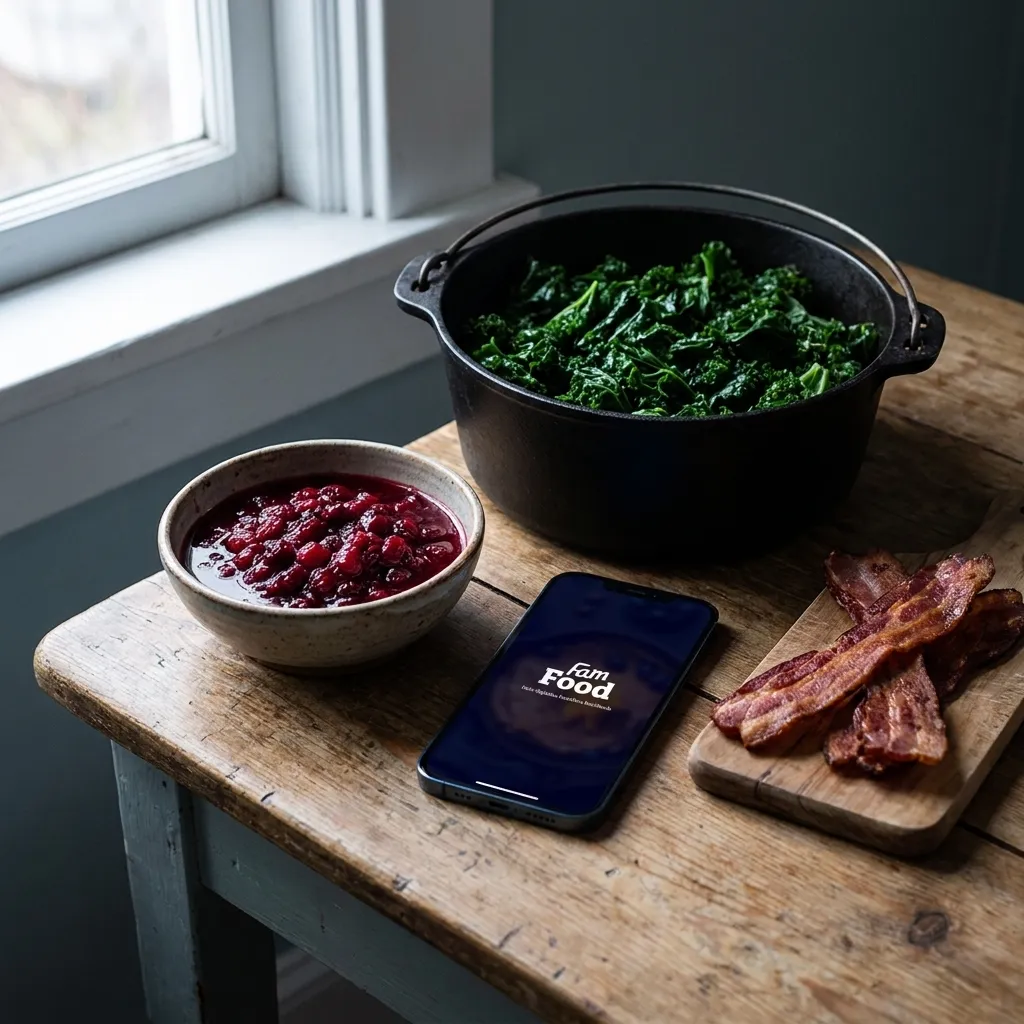
The wind comes off the sea, the pot steams on the stove, and the smell of bacon and kale drifts through the kitchen. If you grew up in Schleswig-Holstein or Hamburg, you know this moment. And if you're from somewhere else, your first spoonful of labskaus makes you wonder: what exactly is this? That's Northern German grandma cooking. It raises questions before it answers them, and it tastes like a place, not just a time.
Quick rundown
- Northern German home cooking thrives on four cornerstone ingredients: herring, kale, horseradish, and smoked bacon. No other German region pairs sweet and salty so consistently in a single dish.
- Kale tastes truly good only after the first frost, because cold converts starch to sugar, according to BZfE (Federal Centre for Nutrition).
- FamFood users from Schleswig-Holstein and Hamburg save Northern German recipe types disproportionately often in the app, especially stews and berry desserts.
- Pears, beans and bacon, plus red berry pudding, can be recreated authentically with just a handful of ingredients.
What makes Northern German grandma cooking so distinctive?
Northern German home cooking relies on four ingredients that rarely land in a Southern German grandma's pot: herring, kale, horseradish, and the ever-present smoked bacon. Add to that a cooking philosophy built on long, slow braises and minimal fuss. A cook here doesn't need ten spices. A cook here has patience.
Geography explains almost everything. Coast, moors, and heath force short growing seasons. What grows in summer must survive the winter. Pickling, smoking, preserving: that wasn't a trend, it was survival. Fish landed on the table daily, not as a celebration meal. Bismarck herring, herring ragout, smoked eel. The Northern German principle of thrift is simple: waste nothing, use everything. Bones become stock, bread scraps become casseroles, leftover berries become red berry pudding.
What we notice at FamFood: users from Schleswig-Holstein and Hamburg save stews, berry pudding variations, and braised dishes far more often than the nationwide average. That's no accident. It's homesickness expressing itself through saves.
Which dishes show up in nearly every Northern German grandma's kitchen?
Kale with Pinkel sausage, labskaus, pears with beans and bacon, red berry pudding, and mehlbeutel (flour dumplings) are the five dishes that cooks from Flensburg to Lüneburg call true household classics. No other German region combines sweet and salty so consistently in a single main course. This combination sounds strange and tastes indispensable by the third bite.
Dish | Region | Sweet-salty? | Kid appeal |
|---|---|---|---|
Kale with Pinkel | All Northern Germany | No | Medium |
Labskaus | Hanseatic cities, coast | No | Mixed |
Pears, beans & bacon | SH, Hamburg, Bremen | Yes | Surprisingly high |
Red berry pudding | Entire North | Yes | Very high |
Mehlbeutel | Schleswig-Holstein | No | Low |
Kale: When is the right harvest time?
Kale needs frost, and that's not folklore. When temperatures drop below zero, the plant converts starch to sugar, as BZfE explains. The result: the kale becomes milder, less bitter, slightly sweet. Harvest begins after the first frost, classically October through February. Buy it in September and you have a different vegetable on your plate. Frozen kale is available year-round and already blanched, but flavour-wise it's a small step behind fresh autumn kale.
Labskaus at home: What grandma does differently than restaurants
Labskaus comes from sailors' galleys. Corned beef, potatoes, beetroot, herring rollmops, fried egg on top. Restaurants plate it decoratively; grandma's version is uncompromising. The crucial difference: grandma stirs the beetroot in while cooking, so the entire mass turns pink. Restaurants lay it on top. Kids respond surprisingly well to the pink colour. What many reject is the rollmops. You can easily leave it out or serve it separately.
How does Schleswig-Holstein cooking differ from Hanseatic cooking?
Schleswig-Holstein leans more on crops, bacon, and dairy: buttermilk soup, mehlbeutel, turnip stew. The Hanseatic city kitchens of Hamburg and Bremen, by contrast, are shaped by colonial trade. Cocoa in desserts, imported spices, fish recipes with Southern European influences. The term "Northern Germany" hides two quite different food cultures.
Feature | Schleswig-Holstein | Hanseatic cities (HH, HB) |
|---|---|---|
Main protein | Bacon, dairy, kale | Fish, imported meat |
Sweet highlight | Red berry pudding, plum cake | Bremen klaben, Lübeck marzipan |
Typical soup | Buttermilk soup, turnip stew | Hamburg eel soup (without eel) |
Spice profile | Caraway, bay leaf | Vanilla, cocoa, nutmeg |
Specialty | Mehlbeutel as side dish | Colonial goods in everyday meals |
Hamburg eel soup deserves its own mention. Despite the name, it needs no eel. Originally it was cooked with whatever was left over. Eel went in if there was any. The real base is a hearty stew of bacon, dried fruit, vegetables, and dumplings, with a splash of vinegar for bite. A dish that chose its name confusingly but convinces you by taste.
Lübeck marzipan and Bremen klaben are passed down generation to generation, often at Christmas. The recipe for klaben, a heavy fruit bread loaf, rarely appears in cookbooks. It lives in grandma's head.
When you save a recipe in FamFood, you can tag it with region. That way, your children will know years later exactly which corner of Northern Germany the dish comes from, and whether it's from the coast or the heath.
Make red berry pudding yourself: the authentic grandma-kitchen recipe
Real red berry pudding needs just four ingredients: mixed red berries (fresh or frozen), sugar, cornstarch, and water. Ready in 15 minutes, keeps in the fridge for four days, and makes kids happier than any store-bought dessert. Supermarket versions contain up to three times as much sugar as the homemade kind.
Basic ratio for 4 servings:
- 500 g berries (raspberry, redcurrant, cherry, or mixed)
- 3 tbsp sugar (to taste)
- 3 tbsp cornstarch, mixed in 4 tbsp cold water
- 150 ml water or fruit juice
Bring berries with water and sugar to a boil, simmer for 5 minutes, stir in the cornstarch mixture, and bring to a boil once more. Done. The consistency firms up as it cools, so don't panic if it looks liquid.
Autumn version with plums: replace 200 g plums (pitted) with 300 g berries. Use slightly more cornstarch; plums release less liquid.
Red berry pudding freezes well. Let it cool completely, portion into containers, and freeze for up to three months. When thawed in the fridge it becomes slightly more liquid; bring it to a boil again and re-thicken with cornstarch if needed.
Pears, beans & bacon: Why this grandma recipe deserves a second chance
Pears, beans and bacon is one of Northern Germany's most misunderstood recipes. Too many versions turn the pears to mush and the bacon bland. Grandma's trick: pears go in only in the last 10 minutes, and the bacon is crisped in a pan first. Both together make the difference between "weird" and "unforgettable."
The right ingredient ratio for 4 people: 600 g green beans, 4 firm pears (Conference or Forelle variety, not overripe), 200 g streaky smoked bacon in slices. Add potatoes, salt, bay leaf, caraway to taste.
The most common mistake: adding pears too early. They fall apart otherwise and make the stew too sweet. Choose pears that are still slightly firm. Soft, overripe fruit from the bowl won't work here.
For a more kid-friendly version: halve the bacon, cut pears into larger pieces. Larger pieces are easier to pick out if someone at the table absolutely won't eat pear.
Beans and pears have simultaneous season in Germany in August and September, according to the German Federal Ministry of Food and Agriculture. That's no accident. Nature practically assembled this dish itself. When you cook seasonally, you catch pears, beans and bacon at the right moment.
How do you preserve Northern German family recipes for the next generation?
Handwritten notes, yellowed recipe cards, scribbles in cookbook margins: Northern German family recipes vanish because nobody secures them in time. A voice recording in grandma's own voice takes three minutes and is worth more than any transcription. It contains not just the recipe, it contains the pauses, the corrections, the remarks that no cookbook holds.
Why voice recordings work so well: when grandma writes down her kale recipe, she writes "a handful of bacon." When she speaks, she automatically explains how big her hand is, how fatty the bacon should be, why she prefers kassler to Pinkel. This extra information gets lost in typing. It's the real recipe kernel.
Voice recording instead of typing: how to do it at your next visit
Next family meal: ask about the one dish nobody's written down yet. Put your phone down, hit record. No interview, no form. Let grandma just tell you how she makes it. Three minutes are enough for a complete recipe. With FamFood you can save voice recordings directly as a recipe and tag them with region, person, and season. Then in ten years you'll know exactly: that's grandma's kale from Eckernförde, recorded in December, with Pinkel.
The recipe you haven't secured today could be the one your children miss most later.
Which Northern German grandma ingredients do you still find easily in supermarkets today?
Kale (fresh October through February, frozen year-round), matjes fillet, Pinkel, and kassler you get in every larger German supermarket. It gets trickier with mehlwurst or real smoked eel. There a trip to the farmers market or an online order from Schleswig-Holstein pays off.
Ingredient | Supermarket | Fresh season | Substitute |
|---|---|---|---|
Kale | Yes (fresh + frozen) | October to February | Frozen year-round |
Matjes fillet | Yes | May to July | Bismarck herring |
Pinkel | Northern German markets, online | October to March | Kassler |
Kassler | Yes, nationwide | Year-round | Smoked belly |
Smoked eel | Farmers market, online | Summer/autumn | Smoked salmon |
Mehlwurst | Rarely | Autumn/winter | Local cooked sausage |
Frequently asked questions about Northern German grandma recipes
What is the most famous Northern German dish?
Kale with Pinkel is considered Northern Germany's identity dish par excellence. It's seasonal, regional, and unmistakable. Outside Northern Germany, labskaus is more famous because tourists notice it. Among people who grew up there, kale wins every vote.
How do I cook kale so it becomes tender?
Kale needs heat and time. Simmer fresh kale for at least 45 minutes, frozen for 20 to 25 minutes. Important: add some lard or butter right at the start. Fat dissolves the bitter compounds and makes the kale silkier. If you cook it the day before, you have the better dish the next day.
Can I serve labskaus without rollmops?
Yes, no problem. Rollmops is traditional but not mandatory. Many families leave it out or serve it separately. The core dish of corned beef, potatoes, beetroot, and fried egg works completely without the pickled herring.
When is kale season in Germany?
Fresh season starts after the first frost, usually mid-October, and runs through February. Earlier kale contains more bitter compounds and less natural sweetness. Frozen kale is available year-round and already blanched; it saves prep time and is a solid alternative flavour-wise.
How do I best freeze red berry pudding?
Cool completely, portion into containers, and freeze for up to three months. Thaw overnight in the fridge. The thawed pudding becomes slightly more liquid. Bring it briefly to a boil in a pot and stir in a teaspoon of cornstarch (mixed in cold water) to restore the original consistency.
About FamFood: We're a team of parents, cooks, and tech enthusiasts united by one thing: the desire not to lose family recipes. FamFood isn't an algorithm that recommends recipes. It's a place where your kale recipe sits next to grandma's red berry pudding secret, for your children, and for theirs.




