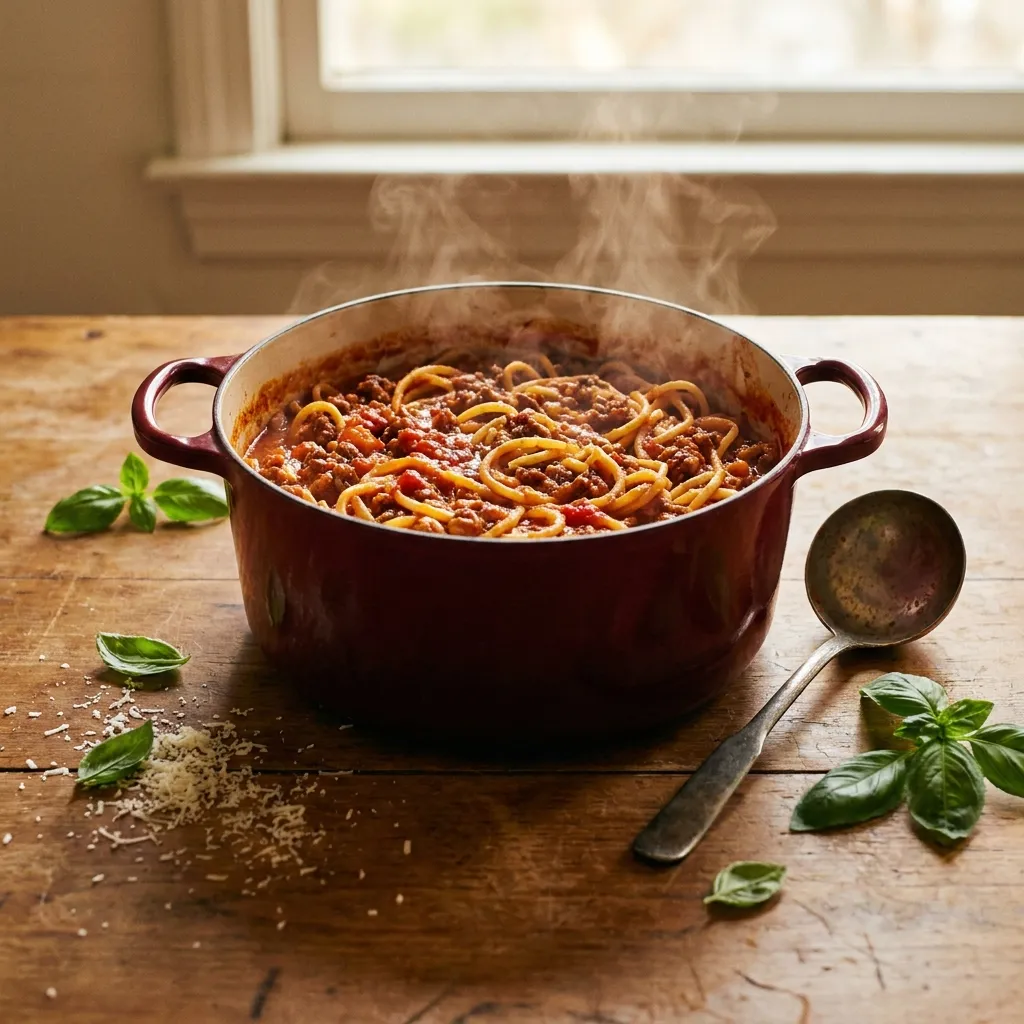
It's 6 p.m. and you're standing in the kitchen. The kids ask every 90 seconds when dinner will be ready. Four dirty pots from lunch are still sitting on the stove, and honestly, you're done.
That's exactly where one-pot cooking makes sense: one pot, everything in it, dinner ready.
Key Takeaways
- A true one-pot meal uses one pot, needs 10 to 15 minutes of active cooking time, and requires fewer than 8 ingredients—that's enough for a complete family dinner.
- For four people: minimum 5-liter capacity. Cast iron or stainless steel beats every specialty pan.
- The most common mistakes (burning, cream curdling, too soupy) can be fixed with one trick, if you know how.
- Among the most-saved recipes in FamFood, 7 out of 10 have fewer than 8 ingredients.
What actually makes a one-pot recipe better for families?
A true one-pot meal cooks protein, carbs, and vegetables all in one pot or skillet from start to finish. It saves more than just dishes—it cuts active cooking time down to 10 to 15 minutes. The stove does the rest.
The definition is simple: one container, all ingredients, one time window. No cooking in parallel, no juggling timers across three pots. That's what separates one-pot from slow cookers (which take hours) and sheet-pan dinners (which need an oven).
For families, the advantage is less obvious than you'd think. It's not about saving time. You don't have to multitask. You cook, and the pot handles the rest.
What we see again and again at FamFood: recipes with fewer than 8 ingredients get saved and cooked most often. Shorter ingredient lists mean fewer decisions at checkout and fewer half-empty containers forgotten in the fridge.
Which pot works best for family-sized portions?
For four people, a one-pot meal needs at least a 5-liter capacity. A tall Dutch oven or wide soup pot in cast iron or stainless steel beats every specialty pan. According to the German Federal Ministry of Food and Agriculture (BMEL): aim for roughly 1.2 liters per person as a minimum, ideally a bit more.
Cast iron vs. stainless steel: quick comparison
Factor | Cast Iron | Stainless Steel |
|---|---|---|
Heat distribution | Very even | Good, but with hot spots |
Weight | Heavy (5–8 kg) | Light (1–3 kg) |
Dishwasher safe | No | Yes |
Price | Medium to high | Medium |
Scratch risk | Low | Medium |
Best for | Braised dishes, soups | Pasta, rice dishes |
Non-stick coatings are convenient, but there's a catch: with kids in the kitchen, scratches happen fast, and a damaged coating has no business on the stove.
What you don't need: special one-pot sets from infomercials, multi-function gadgets with twelve attachments, or a separate wok pan. One good pot in the right size handles everything.
Which ingredients work reliably in one-pot cooking?
Starchy ingredients like pasta, rice, and red lentils work most reliably in one-pot dishes. They absorb liquid directly in the pot, cook alongside meat or vegetables, and thicken the sauce without extra help. According to Stiftung Warentest, whole-grain varieties are especially good for family meals because they deliver more satiety in the same cooking time. Ingredients with very different cooking times need staggered addition—that's the only technique you really have to learn.
Cooking time chart: when everything goes in
Ingredient | Add at | Cook time in pot |
|---|---|---|
Chicken thighs, ground meat | Start | 20–25 min |
Potatoes (diced) | Start | 15–20 min |
Carrots (sliced) | Start | 12–15 min |
Cauliflower (florets) | After 5 min | 10–12 min |
Pasta (dry) | After browning | 10–12 min |
Rice (uncooked) | After browning | 15–18 min |
Red lentils (uncooked) | After browning | 15–20 min |
Frozen peas, frozen spinach | Last 3 min | 2–3 min |
Sour cream, heavy cream | After heat off | Stir only, don't cook |
Fresh herbs | After heat off | Stir only |
Starchy base ingredients are the workhorses of one-pot cooking. They absorb liquid, thicken the sauce, and make the dish creamier than any separately cooked side.
Hard vegetables like carrots or cauliflower go in early. Soft vegetables like spinach or frozen peas go in during the last few minutes. And sour cream or heavy cream always gets stirred in after you turn off the heat. If cream boils, it curdles. Almost impossible to fix.
Chicken thighs, ground meat, and sausages are more one-pot-friendly than filet. Filet dries out during long cooking. Tough, flavorful meat gets more tender the longer it simmers.
Which one-pot recipes do even picky eaters actually finish?
The most successful family recipes in this format are ones where pasta or rice soaks up the sauce directly. The result is creamier than classically cooked sides, and that's exactly what kids love: no separation of "dry" food and sauce on the plate.
One-Pot Pasta with Ground Meat (25 min)
Brown 500 g ground meat in a little oil, add 1 onion and 2 garlic cloves, toast briefly. Add 400 g canned tomatoes, 600 ml broth, and 300 g dry penne straight to the pot, bring to a boil once, then simmer at medium heat for 12 minutes. Cover, turn off heat, let sit 5 minutes. Done. Six ingredients, one pot.
Parents in our FamFood community tell us kids finish this version more often than pasta-and-sauce served separately. The sauce clings to the pasta—no "dry pile" on the plate that gets rejected.
Cauliflower and Chicken with Sour Cream
Brown chicken thighs or drumsticks on all sides in the pan, set aside. Sauté cauliflower florets and onions in the drippings, return the chicken, deglaze with broth. Cover, simmer 20 minutes at medium heat. Turn off heat, then stir in sour cream and season with salt, pepper, and nutmeg. The cauliflower stays tender-crisp if you don't add it too early. That's the most common mistake with this dish.
What we've seen in FamFood tests: kids who normally refuse cauliflower eat it more often in this combination. The sour cream mellows the typical cauliflower smell, and the chicken makes it more interesting than plain vegetables.
Lentil Stew with Sausages
250 g red lentils, 3 potatoes diced, 2 carrots, 1 can tomatoes, 800 ml vegetable broth, 4 sausages sliced. Everything together from cold, bring to a boil once, then simmer 20 minutes on low. Red lentils need no soaking—they almost fall apart on their own and thicken the broth. This stew freezes in portions and keeps, according to the German Federal Center for Nutrition (BZfE), up to three months in airtight containers at minus 18°C or colder.
The two recipes that shouldn't be frozen: Cauliflower and chicken with sour cream lose texture when thawed. Pasta dishes swell after freezing—noodles get mushy. Lentil stew, tomato-bean soup, and the coconut rice dish freeze just fine.
Coconut Rice Dish (20 min)
Rice, vegetable broth, and coconut milk in a 1:1:1 ratio into the pot. Add vegetables of your choice (peas, corn, bell pepper), bring to a boil once, then simmer 18 minutes on low. Mild enough even for toddlers.
Parents tell us this dish works especially well with kids under five. The sweetness of coconut milk masks the vegetable flavor, and the creamy texture makes peas and corn acceptable to little ones.
Quick Tomato-Bean Soup (15 min)
Onion, garlic, canned tomatoes, one can kidney beans, broth, and paprika powder. Bring to a boil, simmer 10 minutes, done. With crusty bread, that's a complete dinner using less than 15 minutes of active work. According to the German Federal Center for Nutrition (BZfE), legumes like beans and lentils cover children's daily iron needs especially efficiently—a good reason to add them to the weekly meal plan more often.
How do you build one-pot nights into your weekly routine?
Two or three one-pot nights a week is enough to noticeably cut kitchen work. Plan a one-pot dinner on Monday and Thursday, and the rest of the week feels easier because the rhythm is set and your brain doesn't restart from scratch every time.
One-pot fits perfectly on Tuesday and Thursday—exactly the days when sports, activities, or parent-teacher meetings steal your time. Prep time is under 10 minutes if you keep your basics stocked.
Five things to always have in the cupboard: canned tomatoes, red lentils, pasta or rice, vegetable broth (powder or cubes), and frozen vegetables. With just these five, you can cook a complete dinner any time without a special shopping trip.
See the Meal Planning Guide: 7 days stress-free for how this fits into a structured family week. One-pot nights are built in as fixed time slots.
How do you handle it when a one-pot night goes wrong?
The most common mistakes are too little liquid (pasta swells, rice burns) and heat too high (cream curdles). Both can be fixed with one quick move if you react fast.
Burned on the bottom: Remove pot from heat immediately. Don't scrape the bottom—that spreads the burned taste everywhere. Cover, let sit 3 minutes. Carefully pour the top portion into another pot, leave the burned part behind.
Too soupy: Take off the lid, turn heat up high, let it reduce uncovered for 5 minutes. Pasta and rice keep absorbing liquid meanwhile.
Too dry or sticky: Stir in a splash of broth or hot water, let it simmer gently for a minute.
Cream curdles: If it happens, grab an immersion blender. One quick pulse and the sauce turns smooth again. Next time, just stir in the cream after turning off the heat.
More sauce and cooking fixes are in our post Rescue Your Sauce: What to do when it goes wrong.
How do you save your favorite one-pot recipes so you actually find them again?
Recipes saved in an app rather than browser bookmarks get pulled up faster on a stressful week. In FamFood you can create your own one-pot collection and drag recipes straight into next week's meal plan, so Tuesday night you're not searching—you're cooking.
Collections and tags make the difference between "I think I had a recipe for that once" and "Here it is, time to shop."
Frequently Asked Questions
Can I scale one-pot recipes up for larger families with 6 or more people?
Yes. Quantities scale 1:1, but your pot has to grow with you. For 6 people you need at least 7 to 8 liters. Important: more volume means longer to heat through—add 3 to 5 minutes and taste for doneness before serving.
Which one-pot recipes freeze well, and how long do they keep?
Lentil stew, tomato-bean soup, and coconut rice dish keep frozen up to 3 months. Pasta dishes and cream-based recipes don't freeze well—noodles get mushy, cream loses body. Best practice: freeze in single portions and thaw overnight in the fridge.
Does the one-pot method work with cauliflower or other vegetables that get mushy quickly?
Yes, but timing matters. Cauliflower goes in 5 minutes after you start and needs only 10 to 12 minutes. Add it at the beginning and you get mush. Frozen shrimp and other delicate items also go in during the last 3 to 5 minutes—that's true for almost all frozen products.
How do I keep sour cream or heavy cream from curdling in a one-pot recipe?
Turn off the heat, move the pot away from the hot burner, then stir in the cream. Never add cream while the pot is still hot or boiling. If you whisk cream with a little cornstarch first (1 teaspoon per 200 g cream), you can add it to a gentle simmer without it breaking.
Can I make one-pot dishes in a slow cooker instead?
Basically yes, but the method changes. Slow cookers stretch cooking time to 4 to 8 hours—pasta and rice swell too much and don't work well. For slow-cooker nights, go for braised dishes with whole meat pieces or legumes instead. One-pot at the stove and slow cooker are two separate systems with different strengths.
About FamFood: FamFood is a recipe app built by families, for families. We cook ourselves, test recipes with real kids at the table, and share only what actually works in everyday life. No glossy food shoots, no impossible ingredient lists.