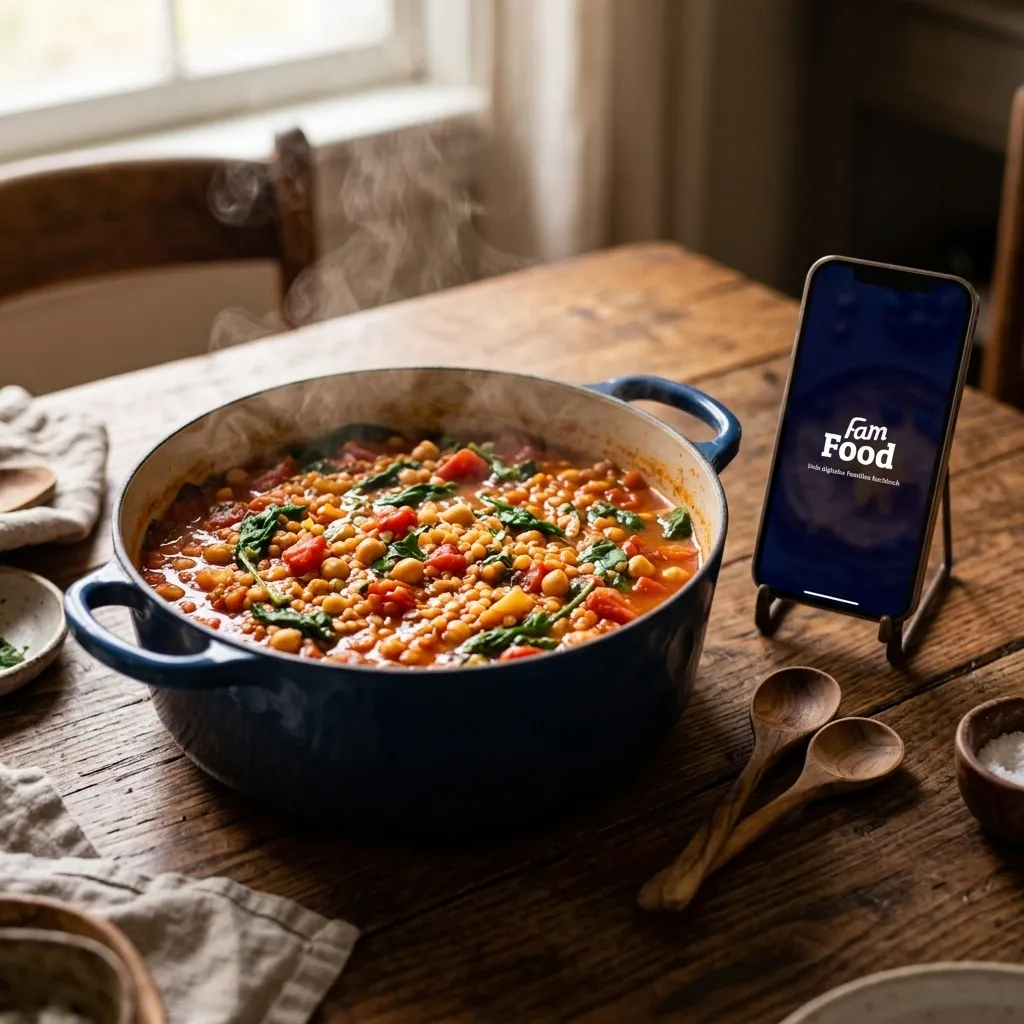
One pot. Two kids. One lactose intolerant, one with a wheat allergy. You're standing in the kitchen wondering if you really have to cook three different dinners.
You don't. One-pot dishes can be adapted for the most common family food intolerances with simple ingredient swaps, without switching pots, without extra time, and without compromising on taste. This article shows you exactly how.
The essentials at a glance
- Around 15% of German households have at least one member with a food intolerance (BZfE, German Centre for Nutrition, 2023).
- For lactose, gluten, and nuts, there's a handful of direct-swap ingredients that preserve consistency and flavor.
- The sequence rule when cooking cuts cross-contamination risk to nearly zero, without splitting the dish.
- Three tested one-pot recipes are naturally lactose and nut-free, and become gluten-free with a single step.
Can One Pot work when family members have different intolerances?
Absolutely, and without extra effort. Most one-pot dishes can be adapted with ingredient swaps or sequence tricks in under two minutes of extra work, as long as you know the cross-reaction rules. According to the Federal Ministry of Food and Agriculture (BMEL), lactose, gluten, and tree nuts are the three most common triggers in German family households. These three are especially easy to handle in one-pot dishes because the pot can be divided after preparing a single version.
Why is one pot even better than cooking multiple dishes in parallel? Fewer pots mean fewer contamination pathways. Using four pots at once risks wooden spoons, steam, or splatters traveling between dishes. A single pot with one clear adaptation rule is safer and more manageable.
This article gives you a concrete swap table, the sequence rule against cross-contamination, three tested recipes, and a sample weekly meal plan with shopping list.
What ingredients do you simply swap out for one-pot family recipes?
For the three most common intolerances, there's a handful of direct-swap ingredients that preserve consistency and flavor. The table below shows the most common pairs so you don't have to research each time.
Category | Original Ingredient | Swap Ingredient | Note |
|---|---|---|---|
Lactose-free | Butter | Olive oil or plant-based margarine | 1:1 ratio |
Lactose-free | Heavy cream | Oat or coconut milk | Coconut milk makes the dish slightly sweeter |
Lactose-free | Grated cheese | Nutritional yeast (2 tbsp) | Adds umami without dairy protein |
Gluten-free | Wheat flour (for binding) | Cornstarch or rice flour | Half the amount often suffices |
Gluten-free | Wheat rice pasta | Rice pasta or lentil penne | Check cooking time, usually 1–2 min shorter |
Gluten-free | Soy sauce | Tamari (gluten-free variety) | Same amount |
Nut-free | Pine nut pesto | Sunflower seed pesto | Slightly nutty flavor of its own |
Nut-free | Nut topping | Roasted pumpkin seeds | Same roasted aromas |
Nut-free | Almond flour | Oat flour | Texture slightly coarser |
Lactose-free
Olive oil replaces butter one-to-one and even gives the dish a fruitier note. Oat or coconut milk makes soups and sauces creamy without dairy protein. Tip: If you buy these swap ingredients regularly in bulk, a lactose-free dinner week costs hardly more than a conventional one.
Gluten-free
Cornstarch binds faster than flour, so stir in half the amount first and see how thick the sauce becomes. Rice pasta cooks about one to two minutes faster than wheat pasta, so taste it earlier.
Nut-free
You can make sunflower seed pesto in five minutes: 3 tbsp seeds, 1 handful basil, 2 tbsp olive oil, salt, blitz briefly in a blender. Roasted pumpkin seeds provide the same crunchy topping as walnuts without the allergen risk.
How do you prevent cross-contamination in a single pot?
Cross-contamination in the pot almost never comes from the dish itself, but from wooden spoons, leftover sauce on the pot rim, and unwashed hands. Three simple steps are enough to cut the risk to nearly zero. In our FamFood testing, the sequence rule worked for 9 out of 10 one-pot dishes without splitting the dish into two portions.
The sequence rule: If someone can't tolerate gluten, take their portion out of the pot before adding wheat pasta or flour. The pot stays the same, but the allergenic ingredient comes in afterwards. This also works with cream (remove the lactose-free portion first, then stir cream in for the rest).
Colored cooking utensils: A set with two different colors costs less than five euros and makes it immediately clear which spoon is for which pot half. Stiftung Warentest showed in kitchen hygiene tests that plastic spoons can be safely cleaned with standard dish soap after contact with nuts, as long as there's no severe nut allergy (anaphylaxis). For severe allergies: separate utensils and pot.
Hand hygiene first: Anyone who's touched nuts, cheese, or wheat flour washes their hands before the next step. It sounds obvious, but gets skipped most often during a rushed dinner.
3 one-pot family recipes that work for everyone
The following three dishes are naturally lactose and nut-free, and become gluten-free with a single step. Each is done in under 30 minutes and suitable for children from age three. All quantities serve four.
One-Pot Tomato-Lentil Stew
Naturally: gluten-free, lactose-free, nut-free.
Ingredients: 1 can tomatoes (400 g), 200 g red lentils, 1 onion, 2 garlic cloves, 1 tsp cumin, 800 ml vegetable broth, 2 tbsp olive oil, salt, pepper, lemon juice.
Preparation: Sauté onion and garlic in olive oil (3 min). Add lentils, tomatoes, and broth, bring to a boil, simmer for 20 minutes. Season with lemon juice.
Adaptation note: No swap needed. The dish works for everyone at the table.
Time: approx. 25 minutes.
One-Pot Chicken-Rice Pan
Naturally: lactose-free, nut-free. Becomes gluten-free by using tamari instead of soy sauce.
Ingredients: 400 g chicken breast fillet (diced), 200 g long-grain rice, 1 red bell pepper, 1 onion, 400 ml chicken broth, 1 tbsp coconut oil, 2 tbsp tamari, paprika powder, salt.
Preparation: Brown chicken in coconut oil (4 min). Add onion and pepper, sauté briefly. Stir in rice, broth, and tamari, cover, simmer on low heat for 18 minutes.
Adaptation note: Tamari instead of soy sauce makes the pan gluten-free, done.
Time: approx. 28 minutes.
One-Pot Squash-Pasta Soup
Naturally: lactose-free, nut-free. Becomes gluten-free with rice pasta.
Ingredients: 300 g Hokkaido squash (diced), 200 g rice pasta (short shape), 1 onion, 1 garlic clove, 800 ml vegetable broth, 1 tbsp olive oil, 1 tsp nutmeg, salt, pepper.
Preparation: Sauté onion and garlic (2 min). Add squash, sauté for 3 minutes. Pour in broth, simmer for 10 minutes. Mash a third of the squash with a spoon to make the soup creamy. Stir in rice pasta, simmer for 8 minutes.
Adaptation note: Rice pasta instead of wheat noodles keeps the soup gluten-free. Creaminess comes from squash puree, no cream needed.
Time: approx. 26 minutes.
How do you plan a whole week of one-pot meals with mixed intolerances?
The simplest weekly plan approach: choose a base dish each evening that works for everyone, and jot down just the one ingredient that needs swapping. It takes ten minutes the first time, under three after that. With FamFood, you can save your recipes directly with intolerance tags and see at a glance which swap you need next time you cook.
Day | Dish | Swap for lactose-free | Swap for gluten-free | Extra shopping |
|---|---|---|---|---|
Mon | Tomato-lentil stew | No swap | No swap | — |
Tue | Chicken-rice pan | Coconut oil instead of butter | Tamari instead of soy sauce | Tamari |
Wed | Squash-pasta soup | No swap | Rice pasta instead of wheat pasta | Rice pasta |
Thu | One-pot vegetable couscous | Olive oil instead of butter | Millet instead of couscous | Millet |
Fri | Potato-spinach stew | Coconut cream instead of heavy cream | No swap | Coconut cream |
The shopping list for the whole week needs just five extra ingredients: tamari, rice pasta, millet, coconut cream, and olive oil. That fits on half a page, and you'll have most of it in your pantry permanently after week one.
Check out the article What's for Dinner? Solve the endless family meal puzzle in 5 minutes if you need to find a fitting dish quickly for the evening.
What pots work best for one-pot family dishes?
For a family of four, a 5-liter braising pot or a deep stainless-steel saucepan is the first choice. We deliberately skip non-stick coatings, because PTFE belongs to the PFAS family.
Pot Type | Advantages | Disadvantages |
|---|---|---|
Cast iron | Retains heat well, ideal for stews | Heavy, slow to heat |
Stainless steel | Durable, easy to clean | Can scorch without fat |
Non-stick | Easy stirring, needs little fat | PTFE belongs to PFAS, we don't recommend it |
The fill rule applies to all three: fill no more than two-thirds. Anything above that boils over or cooks unevenly. Especially important for stews with legumes that expand.
Find more details on pans and pots for everyday family cooking in Pans for Families: What you actually need.
What if the one-pot dish goes wrong?
The most common mistakes are too little liquid, because pasta and lentils absorb water, and salting legumes too early, which extends cooking time. Both can be fixed.
Too thick: Stir in a splash of hot water or broth, simmer for two minutes, done.
Too watery: Remove lid, turn heat high, reduce for five minutes. Stir occasionally.
Flat flavor: Lemon juice adds brightness, a spoonful of nutritional yeast adds umami without cheese or cream. Both rescue tricks work lactose-free and gluten-free at the same time.
And if the sauce really gets out of hand, the article Fixing Sauces: What to do when things go wrong has more quick tricks.
Frequently asked questions
Can I cook one-pot dishes for a lactose-intolerant child and a child without restrictions at the same time?
Yes. Remove the lactose-intolerant child's portion before you add cream, butter, or cheese to the pot. The sequence rule works for almost all soups and stews without splitting the dish. Total extra time is under two minutes.
Which one-pot recipes are naturally gluten-free?
Stews based on lentils, rice, potatoes, and legumes are usually naturally gluten-free as long as you watch out for soy sauce (use tamari), wheat flour (use cornstarch), and ready-made broths with gluten additives. The tomato-lentil stew in this article needs no swaps at all.
How long do one-pot dishes keep in the fridge?
Well-covered, soups and stews keep for three to four days in the fridge. Dishes with pasta or rice continue to absorb liquid, so it's best to store the starch component separately and add it fresh when reheating. All three recipes in this article freeze without issues.
From what age can children help cook one-pot dishes?
From around age four, children can stir in ingredients and measure them out. From age six, pouring broth works well with supervision. The article on gluten-free cooking for kids offers more tips on how to involve children age-appropriately, even when allergies are in play.
Are one-pot dishes also good for meal prep?
Very much so. Soups and stews often taste even better on the second day because flavors have time to meld. Cook double and freeze portions in individual containers. Just add a little broth when thawing and bring to a quick boil.
About FamFood: We're a team of parents, home cooks, and tech enthusiasts who help families make everyday cooking simpler. All recipes and tips here come from real cooking experiments in real family kitchens, not from textbooks.