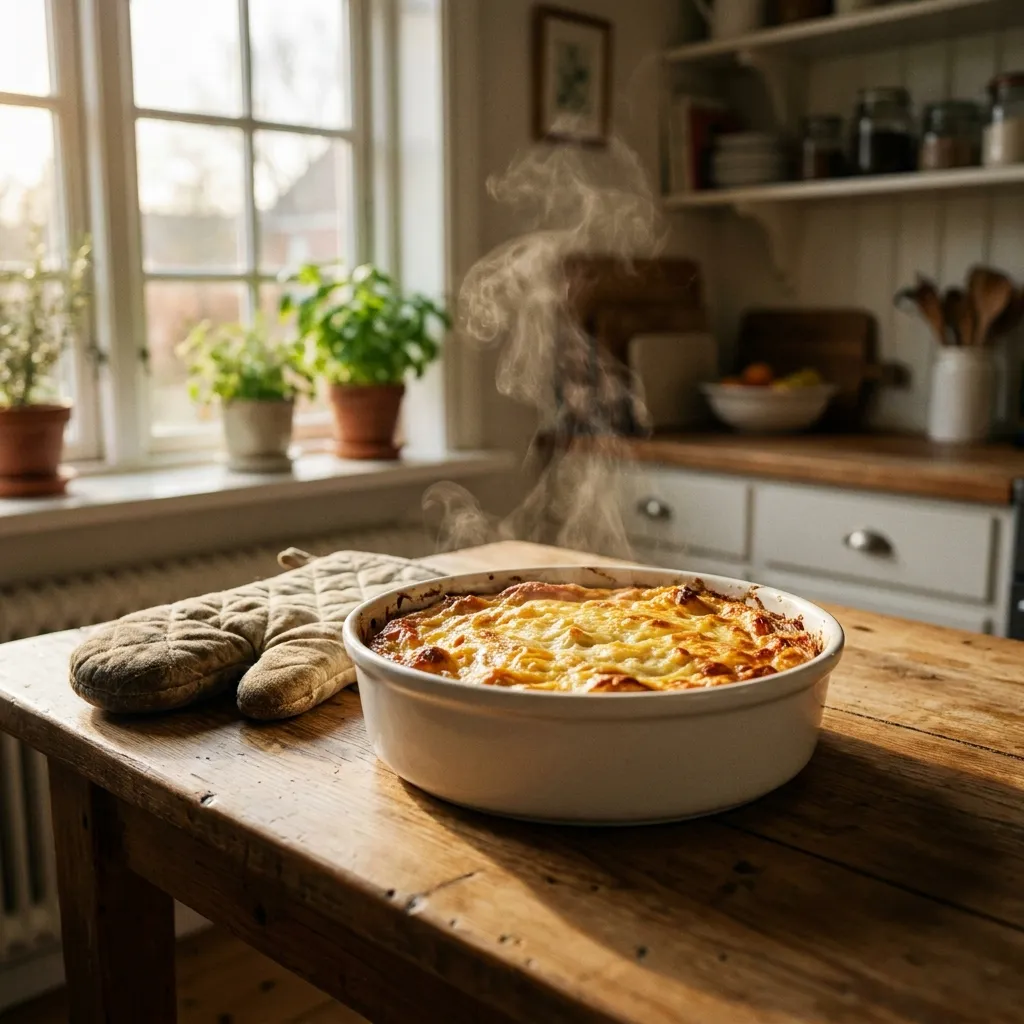
The top of your casserole is golden-brown. The inside is still raw. The oven's been running for an hour. You've made this recipe three times before, and somehow it still doesn't work. Sound familiar?
The problem almost never lies with the recipe. It lies in how your oven is set. Wrong mode, wrong rack, a machine running quietly 27 °F too hot—that alone sabotages the best ingredients. The good news: every single one of these mistakes can be fixed in five minutes.
Key Takeaways
- Household ovens drift 18–36 °F from their set temperature. A simple toast test reveals whether yours does.
- Convection mode saves 27–36 °F in temperature (and matching energy); conventional top/bottom heat works better for yeast dough and delicate batters.
- Rack position is one of the most overlooked baking mistakes: wrong shelf, wrong result.
- According to Verbraucherzentrale (German Consumer Association), ovens account for up to 15% of household electricity use.
Why Your Oven Is Sabotaging Your Recipe
The most common cause of failed oven dishes isn't the recipe—it's the wrong mode or inaccurate temperature. Equipment tests show that household ovens regularly drift 18–36 °F from their displayed setting. At 356 °F, your oven might actually run at 373 °F, and you'll never notice because the display dutifully shows 356.
The result is the classic casserole problem: the top is dark brown because the actual heat is higher than expected. The inside is still half-raw because cooking time was based on the wrong target temperature. You extend the baking time. The edges dry out further. Eventually the dish is done—but it's not pretty.
Three mistakes lie behind this, and this post walks through each: wrong mode, wrong rack position, and an oven that simply doesn't deliver the heat it claims. All three are fixable, and none cost money.
Conventional or Convection: What's the Real Difference?
Convection distributes heat evenly throughout the oven cavity and often allows 27–36 °F lower temperatures than conventional top/bottom heat, which saves energy and prevents drying out. Conventional mode concentrates warmth from the top and bottom simultaneously, with no active air circulation. It sounds more intense, but for certain batters it's the better choice: yeast breads and sponge cakes need calm, directed heat so they rise undisturbed, without forming a crust before the dough is ready.
In convection, a fan constantly circulates heated air, which equalizes the heat. Three trays of cookies at once? No problem with convection. A roasted chicken that needs color on all sides? Convection. A delicate choux dough that collapses at the slightest breath of air? Conventional.
Dish | Recommended Mode | Why |
|---|---|---|
Cookies (multiple trays) | Convection | Even browning across all levels |
Chicken, roasts | Convection | All-around browning via air circulation |
Casseroles | Convection | Saves energy, prevents drying out |
Yeast cake, braided loaf | Conventional | Calm heat for uninterrupted rise |
Bread | Conventional | Better crust formation from below |
Sponge cake, choux dough | Conventional | No air current that disrupts structure |
The 36-Degree Rule When Switching
If you're converting a recipe from conventional to convection, reduce the stated temperature by 36 °F. This isn't a forum guess—it's what equipment manufacturers recommend in their manuals. Baking time usually stays the same or shortens slightly. Tip: the first time, check five minutes before the timer goes off.
Rack and Position: Why the Shelf Actually Matters
Most recipes assume the middle rack, but a roast cooks through more evenly on the lowest rack thanks to bottom heat, while gratins brown faster on the top rack. Using the wrong height is one of the most overlooked baking mistakes because it doesn't trigger an error message. The dish just isn't right, and suspicion falls on the recipe instead.
Heat rises. The top rack is hotter than the bottom, especially in conventional mode. It sounds like a physics lesson, but it has real consequences in the kitchen.
Dish | Recommended Rack | Why |
|---|---|---|
Cake, muffins | Middle | Even heat from top and bottom |
Roasts, braised dishes | Bottom | Bottom heat prevents drying |
Pizza, quiche | Bottom | Crispy crust from direct lower heat |
Gratin, baked casseroles | Top | Quick browning of the surface |
Cookies (single tray) | Middle | Balanced browning |
Bread | Bottom to middle | Stable crust formation |
With convection running multiple trays at once, rack choice plays a smaller role because the fan equalizes the heat. Still, the top tray browns a bit faster. If you like, swap the trays halfway through baking.
Preheating: When It's Essential, When It's Pure Waste
Preheating is non-negotiable for yeast dough, puff pastry, and sponge cake because the initial heat shock shapes the structure. For casseroles, braised dishes, and many vegetable recipes, though, you can just slide the dish into a cold oven and add a little extra cooking time. This saves real energy, and often the result is even better.
Preheating is essential for:
- Yeast dough and yeast cakes (heat shock makes them rise)
- Puff pastry (the layers need immediate heat to separate)
- Sponge cake and choux dough (structure must set at once)
- Pizza (a crispy crust happens only on a preheated tray or stone)
Cold start works well for:
- Casseroles and gratins
- Braised dishes and roasts
- Roasted vegetables
- Reheated meals
A standard oven needs roughly 10–15 minutes to reach 356 °F. If you preheat needlessly for every casserole, you waste about 0.1–0.15 kWh every other evening just on heating. Over a year, it adds up.
How Hot Is Your Oven Really? A DIY Test with Everyday Tools
A simple slice of white bread on the middle rack at 392 °F in conventional mode should turn an even golden-brown in 4–5 minutes. If it stays pale or burns in blotches, your oven drifts from its target temperature. This isn't a defect—it's the rule with household ovens. In FamFood tests, we found that every second household oven drifts at least 18 °F. In a third, it was more than 27 °F.
Here's how to do the toast test:
- Preheat to 392 °F conventional mode (15 minutes)
- Place one slice of white bread on the middle rack with no parchment
- Check after exactly 4 minutes
- Even golden-brown: Oven is accurate
- Pale or barely colored: Oven is too cold (note a correction value: +18 to +36 °F)
- Dark brown or unevenly burnt: Oven is too hot or heats unevenly
A more precise option is an oven thermometer. Stiftung Warentest (a German independent testing organization) recommends simple models starting around $8, available in most kitchen sections. Write down your personal correction value once and apply it to every future recipe.
Save Energy While Baking: 5 Habits That Work Immediately
According to Verbraucherzentrale, an oven causes roughly 10–15% of household electricity use. Five concrete habits can noticeably lower that share without sacrificing results or flavor. For families cooking for three to five people daily, small changes quickly add up.
Use residual heat. Turn off the oven 5–10 minutes before baking time ends. Stored heat finishes most dishes. It works reliably for casseroles and gratins.
Open the door less. Every opening lets 36 °F of heat escape. The oven reheats, which costs power. The window and interior light exist so you can check without opening.
Batch your baking. If you bake twice a week, bake both times back-to-back. The oven is already hot; the second round needs less energy to reheat.
Prefer convection. 36 °F lower temperature means measurably lower consumption. Anywhere convection gives the same result, it's worth the switch.
Keep the glass clean. A burnt, cloudy window forces you to open the door to peek. A clean glass doesn't. Plus, grime on the glass conducts heat poorly inward, which slightly but measurably reduces efficiency.
Mastering the Oven with Kids: Safe and Fun
Children can safely help with the oven around age 8, if clear rules apply: always use oven mitts, never unattended, use the window instead of opening the door to check. The oven isn't something to forbid—it's a tool you learn to know and respect. Just like knives for kids, where age-matched tasks build confidence, the same works with the oven.
Age-matched oven tasks:
- Age 6+: Set the timer, adjust the temperature (explaining what the number means)
- Age 8+: Remove a tray with mitts, watch the dish through the window and describe what's happening
- Age 10+: Preheat on your own, judge doneness, apply the residual-heat rule
Baking is a practical physics lesson. Why does yeast dough rise? What happens to egg white in heat? Why does sugar brown? Once you explain it while a tray is in the oven, you have a child asking questions on their own next time. Find more everyday kitchen tricks in our Family Kitchen Tips.
Common Oven Questions Answered
Do I always have to preheat?
No. Preheating is essential for yeast dough, puff pastry, sponge cake, and pizza because immediate heat shock shapes the dough structure. Casseroles, braised dishes, and vegetables work fine from a cold start, add 10–15 minutes to cooking time, and save measurable energy.
What's better for pizza: convection or conventional?
For pizza, choose conventional mode on the bottom rack or with a preheated pizza stone. Direct bottom heat makes the crust crispy. Convection dries the topping too fast. Temperature: 428–482 °F, the hotter the better for crust.
How do I know my oven shows the wrong temperature?
Simplest test: white bread on the middle rack at 392 °F conventional for 4–5 minutes. Even golden-brown means the oven is accurate. Pale or unevenly burnt means a drift exists. An oven thermometer (around $8) gives the exact correction value.
How much power does an oven use per hour?
A typical household oven consumes 0.9–2.0 kWh per hour, depending on model, temperature, and mode. Convection runs about 20% lower than conventional. At $0.30/kWh, one hour of baking costs $0.27–$0.60.
Can I put multiple trays in the oven at once?
Yes, but only in convection mode. The fan spreads heat evenly across all levels. In conventional mode, the middle tray is too hot, the outer ones too cool. One tip: even in convection, the top tray browns slightly faster. Swap them halfway through if you want identical browning on all trays.
About FamFood
FamFood is a recipe app for families who cook every day, not once a month. We gather everyday tips, recipes, and kitchen know-how from real family cooking experience, without the glossy filter. What's here, we've tested ourselves. famfood.app