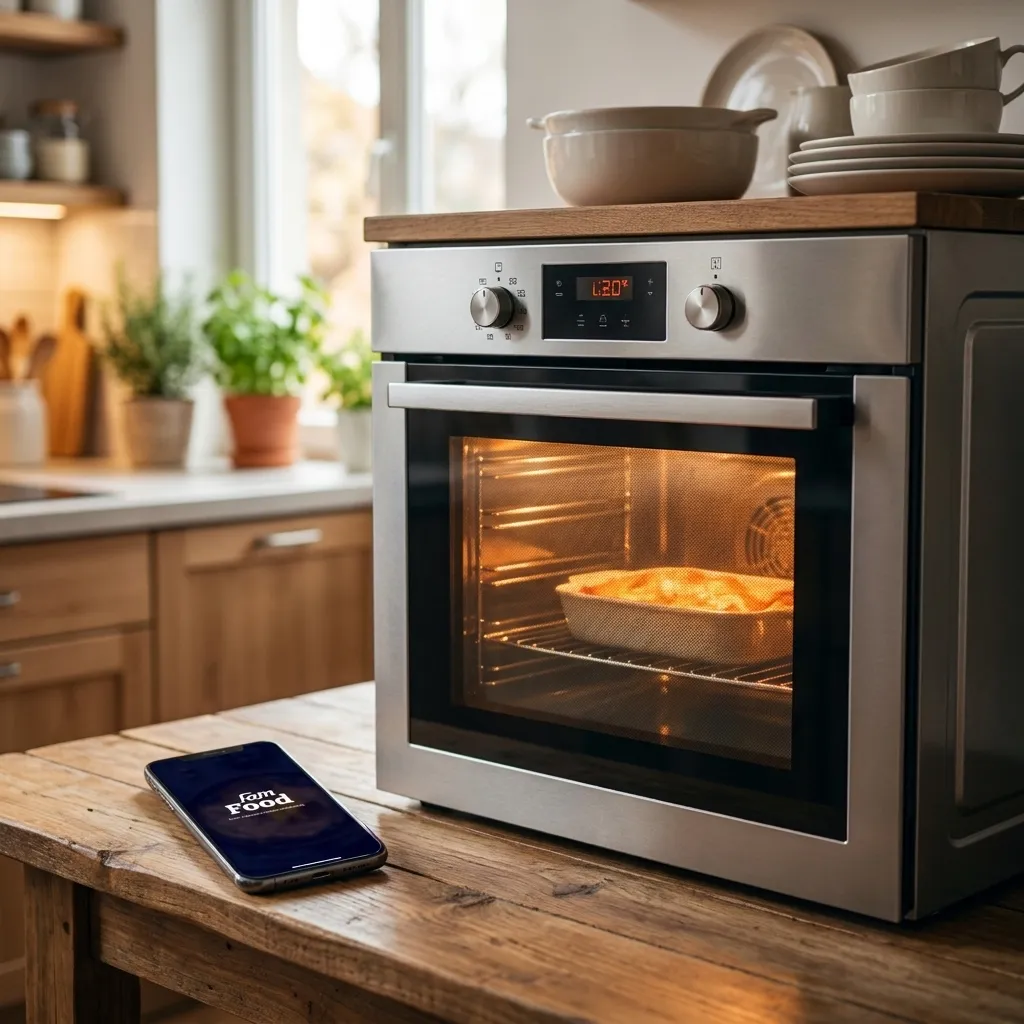
Oven Heat Settings: Conventional vs. Fan Bake
Most families turn the oven dial to 200 degrees and hope for the best. Pound cake, chicken legs, leftover casserole — same default. It costs flavor, texture, and sometimes the entire dish.
Three minutes to read. Then you'll know which setting wins when, and why.
Key Takeaways
- Conventional heat protects delicate batters; fan bake beats it for casseroles, roasts, and multiple racks at once.
- When switching to fan bake, always reduce by 15–20 °C from the recipe, because recipes are almost always written for conventional.
- Rack position matters as much as temperature: middle = standard, bottom = crispy base, top = golden crust.
- Use residual heat for the last 5–10 minutes to save measurable electricity without hurting the result.
Conventional vs. Fan Bake: What's the Real Difference?
Conventional heat warms the oven from two fixed points: an element at the top, one at the bottom. Heat sits in the space and works from outside inward through the batter. Fan bake adds a fan that pushes air evenly throughout the oven. It sounds like a detail. It decides whether your cake stays moist or dries out.
The crucial effect: moving air transfers heat faster to the surface of what you're cooking. That's why fan bake feels hotter at the same degree setting than conventional. A delicate sponge cake that forms a thick crust instantly under fan bake can still be raw inside.
Daily rule of thumb: batter = conventional. Everything else = fan bake.
Feature | Conventional | Fan Bake |
|---|---|---|
Heat source | Top + bottom, static | Fan distributes hot air |
Temperature (same effect) | Recipe says | about 15–20 °C lower |
Good for | Cakes, sponge, yeast dough, quiche | Casseroles, roasts, sheet vegetables, multiple racks |
Crust forming | Slow, controlled | Fast, even |
Multiple racks | Uneven | Even |
Moisture in oven | Better retained | Dries batters faster |
Which Setting Do You Actually Use? The Family Decision Guide
For pound cake, sponge, and yeast dough, conventional heat is the first choice because delicate batters need time before the surface closes. For casseroles, chicken, sheet vegetables, and baking on multiple racks at once, fan bake wins every time. Remember this, and you'll rescue at least one dish a week.
FamFood tests show a pattern: families who bake sponge cake accidentally on fan bake describe the result almost identically—dry outside, too soft inside, barely any rise. The fan pulls moisture out of the batter before it can build structure.
With multiple racks at once, fan bake has no real alternative. Conventional heats the middle rack well, the bottom stays pale, the top burns.
Baking
Dish | Setting | Temperature |
|---|---|---|
Pound cake, marble cake | Conventional | 175 °C |
Sponge base | Conventional | 170 °C |
Yeast loaf, rolls | Conventional | 180 °C |
Cookies (one rack) | Conventional | 175 °C |
Cookies (multiple racks) | Fan bake | 155 °C |
Stuffed rolls, quiche | Fan bake or conventional | 180 °C / 200 °C |
Roasting & Cooking
Chicken legs, sheet vegetables, salmon fillet on a tray: that's fan bake territory. Circulating air browns the surface evenly from all sides and dries meat juices in a controlled way. Result: crispy skin, juicy inside, less turning needed.
Dish | Setting | Temperature |
|---|---|---|
Chicken legs | Fan bake | 180 °C |
Sheet vegetables (courgette, peppers) | Fan bake | 200 °C |
Casserole (pasta, potatoes) | Fan bake | 175 °C |
Salmon fillet on tray | Fan bake | 170 °C |
Pizza | Conventional, bottom | 220–240 °C |
Reheating & Keeping Warm
Leftovers from the fridge warm gently at fan bake, 150 °C, in about 10–15 minutes. The microwave is faster, but casseroles and roasts often lose texture. In the oven, the crust stays crispy and the inside heats evenly. To keep warm: 80 °C conventional, covered.
What Temperature Is Really Right?
Recipes are written almost always for conventional. If you switch to fan bake, subtract 15–20 °C. From 180 °C conventional becomes 160–165 °C fan bake. This is the most common cause of dry baked goods, because most people don't make this adjustment.
The 15–20 °C rule comes from physics: moving air transfers heat more efficiently than static air. The oven achieves the same cooking effect with less energy and less time.
One more factor families regularly underestimate: Stiftung Warentest measured in oven tests that many appliances deviate 10–25 °C from the set temperature. A simple oven thermometer under 10 euros solves this permanently. Clip it to the middle rack, check it during your next preheat, and note the correction value.
Preheat: when you need it, when you don't?
- Yeast dough, sponge, pizza: always preheat, at least 10–15 minutes.
- Casseroles, braised dishes, sheet vegetables: often optional. Put the casserole dish in a cold oven; it reaches temperature together with it.
- Frozen meals per package instructions: almost always a preheated oven, because product tests are based on that.
For large family quantities—a full 30-centimeter tray of vegetables or a 2-kilogram roast—the food takes longer. Allow 10–15 percent more time than the recipe says and check with a meat thermometer or wooden pick.
Why Is Your Casserole on the Wrong Rack?
Rack position determines whether top or bottom heat dominates. Bottom rack means strong base heat, ideal for pizza and tarts with a crispy bottom. Middle rack gives even heat from top and bottom, ideal for casseroles and roasts. Top rack delivers fast browning from above—for the last minutes when the cheese crust should turn golden.
Three racks, one rule:
Rack | Heat focus | Typical dishes |
|---|---|---|
Bottom | Strong bottom heat | Pizza, tart, quiche (crispy base) |
Middle | Even | Casseroles, roasts, cakes, chicken |
Top | Strong top heat | Gratins, baked-on toppings, brief grilling |
The most common mistake: sliding the casserole too high. The cheese layer burns while the inside is still cold. The fix is simple: casserole in the middle, move it up one rack for the last 5 minutes to get a golden crust.
The grill function is meant for very brief use, 3–5 minutes maximum, with the oven door open and constant watching. Never leave the oven unattended during grilling.
How Do You Actually Save Energy with Your Oven?
According to the German Federal Ministry for Economic Affairs and Climate Action, the oven accounts for roughly 4–5 percent of household electricity use. The biggest levers aren't standby mode but decisions right while cooking: fan bake instead of conventional for large quantities, no unnecessary preheating, using residual heat consistently.
Residual heat in practice: turn off the oven 5–10 minutes before the cooking time ends. For casseroles, braised dishes, and cakes, the stored heat finishes the cooking without loss of quality. On a 45-minute casserole you can save electricity regularly without changing anything about your routine.
Fan bake is about 20 percent more energy-efficient than conventional at the same cooking effect, because moving air carries heat to the food faster. That's why you have to lower the temperature.
Every oven door opening costs about 20 °C. Use the viewing window and oven light. Keep the door closed.
Using the Oven with Kids: What Works, What Doesn't?
Children from primary school age can safely help at the oven if an adult handles the heat control. Child's job: topping, shaping, checking through the window. Taking hot pans out stays with the adult.
The viewing window is more than a safety feature. It's a learning tool. Kids watch batter rise, cheese melt, color change. These concrete observations build understanding of heat and time better than any explanation.
What we hear from the FamFood community again and again: families who bake together stick with the routine longer than families where cooking is adults-only. Children who know the process ask less often "When's it done?" and more often "Can I look?"
More on structuring baking with primary-school kids, find it in the FamFood post Let Kids Bake: Learning Format, Not Chaos.
The 5 Most Common Oven Mistakes in Family Cooking
Wrong setting, wrong rack, opening the door too often, no preheat with yeast dough, too many trays at once: these five patterns come up most when family dishes fail in the oven. None of them is hard to fix.
Real example: chicken legs burnt outside, raw inside. Cause almost always: top rack plus too high a temperature. Fix: middle rack, 180 °C fan bake, 40–45 minutes, check core temperature at 82 °C.
Mistake | Symptom | One-sentence fix |
|---|---|---|
Fan bake on sponge | Dry outside, raw inside, little rise | Switch to conventional, 170 °C |
Wrong rack | Casserole burnt on top, cold inside | Choose middle, move up one rack for last 5 min |
Door open too often | Cooking time stretches, batter collapses | Use viewing window, open door only for turning |
No preheat with yeast | Dough doesn't rise, stays dense | Preheat at least 15 min, check oven thermometer |
Too many trays (conventional) | Uneven browning, one tray raw | Switch to fan bake or bake trays one after another |
Energy mistakes like standby and constant preheating are covered in the sister post "Oven Use: Errors That Eat Electricity." Here it's purely about cooking results.
More general kitchen tricks that ease family life, collected in the post Kitchen Tips for Families: Making Life Easier.
Common Oven Questions
What's the difference between fan bake and hot-air?
In English-speaking regions, fan bake and convection both mean the same thing basically: a fan distributes oven heat evenly. Some manufacturers use terms that suggest variants with extra heating rings around the fan. In daily practice the differences are tiny. When in doubt: treat fan bake and convection the same way, reduce temperature versus conventional by 15–20 °C.
Can I convert every recipe from conventional to fan bake?
Almost every one. The rule: subtract 15–20 °C, cut cooking time by about 10 percent, and check earlier. Exceptions are very delicate sponge cakes or soufflés, which need the quiet, static heat of conventional so the batter rises evenly before the surface sets.
Do I always have to preheat the oven?
No, not always. With yeast dough, sponge, and pizza: yes, at least 10–15 minutes, because starting temperature affects the result directly. With casseroles, braised dishes, and sheet vegetables you can put the food in a cold oven. It warms up together with it and takes a bit longer, but the result is at least as good.
Why is my cake dark outside but still raw inside?
Too high a temperature is the most common cause. The outer layer caramelizes before heat reaches the center. Lower the temperature by 15–20 °C, extend baking time, and lay aluminum foil loosely on top if the surface is already colored but the pick test still comes out wet.
What oven setting is best for reheating leftovers?
Fan bake, 140–150 °C, covered with aluminum foil for the first two-thirds of the time. Then remove foil so the surface crisps up again. For casseroles and braised dishes this takes about 15–20 minutes. The microwave is faster, but the oven keeps texture and crust quality much better.
About FamFood
FamFood is the digital family cookbook that brings recipes, meal planning, and kitchen know-how together in one place. We cook ourselves, test with real families, and write down only what actually works in everyday life. Find all tips, plans, and recipes at famfood.app.




