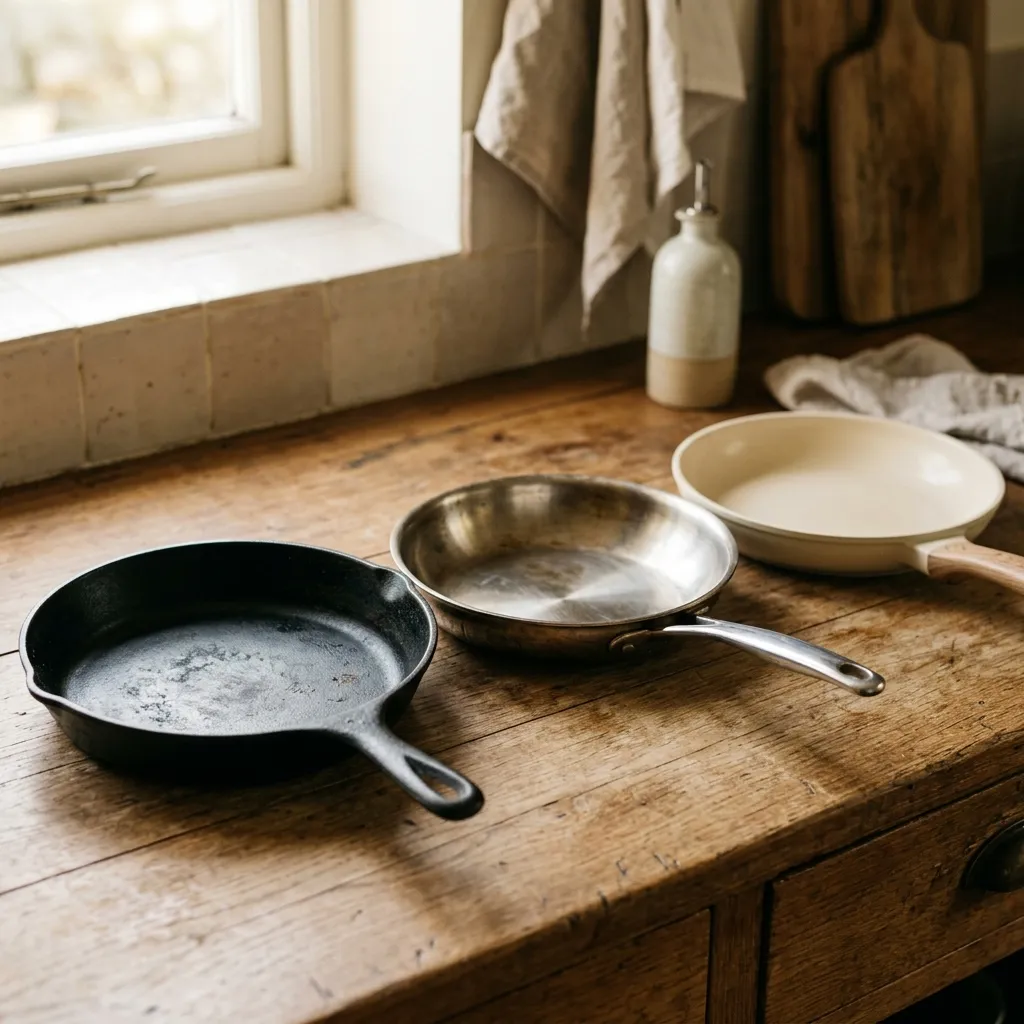
Most cookware guides start with non-stick pans. We don't.
Every day, your family's food lands in your pan. So the first question matters: What can migrate from the pan into your food? Price, care, and convenience come after. This guide shows you which pans we recommend for families, why PTFE non-stick pans don't make the cut, and how to nail fried eggs and pancakes without any coating at all.
Key Takeaways
- Health comes first: We recommend families uncoated pans made of stainless steel, cast iron, or carbon steel. The German Consumer Center (Verbraucherzentrale) names these same materials as alternatives.
- PTFE, known by the brand name Teflon, belongs to the PFAS family. These substances are extremely stable and accumulate in water, soil, and the human body worldwide.
- Plastic particles detach from a damaged coating. How very small PTFE particles affect the body remains unclear according to the Consumer Center.
- An empty PTFE pan can exceed 360 °C on modern stovetops after just 2 to 5 minutes. Toxic fumes form above this temperature.
- "PFOA-free" does not mean PFAS-free. Often PFOA was simply replaced with other fluorine compounds, such as GenX.
Why don't we recommend PTFE non-stick pans?
PTFE belongs to PFAS, the so-called forever chemicals. According to the German Consumer Center, they're extremely stable and accumulate worldwide in water, soil, and the human body. When the coating gets damaged, say, by a metal spatula, large and tiny plastic particles come loose. How the smallest of these particles affect the body remains unexplored. While that question hangs open, we play it safe and recommend uncoated pans.
Researchers from Flinders University and the University of Newcastle in Australia measured just how many particles that can be. According to their 2022 study in Science of the Total Environment, a single crack in the coating can release roughly 9,100 plastic particles. A severely peeling coating released about 2.3 million micro and nano plastic particles. The researchers themselves say little is known about these substances yet, and the consequences need investigation.
The German Federal Institute for Risk Assessment (BfR) weighs it differently. Based on current knowledge, it does not expect swallowed particles from a scratched coating to impair health. PTFE is chemically inert and, it says, passes through the body unchanged.
For us, the word "current" is key. When a health question is open, we choose for your family's kitchen the pan where that question never arises in the first place.
What happens if a non-stick pan gets too hot?
Above 360 °C, PTFE-coated pans release toxic fumes according to the Consumer Center. An empty pan can hit that mark on modern stovetops in just 2 to 5 minutes. As long as water or water-based foods are in the pan, the temperature barely rises above 100 °C, according to the BfR. The danger zone is exactly the moment the pan sits empty on the hot burner.
What does "PFOA-free" mean on the label?
PFOA was once used as a processing aid in making PTFE. The World Health Organization's International Agency for Research on Cancer classified PFOA as carcinogenic to humans in 2023, placing it in the highest Group 1 category. The EU banned PFOA as of July 4, 2020.
The label "PFOA-free" sounds reassuring. But according to the Consumer Center, it often just means PFOA was swapped for other fluorine compounds, like GenX. Manufacturing PTFE contaminated water, soil, and people at production sites to such substances. If you want a truly fluorine-free pan, look for labels stating "PFAS-free" or "fluorine-free."
The EU is moving too. In its revised PFAS restriction proposal from August 2025, according to the Food Packaging Forum, alternatives exist for non-stick cookware in private households and PFAS should be limited there. Nothing's decided yet. The scientific review is due by end of 2026.
Which pans actually fit family cooking?
For most families, two uncoated pans suffice: one stainless steel, one carbon steel or cast iron. Stainless steel is virtually indestructible according to the Consumer Center and dishwasher-safe, but needs some practice. Carbon steel and cast iron build a patina over time that acts like a natural non-stick layer.
Pan Type | Strengths | Weaknesses | Our Take |
|---|---|---|---|
Stainless Steel | Indestructible, dishwasher-safe | Needs some preheating practice | Top choice for daily use |
Carbon Steel | Very durable, good for searing, natural patina | Heavy, not dishwasher-safe | Top choice for hash browns and pancakes |
Cast Iron | Very durable, natural non-stick effect | Heavy weight, not ideal for long braises with acid | Good for roasting and braising |
Ceramic-Coated | No PTFE, non-stick effect | Non-stick wears over time, may contain silicone oil | Second choice only |
PTFE Non-Stick | Slippery from day one | Belongs to PFAS, particles shed when scratched, fumes above 360 °C | We don't recommend it |
Do fried eggs and pancakes work without coating?
Yes. The trick is proper heat, not coating. Preheat an empty stainless steel pan over medium heat and do the water test: drop a few water droplets in. If they sizzle and vanish instantly, the pan isn't ready yet. If they ball up and roll across the bottom, you're there. Turn heat down slightly, add fat, then the egg.
With carbon steel, the patina helps. It builds during seasoning and improves with every sear. Your first eggs might stick a little. That's practice, not a pan flaw.
How do you care for stainless steel, carbon steel, and cast iron?
Uncoated pans are tough, but each material needs different care. Stainless steel goes in the dishwasher and handles metal utensils fine. Carbon steel and cast iron you wash by hand, dry immediately, and rub lightly with oil. This keeps the patina intact and rust at bay. One rule applies to all three: never plunge a hot pan into cold water, or the bottom may warp.
Using stainless steel right:
- Preheat empty pan over medium heat.
- Do the water test, then add fat.
- For burnt-on bits, boil a little water in the pan. Usually a sponge takes care of the rest.
Caring for carbon steel and cast iron:
- Season a new pan before first use. Follow the manufacturer's instructions.
- After cooking, clean with hot water and a brush, ideally without soap.
- Dry on the stovetop and rub lightly with oil.
- Don't use cast iron for long braises with lots of acid, like tomato sauce or wine.
If you want to save your favorite recipes for your new pan so they don't get lost, check out our recipe app as your digital family cookbook.
You already own a non-stick pan. What now?
We recommend switching to an uncoated pan. Until you do, four firm rules apply to any non-stick pan you own. Use only wooden or silicone utensils, never metal. Never heat the pan empty. Never turn it to the highest setting. And the moment the coating shows scratches, peeling, or bare spots, retire it. By then, particles can already come loose.
The four rules at a glance:
- Wooden or silicone only. A metal spatula damages the coating, and particles shed from every scratch.
- Never heat empty. An empty pan can exceed 360 °C in just minutes.
- No metal sponges. Clean gently with warm water and a soft sponge.
- Damaged means gone. Scratched or peeling coatings have no place on your stove.
What should you look for when buying a pan?
Start with material: stainless steel, carbon steel, or cast iron, uncoated. Check whether it fits your stovetop. For induction, use a magnet test: if it sticks to the bottom, it'll work. Hold the pan before you buy, since carbon steel and cast iron pans are heavy. If kids cook with you, weight counts. And don't let "PFOA-free" fool you.
Your buying checklist:
- Material: uncoated stainless steel, carbon steel, or cast iron.
- Stovetop: induction symbol on the box or magnet test in the store.
- Size: fits your largest burner and matches how many you cook for.
- Weight: hold it in your hand, especially if children cook too.
- Coated models: only if labeled "PFAS-free" or "fluorine-free." "PFOA-free" isn't enough.
The most common questions about pans and health
Is Teflon the same as PTFE?
Yes. Teflon is a brand name for PTFE, or polytetrafluoroethylene. PTFE belongs to the PFAS family. Often the packaging just says "non-stick coating." The product description tells you if PTFE is inside.
Are ceramic pans a healthy alternative?
Ceramic-coated pans skip PTFE entirely. But according to the Consumer Center, their non-stick effect fades over time, and they may contain silicone oil. Our first choice remains pans with no coating at all: stainless steel, carbon steel, and cast iron.
At what temperature does a non-stick pan become dangerous?
Above 360 °C, PTFE coatings release toxic fumes. An empty pan can hit that on modern stovetops in just 2 to 5 minutes. Never heat a coated pan empty.
Can metal utensils go in the pan?
Yes for stainless steel, carbon steel, and cast iron. Coated pans take only wooden or silicone tools. Metal scratches the coating, and plastic particles shed from those scratches.
About FamFood: FamFood is the digital family cookbook, born from real kitchen life. We collect what works in family kitchens: the recipes and the knowledge behind them. On health questions, we follow one rule: when in doubt, we pick the healthier choice.




