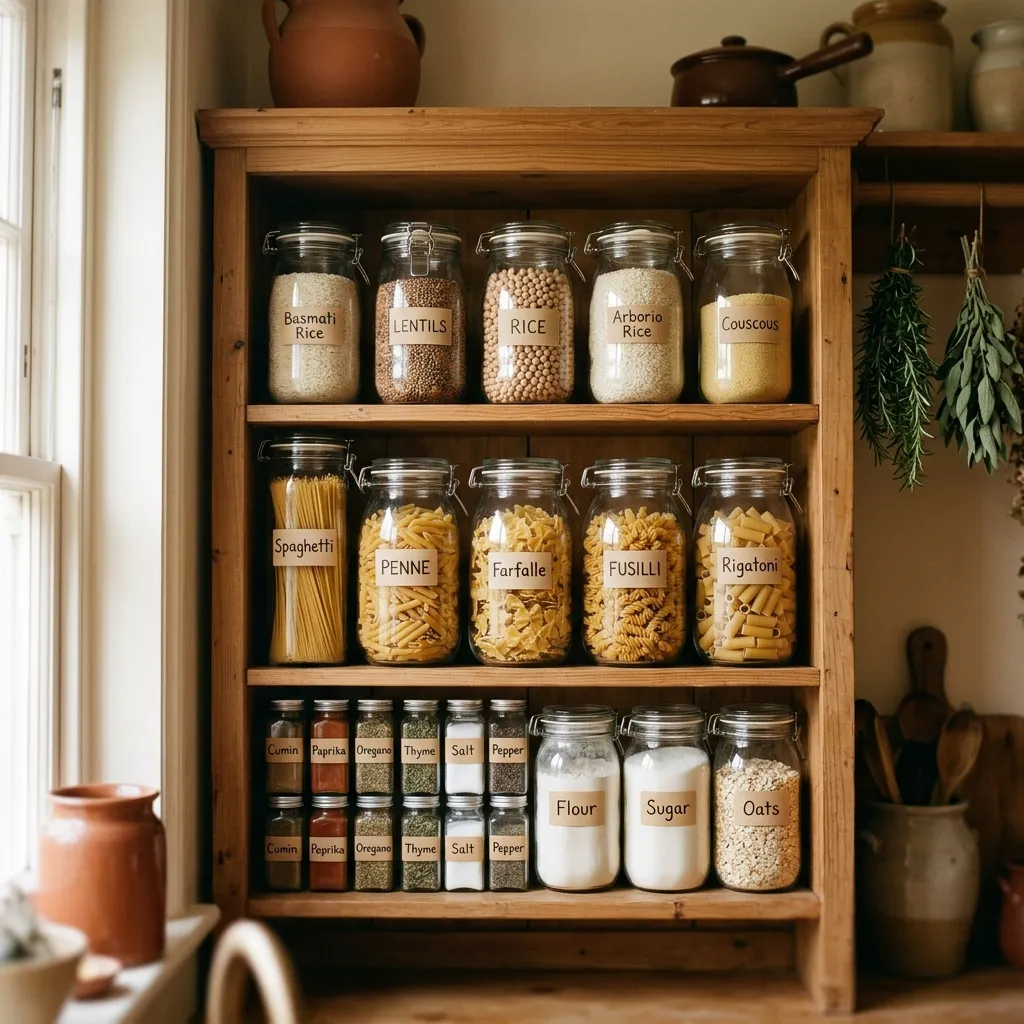
Pantry Audit: Organize Your Cupboard
Full cupboard, yet at 6 p.m. you have no idea what to cook—sound familiar? Three tins of tomatoes, two half-empty pasta boxes, spices you can't name anymore. And somewhere in the back: rice that predates your last move. Each person in Germany throws away 85 kg of food per year, according to WWF Deutschland—and most of it doesn't come from the fridge.
How can a cupboard stuffed to bursting still be useless, and what exactly does a single audit change?
Quick overview
- German households throw away an average of 85 kg of food per person annually, much from the pantry, according to WWF Deutschland.
- An audit takes 30 to 45 minutes and uncovers 15 to 20% of items that are double-bought or nearing expiry.
- The FIFO principle (new to the back, old to the front) keeps your cupboard organized long-term without daily effort.
- Seven categories capture 90% of a typical family pantry completely.
What does a pantry audit actually deliver for families?
A pantry audit typically uncovers 15 to 20% of food items close to their expiry date or bought twice by accident. For families, that means less food waste, lower shopping costs, and faster answers to "What are we cooking tonight?" The audit takes 45 minutes once, then works for you for weeks. It's not a cleaning spree—it's the foundation for cooking spontaneously from what you've got.
The problem isn't a shopping problem. It's a visibility problem.
If you can't see what's at the back, you buy what's already there. That 85 kg of annual food waste per person doesn't happen because the cupboard is too empty. It happens because no one has an overview. That's not personal failure—it's the consequence of missing structure.
An audit doesn't replace a pantry, but it turns a chaotic shelf into a reliable tool. And it's completely different from stockpiling, which is about what you should acquire. The audit shows what you already have.
Sounds convincing—but there's a moment when that same audit barely helps, and most people choose exactly that moment.
When is the right time for a pantry audit?
The best moment is just before your weekly shop, when the cupboard is most empty. That way you see actual gaps instead of overstock. For families, a regular rhythm works best: one thorough audit per quarter, one quick five-minute check per month.
If you audit right after a big shop, you see only fullness. Missing basics get lost, duplicate stock hides behind full shelves. The cupboard right after shopping is the worst possible time.
A practical tip for families with children: kids around six and older can help empty and sort. They learn to read best-by dates and what "FIFO" means. It doesn't take longer, but turns the audit into something everyone knows and owns.
The timing is set—what happens in those 45 minutes, and where most people get stuck?
How to run a pantry audit in 45 minutes
A complete pantry audit breaks down into four steps and takes 30 to 45 minutes for an average household. First time, plan for an hour. After that it's much faster because the structure is already in place.
Step 1: empty everything and sort. Clear each area and group by category on the table or counter: tinned goods, dry goods, spices, baking supplies. Only when everything is out do you see what you actually have.
Step 2: check best-by dates and decide. Every product gets a clear decision: still good, nearing expiry, or out. The distinction between best-by date and use-by date helps here—more on that next.
What is the FIFO principle and why does it work?
FIFO stands for "First In, First Out": what you bought first comes out first. Supermarkets stock shelves this way; new stock goes to the back. At home it means: when putting things away, always place the newer pack behind the older one. You don't need expensive shelf dividers, just consistency when you restock. Two minutes putting away saves ten minutes later searching and throwing out.
Best-by date vs. use-by date: what must go, what doesn't?
The best-by date doesn't mean "toxic after this," it means "guaranteed optimal until here." Dried pasta, rice, tinned goods, and spices are often completely fine months after the best-by date if stored dry and cool. The use-by date on meat or fresh fish is a hard line. Smell and sight decide for best-by products. The Verbraucherzentrale recommends checking product properties, not blindly throwing things out.
Step 3: create a stock list. Note what you have, in what quantity, and until when it's good. Digital or paper—the next section covers that choice.
Step 4: put everything back using FIFO. New products go to the back, older ones to the front. Label shelf areas with painter's tape if it helps. No expensive systems needed.
Four steps, seven categories—but which one does almost everyone miss, and which makes the biggest difference?
Which categories belong in every family pantry checklist?
A practical pantry checklist for families covers seven main categories: grains and pasta, pulses, tinned goods, oils and vinegars, spices, baking supplies, and snacks and sweets. If you track these categories consistently, you'll have 90% of a typical family pantry under control without getting lost in subcategories.
What we observe repeatedly at FamFood: seven of ten most-saved recipes contain fewer than eight ingredients, all within a well-run pantry. When you know your pantry, you can cook spontaneously without shopping first.
And speaking of observations: families we work with cook dinner faster and with less stress once they know what's at the back of the shelf. Not because they have more, but because they don't have to think about what they have.
Category | Typical products | Most common trap |
|---|---|---|
Grains & pasta | Rice, noodles, couscous, oats | Multiple opened packages |
Pulses | Lentils, chickpeas, white beans (tinned/dry) | Forgotten because they're at the back |
Tinned goods | Tomatoes, corn, peas, fish, instant soup | Double-buys from special offers |
Oils & vinegars | Olive oil, sunflower oil, apple cider vinegar, balsamic | Opened bottles that go rancid |
Spices | Salt, pepper, paprika, cumin, cinnamon | Biggest double-buy category hands down |
Baking supplies | Flour, sugar, baking powder, yeast, vanilla | Opened packages that get damp |
Snacks & sweets | Nuts, chocolate, biscuits, dried fruit | Easy to forget, then they expire |
A note on the freezer: it deserves its own audit. What's stored there follows different storage rules and different organization logic—that's beyond this scope.
The list is done. What's missing is the system to keep it alive after the audit—and that's where digital and paper split opinion.
Digital list or paper: what works better for families?
Paper starts faster, but digital lists win long-term. They're searchable, everyone in the family can update them, and they link directly to your shopping list. What matters isn't the medium—it's whether the list actually gets maintained after the audit.
Method | Advantages | Disadvantages | Best for |
|---|---|---|---|
Paper notepad | Available instantly, no tech knowledge needed | Gets lost, not shareable, hard to search | First audit, single households |
Notes app (Apple Notes, Google Keep) | Works on all devices, free | No special functions, manual upkeep | Small families with iOS/Android |
Specialized pantry app | Barcode scanner, best-by reminders, shopping list | Learning curve, sometimes costs money | Families who maintain pantry regularly |
The honest recommendation: pick the simplest solution everyone in the house actually uses. A perfectly optimized app only you know about helps less than a notes app where your partner can cross off items.
If you're already saving favorite recipes digitally, link your pantry directly to your weekly plan: what do I have? what can I cook from it? That turns "what am I cooking tonight?" stress into an answerable question. More on that in the article What's for dinner tonight? Solve the eternal family dilemma in 5 minutes.
The choice is made—now comes the part where most audits fail before the next one is due.
How to keep your pantry organized after the audit
The biggest mistake after an audit: changing nothing in the system. If you only tidy once, you'll face the same chaos in three months. Three habits keep your cupboard running without daily time investment.
Habit 1: put new purchases away immediately using FIFO. Not "shove it somewhere because I'm in a rush." It sounds strict, but takes two minutes. Skip this habit and you'll rebuild the old chaos in two shopping trips.
Habit 2: five-minute check before you shop. Before you write your shopping list, glance at your inventory list and the front row of shelves. What's expiring soon? What's actually missing? What's in there twice? Those five minutes replace impulse buys you'll regret later.
Habit 3: quarterly audit as a family appointment. Put it in the calendar like a dentist visit. Once a quarter, 45 minutes. When kids are involved, it becomes a routine they'll carry into adulthood. Labeled shelf zones help more than any expensive organizing system, because they make the structure visible to everyone, not just the person who tidied.
Three habits maintain order—but what about what the audit just uncovered and urgently needs to go?
What to do with food the audit reveals
Don't throw away products nearing their best-by date—make them your priority. Move them to the front; they determine your meal plan for the next few days. Leftovers often come together in a single stew, soup, or casserole before anything is actually lost. These "what-have-I-got-left?" dishes are often the best ones.
Plan your evenings or weeks around what must be used first. It feels limiting at first, but it builds creativity. For concrete recipe ideas on turning leftovers into real meals, see the article Use up leftovers: 7 creative ideas for families.
For larger surpluses you genuinely won't use, food sharing is a real option. On platforms like foodsharing.de, you can easily pass on shelf-stable food instead of throwing it away.
The best dishes often come from exactly these leftovers—and probably not in the ten ways you're thinking right now.
Frequently asked questions
How often should you audit your pantry?
Once per quarter thoroughly, once per month as a quick five-minute check. The quarterly audit takes 30 to 45 minutes and gives you a complete overview. The monthly check is enough to watch best-by dates and avoid double-buys. Do the audit just before shopping, not after.
What goes on a pantry checklist?
Seven categories cover 90% of a typical family pantry: grains and pasta, pulses, tinned goods, oils and vinegars, spices, baking supplies, and snacks and sweets. Add quantity and best-by date for each product. Treat the freezer as its own separate list.
How do I handle expired food during the audit?
Best-by date isn't a hard expiry. Dry goods, tinned items, and spices are often still good months after the date if stored dry and cool. Look, smell, and check texture. Use-by dates on fresh meat and fish are a hard line. When in doubt, check the Verbraucherzentrale guide.
Can you do a pantry audit with children?
Yes, and it's worth it. Kids around six and older can remove products from shelves, sort by category, and read best-by dates aloud. It doesn't slow the audit down, but teaches how food is stored and why you don't bin everything that "looks old." A great introduction to sustainable thinking.
Which app works best for pantry management?
It depends on the household. For families who shop and cook together, apps with shared lists are ideal. The best app is the one everyone actually uses. If you want to link recipes and pantry, FamFood works well because recipes, ingredients, and planning all come together in one place.
About FamFood: At FamFood we're building a digital family cookbook that brings recipes, pantry, and weekly planning together in one place. Our experience from working with families shows: most dinner-time problems don't happen at the stove, they happen at the disorganized shelf before it. We wanted to change that, and we're working on it every day.




