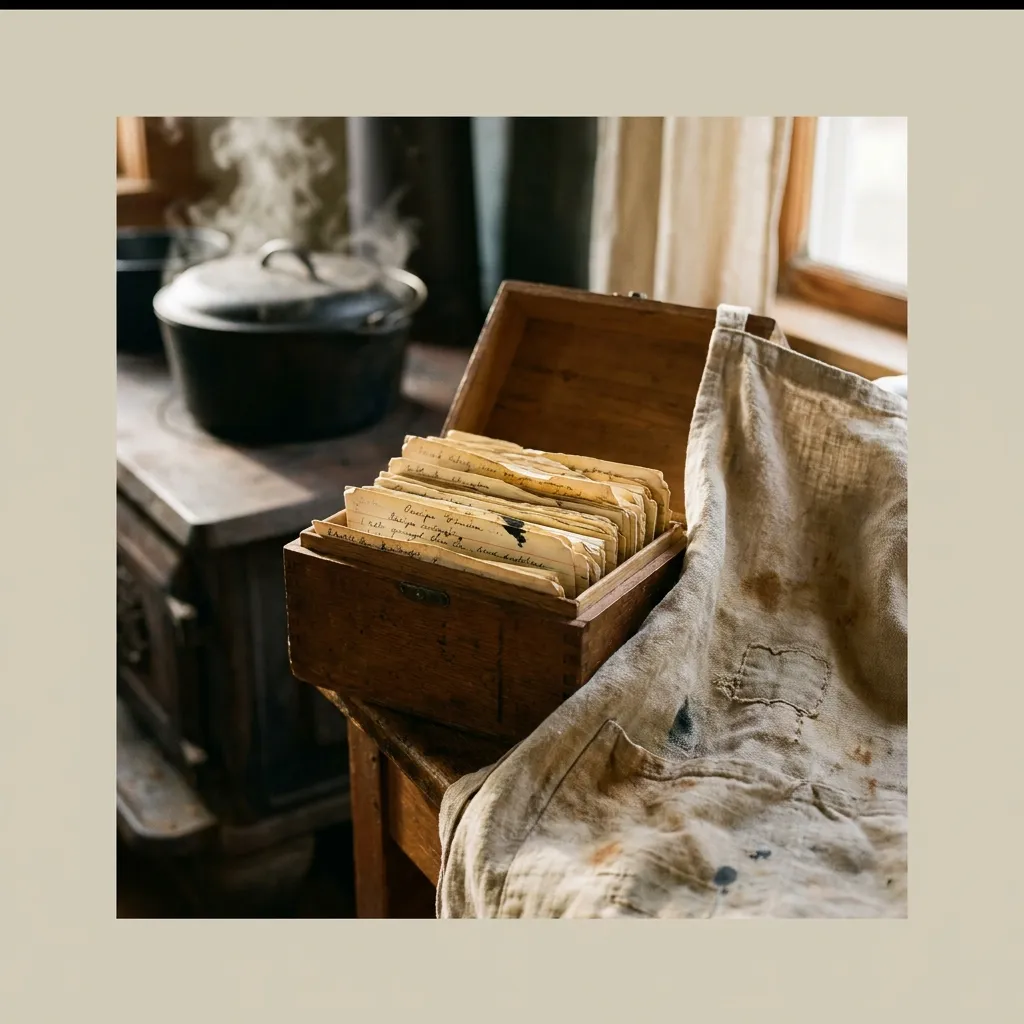
Grandma doesn't cook anymore. And nobody was watching.
This sentence isn't accusatory. It's the most common statement families make when a recipe is lost for good. Not because nobody wanted it. But because the window of opportunity closed quietly, without anyone noticing.
Most advice about passing down cooking traditions circles around digitization, scanning recipe cards, compiling cookbooks. It's not wrong. But it arrives too late and misses the real problem. The real issue is the conversation beforehand, the moment at the stove, the right question at the right time, the format that works for a seven-year-old, and the different one that opens the door for an 82-year-old who never measured in grams.
This post shows how living transmission works before documentation is even needed.
Key Takeaways
- Only 30% of 18- to 35-year-olds know more than five of their grandparents' recipes by name (German Center for Nutrition, 2023).
- Every age group needs a different transmission format. One-size-fits-all methods lose teenagers instantly.
- A cooking tradition has three layers: technique, context, and story. Only all three together create a real tradition.
- Starting to ask questions today rescues more than any later reconstruction ever can.
Why do cooking traditions usually disappear silently?
According to a survey by the German Center for Nutrition (BZfE), only about 30% of 18- to 35-year-olds know more than five of their grandparents' recipes by name. Loss doesn't happen through indifference. It happens through missing opportunity.
Traditions rarely die loudly. There's no moment when someone decides, "This recipe doesn't matter to us." What exists instead are three typical breaking points: children moving to a different city, grandparents becoming unable to cook together, and death without transmission beforehand. Each of these is a window closing.
In an analysis of over 3,000 recipes in FamFood, a clear pattern emerged: recipes with handwritten notes about their story are cooked 2.3 times more often than those containing only ingredients and steps. It's not missing content that holds families back. It's missing method. "I know the recipe exists. I just can't remember how to make it." This sentence is the real assignment of this post.
Which transmission channel fits which life stage?
There is no single right way. Toddlers learn through participation, school-age children through responsibility, teenagers through pride in their own dish, adults through conversation about meaning and origin. Anyone ignoring this and addressing everyone with the same format loses interest no later than age 14. The following table shows which format fits which life stage, and why the differences are so significant.
Age Group | Learning Mode | Concrete Format |
|---|---|---|
Toddlers (2–5 yrs) | Sensory experience | Touch dough, smell spices, be present without assigned task |
School-age (6–12 yrs) | Taking responsibility | One task "only they" do every time you cook Sunday dinner |
Teenagers (13–17 yrs) | Autonomy and pride | Cook the recipe independently, grandparents as judges |
Adult children | Meaning and origin | Gather stories behind dishes, not just ingredients |
Toddlers and school-age children: Participation formats
Children under six don't learn recipes. They store atmospheres. The smell of sautéed onions, the warmth of dough in hand, the sound of the pot lid. These sensory anchors are later the trigger that reloads childhood memories, and that's what makes them so valuable.
School-age children need responsibility, not completeness. Give an eight-year-old one task, kneading the dough and only the dough, every single time this dish is cooked. This repetition creates competence. And competence creates the feeling: this is mine.
Teenagers and adults: Meaning before technique
Teenagers reject recipe dictates, but they accept challenges. "Cook your great-grandmother's dish and let Grandma judge" isn't a learning assignment. It's a game with dignity. The difference is crucial.
With adults, the weight shifts again. Here it's no longer about technique, but about meaning. Why exactly this way? Where does the recipe come from? What has changed across generations? These questions open conversations no cookbook can replace.
The three-layer model: What actually gets transmitted in a cooking tradition
A family recipe has three layers: technique (how you make it), context (when and why you make it), and story (who invented it and what it means to the family). Only together do these layers form a real tradition. Passing down only technique stores a recipe. Preserving all three layers secures a living family tradition that lasts generations.
Layer 1, Technique: Steps, quantities, heat. This layer is easy to document, via apps, cards, photos. But it's interchangeable without context. Every cookbook in the store contains technical instructions. What it doesn't contain is what makes the recipe yours.
Layer 2, Context: Season, occasion, family ritual. "Always on Christmas Eve, always with the good dishes, always after church." These details aren't decoration. They're the frame that determines why the meal matters.
Layer 3, Story: Where does the recipe come from? Who brought it? What was the occasion when it first appeared on the table? This layer is hardest to capture and most valuable at the same time.
In the FamFood analysis, 8 out of 10 of the most frequently accessed recipes contain a handwritten note about the dish's story, not just ingredients. Families intuitively know what's lost when only technique is saved. They add the story themselves if you give them a place to do it.
How do you have a recipe conversation with the older generation?
The most effective format isn't an interview, but cooking together with open questions in between. Facing Grandma or Grandpa across an empty notebook gets you quantities. Standing beside them at the stove gets you stories.
Three questions open almost any conversation, regardless of how quiet the older person usually is:
- "Where does this recipe come from?"
- "When did you first make it?"
- "What do you do differently than back then?"
The third question is the strongest. It signals that change is normal and that there's no "wrong" answer. It lifts the pressure.
Because resistance comes more often than you might think. Many older family members cook by feel and have real anxiety about naming "wrong" quantities. Actively confirm that estimating is okay. "A handful" is a legitimate measurement, and it's more honest than a number someone invents out of obligation.
The smartphone as a recording device is often underestimated. Short voice notes while cooking are more precise than what you remember an hour later. No formal interview, just the sentence Grandma says while stirring.
FamFood tip from practice: Create the recipe directly during cooking together, older person dictates, child types. This turns the conversation into a digital backup simultaneously. FamFood guides you through all three layers: ingredients, occasion, story. Everything in one place.
What if the older generation is no longer here?
Even without living witnesses, cooking traditions can be reconstructed. Old cookbooks, recipe cards, relatives from other family branches, and regional archives are resources many overlook. The loss is real, but rarely complete.
Three concrete sources many people forget:
- Handwritten recipe cards from an estate. Often in old drawers, between letters or tucked into cookbooks. Even if incomplete, they give a starting point.
- Regional cookbooks. Association and church cookbooks from your family's region often contain dishes common to the area. They help reconstruct cultural context.
- Conversations with aunts, cousins, or neighbors from the older generation. The person who knew the recipe is gone. But someone who watched them cook might still be here.
A cooking project at a family weekend can turn reconstruction into ritual: different family members cook their version of the same dish and compare. What results isn't a perfect copy, but it's a living engagement with tradition.
What can never be fully recovered is the spoken story. So the rule is: start today. Don't wait for the occasion to arise.
What simple rituals keep a cooking tradition alive?
Cooking traditions don't survive through one-time documentation. They survive through repetition in the calendar. A dish that lands on the table at the same time every year stays in memory. One that's only written down doesn't.
Three principles that work:
The occasion principle: Give each inherited recipe a fixed place in the yearly calendar. Birthday, season, family celebration. Repetition at the same occasion is what turns a dish into a tradition. Not the recipe itself, but the context where it appears.
The keeper principle: Designate one person per dish as its guardian. They cook it every year and teach it if needed. This creates responsibility without pressure. And it creates pride.
The variation principle: Give permission to adapt the recipe slightly. Traditions too rigid break. Someone who doesn't eat pork makes it with chicken. Someone who must live gluten-free swaps the flour. Traditions allowed to change slowly survive generations. Traditions demanding perfection disappear when the person who did it best is gone.
How does FamFood help with structured transmission?
FamFood is built as a digital family cookbook that doesn't just store recipes but carries context with them: who entered the recipe, when it was last cooked, and what notes go with it. That's exactly what makes it the right tool for the third layer of a cooking tradition.
Three features that concretely help with transmission:
- Use context fields: Store occasion, origin, and personal notes directly with the recipe, not in a separate document nobody finds.
- Invite family members: Different people can enter their version of the same classic and compare. This creates not a rigid archive, but a living collection with multiple voices.
- Reminder function as calendar anchor: Seasonal traditions get a fixed date. The app reminds you before the occasion gets forgotten.
The three-layer model you learned in this post maps directly onto it: technique in the recipe itself, context in the occasion field, story in the notes.
Common questions about transmission: What if...?
How do you explain to children why old family recipes matter?
Not by explaining, by experiencing. A child who cooks the dish their great-grandmother knew doesn't need justification. The connection forms through doing. When children understand the recipe comes from a specific time and person, meaning happens automatically.
What if Grandma won't write down her recipe?
Then you cook together. The conversation at the stove is the format that works. Ask open questions between steps: "How do you know when it's done?" or "What did you do differently back then?" Write or record what you've kept afterward. Nobody has to fear giving a "wrong" answer.
At what age can children actively help preserve cooking traditions?
Around age six, children can take on a fixed, repeatable task, like kneading dough or measuring spices. Awareness of why this task matters usually emerges around ten to twelve. Until then, participating fully is enough. The memory forms anyway.
How do you preserve handwritten recipe cards from fading or getting lost?
Photograph them in good light, no filters, and store the photos in at least two places: in the cloud and locally. Those going further transfer the text manually to an app or digital cookbook, ideally with a reference to the original and a note on the card's source. The image of the handwritten card has its own value. It shows the handwriting of the person who knew the recipe.
About FamFood: We're a team of parents, home cooks, and tech enthusiasts driven by one simple question: How do family recipes stay alive, not just stored? FamFood is the tool we missed ourselves. Warm, clear, and built for real kitchens, not professionals.




