Passing Down Cooking Traditions: How to Do It
Most families say Grandma's recipes matter to them. And yet almost all of them are already half gone—or are they?
68% of Germans say family recipes are personally important to them. Fewer than one-third have ever actively tried to preserve them. A recipe that was never written down dies with the person who carries it in their head: quietly, without goodbye. The gap widens every day that dish isn't cooked.
Why do cooking traditions that everyone loves disappear—and what exactly needs to happen for them to stay?
Key Takeaways
- According to research from GfK, 68% of Germans value family recipes, but fewer than one-third have ever actively documented or passed them on.
- Children as young as 4 can take on meaningful cooking tasks; the right assignment matters more than age.
- The biggest risk isn't lack of interest but lack of tools: techniques and measurements like "a handful" must be actively asked for and documented.
- Variations aren't a betrayal of tradition; they're part of it, as long as the core stays intact.
Why do cooking traditions disappear even though everyone loves them?
According to market research institute GfK, 68% of Germans say family recipes are personally important. Yet fewer than one-third have ever actively tried to write them down or pass them on. The gap isn't in the wanting—it's in the how.
Three patterns keep showing up. First: recipes exist only in the older generation's head, never on paper. When you ask for "Grandma's goulash recipe," you hear "Oh, I just make it like this, you know how it goes." Second: daily stress pushes shared cooking to "sometime," and sometime never comes.
Third, and this is the trickiest trap.
The younger generation underestimates how much tacit knowledge lives in a recipe. Texture, smell, timing, the color of sautéed onions—not a secret Grandma guards. Knowledge she never put into words because she'd made it so many times it feels like breathing. The biggest risk isn't lack of interest; it's lack of tools.
The goulash recipe that was never written down because "you just know how," and what exactly it contains—no amount of later writing ever rescues if you don't know what questions to ask.
What actually makes a cooking tradition?
A cooking tradition is more than a recipe. It's the sum of ingredients, techniques, occasion, and the story behind it. Miss one of these pieces, and something is lost in the passing, even if the dish tastes the same at the end.
You can see the difference between "recipe" and "tradition" in Christmas cookies. A recipe for vanilla crescents exists in every baking book. A tradition is the crescent you shaped with Grandma as a child, always on the second Sunday of Advent, always with too much powdered sugar on the kitchen floor. Technique, ritual, season, and memory belong together.
What the FamFood team learned from conversations with hundreds of families: when families name their favorite dishes, they almost always name a person first, not a dish. Not "lentil soup," but "Grandpa's lentil soup." Not "onion cake," but "the onion cake Mom always made for harvest festival." For passing things on, that means: whoever passes along only the ingredient list passes along half the tradition. Whoever adds the occasion, the memory, and that one quirky thing Grandma did while cooking passes along the whole thing.
If a tradition is more than a recipe, the next question follows: at what point can someone truly take it over, and where does it usually fall apart?
At what age can children actively take over cooking traditions?
From age 4, children can handle simple tasks like stirring or shaping dough, and that's not symbolic participation—that's real contribution. What matters isn't age; it's the task you give them. It has to match the child's ability and visibly contribute to the finished dish. Children who helped cook are far more likely to eat the result and proud of it. This self-efficacy effect is well documented. By around age 8, preparing a first dish independently under supervision becomes realistic. From the teenage years on, full responsibility is possible.
The German Federal Ministry of Food and Agriculture (BMEL) notes in its guidelines for nutrition education that practical cooking in a family setting ranks among the most effective methods for anchoring healthy eating habits in children. Cooking traditions do exactly that, and they do it incidentally.
The lowest-barrier handoff moment is often the simplest: "You're stirring now." No explaining, no prep, just pass the spoon. For cooking traditions, the same rule applies as for many things in parenting: starting beats perfect planning.
Tasks by Age: An Overview
Age Group | Suitable Tasks | Tradition Moment |
|---|---|---|
4-6 years | Stirring, measuring flour, shaping dough | "You're making the balls now" |
7-10 years | Chopping vegetables (butter knife), kneading dough, filling layers | Steering the first step independently |
11-14 years | Tasting sauce, judging baking time, writing the recipe from memory | Cooking the dish alone under supervision |
Teenagers | Preparing complete dish independently, suggesting variations | Taking the recipe for the next generation |
For those who want to dig deeper into how to assign first cooking tasks correctly, there's more in the post Let Kids Bake: Learning Format Instead of Chaos.
So starting beats perfect planning—but what happens to the knowledge Grandma never put into words because it feels like breathing to her?
How do you capture Grandma's tacit knowledge before it's lost?
The biggest risk in passing things on isn't lack of interest; it's lack of tools. Techniques, measurements like "a handful" or "until it smells right," doneness cues like "when the onions turn translucent, you'll know"—you can't copy these from someone's head. You have to ask for them actively and document them as they happen.
The golden rule: don't write it down after, write during cooking. Whoever films or takes notes live captures things that would simply be forgotten later, because they're so automatic for Grandma that she wouldn't mention them.
Five questions to ask Grandma while she cooks:
- How much is that exactly? (Convert "a handful" to grams or tablespoons)
- How do you know when it's done? (Make her name the color, smell, or texture)
- Is there a variation you've tried too? (Write down alternatives)
- Where does this recipe actually come from? (Capture story and occasion)
- What's the most common mistake beginners make? (Knowing what goes wrong is gold)
Among the most-saved recipes in FamFood, more than 6 in 10 come from the "Family Recipe" category, and many are later added to by relatives, often with the comment "Finally got it out of Mom." That shows: the willingness is there; it just needs a moment and a format.
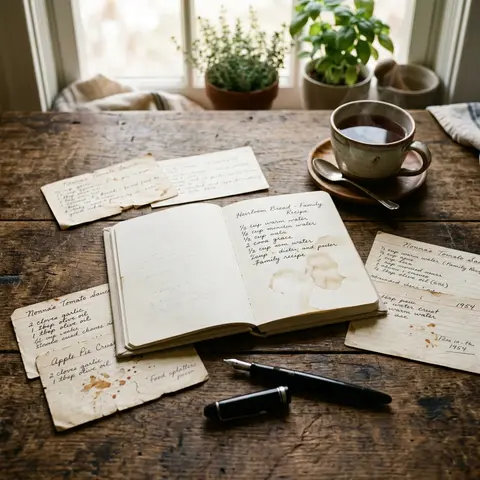
Digital preservation isn't a nice-to-have. Paper yellows, photos fade, notebooks disappear into moving boxes. Whoever saves a recipe in a family app makes sure it doesn't vanish with a single object. More on how to do this technically is in the post Save Grandma's Recipes: How to Digitize Old Family Recipes Forever.
The knowledge is now captured—but a recipe written down once and then lost in a drawer isn't yet a tradition. What keeps it alive?
What rituals help keep cooking traditions alive?
Regularity beats effort. A standing cooking date, even just once a month, anchors a tradition stronger than the most elaborate Sunday dinner that happens twice a year with everyone stressed.
Concrete ritual ideas that actually work in families:
- Monthly "Grandma's Kitchen" night: A fixed date when a handed-down dish is cooked, taking turns among different family members.
- The birthday dish: Each family member has a favorite dish that's always the same on their birthday. After a few years, it's no longer an obligation—it's a ritual.
- **Seasonal cooking: First frost means kale. First strawberry means jam. Tie dishes to natural events so the calendar does the remembering for you.
The anchor effect works even with smaller occasions: first day of school, first harvest from the garden, return from a long trip. Tie a dish to an occasion and you make the occasion unforgettable, and the dish with it.
One more tip: give the dish a name in the family. Not "lentil soup," but "Grandpa's lentil soup." Not "onion cake," but "Mom's autumn cake." The name is the first step to tradition.
Regularity anchors—but what if the next generation wants to touch the recipe, change it, modernize it? Is that betrayal, or is that exactly what keeps traditions alive?
What if the younger generation wants to "modernize" the recipe?
Adaptations aren't betrayal of tradition; they're part of it. Every generation changed their predecessors' recipes slightly, and that's exactly how they stayed alive. The question isn't whether you're allowed to touch the recipe; it's what the unchangeable core is.
It helps to distinguish between core and shell. The core of a recipe is technique, base ingredients, and occasion. The shell is spices, quantities, presentation. Grandma's onion cake with spelt flour instead of wheat? The character stays. Grandma's onion cake without onions and with roasted vegetables? That's a different dish.
Here's a concrete tip from practice: name variations explicitly as "2025 Version" and save alongside the original, not instead. That way the original stays, and the new version gets its own validity. Whoever has their own recipe passes it on. Ownership drives sharing motivation—true for kids and adults alike.
The 2025 version is saved, the original too—the question remains: in what format will both still exist in 20 years?
How do you preserve family recipes so they're really still there in 20 years?
Paper yellows, hard drives die, WhatsApp chats vanish when a number gets deleted or a phone breaks. Whoever wants to secure cooking traditions long-term needs a format that's actively maintained, easy to share, and independent of a single device.
Format | Longevity | Accessibility | Shareability |
|---|---|---|---|
Handwritten notebook | Medium (20-30 years with good storage) | Local only | Difficult |
Photo album with recipe cards | Medium | Local only | Copying needed |
Local hard drive | Low (device can fail) | One device only | Manual transfer |
Cloud family app | High (device-independent) | Anywhere, for all | One click |
A digital family recipe collection is the most practical solution because it meets all three criteria. FamFood is built for exactly this: add recipes together, supplement them, and share them with the family without any single device or notebook becoming the bottleneck.
The recipe you save today is the one your granddaughter cooks in 30 years—but only if you pass the spoon today. More on how to digitize old handwritten recipes is in the post Grandma's Classics: How They Stay Alive.
Frequently Asked Questions
How do I start passing down cooking traditions in my family?
Easiest way: start at the next shared cooking session, don't wait for a special occasion. Pick a dish that already has a history and invite someone from the next generation to join. You don't have to explain the first step—just do it and pass the spoon.
What if nobody in the family wants to cook anymore?
Then start with eating, not cooking. Whoever knows and loves the dish will eventually get curious about how it happens. A shared meal with a favorite family recipe can spark more interest than any cooking class invitation.
How do I capture recipes Grandma never wrote down?
Next time she cooks, film with your phone or take notes live. Ask about quantities, timing, and the most common mistake beginners make. Those three questions pull out most of the tacit knowledge. Later you can assemble a complete recipe from these notes.
At what age should children get involved with family recipes?
From age 4, simple tasks like stirring or shaping dough are possible. More important than age is the task: it needs to match your child's ability and make a visible contribution to the finished dish. A child who sees their stirring affect the result will come back on their own next time.
Can I change Grandma's recipe without destroying the tradition?
Yes, if you keep the core intact. Core means: base ingredients, technique, and occasion. Making Grandma's apple cake with a different apple variety changes the shell. Reinventing it as tiramisu changes the core. Save both versions side by side, then the new variation becomes part of the recipe's story instead of replacing it.
About FamFood
From hundreds of family conversations, the FamFood team knows: cooking traditions don't disappear from lack of interest—they disappear from forgetfulness. We've seen how a single recorded recipe brings entire family memories back. That's why we built FamFood: a digital family cookbook that keeps recipes alive, not as museum pieces, but as things passed on, adapted, and loved.