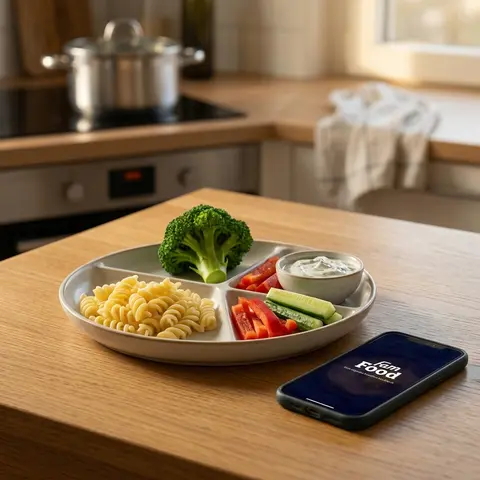
The child pushes the broccoli to the edge of the plate without even touching it. Every single evening. You wonder if this will ever stop.
It will. But not through force, and not overnight. It stops through a gradual process that nutrition psychologists call "food exposure." And you can implement it at home without turning dinner into a battle.
The essentials
- Up to 76% of children between 2 and 6 years old show pronounced food neophobia phases, rejection is not defiance, it's normal (DIfE).
- A new food needs 8 to 15 neutral encounters before a child is ready to taste it.
- The 5-step ladder moves from simply looking to voluntary tasting, without skipping any steps.
- Certain sentences at the table sabotage the process, even when well-intentioned.
Why do children resist new foods so intensely?
Food neophobia, the inborn caution toward unfamiliar foods, isn't defiance—it's a survival mechanism. According to a study from the German Institute for Nutrition Research (DIfE), up to 76% of children between ages 2 and 6 show pronounced neophobic phases. This means rejection is normal. It's not your fault, and it's not your child's fault.
From an evolutionary perspective, this caution made sense. Thousands of years ago, toddlers who foraged independently had a clear survival advantage if they avoided the unknown at first. The brain marks anything unfamiliar as potentially dangerous until repeated experience proves otherwise.
The peak phase occurs between ages two and six. After that, the intensity naturally diminishes for most children. When you understand this, you can guide the process instead of fighting it.
It's important to distinguish between genuine food neophobia and situational defiance. Real neophobia shows itself consistently across food groups. Situational defiance is often context- or mood-dependent. Both respond to the same core strategy: patience and neutral repetition.
What is the exposure method, and how long does it actually take?
The exposure method means a new food must encounter a child 8 to 15 times in a neutral way before the child is ready to taste it. Not eat it, just encounter it. The German Center for Nutrition (BZfE) recommends patient repetition without pressure as the most effective entry point for picky eaters.
"Neutral encounter" means the food sits on the table. It might land on the plate, but it doesn't have to be touched. No comment, no expectation, no reaction to rejection. Simply present.
How long does this realistically take? Weeks, not days. If you cook three times a week and the new food appears each time, you'll hit twelve exposures in four weeks. That's the benchmark. For some children it goes faster, for others it takes twenty encounters or more.
What lowers success rates: praise ("Great job touching that!") and criticism ("Just eat it already!") both backfire. Praise increases pressure for the next round. Criticism creates stress reactions that anchor the food negatively. Neutral is harder than it sounds, but it's the critical variable.
The 5-Step Ladder: From Looking to Tasting
Children need a bridge between "I don't know this" and "I like it." That bridge has five consecutive steps you can build into daily life without extra effort. The goal isn't to skip steps, but to treat each one as genuine progress.
Step | What the child does | Your behavior |
|---|---|---|
1 – Looking | Food sits on the table or in the pot, doesn't need to go on the plate | No mention, no comment |
2 – Touching | Child presses, smells, holds, without eating | Matter-of-factly name it: "That's fennel, smells like anise" |
3 – Cooking together | Child cuts, stirs, or adds ingredients to the pot | Work together, no tasting required |
4 – Lip contact | Licking, briefly in the mouth, spitting out allowed | No cheering, no disappointment |
5 – Chewing & swallowing | Voluntary tasting, at their own pace | Matter-of-factly confirm: "You tried it." |
Each step is progress. If your child picked up zucchini yesterday, that's step 2. Today again. Maybe step 3 the day after tomorrow. Setbacks happen, that's normal.
Step 3 deepened: How cooking together reduces touch anxiety
Step 3 is often the strongest leverage point. A child who throws vegetables into the pot has already built a relationship with it, long before the first bite is due. In FamFood tests, we observed that children who participated in cooking touched the finished dish in over two-thirds of cases, even if they didn't eat it.
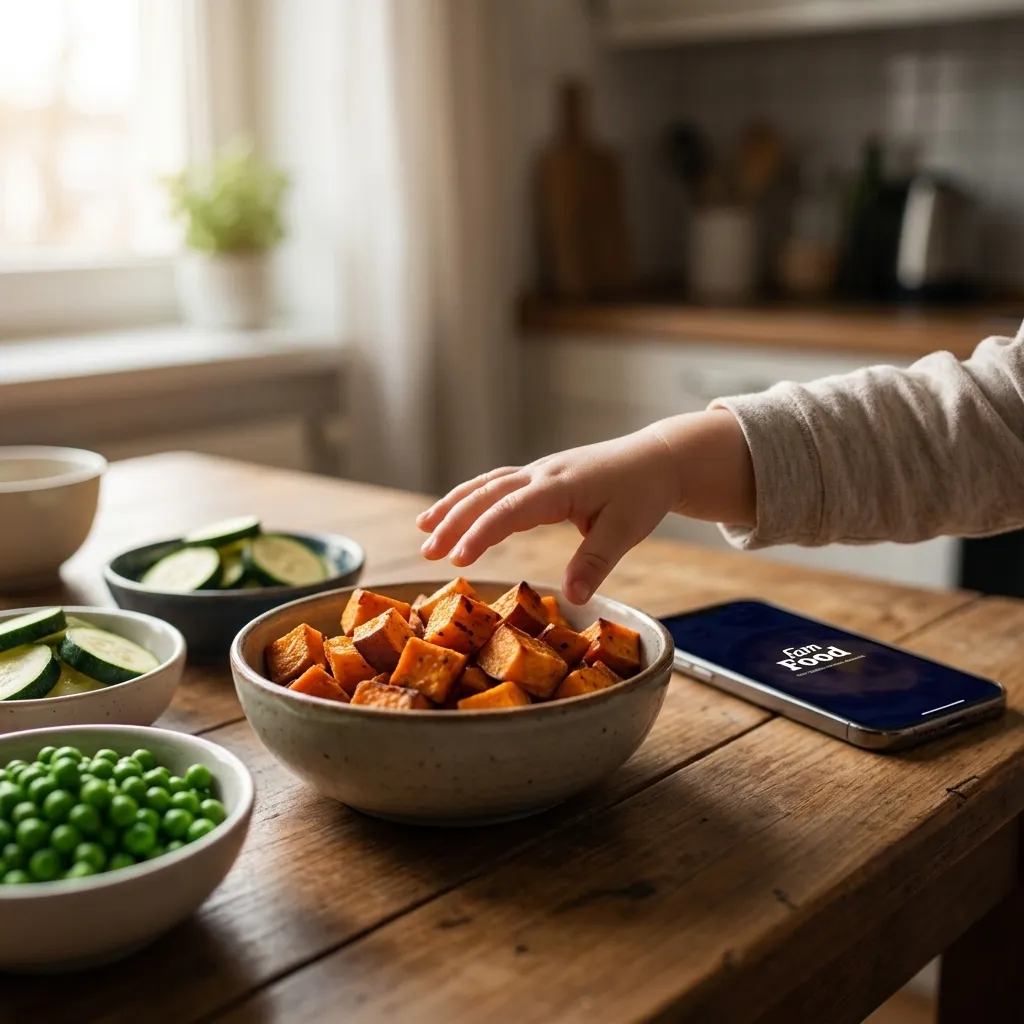
Concrete entry points: squeezing peas from the pod. Grating zucchini with a child's grater. Placing sweet potato pieces in a baking dish. The task doesn't need to be executed perfectly or produce a good result. The goal is contact, not culinary skill.
More ideas for bringing kids actively into the kitchen can be found in our post Let Kids Bake: Learning Format, Not Chaos.
Which foods work best as a starting point for picky eaters?
Not every food is equally suited to breaking through neophobia. Soft texture, mild flavor, and familiar colors measurably lower resistance. In FamFood analysis of our user recipes, zucchini, sweet potato, and peas appear most frequently on plates of children previously labeled difficult eaters.
Food | Why it works | Difficulty level |
|---|---|---|
Zucchini | Neutral flavor, soft texture, can be hidden invisibly | Easy |
Sweet potato | Slightly sweet note, orange color, creamy when roasted | Easy |
Peas | Small, familiar shape, slightly sweet, works frozen | Easy |
Carrot (cooked) | Mild, sweet, familiar color | Easy |
Bell pepper (roasted) | Caramelized sweetness, soft, loses raw edge | Medium |
Cauliflower | Neutral, can be pureed or roasted as "popcorn" | Medium |
Brussels sprout | Intense flavor, bitter, better after other successes | Difficult |
The basic rule: mild flavors before intense ones. Soft before raw. Orange and yellow are accepted more often by children than dark green. And always serve something new next to a familiar favorite food so the plate stays safe.
Recipe ideas that combine these foods with kids can be found at Cooking Mushrooms with Kids: Starting Point for Families.
Three kitchen methods that increase acceptance
How you prepare a food often matters more than the food itself. Raw bell pepper turns kids off, caramelized pepper strips get results. Three simple prep principles increase acceptance without tricks.
Roasting instead of boiling. The Maillard reaction during roasting creates sweet, nutty flavors. Roast broccoli, cauliflower, or zucchini at 400°F until edges brown slightly. The result tastes less "green" and more approachable than boiled vegetables.
Chopping finely and embedding. Hiding new vegetables in familiar dishes makes sense as an entry point, but only as a bridge. Finely grated zucchini in bolognese or peas in pancake batter lower the barrier to first contact.
The child decides the portion. Someone who chooses how much goes on their plate, even if that's "nothing," feels less threatened. Control at the table reduces defensiveness. Put the new food in a separate bowl on the table and let your child serve themselves.
When is "hiding" useful, when does it backfire?
Hiding works well for first contact. It fails as a long-term strategy because the child never learns the food as a standalone experience. A child who only knows zucchini pureed has no framework for roasted zucchini pieces. So always pair hiding with parallel visible exposures: the zucchini also sits as a piece on the table, it also sometimes appears unprocessed on the cutting board while cooking.
What should you absolutely not say at the table?
Certain sentences sabotage exposure, even with good intentions. "Just one bite" creates pressure that raises stress at the table and entrenches rejection rather than breaking it down. Nutrition scientist Dr. Antje Gahl from the German Society for Nutrition (DGE) recommends a neutral table culture without reward-and-punishment rhetoric.
Avoid these sentences:
- "Just one bite, then you can stop."
- "Try it, you'll love it."
- "You have to eat this today, I made it specially."
- "Look, Dad eats it too."
Instead, matter-of-factly and without expectation:
- "That's fennel. It smells a bit like anise."
- "I'll leave some here on the table in case you get curious."
- No comment if the child refuses. None at all.
Enjoy your own meal. Don't comment on your child's plate. Keep frustration out of the dining room. That's harder than any cooking strategy, but it has the biggest impact on results.
How can you track progress without creating pressure?
A simple food diary or small list in the kitchen works: not as a checklist with mandatory goals, but as a reminder of which step you've already reached. In FamFood you can note it directly with the recipe, for example "Emma touched broccoli today, step 2."
Make small progress visible without evaluating it. That applies to you as a parent too. Two steps forward, one back is normal. Plan for setbacks, and they won't surprise you.
For quick, kid-friendly recipes that already have these principles built in, find a good starting point at Quick Kids' Recipes: 8 Ideas for the Kitchen.
Common questions about new foods and children
At what age should I start introducing my child to new foods?
As early as possible, ideally starting around 6 months when you introduce solids. The more different flavors a child experiences in the first two years of life, the broader their taste window stays. The neophobia phase between ages 2 and 6 is then less intense if variety was built early.
How many times does a child need to see a new food before they'll try it?
According to BZfE, 8 to 15 neutral encounters is the scientifically supported benchmark. Some children need less, others need more. What matters is that each encounter stays neutral, meaning no pressure in either direction.
Can I hide new food in a dish so my child doesn't notice?
As an entry point, yes. As a long-term strategy, no. Hidden vegetables don't build independent acceptance. So always pair it with parallel visible exposures: the food also sits recognizably on the table or appears on the cutting board while cooking.
What if my child gags or vomits when encountering new foods?
Occasional gagging in very young children is often reflex-based and not a red flag. But if gagging happens with every new food, is strong and consistent, or is accompanied by fear reactions, talk to your pediatrician. It could indicate a sensory processing disorder that needs professional support.
How long does it take for a picky eater to really open up to eating?
That's individual, but realistically it takes several months of consistent, pressure-free exposure. Most parents who apply the exposure method consistently report real breakthroughs after three to six months. Patience isn't a strategy that gets rewarded eventually. It is the strategy.
About FamFood
FamFood is the digital recipe app for families who want cooking to be a shared joy, not a chore. We develop the app together with real families, test recipes in real kitchens, and write about what actually happens there, even when the broccoli lands on the plate's edge again.