Save Wilted Veggies: What Works, What Doesn't
You open the vegetable drawer. Limp carrots. Yellowed leeks. Zucchini bending like a wet straw. Your first instinct: toss everything. Your second instinct, if you pause for a second: wait.
Almost all of it can be saved. You just need to know how.
The essentials at a glance
- Wilted isn't the same as spoiled: smell and mold decide, not texture.
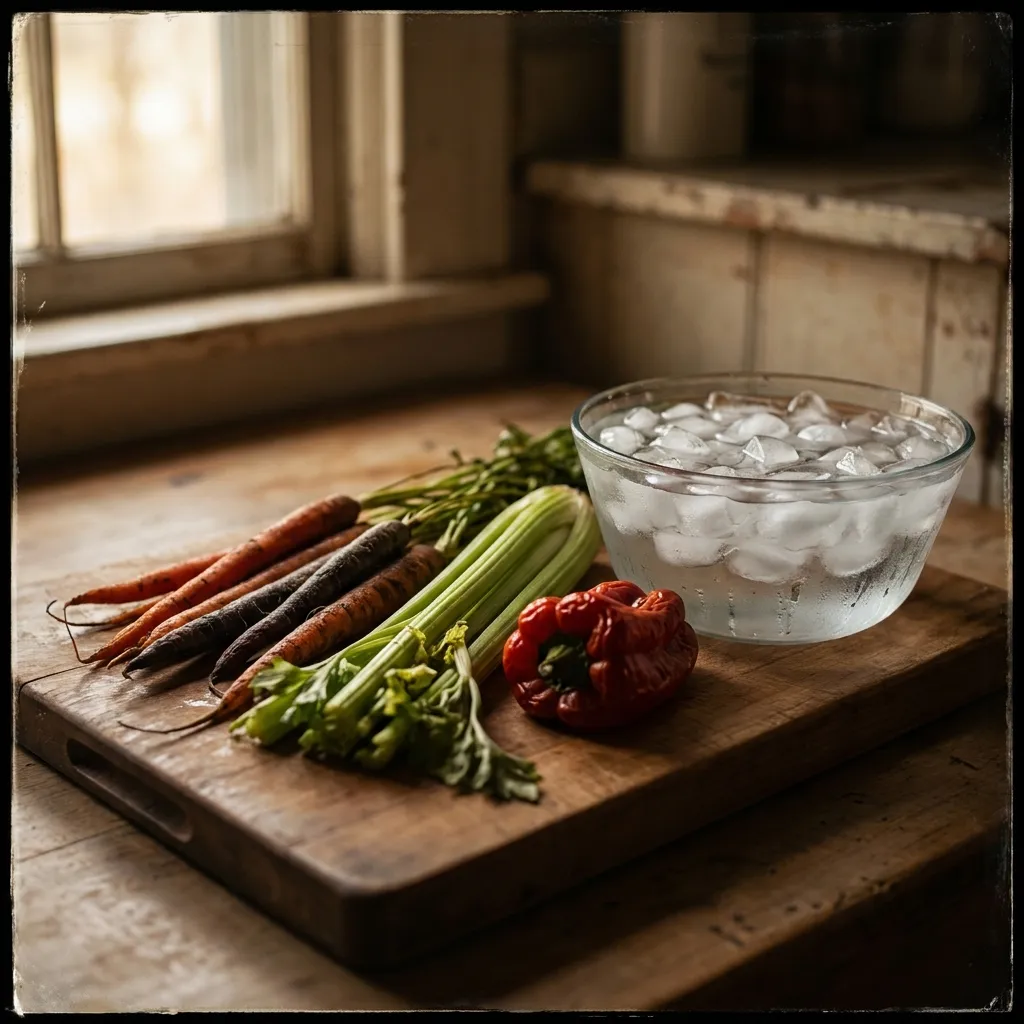
- A 20–30 minute ice-water bath restores turgor pressure in carrots, celery, and leeks almost completely.
- Lightly wilted vegetables blanched and frozen keep for 6–10 months (BMEL, 2023).
- Families that rescue vegetables consistently save up to €250 per year, according to calculations based on Destatis data.
How do you know if wilted vegetables are still worth saving?
Limp, shriveled, or slightly discolored doesn't mean spoiled. What matters is smell, mold, and the texture inside: if the vegetable smells neutral and shows no mold, it's almost always still edible. The water loss that makes carrots bendable and leeks limp is purely physical—not a sign of spoilage.
Three seconds are enough to decide. Eyes: any mold spots, white fuzz, or dark patches? Nose: does it smell rotten, sweet-fermented, or chemical? Fingers: is the inside mushy and wet when you press it, or is there still resistance? If you answer no to all three, you have vegetables worth using.
Save or toss? Quick reference by vegetable type
Vegetable | Wilted but edible? | Best method | Don't use if… |
|---|---|---|---|
Carrots | Yes | Ice bath, soup, roasted | Brown and soft inside |
Celery | Yes | Ice bath, stew | Mold at cut ends |
Bell peppers | Yes | Roasted, pan-fried, frozen | Mold spots on skin |
Zucchini | Yes | Pan, soup, frozen | Mushy when pressed, rotten smell |
Leeks | Yes | Soup, pan, ice bath | Slime between layers |
Fennel | Yes | Roasted, soup | Brown, wet layers inside |
Broccoli | Yes (yellow florets are fine) | Ice bath, blanch | Black spots, rotten smell |
Leafy greens | No (if slimy) | Only if still crisp: ice bath | Once leaves turn slimy |
Tomatoes | Only if no mold | Cook or preserve immediately | Mold spots, cracks |
Cucumber | Limited | Cooked only, not raw | Soft and watery inside |
Why do vegetables wilt in the first place, and how do I slow it down?
Vegetables continuously lose water through their cell walls after harvest. The warmer and drier the storage, the faster they shrivel. According to the German Federal Ministry of Food and Agriculture (BMEL), German households throw away around 75 kg of food per person per year, with vegetables making up a significant portion. So the biggest opportunity isn't at the supermarket—it's in your refrigerator.
The scientific term: turgor pressure. Plant cells are packed with water, which keeps them firm. When that water evaporates or isn't replenished, pressure drops and cells go limp. This is physics, not spoilage.
Three measures slow the process considerably:
- Root vegetables (carrots, celery, parsnips): store cool and moist, wrap the crown in damp paper towels, place in an open plastic bag in the fridge.
- Tomatoes and zucchini: keep at room temperature, not in the fridge. Cold speeds up cell breakdown here.
- Store visibly: vegetables in a glass bowl on the counter get cooked faster. Vegetables hidden in the crisper drawer get forgotten. In FamFood testing, families that keep vegetables visible on the counter process them about two days sooner than families who stash everything in the drawer.
The ice-bath method: How to revive limp carrots, celery, and more in 30 minutes
Limp carrots, celery stalks, or fennel strips bounce back almost completely after a 20–30 minute soak in ice-cold water. Water enters through the cell walls and restores turgor pressure; structure returns. For carrots, radishes, and broccoli florets, this method is so reliable it's almost always worth the detour.
Here's how:
- Cut vegetables roughly or break into pieces so more surface area can absorb water.
- Fill a large bowl with cold water and a handful of ice cubes.
- Add vegetables and let sit for 20–30 minutes.
- Remove, pat dry, and use immediately.
Varieties that respond best: carrots, radishes, leeks, celery stalks, broccoli florets, fennel strips. When it stops working: if the inside is already brown and wet when you cut it. That means cell breakdown has begun, and ice water can't repair the structure anymore.
One practical tip: use the vegetables right after the ice bath, don't store them again. The cells have absorbed fresh water but release it faster than fresh vegetables when heat is applied.
Which vegetables can you freeze before they go completely bad?
In most cases, lightly wilted vegetables can be blanched and frozen, keeping for 6–10 months. Blanching stops enzymes that would otherwise continue breaking down color, flavor, and vitamins. The BMEL recommends storing frozen vegetables at least –18 °C for 8–12 months, depending on type.
What not to freeze raw: leafy greens, raw tomatoes, and cucumbers. Their high water content makes them mushy and inedible after thawing. Tomatoes are the exception: cooked down as sauce or passata, they freeze beautifully.
For everyday family cooking, it's worth laying vegetables flat in freezer bags and labeling with the date. Flat-frozen portions can be removed individually later without thawing the whole block.
Blanching guide: time & temperature by vegetable type
Vegetable | Blanching time (boiling water) | Ice bath | Keeps until |
|---|---|---|---|
Carrots (sliced) | 3 minutes | Ice water, 3 min. | 10 months |
Bell peppers (strips) | 2 minutes | Ice water, 2 min. | 8 months |
Zucchini (slices) | 1 minute | Ice water, 1 min. | 6 months |
Broccoli (florets) | 2 minutes | Ice water, 2 min. | 8 months |
Leeks (rings) | 2 minutes | Ice water, 2 min. | 8 months |
Fennel (strips) | 3 minutes | Ice water, 3 min. | 8 months |
Celery (chunks) | 3 minutes | Ice water, 3 min. | 10 months |
What do I cook with wilted vegetables? Four basic recipe types for family life
Wilted vegetables lose crunch but barely lose flavor. Often the taste actually intensifies from water loss. That makes them ideal for four cooking methods: soup, roasted, pan-fried, and pesto or sauce. How fresh they are matters less because heat, seasoning, and roasting aroma do the heavy lifting.
Type 1: Soup or stew. Almost any vegetable works; seasoning matters more than freshness. Limp carrots, wilted leeks, soft potatoes: everything into a pot, cover with broth, simmer for 20 minutes. With an immersion blender, you get a creamy soup.
Type 2: Roasted vegetables. Roasting flavor reliably masks soft textures. Cut peppers, zucchini, and fennel into cubes, toss with olive oil and salt, roast at 200 °C for 25 minutes. The result tastes more intense than fresh vegetables, not worse.
Type 3: Pan dish. High heat, quick, Asian seasonings. Slice carrots, peppers, and leeks, sear for two minutes in hot oil, deglaze with soy sauce and ginger. Done.
Type 4: Herb pesto or green sauce. Leeks, fennel greens, celery leaves, and parsley go straight into a blender. Purée with olive oil, garlic, salt, and lemon juice to make a green sauce. Keeps in the fridge for three days, frozen for three months.
Leftover soup without a recipe: the method in 4 steps
- Aromatic base: sauté onion and garlic in oil.
- Add vegetables: everything you have, diced, toast briefly.
- Add liquid: water or broth, 1:1 ratio to vegetables, bring to a boil.
- Season and finish: salt, pepper, herbs. Purée or leave chunky.
A FamFood tip that works in practice: let each child pick one ingredient for the leftover soup. The soup gets a name, throwing away gets no chance. More ideas like this are in FamFood, where you can save family recipes like these and find them again anytime.
Rescuing wilted vegetables with kids: Turn it into a kitchen lesson
Children who see "ruined" vegetables transformed into a meal develop a more realistic understanding of food and resources. That's what research on nutrition education from the Federal Center for Nutrition (BZfE) shows. No lecture needed—the experience explains itself.
From age 4 on, kids can put vegetables in the ice bath and watch what happens after 20 minutes. The carrot gets firm again. For many kids, that's surprising enough to ask questions.
From age 7 on, they season the roasted vegetables and place the pieces on the sheet. Kids who season it themselves are more likely to eat it too.
A good conversation starter, not an interrogation: "What do you think made the carrot go limp?" The answers are often surprisingly close to the truth. And once a child has explained turgor pressure in their own words, they don't throw limp carrots away anymore. More kitchen tips for family life are in Kitchen tricks: 10 tips that save the day.
How much do you actually save by rescuing wilted vegetables consistently?
The German Federal Statistical Office (Destatis) estimates that a four-person German household spends around €1,000 per month on food. Studies by the University of Stuttgart commissioned by the BMEL show that vegetables and fruit make up around 25% of avoidable household food waste. Families that rescue vegetables consistently can save up to €250 per year.
The simple calculation behind it: 250 g of vegetables per week instead of the trash adds up to roughly 13 kg per year. Depending on the type, that's €30–50. Sounds small? Add fewer shopping trips, a less stressful meal plan, and the CO2 angle: according to the WWF Germany, producing one kilogram of vegetables generates 0.2–2 kg of CO2 depending on type. What doesn't get thrown away doesn't need to be grown again.
Of the most-saved family recipes in FamFood, 7 out of 10 use fewer than 8 ingredients and work easily with leftovers and slightly wilted vegetables. That's no accident: families that plan for leftovers cook more relaxed. If you want to take the next step, Creative leftover use: 9 ideas that actually work has more approaches that work in real life.
Frequently asked questions
Can you eat wilted vegetables raw?
Yes, in most cases. As long as there's no mold and the smell stays neutral, wilted vegetables are safe to eat raw. The texture is softer, which can be unpleasant in salads but barely noticeable in raw veggie dips. After a 20-minute ice bath, crispness often comes back completely.
How long do vegetables stay fresh in an ice bath?
The ice bath refreshes the cells but doesn't extend shelf life. Use the vegetables right after the bath. In the refrigerator they'll keep another 1–2 days, though the absorbed water evaporates faster than in fresh vegetables.
What do I do with completely soft vegetables that won't firm up?
If the inside is brown, wet, and mushy, the ice bath won't help. Then ask: mold or no mold? No mold, no rotten smell: cook it right away, best as a soup or canned sauce. Mold in one spot on firm vegetables like carrots: cut it out generously, use the rest. Mold on soft vegetables: throw it away—the spores have already penetrated the whole inside.
Does wilted vegetables lose its vitamins?
Partly, yes. Water-soluble vitamins like vitamin C break down over time, even without visible wilting. Water loss itself doesn't destroy vitamins. Heat during cooking and long soaking (more than an hour) break down more vitamins than wilting does. Cooked briefly or eaten raw after an ice bath, the nutrient content stays well-preserved.
About FamFood: We're a small team of parents, home cooks, and app developers who couldn't shake one simple question: why is cooking for families so often stressful when the basics are already there? FamFood helps you save recipes, plan for leftovers, and approach your weekly meal plan calmly, without reinventing dinner every night.